Dessert apples
Apples grown to be eaten raw rather than cooked or pressed for cider. Below are notes on what sets them apart, then the varieties in the atlas that their sources describe as dessert apples.
A dessert apple is one grown to be eaten raw, as distinct from the culinary apples grown for cooking1 and the cider apples grown for pressing2. Most varieties are one or the other, though some serve both ways1.
For E. A. Bunyard, sweetness was the test: sorting the apples in his Handbook of Hardy Fruits (1920), he divided the striped kinds into cookers and a group “nearly all of sufficient sweetness to be classed as dessert”; of the red-and-russet Reinettes, Cox’s Orange Pippin among them, he wrote that “No acid cooking varieties will be found in this group”3.
Dessert apples are not without acid: in juice analysed at the Long Ashton Research Station, near Bristol, between 1905 and 1975, Cox’s Orange Pippin had 0.60% malic acid and Golden Delicious 0.45%, against 0.85% in the cooking apple Bramley’s Seedling4. Andrew Lea puts the sugar in Cox’s juice at about 12%, and in Bramley’s at about 10%5. The same analyses found little tannin in dessert apples, 0.06% to 0.12% in Cox’s Orange Pippin, Golden Delicious and Worcester Pearmain, where a bittersweet cider apple has more than 0.2%4. A 2015 genetic study notes that dessert and cider apples differ in fruit size, regularity of cropping and bitterness, but found little difference between them across the genome as a whole2.
Dessert apples also have their seasons: Robert Hogg’s list of the best dessert apples (1884), set out “in their order of ripening”, runs from Joaneting and Margaret in July to Sturmer Pippin and others in use from February to June6. Some must be eaten soon after picking: the Royal Horticultural Society notes that Discovery, in season in August and September, cannot be stored, while Fiesta keeps until late winter1. Nor is the line with cooking apples fixed, for many culinary apples grow sweeter in store and can be eaten raw from late winter1.
1,217 varieties Filter them with the finder
-
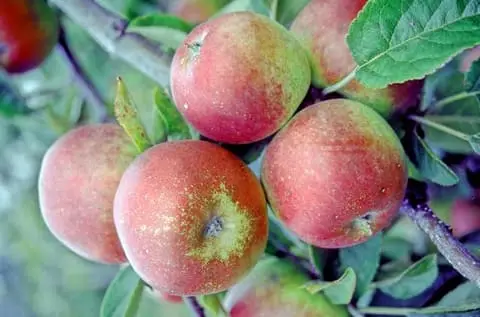
Åkerö
Named after a Södermanland manor where its 18th-century mother tree still stood in 2020; described by Eneroth in 1858
-
Akibae
A Nakano grower's 1981 cross of Senshu and Tsugaru; its dark fruit was ignored in Tokyo but welcomed in Kyushu
-
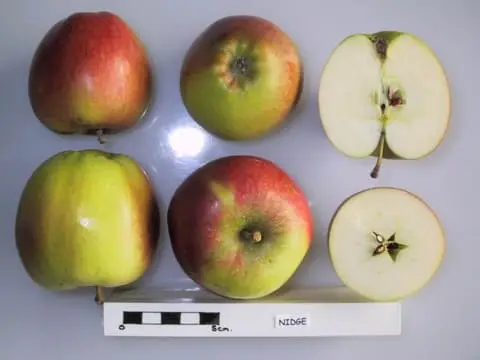
Amasya
Anatolia's own winter apple: 6 per cent of Turkey's crop in 2020; in 2024 only 1.03 per cent of it grew at Amasya
-
Ambri
Kashmir's native apple and its most popular in 1895, now found in scattered orchards and being revived
-
Ambrosia
A seedling that came up by chance in a Cawston orchard about 1987; fourth in Canada's 2025/26 apple forecast
-
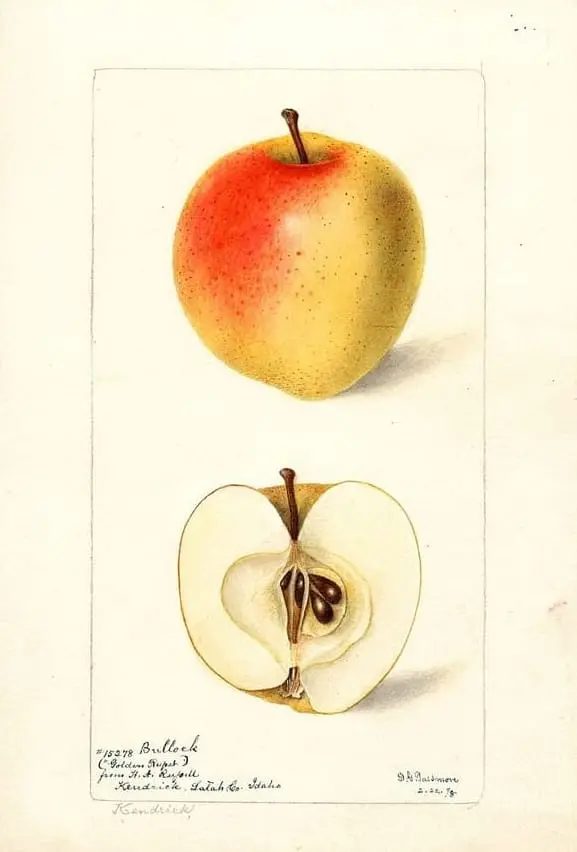
American Golden Russet
A small New Jersey russet whose flesh Downing likened to a buttery pear; Coxe knew it in 1817 as Sheep-nose
-
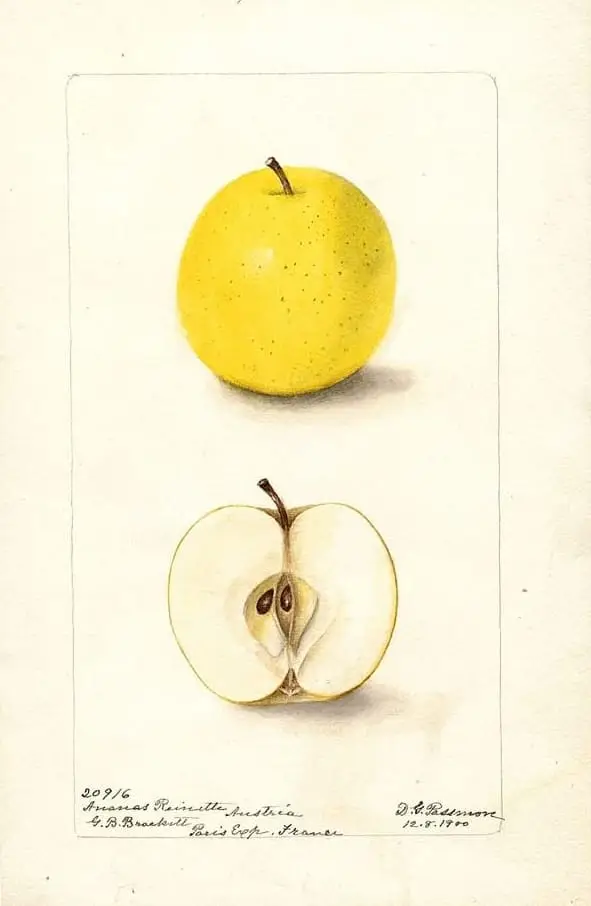
Ananas Reinette
Long thought Dutch, first described in Germany in 1826; DNA names Golden Harvey as one of its parents
-
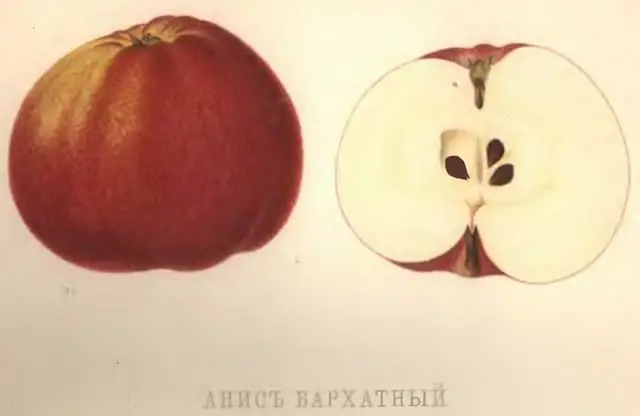
Anis
An old Volga folk apple whose clones bear small, bloom-dusted red fruit; Anis Polosaty has an anise-like scent
-
Anna
Bred by Abba Stein at Kibbutz Ein Shemer in Israel; it fruits after only 250–300 hours of winter chill
-
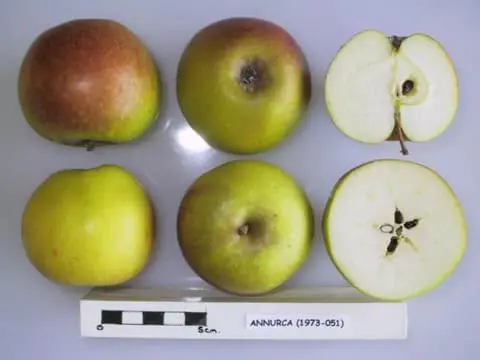
Annurca
Campania's "queen of apples", picked before it is fully red and then coloured on beds laid out on the ground
-
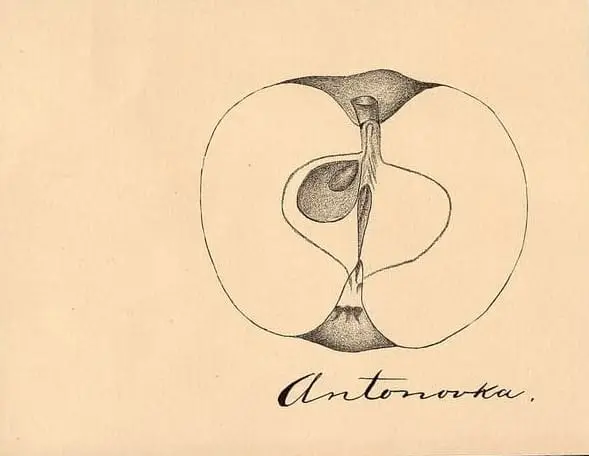
Antonovka
Central Russia's old folk apple, prized for its scent and hardiness; DNA shows Schmidt's Antonovka is the same variety
-
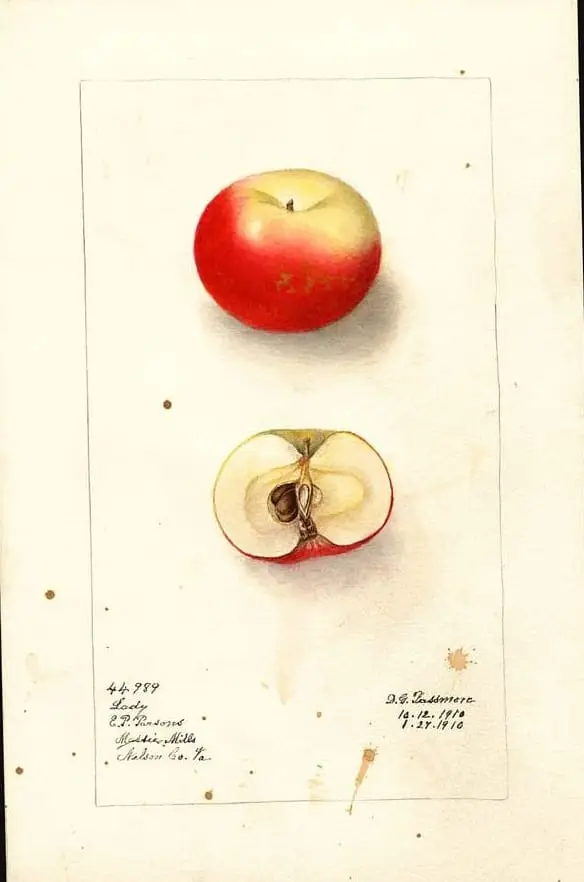
Api
A tiny, glossy, red-cheeked apple recorded in 1628 and said to have been found wild in a forest in Brittany
-
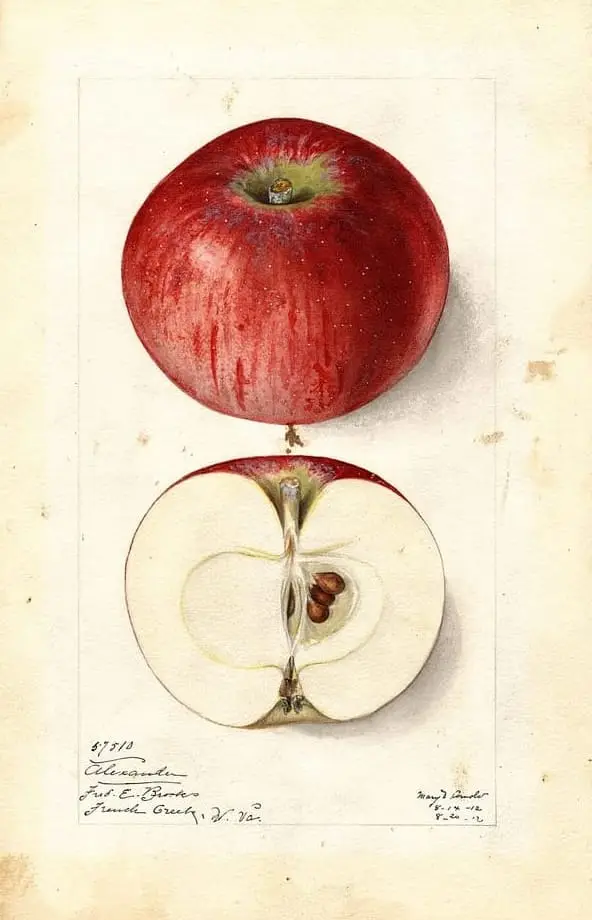
Aport
An old Russian apple, known in the West as Alexander, that became the celebrated Aport of Almaty after 1865
-
Arisoo
Bred to follow Hongro as South Korea's Chuseok apple; it colours in summer heat, and its cut flesh barely browns
-
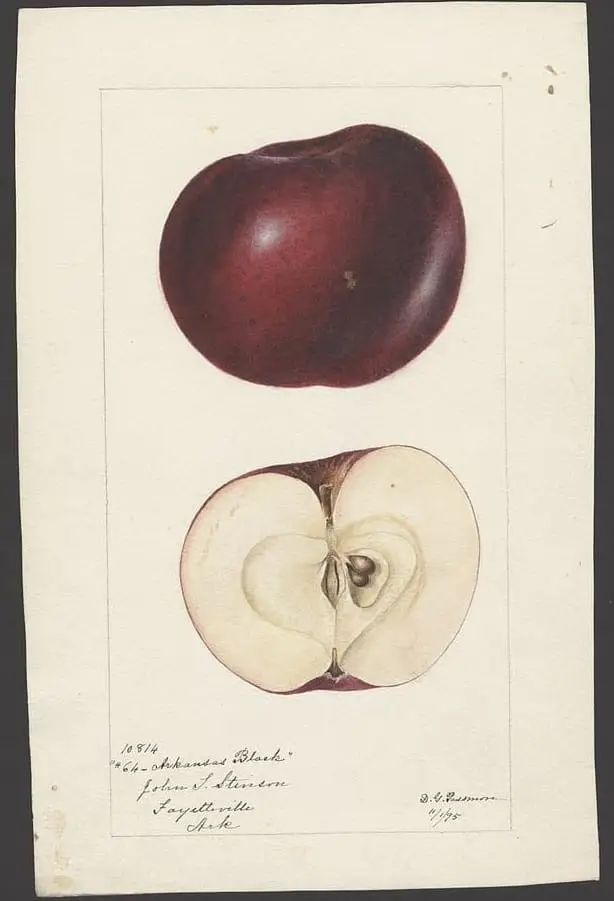
Arkansas Black
From Benton County, Arkansas, about 1870; in the sun its red skin deepens to purplish red or almost black
-
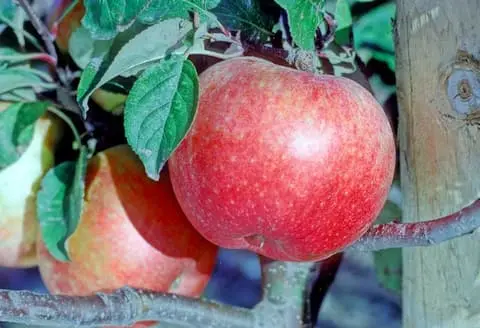
Aroma
Crossed in 1947 from Ingrid Marie and Filippa and released by Balsgård in 1973; second in Swedish orchards in 2023
-
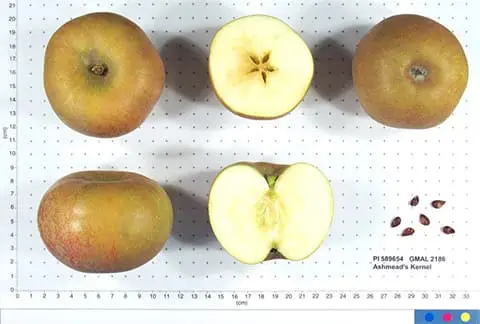
Ashmead's Kernel
Raised in Gloucester about 1700 by Dr Ashmead, a physician; a rich russet that genetic markers show is triploid
-
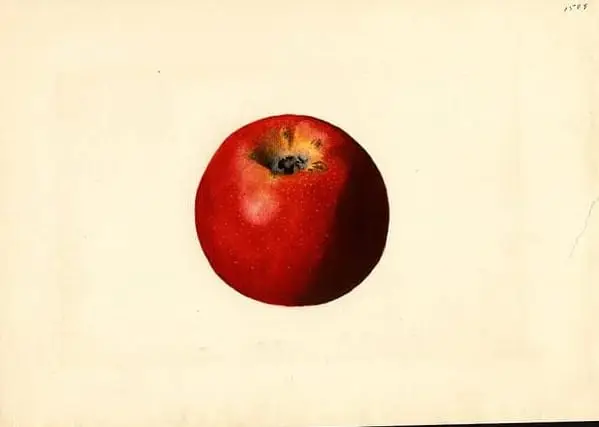
Baldwin
The United States' leading apple in 1909–13; the freezes of 1933–34 killed or ruined nearly two million of its trees
-
Bay 3484
Bred from Weirouge at the Bavarian Centre of Pomology, Hallbergmoos; its fruit is sold under the trade mark Baya Marisa
-
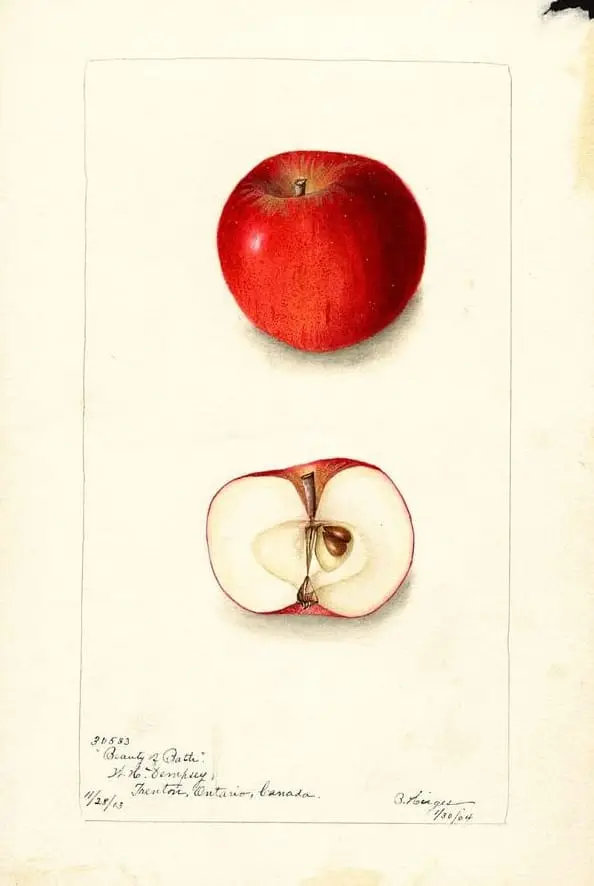
Beauty of Bath
An August apple from Bailbrook, near Bath, about 1864; once the most important early commercial apple in the UK
-
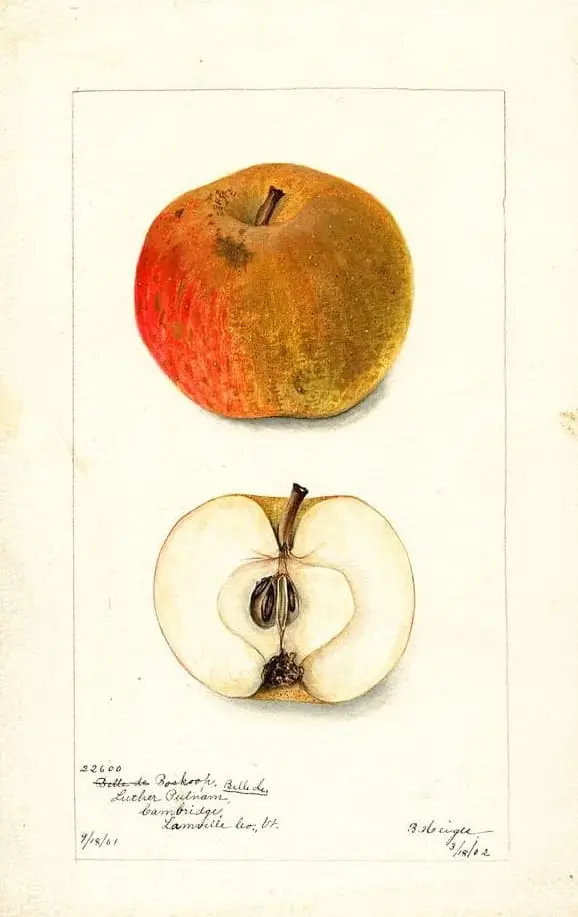
Belle de Boskoop
Found at Boskoop in 1856 and much grown in the Netherlands and Germany; DNA shows Kasseler Renette is one parent
-
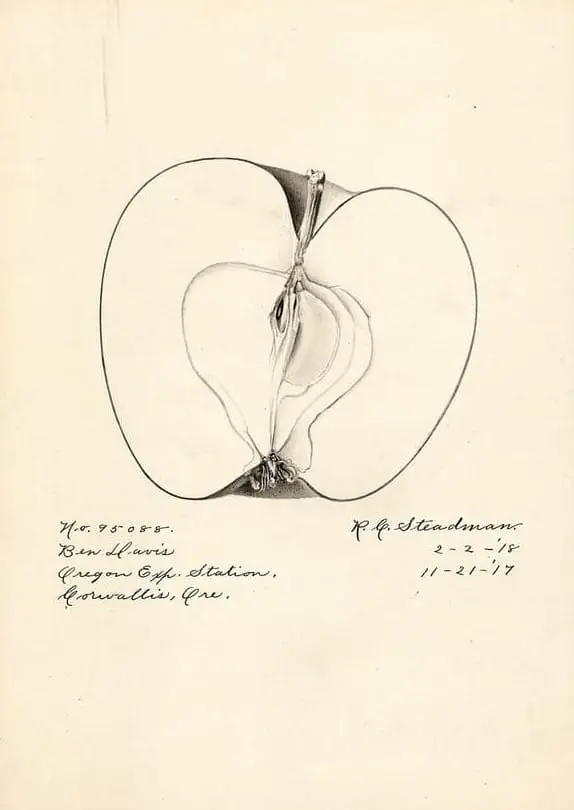
Ben Davis
A tough-skinned keeper of unknown Southern origin; in 1909–13 second only to Baldwin among American apples
-
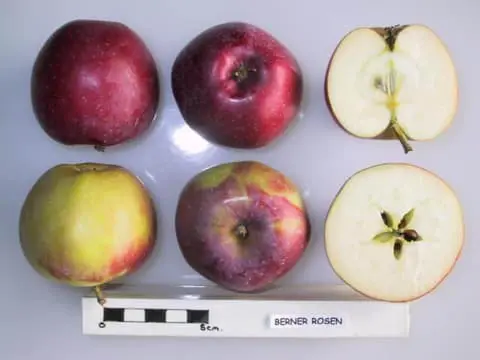
Berner Rose
A chance seedling from the canton of Bern that first fruited in 1888; its parents were found by DNA
-
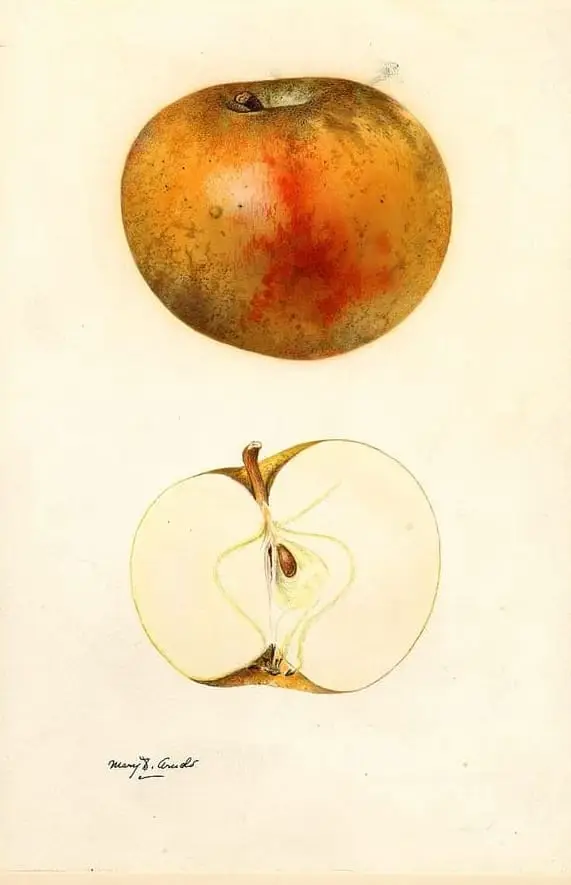
Blenheim Orange
Grown from a pip at Woodstock, beside Blenheim Park; a large triploid that DNA ties to Reinette de Hollande
-
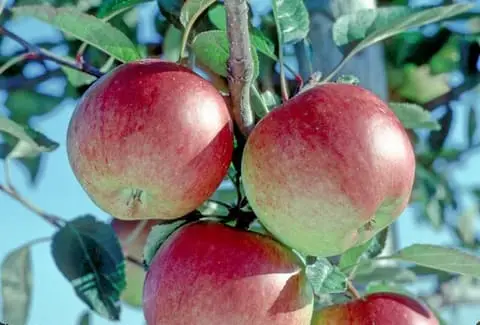
Braeburn
A Nelson chance seedling grown commercially from 1952; DNA names Delicious and Sturmer Pippin as its parents
-
Bravo de Esmolfe
A scented, whitish apple from the village of Esmolfe in central Portugal, an EU protected designation since 1996
-
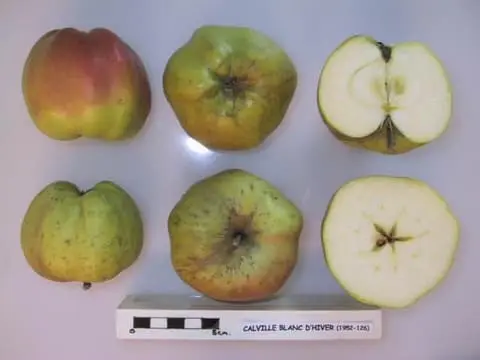
Calville Blanc d'Hiver
Described by Jean Bauhin in 1598; DNA points to Calville Rouge and Reinette Franche as its parents
-
Civni
Bred near Ferrara from a 1988 cross of Gala and Elstar; a late-summer apple run by its breeder, CIV, as a club variety
-
CN 121
A seedling of open-pollinated Honeycrisp raised at Worthington, Minnesota; sold under the trade mark SugarBee
-
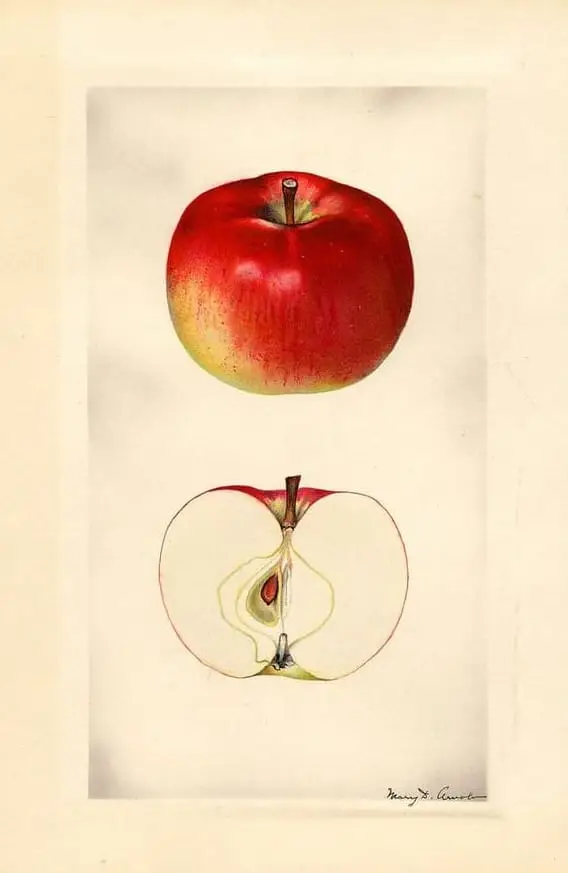
Cortland
The first apple from the Geneva station's breeding: Ben Davis × McIntosh, crossed in 1898 and introduced in 1915
-
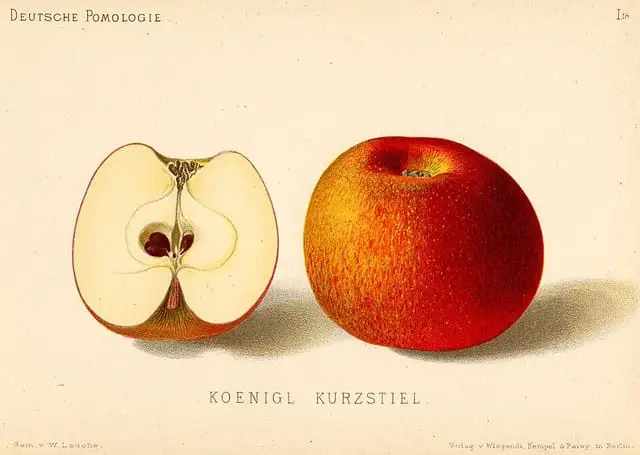
Court Pendu Plat
Flowers later than any other apple, so escaping spring frosts as the Wise Apple; first described shortly before 1613
-
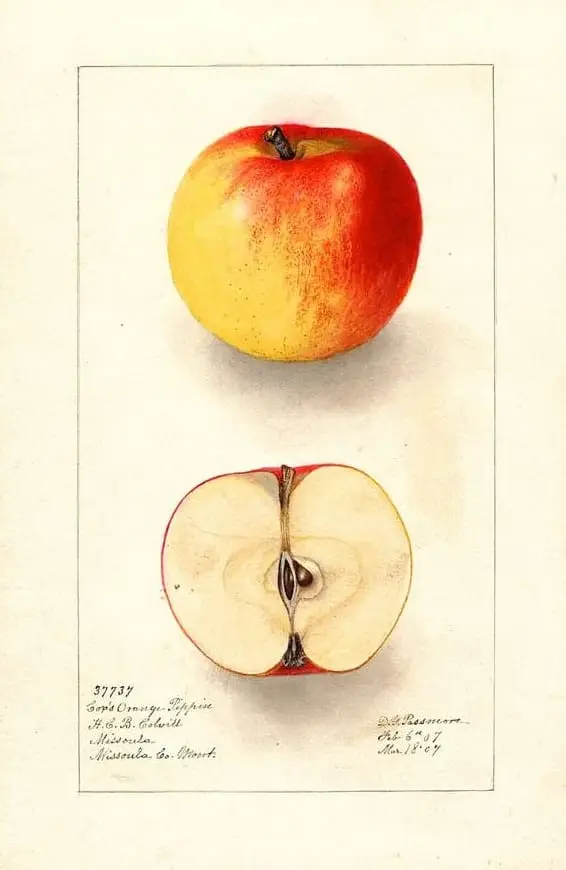
Cox's Orange Pippin
Raised at Colnbrook about 1825; DNA shows its parents are Margil and Rosemary Russet, not Ribston Pippin
-
Cripps Pink
Bred by John Cripps from a 1973 cross of Lady Williams and Golden Delicious; top-grade fruit is sold as Pink Lady
-
Cripps Red
Cripps Pink's sister seedling from a 1973 cross at Stoneville, Western Australia: very late, very firm and tangy
-
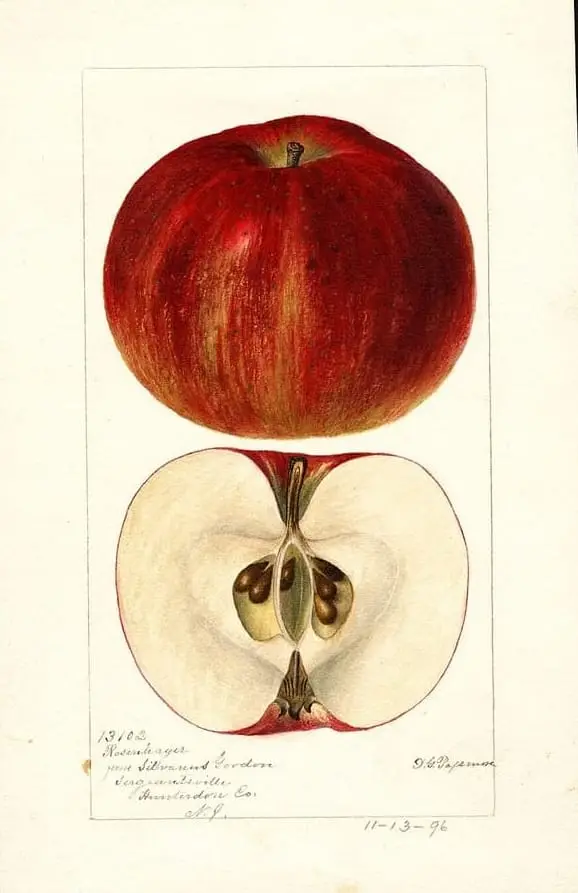
Danziger Kantapfel
Described by Knoop in 1760 and grown in Germany under dozens of local names; a parent of Freiherr von Berlepsch
-
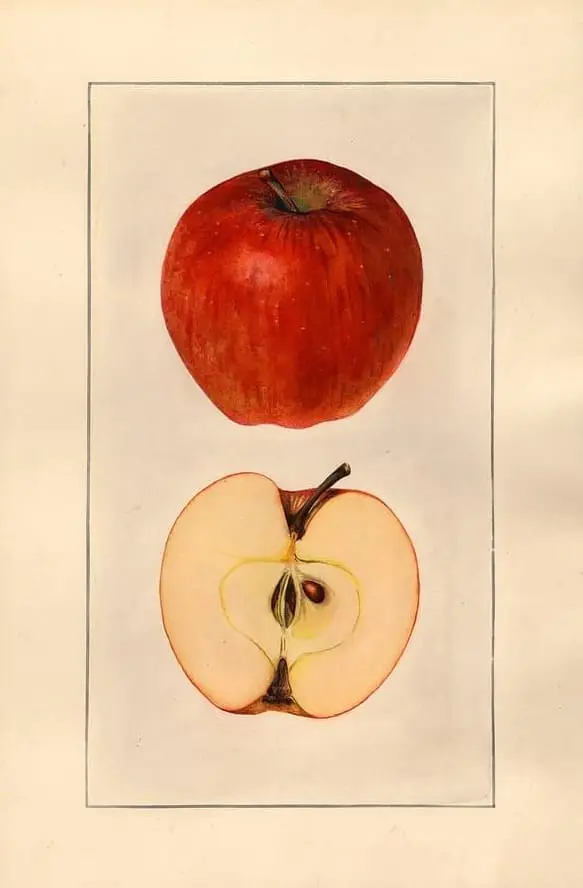
Delicious
Found by Jesse Hiatt at Peru, Iowa, and first called Hawkeye; by 1928 the most planted apple in American orchards
-
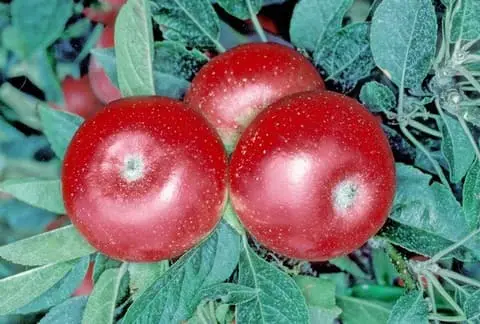
Discovery
Raised in Essex about 1949 and first called Thurston August; DNA confirms Worcester Pearmain and Beauty of Bath
-
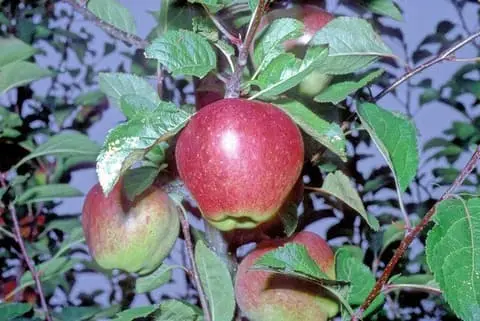
Dorsett Golden
Grown from a seed planted at Nassau in 1953 and called a Golden Delicious seedling; DNA makes it a child of Anna
-
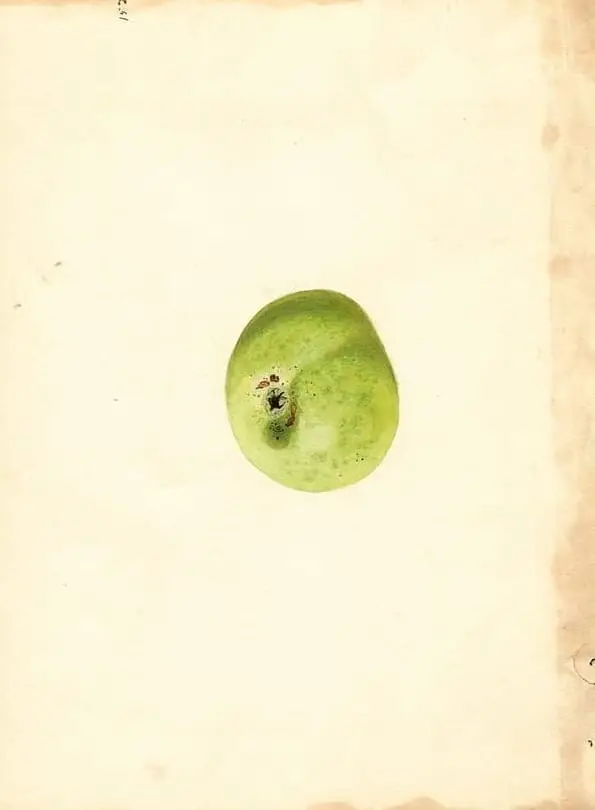
Duchess of Oldenburg
Borovinka at home; its hardiness in prairie test winters led Americans to import more Russian apples
-
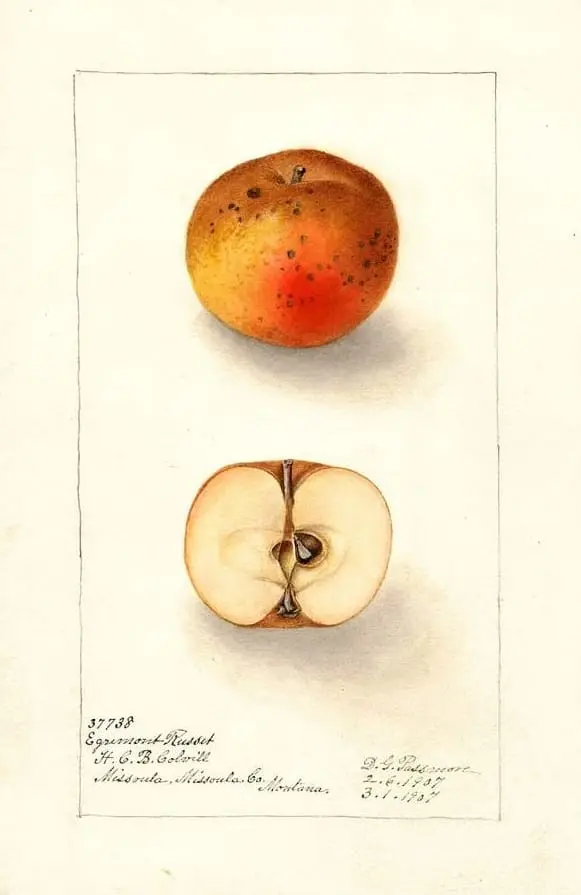
Egremont Russet
Of unrecorded origin and first recorded in 1872, it is probably the UK's most important commercial russet
-
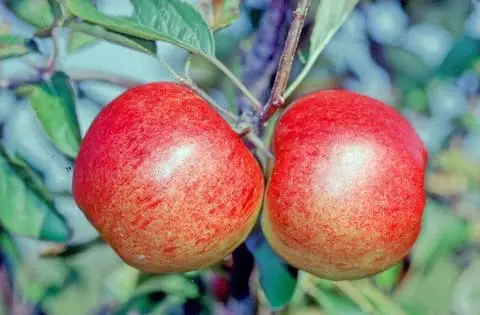
Elstar
Dutch cross of 1955 named from Elst and the assistant breeder Arie Schaap; Germany's leading table apple in 2022
-
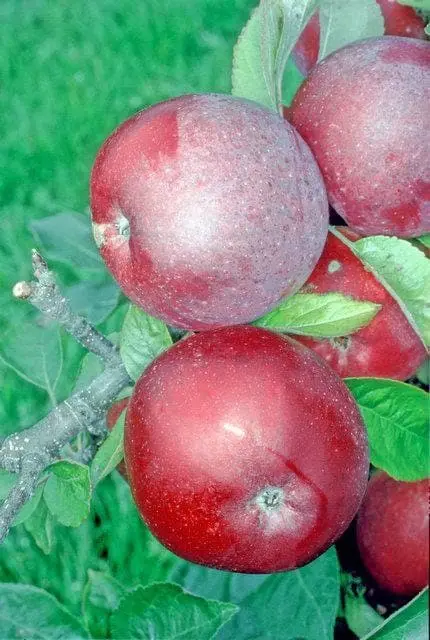
Empire
Grown from McIntosh seed gathered near Claverack in 1945, after spring frosts had destroyed Geneva's planned crosses
-
Enterprise
A late, long-keeping red apple from the Purdue–Rutgers–Illinois scab-resistance programme, and a parent of WA 38
-
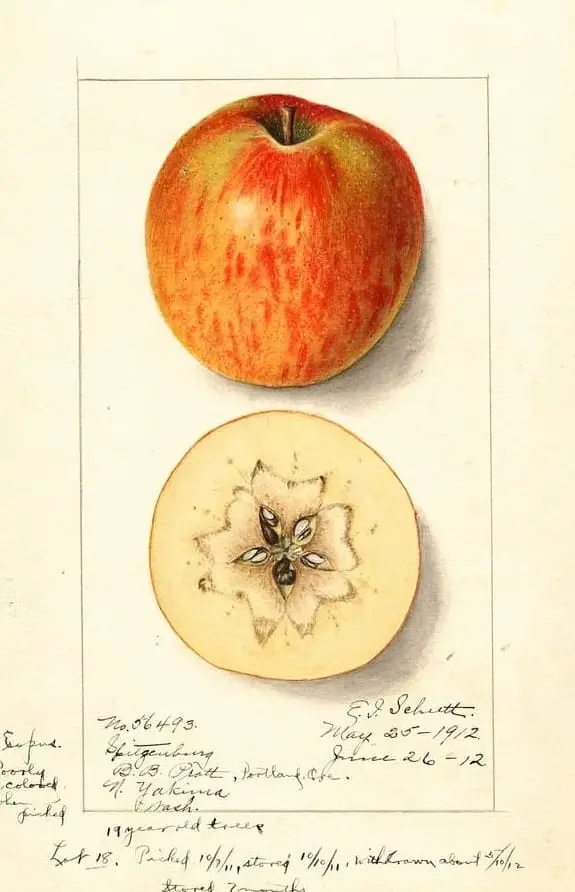
Esopus Spitzenburg
A Hudson valley apple known before 1790; DNA shows it a parent of Jonathan and probably a child of Reinette Franche
-
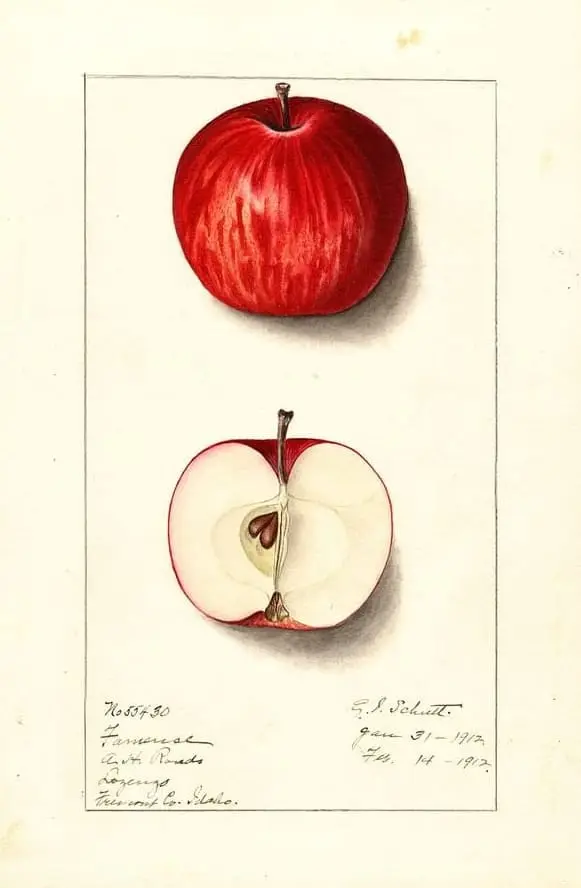
Fameuse
The Snow apple of Quebec, of obscure origin in Canada or France; SNP data make it a likely grandparent of McIntosh
-
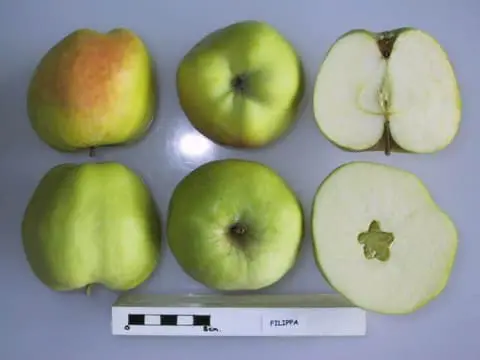
Filippa
Grown from pips sown in a pot by Filippa Johannsen at Hundstrup, Fyn, about 1880; a parent of Aroma
-
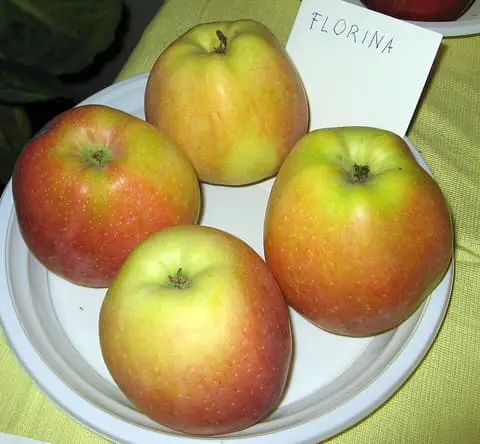
Florina
Selected at Angers in 1977 from progenies sent from America; Europe's reference scab-resistant apple in the 1980s–90s
-
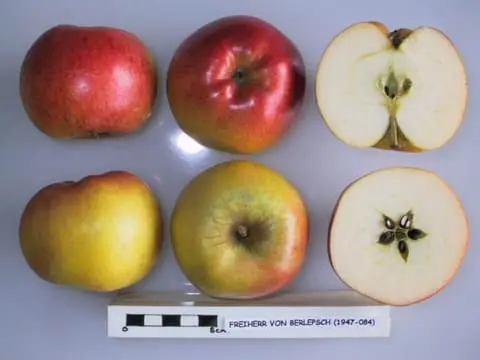
Freiherr von Berlepsch
Raised about 1880 at Grevenbroich; DNA shows its parents are Ananas Reinette and Danziger Kantapfel, not Ribston Pippin
-
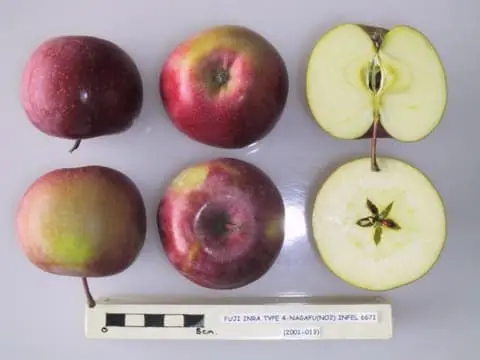
Fuji
Bred at Fujisaki, Aomori, from a 1939 cross; by a 2025 estimate it makes up 70 per cent of China's apples
-
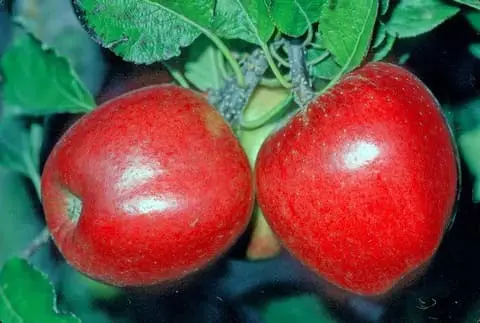
Gala
Raised by J. H. Kidd at Greytown, New Zealand, about 1934 from Kidd's Orange Red and Golden Delicious
-
Gamhong
Named in 1992 for "sweet" and "red", it proved hard to grow and made its name at the apple festival in Mungyeong
-
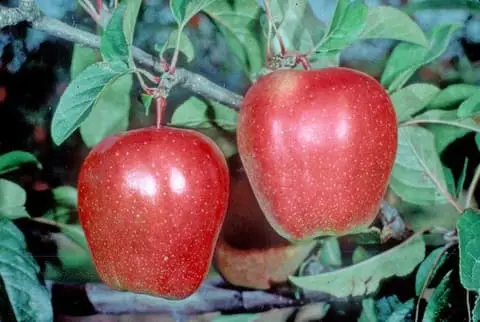
Gloster
Bred at Jork in the Altes Land from a 1951 cross of Glockenapfel and Richared Delicious; dark red and long-keeping
-
Golab Kohanz
A native Iranian summer apple, sweet and fragrant but soft and quick to spoil; breeders cross it for earliness
-
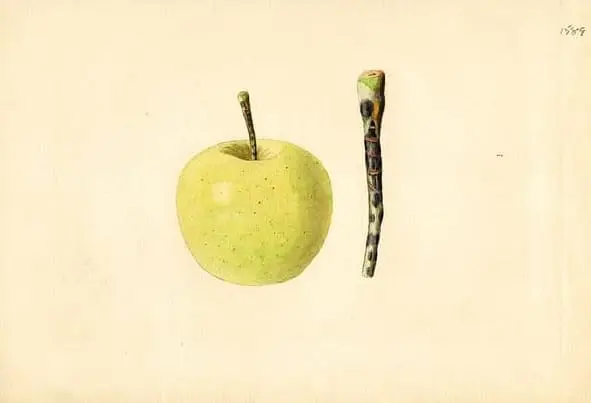
Golden Delicious
A West Virginia seedling that Stark Bro's bought for $5,000 and guarded in a locked cage with a burglar alarm
-
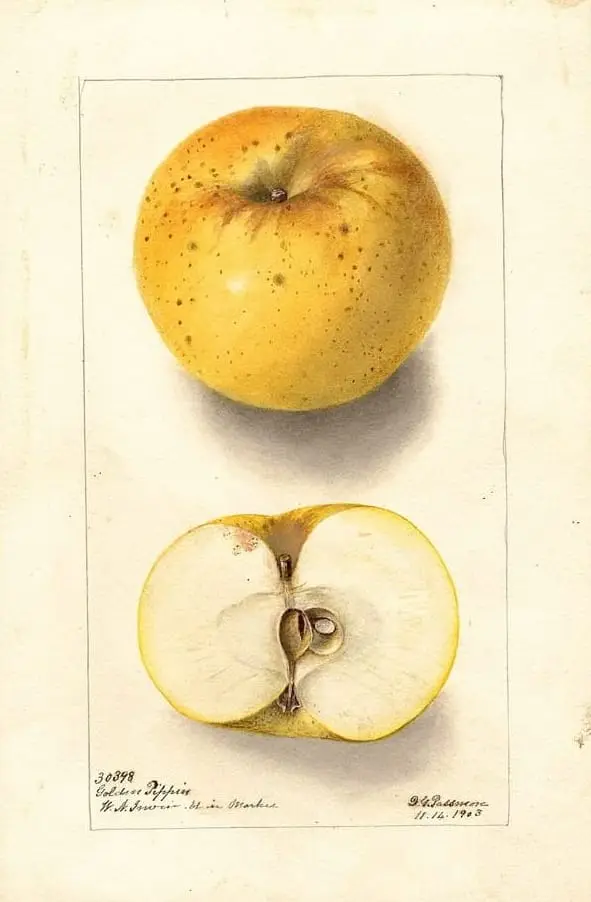
Golden Pippin
Small, golden and very old; to English connoisseurs, wrote Downing, the queen of all dessert apples
-
GoldRush
A late yellow apple of the Purdue–Rutgers–Illinois programme, named for its gold colour and "rush" of flavour
-
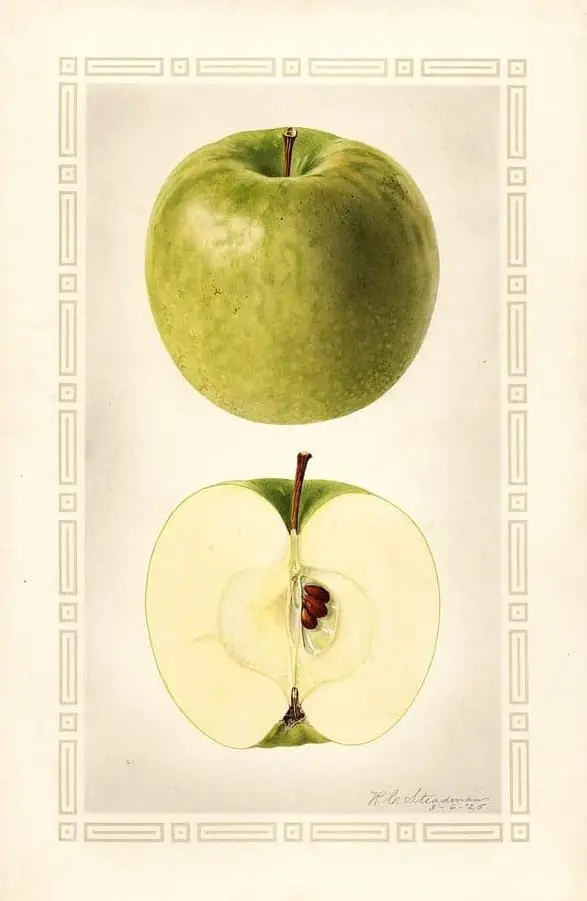
Granny Smith
From Maria Ann Smith's orchard near Sydney; by 1975 it made up 39 per cent of Australia's apple crop
-
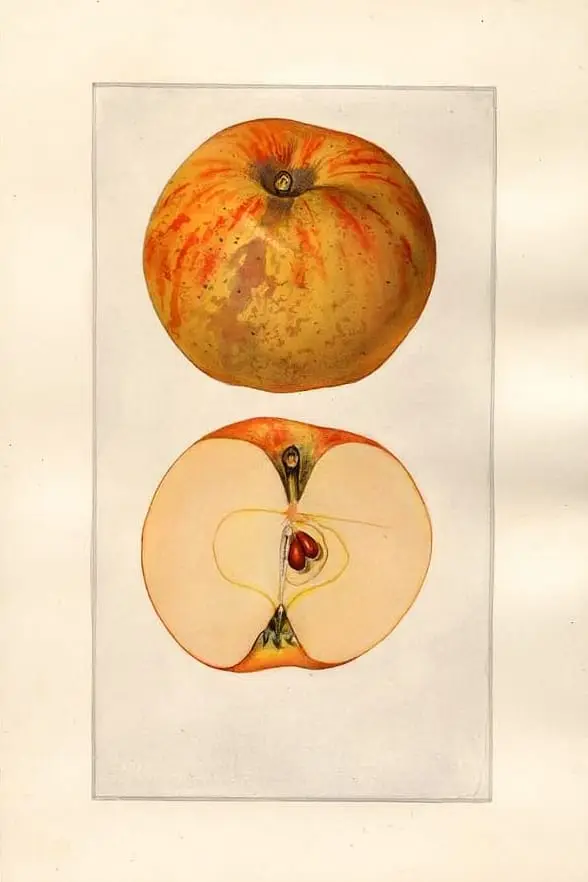
Gravenstein
A triploid of disputed origin, linked to Gråsten Castle and to Italy; Danish growers named it the national apple in 2005
-
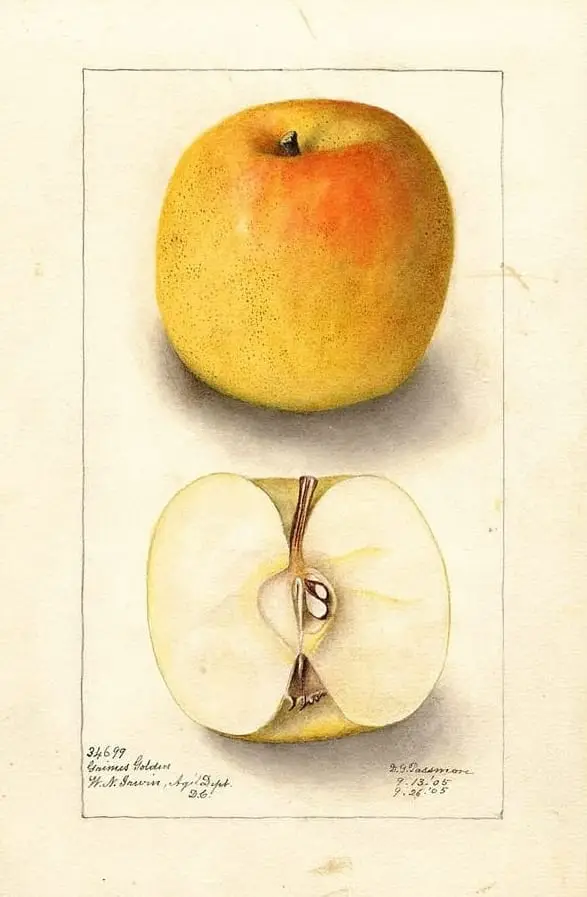
Grimes Golden
A West Virginia apple sold to New Orleans traders by 1804; DNA confirms it as a parent of Golden Delicious
-
Hanfu
A cold-hardy cross of Dongguang and Fuji from Shenyang, grown on about 26,700 hectares around that city by 2016
-
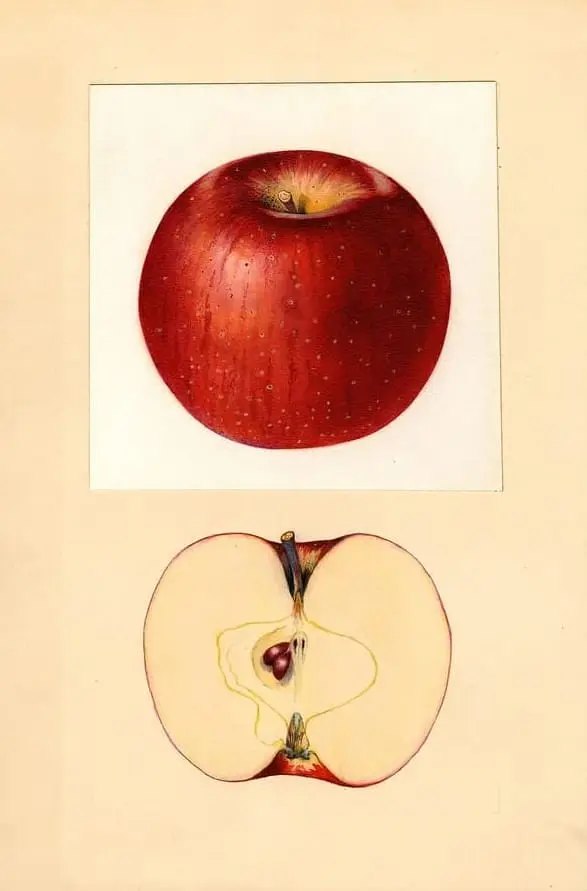
Haralson
A Malinda seedling named after the first head of Minnesota's fruit breeding farm; DNA names Wealthy as its other parent
-
Hokuto
A triploid Aomori apple registered in 1983 as Fuji × Mutsu; DNA studies have since ruled Mutsu out as its father
-
Honeycrisp
Nearly discarded after winter injury, it became Minnesota's state fruit; DNA showed its recorded parents were wrong
-
Hongro
The first apple bred in South Korea, named in 1988 to ripen for Chuseok; only Fuji covers more of its orchards
-
Howell TC2
Red-skinned, red-fleshed seedling of Airlie Red Flesh, raised at Prosser, Washington, and selected in 2010
-
Howell TC3
Yellow-skinned, red-fleshed seedling of Airlie Red Flesh, raised at Prosser, Washington, and selected in 2010
-
Howell TC7
Pink-blushed apple with white and red flesh, raised at Prosser, Washington, from Airlie Red Flesh seed
-
Huaguan
Bred in Zhengzhou, China, from Golden Delicious and Fuji; sold in North America under the trade mark Autumn Glory
-
Huashuo
Bred in Zhengzhou from Meiba and Huaguan, an early August apple put forward as a Chinese-bred alternative to Gala
-
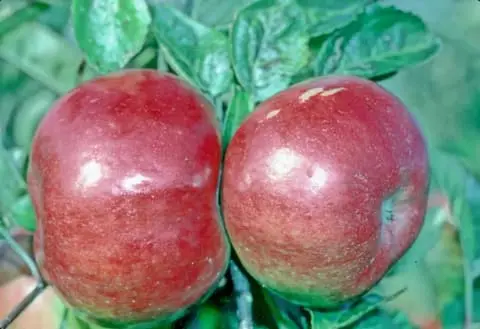
Idared
Raised in Idaho from Jonathan and Wagener and introduced in 1942; in the US today nearly all of it is processed
-
Ilzer Rosenapfel
A perfumed chance seedling of about 1840 from eastern Styria, by 1920 one of the region's main apples
-
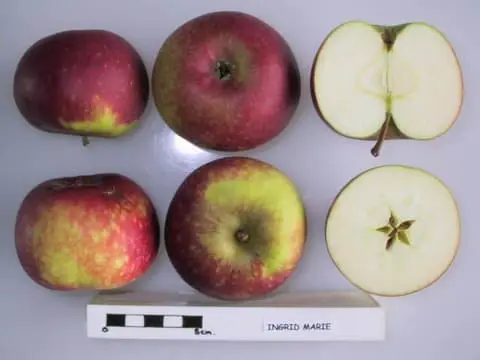
Ingrid Marie
Found in a Fyn school garden about 1910; Denmark's most widespread apple until 1997 and still Sweden's in 2023
-
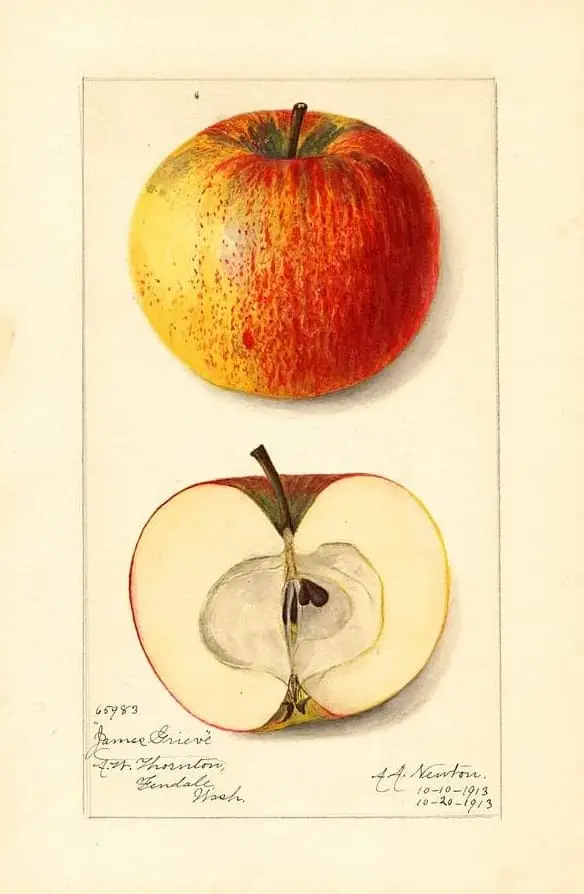
James Grieve
Raised in Edinburgh by the nurseryman James Grieve and shown in 1892; DNA finds Cox's Orange Pippin among its parents
-
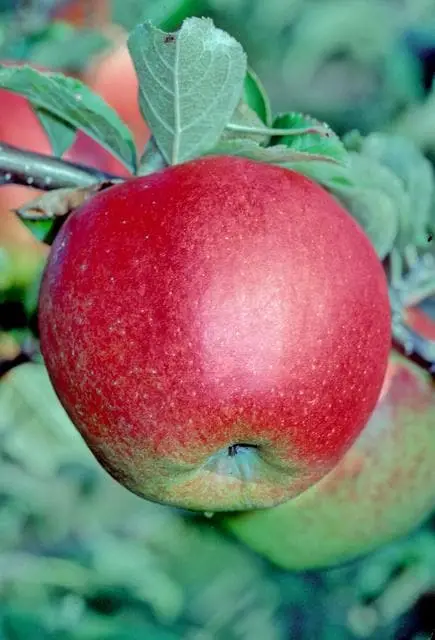
Jonagold
Golden Delicious × Jonathan, crossed at Geneva in 1943; in 1981 western Europe planted it more than any other apple
-
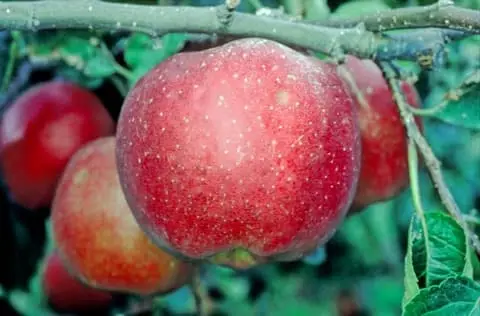
Jonagored
A blood-red sport of Jonagold, found in 1980 at the top of a tree in Jos Morren's orchard at Halen, Belgium
-
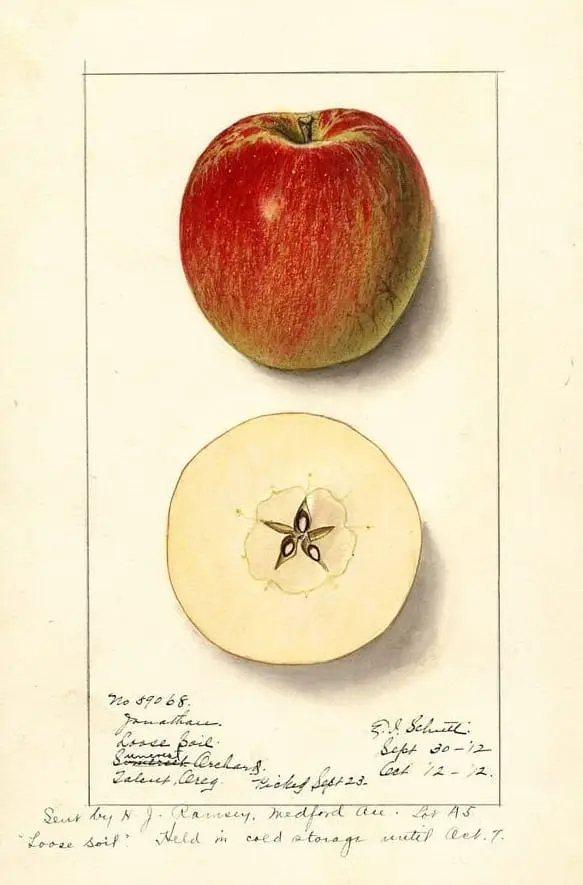
Jonathan
Named by Judge Buel after Jonathan Hasbrouck; in a 2020 DNA study only Cox's Orange Pippin had more inferred offspring
-
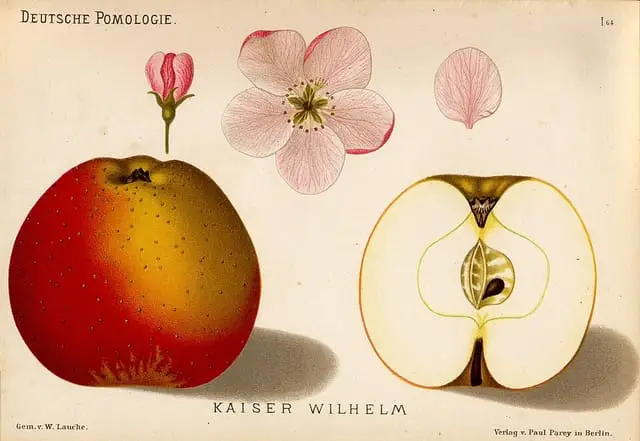
Kaiser Wilhelm
Named in 1875 with Emperor Wilhelm I's consent; DNA shows it is the Rhineland apple Peter Broich
-
Keepsake
A hard, long-keeping Minnesota apple from a 1936 cross, introduced in 1979; DNA shows it is a parent of Honeycrisp
-
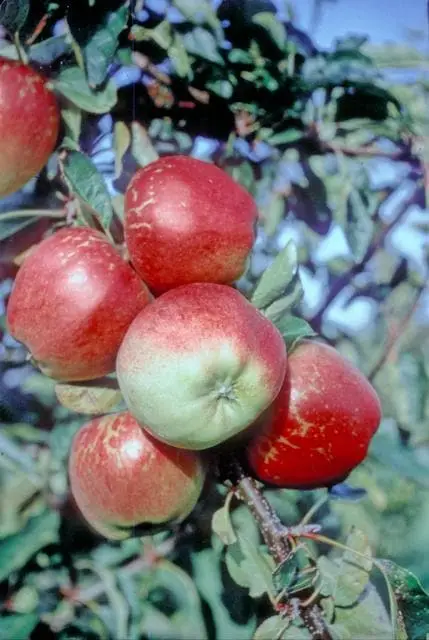
Kidd's Orange Red
J. H. Kidd's first success at Greytown, from Cox's Orange Pippin and Delicious, and a parent of Gala
-
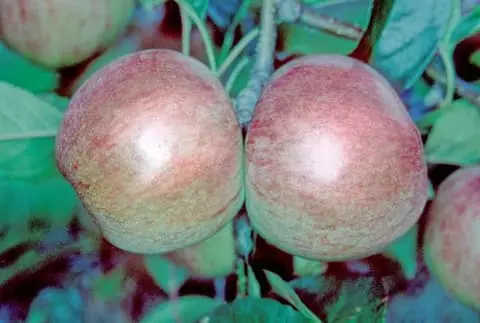
Lady Williams
A chance seedling Maud Williams saved near Donnybrook in the 1930s; parent of Cripps Pink and Cripps Red
-
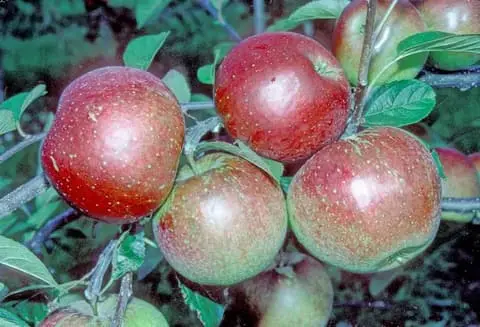
Laxton's Superb
Raised at Bedford in 1897; DNA names its parents as Cellini and Cox's Orange Pippin, not the recorded Wyken Pippin
-
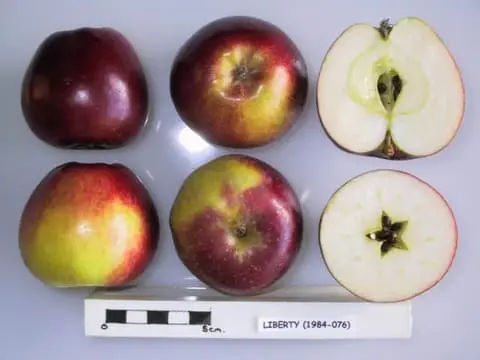
Liberty
Bred at Geneva, New York, from a 1955 cross and named in 1978 to denote its freedom from disease
-
Ligol
Selected at Skierniewice in 1972 from Linda and Golden Delicious; by 2017 the fourth most planted apple in Poland
-
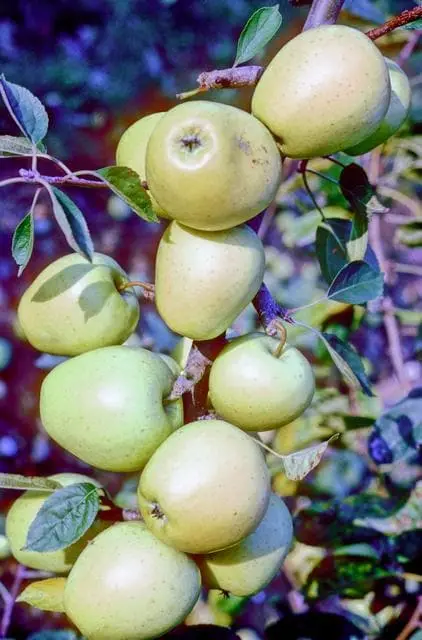
Limoncella
A small, yellow, firm-fleshed apple of southern Italy, first described in 1831 and now in danger of disappearing
-
Luresweet
A scab-resistant red-fleshed apple from Markus Kobelt's nursery at Buchs; sold under the trade mark Redlove Odysso
-
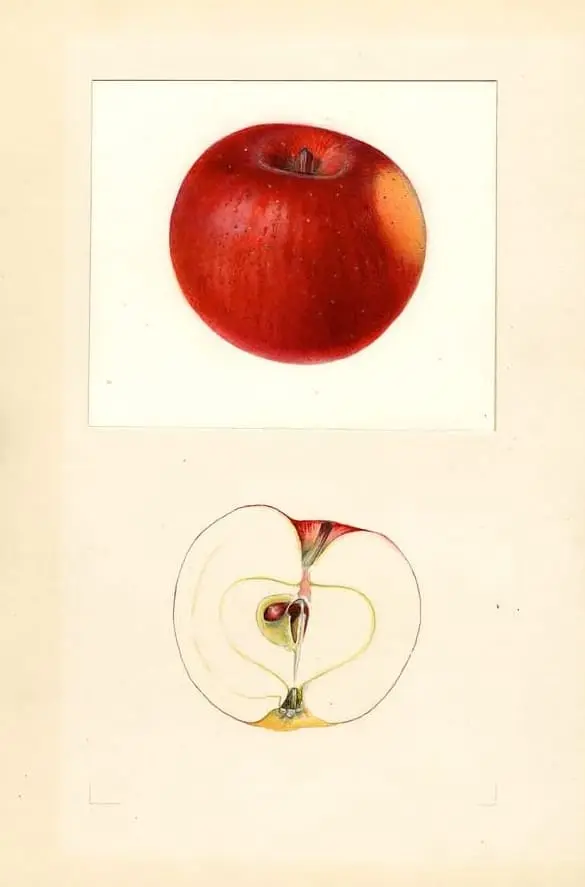
Macoun
McIntosh × Jersey Black, crossed at Geneva in 1909 and named after the Canadian pomologist W. T. Macoun
-
MAIA-1
A Honeycrisp × Fuji seedling bred by a growers' association; only Honeycrisp was planted more in Michigan in 2020–22
-
MAIA-L
A late, deep red open-pollinated seedling picked out at Pataskala, Ohio; sold under the trade mark Ludacrisp
-
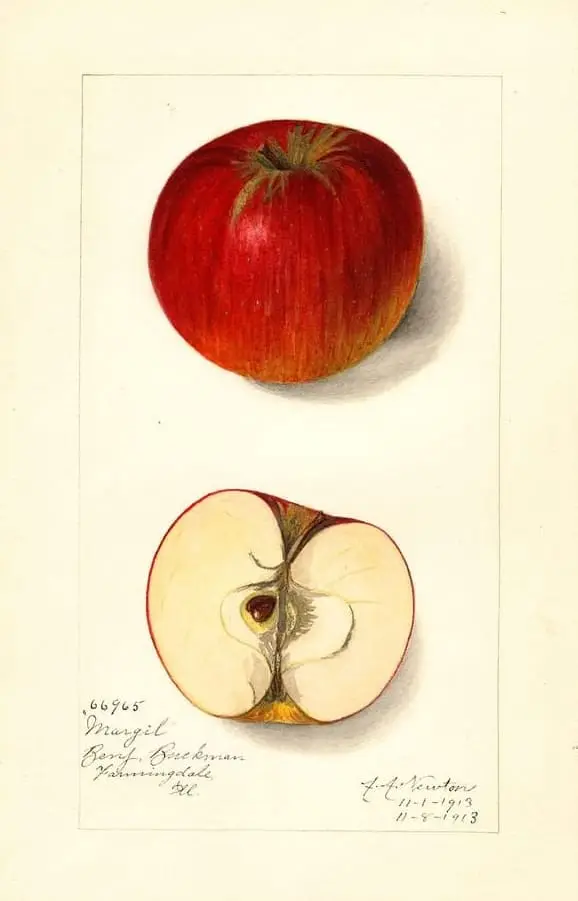
Margil
A small, ribbed, richly aromatic old apple that DNA shows to be a parent of both Ribston Pippin and Cox's Orange Pippin
-
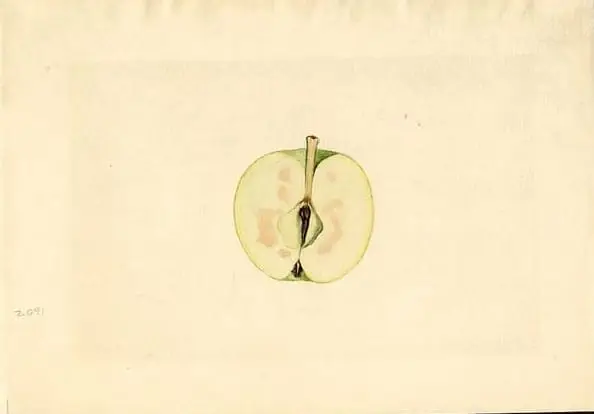
McIntosh
A seedling found in the Ontario bush; its discovery and development became a national historic event of Canada in 1999
-
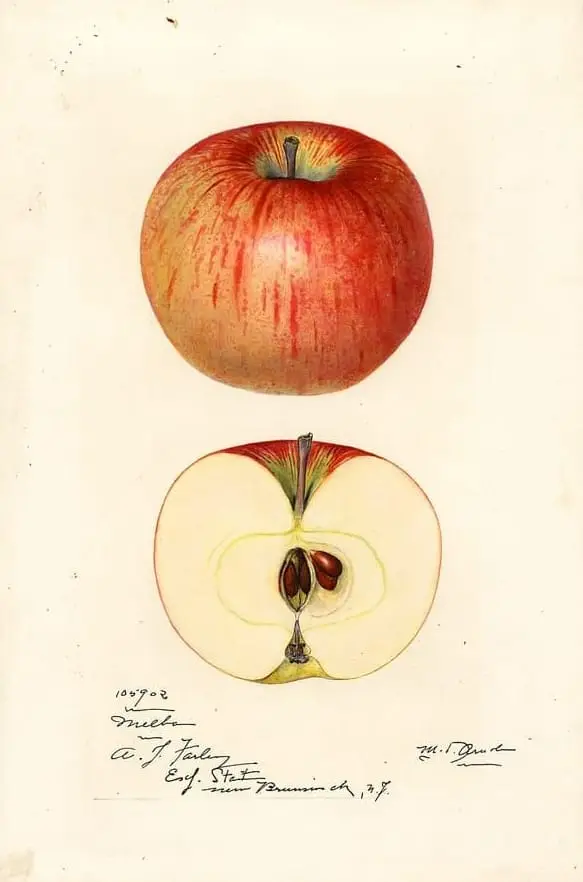
Melba
Raised at Ottawa from McIntosh seed sown in 1898, first fruiting in 1908; a parent of at least ten later apples
-
MN55
An early Minnesota apple from a 1997 Honeycrisp cross; sold under the trade marks First Kiss and Rave
-
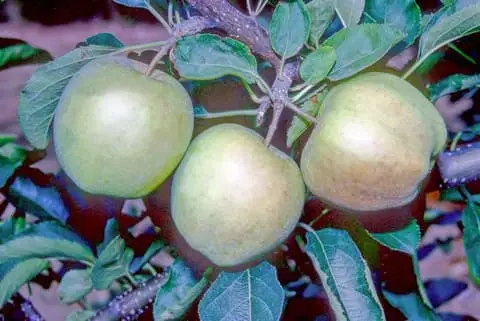
Mutsu
Raised at Aomori in 1930, a big triploid that turns pink when grown in paper bags; renamed Crispin in Britain in 1968
-
New York 1
Bred at Geneva, New York, from a 1998 cross with Honeycrisp; its fruit is sold under the trade mark SnapDragon
-
New York 2
A late, firm and tart Cornell apple from a 1992 cross of Braeburn and Autumn Crisp; sold under the trade mark RubyFrost
-
Newell-Kimzey
Red-fleshed chance seedling recorded at Airlie, Oregon, in 1960; seed parent of Bill Howell's red-fleshed apples
-
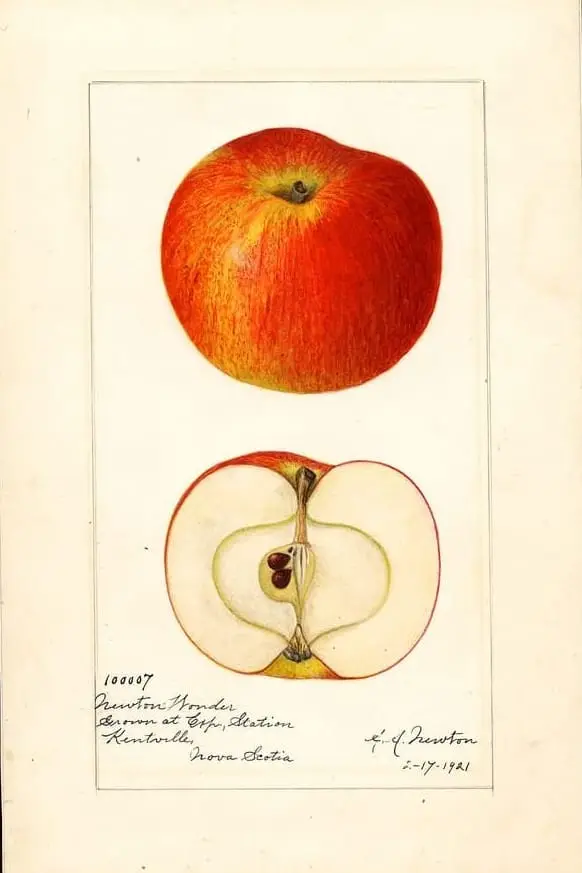
Newton Wonder
A Derbyshire cooker introduced about 1887; DNA gives its parents as Maharaji and Northern Greening, not those on record
-
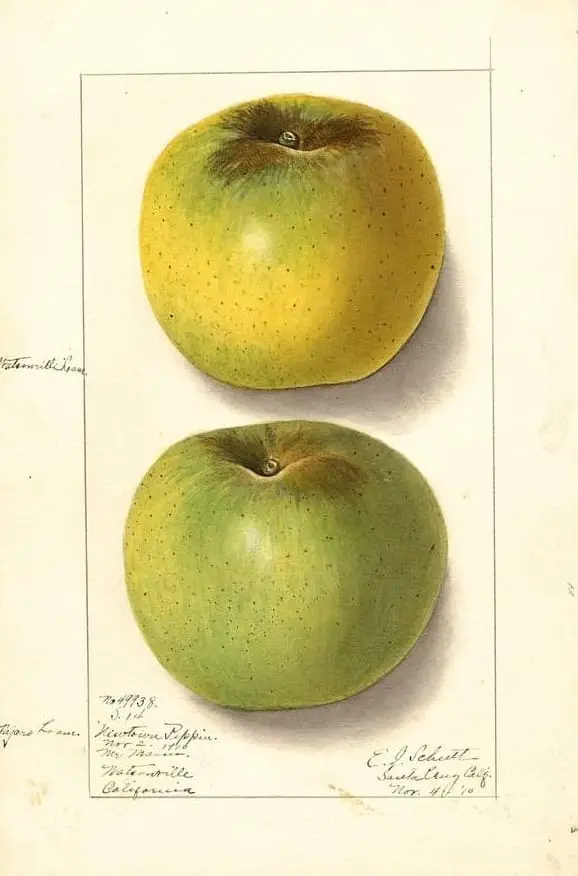
Newtown Pippin
From Newtown, Long Island: the first American apple to draw notice in Europe, sent to Franklin in London in 1759
-
Nicoter
Crossed at Sint-Truiden, Belgium, in May 1993 from Gala and Braeburn; its variety rights reached the EU Court of Justice
-
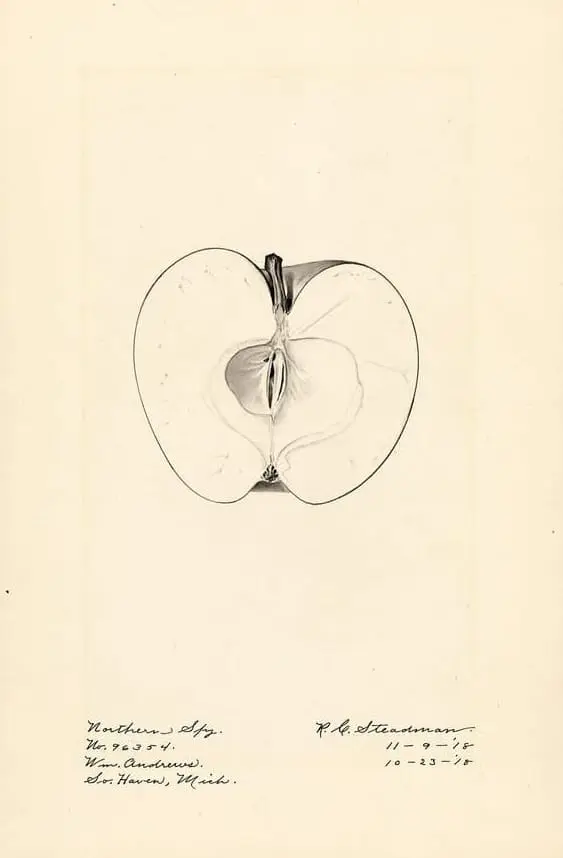
Northern Spy
Raised from Connecticut seed at East Bloomfield, New York, about 1800; third among US apples in 1909–13
-
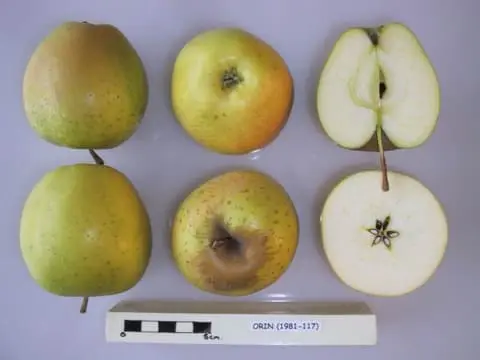
Ōrin
A Fukushima farmer's apple, first fruiting in 1943, that spread without official registration to rank third in Japan
-
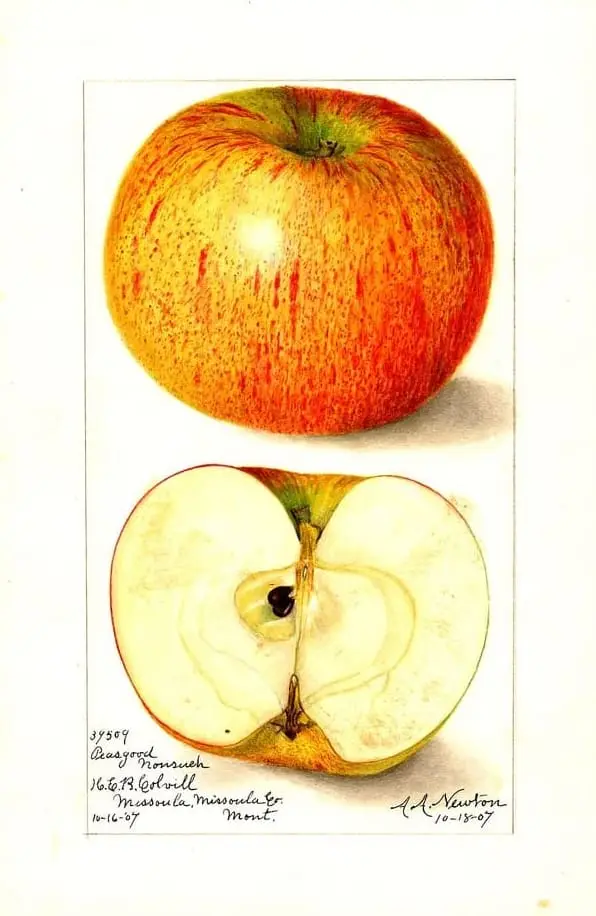
Peasgood's Nonsuch
Grown from a pip sown at Stamford about 1858; DNA shows its parents are Alexander and Golden Noble, not Catshead
-
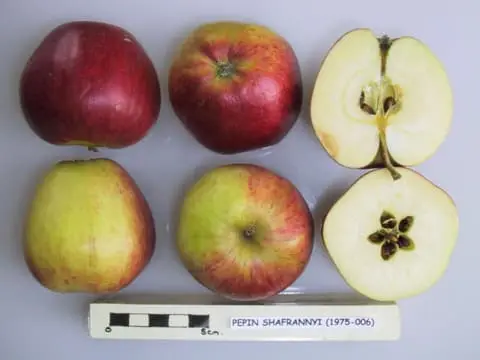
Pepin Shafranny
Michurin's winter apple of 1907–15; SNP data name Scarlet Pearmain and Glogerovka as its parents, not those recorded
-
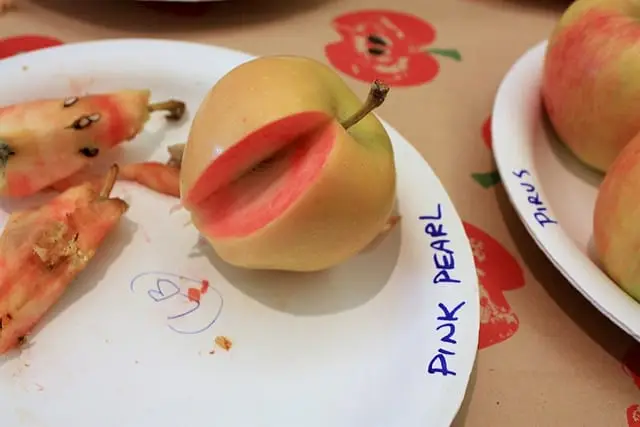
Pink Pearl
Albert Etter's best-known red-fleshed apple, a Surprise seedling from Ettersburg, California, patented in 1947
-
Pinova
Crossed at Dresden-Pillnitz in 1965 from Clivia and Golden Delicious; released in 1986, it crops early and heavily
-
PremA17
An early yellow-and-red apple from a 1995 cross in Hawke's Bay; its fruit is sold under the trade mark Smitten
-
Prima
The first apple named by the Purdue–Rutgers–Illinois scab-resistance programme, in 1970; PRI begins its name
-
R201
A red-fleshed apple from a 2006 cross at Seiches-sur-le-Loir, France; sold under the trade mark Kissabel Rouge
-
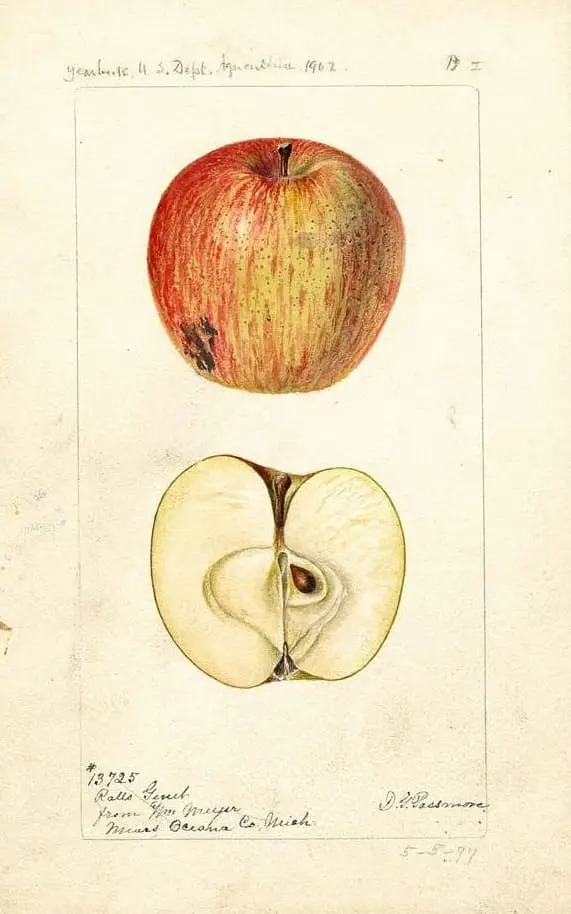
Ralls Janet
A late-blooming Virginia apple known by about 1800; in Japan, as Kokko, it became a parent of Fuji
-
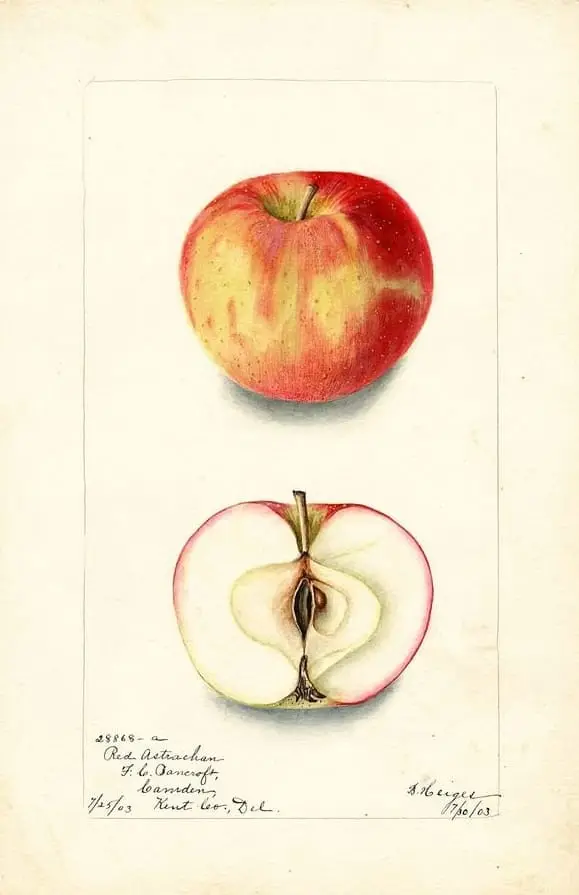
Red Astrachan
A bloom-dusted summer apple, in England from Swedish stock by 1816; a 2025 DNA study names both its parents
-
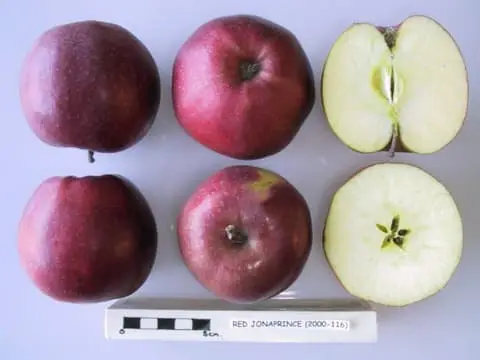
Red Jonaprince
A dark red sport of Jonagold found at Weert in 1994; 4 per cent of Europe's apple crop in 2025/26
-
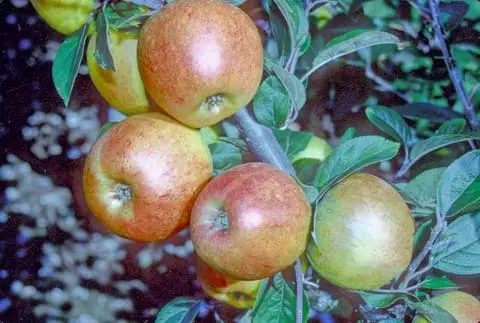
Reine des Reinettes
France's Reine des Reinettes is England's King of the Pippins; Leroy thought them two apples, DNA finds one
-
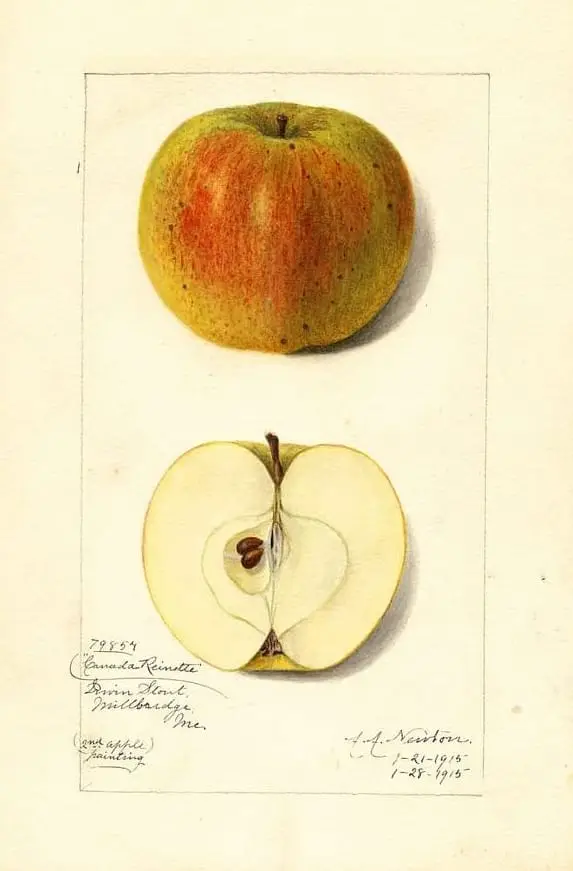
Reinette du Canada
Probably French despite its name: first announced in Paris in 1771 as the monstrous reinette of Canada
-
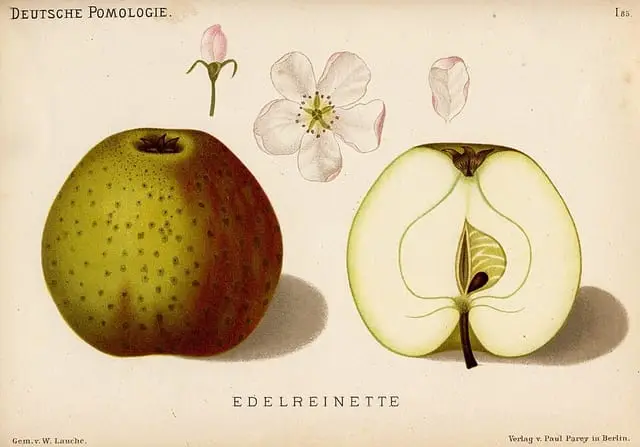
Reinette Franche
Named in 1540 and probably Norman; in a 2020 DNA study of over 1,400 apples it had the most parent–offspring links
-
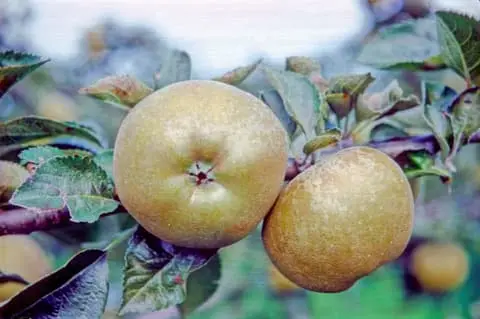
Reinette Grise du Canada
The russeted form of Reinette du Canada, identical to it at 16 DNA markers; recorded in Paris in 1805
-
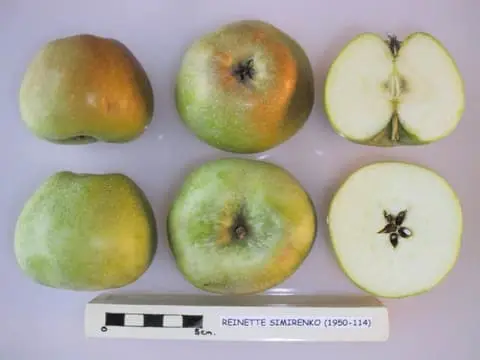
Reinette Simirenko
From the Simirenko orchards near Mliiv, origin unknown; Ukraine's public orchards held about 10 million trees in 1989
-
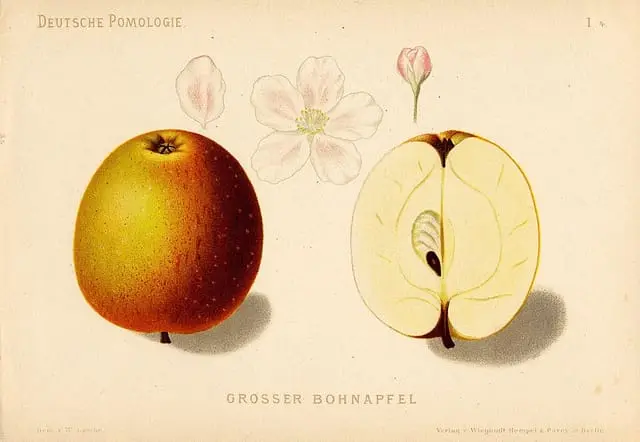
Rheinischer Bohnapfel
A triploid Rhineland apple described by Diel in 1797; hard and sour when picked, it was said to keep over a year
-
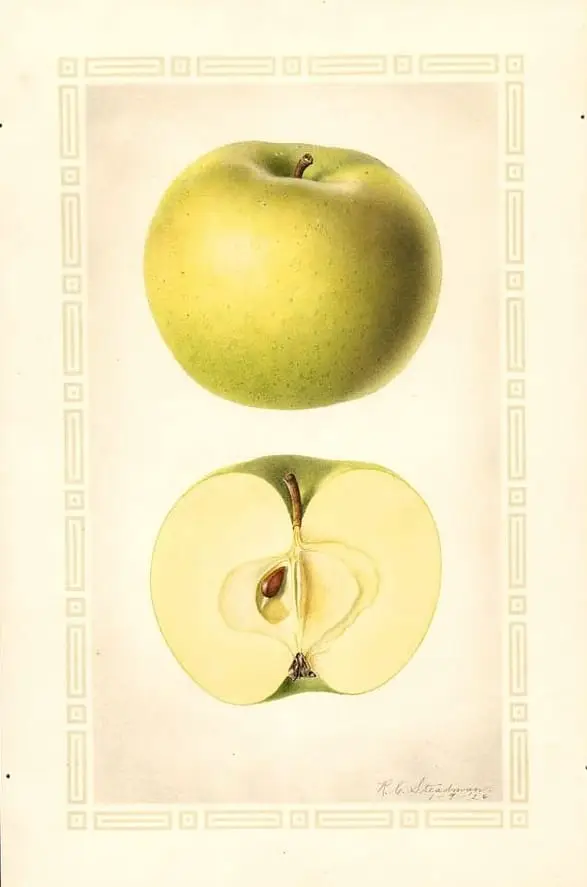
Rhode Island Greening
Probably from Green's End near Newport; second only to the Baldwin in New York in 1905, and Rhode Island's state fruit
-
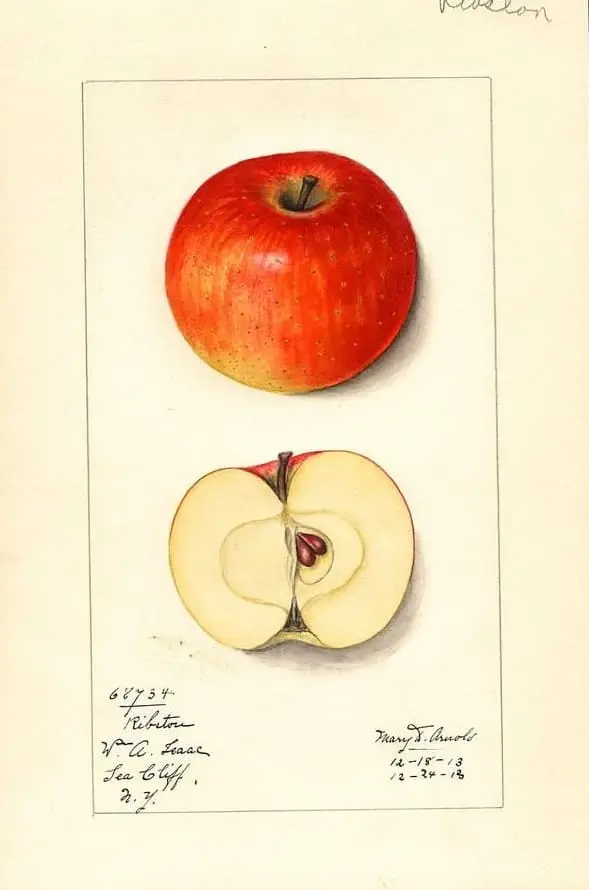
Ribston Pippin
Grown at Ribston Hall, Yorkshire, from a pip said to come from Normandy; its DNA parents are Margil and Nonsuch Park
-
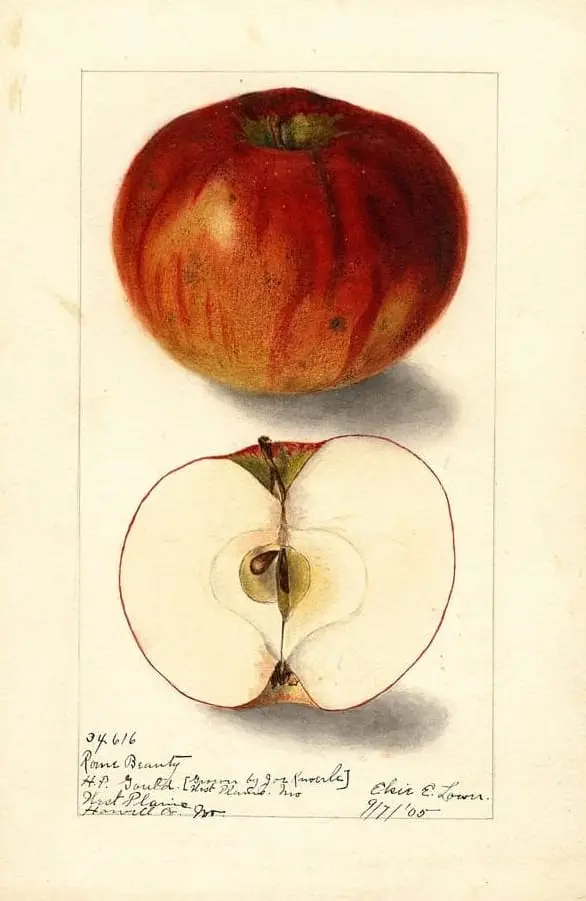
Rome Beauty
An Ohio apple that blooms late and keeps until spring; in 2020–24, 94 per cent of the US crop went to processing
-
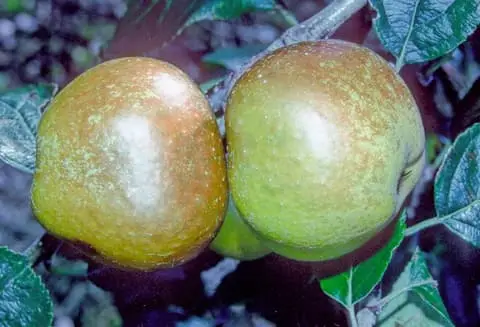
Rosemary Russet
An English russet first recorded in 1831; DNA shows it a child of Nonpareil and a parent of Cox's Orange Pippin
-
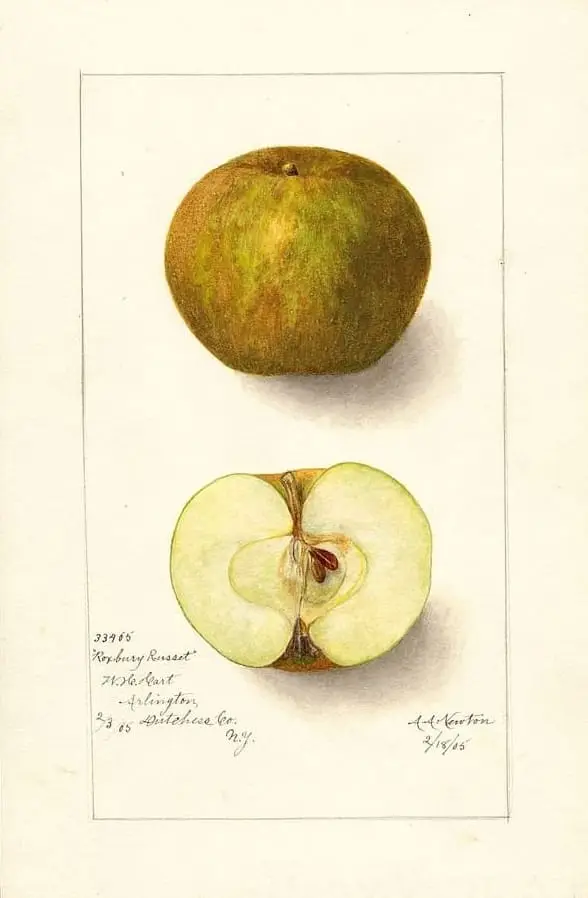
Roxbury Russet
Often called the oldest American apple; SNP data show the old French Reinette Franche to be one of its parents
-
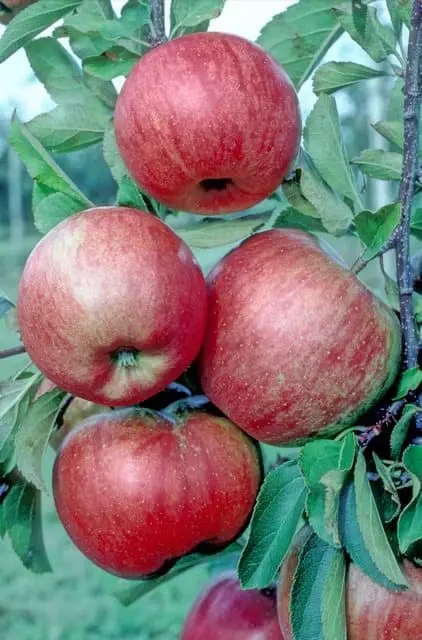
Šampion
Raised privately by Otto Louda at Střížovice from a 1960 cross; third in Poland's apple orchards in 2017
-
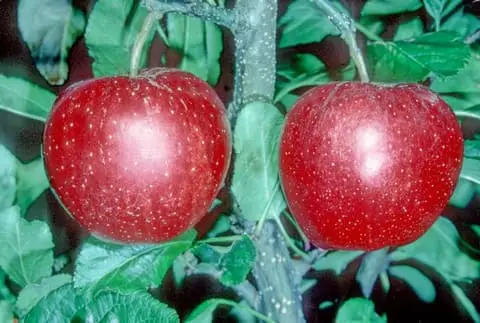
Scifresh
Bred at Havelock North from a 1985 cross of Braeburn and a highly coloured sport of Gala; sold under the trade mark Jazz
-
Scilate
A late apple from a 1985 Havelock North cross; in 2025 the second-largest share of New Zealand's apple exports
-
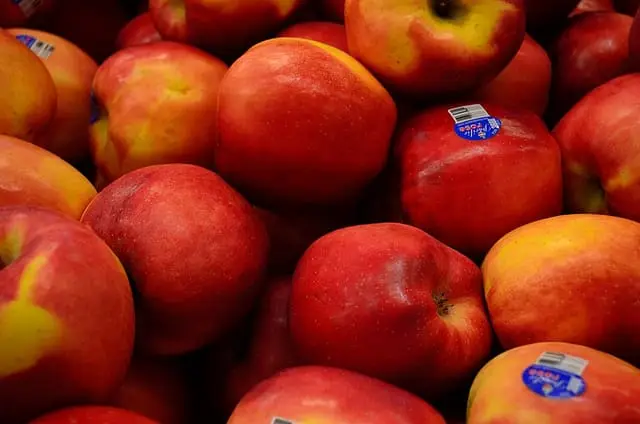
Sciros
A late rose-pink apple bred at Havelock North from Splendour and Gala; sold under the trade mark Pacific Rose
-
Sekai Ichi
A very large Aomori apple, often 500 grams or more, named after advertising that called it the biggest in the world
-
Senshu
Bred in Akita from a 1966 cross of Tōkō and Fuji; a parent of Shinano Gold, Akibae and Kiō
-
Shinano Gold
A yellow Nagano apple from a 1983 cross; licensed to South Tyrol in 2016, the first Nagano variety licensed abroad
-
Shinano Sweet
A soft, sweet October apple bred in Nagano from Fuji and Tsugaru; fifth in Japan by area in 2018
-
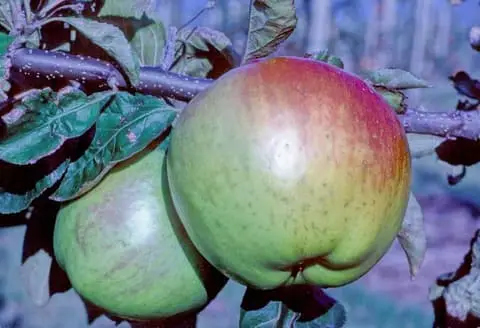
Signe Tillisch
Raised in Denmark in 1866 and named after the grower's daughter; DNA shows it a child of Alexander and London Pippin
-
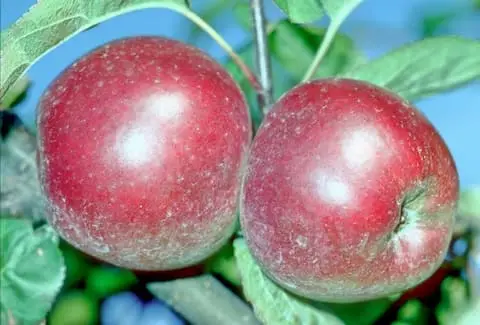
Spartan
Bred at Summerland from a 1926 cross; "probably the most important apple variety introduced ever in British Columbia"
-
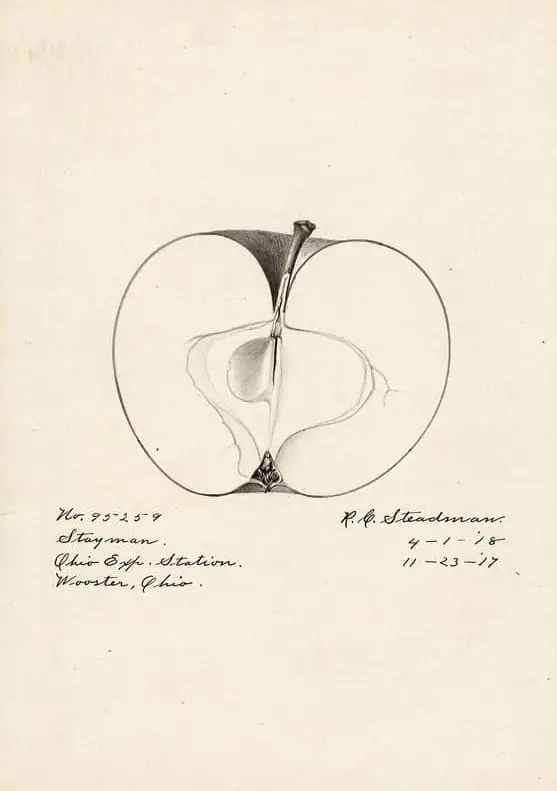
Stayman
A Winesap seedling raised at Leavenworth, Kansas, in 1866; the fifth apple of American orchards in 1928
-
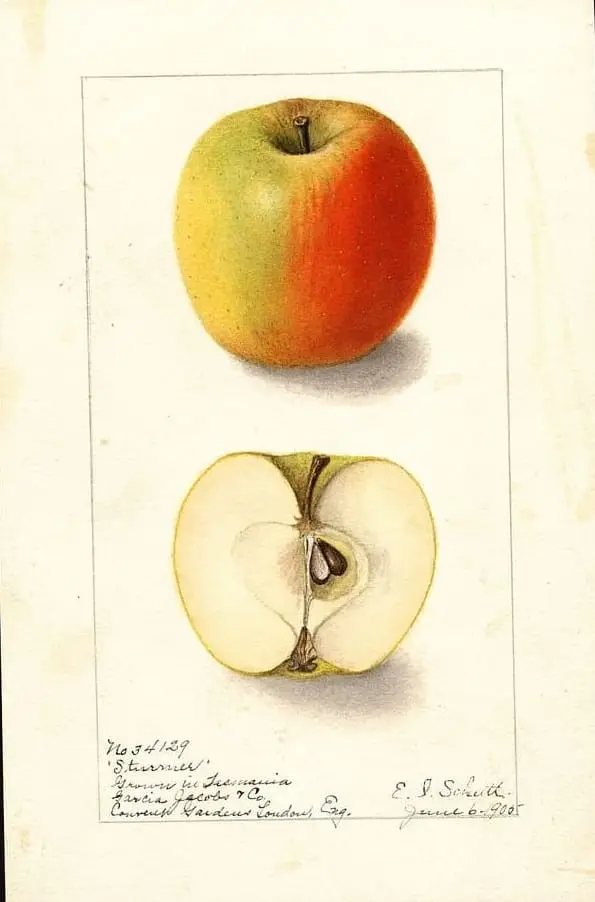
Sturmer Pippin
Raised at Sturmer by 1831; Tasmania's most important apple in 1936, and by DNA a parent of Braeburn
-
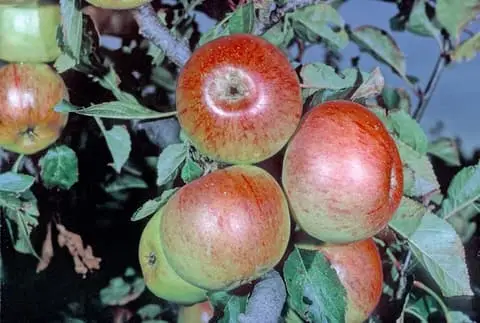
Sunset
A Cox's Orange Pippin seedling raised at Ightham, Kent, about 1918; DNA markers suggest James Grieve as its other parent
-
Toki
A yellow Aomori apple named after its raiser; registered as Ōrin × Kogetsu, its father is now given as Fuji
-
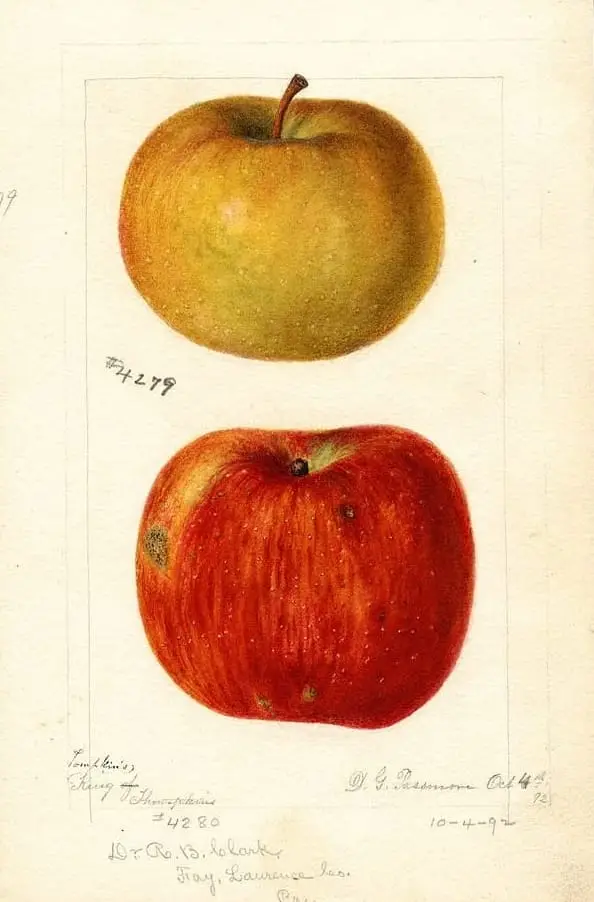
Tompkins King
Brought from New Jersey to Tompkins County, New York, in 1804; a triploid with Esopus Spitzenburg as one parent
-
Topaz
A scab-resistant Czech apple from Rubín × Vanda; in 2026 second only to Gala among organic apples in Europe
-
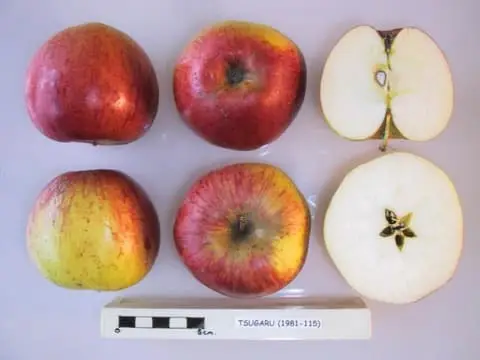
Tsugaru
Japan's second most planted apple in 2018, from a 1930 Aomori cross; DNA shows its unrecorded father was Jonathan
-
UEB 32642
A scab-resistant cross of Golden Delicious and Topaz, selected in Czechia in 1999; sold under the trade mark Opal
-
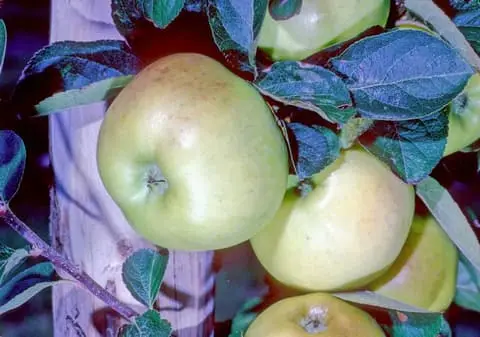
Verde Doncella
An old Spanish apple from nineteenth-century nurseries: sweet, pale-skinned and able to keep through the winter
-
WA 38
Bred at Washington State University from a 1997 cross of Enterprise and Honeycrisp; 7 per cent of the US crop in 2025/26
-
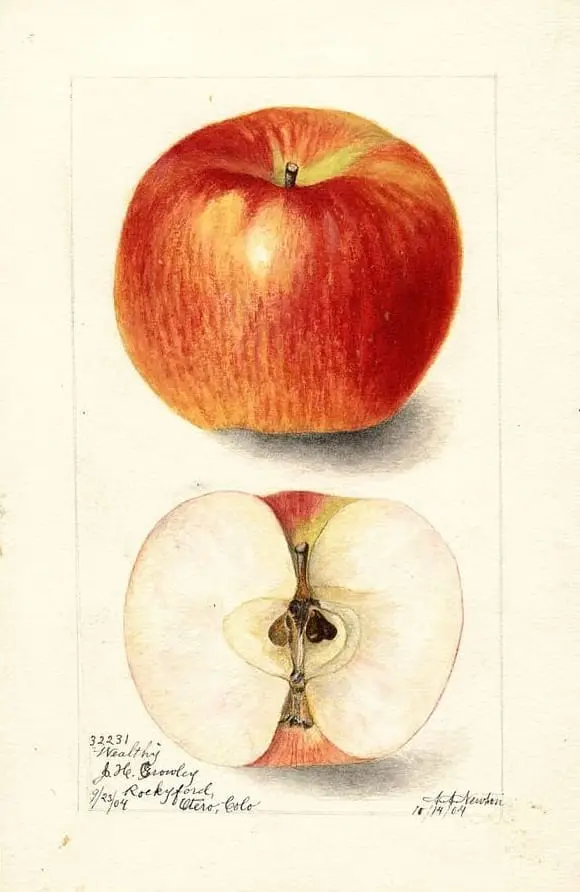
Wealthy
Peter Gideon's hardy Minnesota seedling of the 1860s; DNA names Jonathan and Duchess of Oldenburg as its parents
-
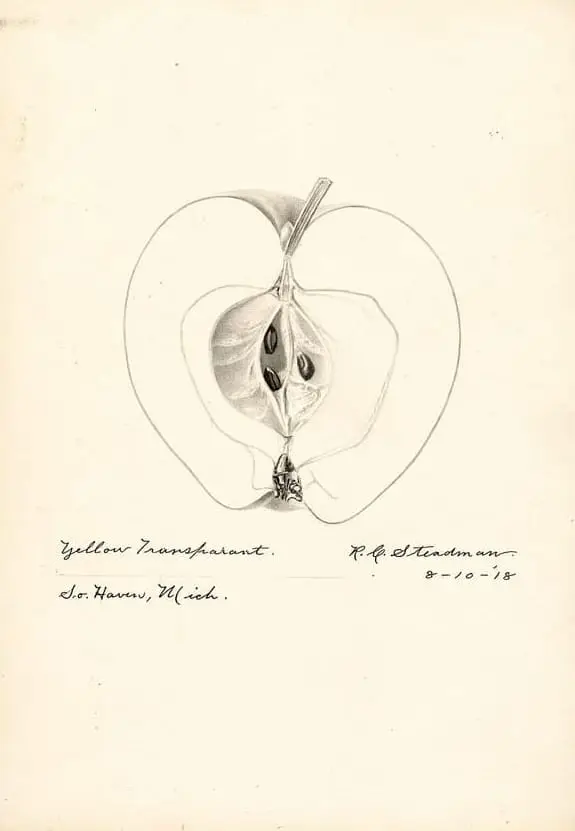
White Transparent
A thin-skinned summer apple long common in Russia's Baltic provinces; SNP data name Aspa and Saint Germain as parents
-
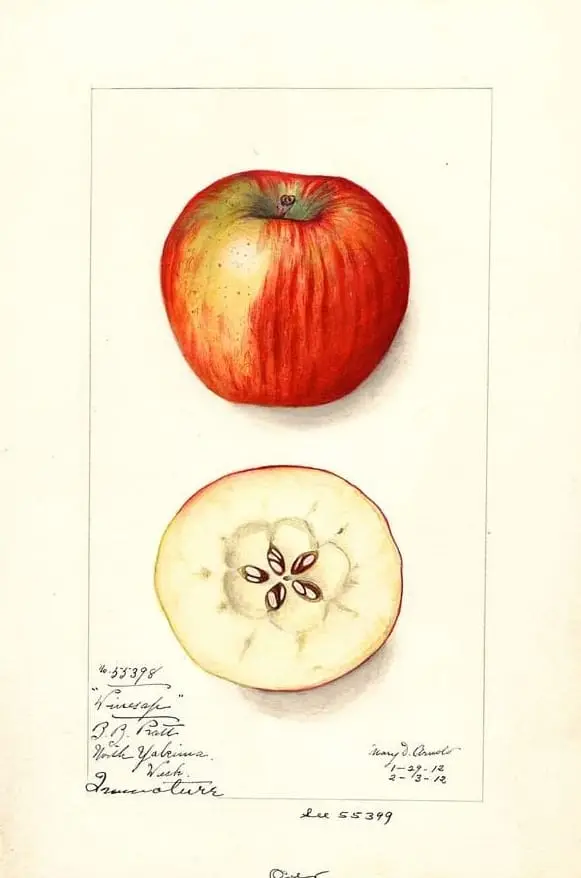
Winesap
Of unknown origin, it was "the most favored cider fruit in West Jersey" in 1817 and a parent of Delicious
-
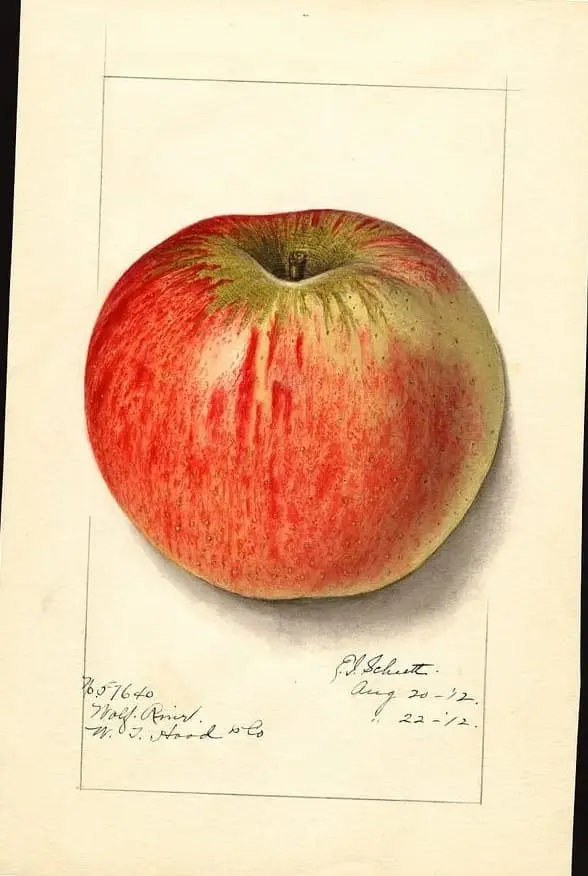
Wolf River
A large, very hardy apple raised by W. A. Springer near the Wolf River at Fremont, Wisconsin; first recorded in 1875
-
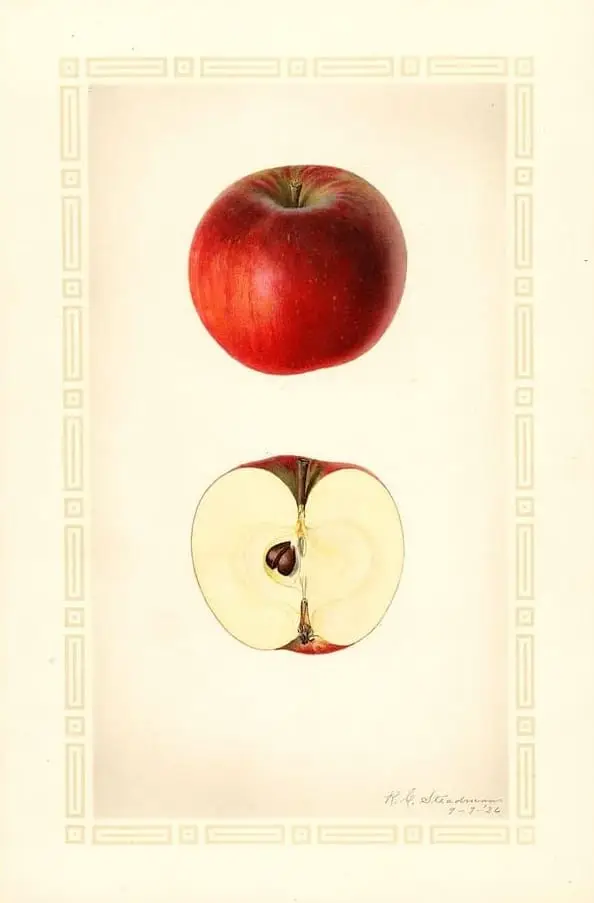
Worcester Pearmain
Bright red and early, from Worcester in the 1870s; a parent of Discovery, Merton Worcester and many more
-
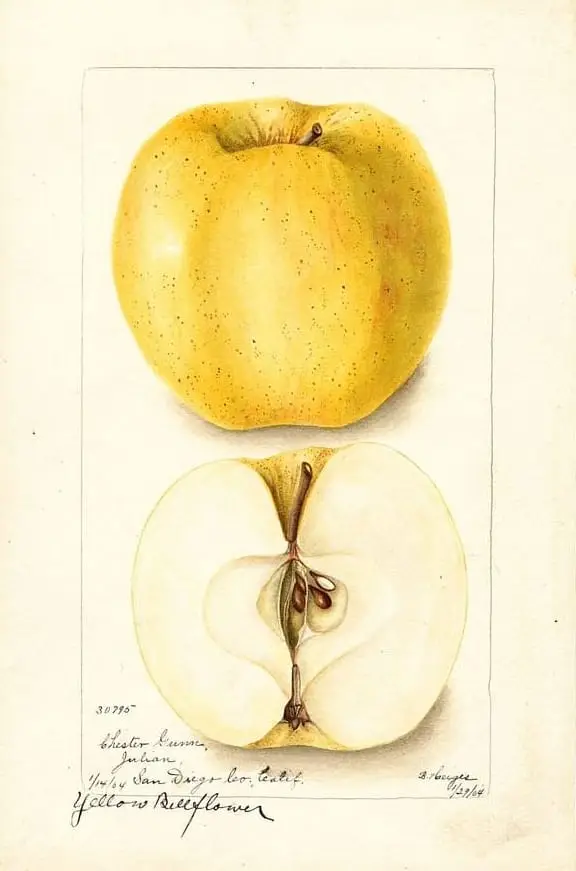
Yellow Bellflower
In 1817 the most popular apple in the Philadelphia market, it came from near Crosswicks, New Jersey
-
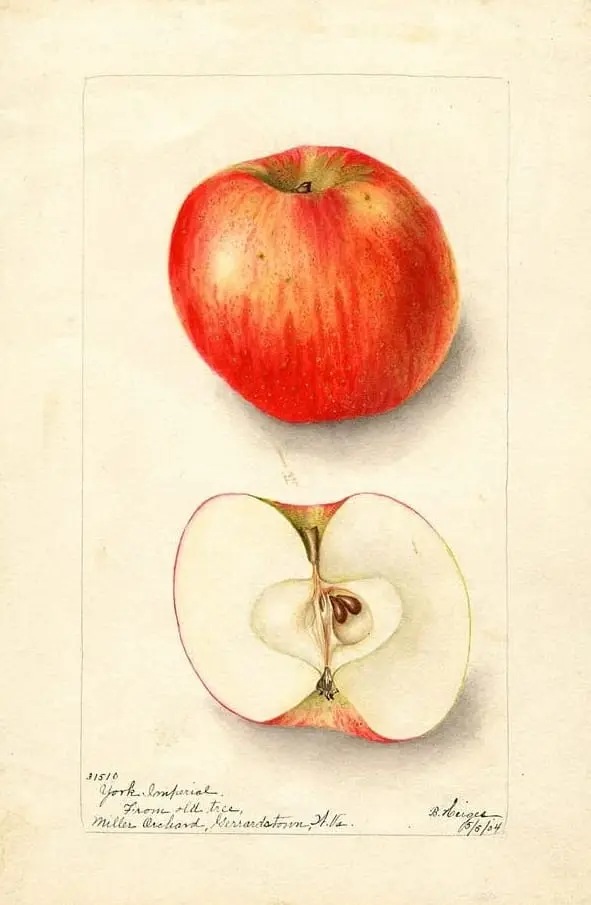
York Imperial
A lopsided Pennsylvania winter apple, named after Charles Downing called it the "imperial of keepers"
And 1,068 more in the catalogue, A to Z
- A.D.W. Atkins about 1971
- Abbondanza 1896
- Abondance by 1947
- Acklam Russet by 1768
- Acme 1944
- Adamsapfel Ostpreussischer by 1951
- Adersleber Calville about 1870
- Admiral about 1921
- Advance 1908
- Aivaniya by 1957
- Aldenham Blenheim before 1929
- Alfred Jolibois by 1948
- Alice 1943
- All-Red Gravenstein
- Allington Pippin before 1884
- Alnarps Favorit 1945
- Altlander Rosenapfel by about 1850
- Alton 1923
- Amanishiki 1936
- Amber before 1936
- American Beauty by 1854
- American Summer Pearmain by 1817
- Ames by the 1920s
- Andre Briollay by 1947
- Angyal Dezso 1900s
- Anisa by 1957
- Antonovka Grammovaya 600 1888
- Aori by 1977
- Api Noir by the late 1700s
- Appel van Paris 1935
- Ard Cairn Russet about 1890
- Arkansas about 1833
- Arlet by 1995
- Ascot 1898
- Astillisch 1929
- Astrachan Large Fruited 1850s
- Atalanta (Netherlands) 1935
- Atlas 1898
- Auralia by 1967
- Autumn Arctic
- Autumn Harvest by 1934
- Autumn Pearmain by the late 1500s
- Baker's Delicious by 1932
- Balder 1950
- Ballarat Seedling by the early 1900s
- Ballard Beauty 1946
- Bancroft by 1930
- Banffy Pal by 1948
- Banns by 1928
- Banziger by about 1890
- Barchard's Seedling by 1856
- Barkley Red Rome 1944
- Barnack Beauty about 1840
- Barnack Beauty Sport 1944
- Barnack Orange 1904
- Barnhill Pippin by 1934
- Barre by 1948
- Barry by 1936
- Bastien by 1948
- Batul-alma early 1800s
- Baumann's Reinette by 1811
- Baxter by about 1800
- Baxter's Pearmain by 1821
- Beacon 1908
- Beauty of Bedford before 1913
- Beauty of Blackmoor 1947
- Beauty of Hants before 1850
- Bebe Rose by 1947
- Bec d'Oie (Cher) by 1947
- Bedminster Pippin by 1952
- Beeley Pippin about 1880
- Belle de Magny by 1888
- Belle de Pontoise 1869
- Belle des Buits by the mid 1800s
- Belledge Pippin by 1818
- Bellefleur Krasny 1914
- Belvoir Seedling by 1935
- Ben's Red about 1830
- Benenden Early about 1945
- Benoni about 1830
- Bereczki Mate by 1948
- Beregi Sovari by 1900
- Bess Pool by 1824
- Bessemyanka Michurina 1912
- Betsey by 1842
- Betty Geeson by 1854
- Beurriere by 1948
- Beverly Hills 1939
- Biesterfelder Renette by 1905
- Birgit Bonnier
- Black Ben Davis about 1880
- Black McIntosh 1928
- Black Mickey 1929
- Blackjon about 1927
- Blandurette by 1948
- Blaxtayman 1926
- Blaze 1939
- Bloody Ploughman by 1883
- Blue Pearmain by the early 1800s
- Bodikers Gold-Reinette by 1875
- Bodil Neergaard about 1850
- Boiken by 1828
- Bondon by 1948
- Bonne Hotture by 1867
- Bonnet Carre by 1948
- Bonnet de Comte by 1947
- Bosbury Pippin by 1920
- Bossom by 1831
- Bouet de Bonnetable by 1948
- Bouquepreuve by 1884
- Bouscasse de Bres possibly 1800s
- Bow Hill Pippin by 1893
- Box Apple by 1955
- Braddick Nonpareil by 1818
- Braintree Seedling 1930
- Bramshott Rectory by about 1938
- Breedon Pippin about 1801
- Breitling by about 1879
- Brenchley Pippin by 1884
- Britemac 1934
- Brookes's by 1820
- Brown Crofton by 1950
- Brown Kenting by 1831
- Brown's Seedling before 1874
- Brownlees' Russet by about 1848
- Budai Ignac by 1948
- Burchardt's Reinette by 1863
- Burgundy by 1974
- Burn's Seedling by 1831
- Buzaval Ero Alma by 1948
- Cabusse by 1947
- Cacanska Pozna by 1975
- Cagarlaou by 1947
- Calville d'Aout 1925
- Calville d'Oullins about 1850
- Calville de Maussion by 1870
- Calville Rouge du Mont d'Or by 1934
- Cambusnethan Pippin about 1750
- Campanino by 1950
- Canada Blanc de la Creuse by 1947
- Caravel by 1964
- Carlton 1912
- Caroli d'Italie by 1876
- Caroline by 1822
- Carrey by 1947
- Carswell's Honeydew 1939
- Carswell's Orange 1938
- Cartaut by 1934
- Carter's Blue by 1869
- Carter's Pearmain by 1934
- Case Wealthy 1933
- Cavallotta by 1958
- Celt 1943
- Chad's Favourite by 1939
- Champ-Gaillard by 1868
- Channel Beauty by 1922
- Charden 1959
- Charles Ross by 1890
- Charlot by 1947
- Chataignier by 1200
- Chaux by 1947
- Chaxhill Red by 1873
- Cheddar Cross 1916
- Chehalis 1955
- Chenango Strawberry by about 1850
- Cherry Cox about 1942
- Chieftain 1917
- Chips about 1867
- Chivers Delight 1936
- Chorister Boy by 1890
- Ciodo by 1958
- Cissy between 1750 and 1800
- Citron d'Hiver (Swiss) by 1925
- Claygate Pearmain by 1821
- Clear Gold
- Clearheart by 1951
- Cleeve before 1930
- Clivia by 1961
- Cloden
- Clopton Red 1946
- Close by about 1925
- Cludius Herbstapfel 1850s
- Cockle Pippin about 1800
- Cola early 1900s
- Cola Gelata early 1900s
- Collins about 1865
- Colonel Vaughan late 1600s
- Comrade by 1932
- Coquette by 1947
- Coquette d'Auvergne by 1947
- Cornish Aromatic by 1813
- Cornish Gilliflower by 1813
- Cornish Honeypin by 1955
- Cornish Pine by 1920
- Coronation by 1902
- Coul Blush by 1827
- Court of Wick by 1790
- Cox's Early Export by 1950
- Cox's Orange Pippin Red Sport (Potter) by 1957
- Cox's Pomona about 1825
- Coxstone 1926
- Craciunesti by 1934
- Cravert by about 1870
- Cravert Rouge
- Crawley Beauty about 1870
- Cretesc de Breaza by 1958
- Crimson Beauty (Canada) about 1880
- Crimson Cox about 1913
- Crimson Spy by 1931
- Crimson Superb by 1950
- Criterion 1968
- Crowngold
- Csikos Orias Halasi by 1948
- Curl Tail by 1872
- Cusset Blanc by 1947
- Cutler Grieve by about 1912
- D'Arcy Spice about 1785
- d'Eylau by about 1812
- Dalice between 1933 and 1937
- Damjanich by 1948
- Daniel Fele Renet by 1948
- Dark Red Staymared by 1927
- Daru Sovari by 1875
- Davey 1928
- Dawn by 1940
- de Flandre by 1876
- de Jaune about 1700
- de l'Estre before 1786
- de Quint by 1948
- Decio about 450 AD
- Decosta by 1988
- Delectable by 1952
- Democrat about 1900
- Dermen McIntosh by 1966
- Desseffy Arisztid by 1948
- Devon Crimson Queen by 1953
- Devonshire Quarrenden by 1678
- Diamond Jubilee about 1889
- Dillington Beauty by 1872
- Directeur van de Plassche 1935
- Domnesc by 1831
- Doree de Tournai 1817
- Double Red Rome Beauty about 1920
- Double-Red Baldwin 1924
- Doud Golden Delicious by 1952
- Downton Pippin by 1806
- Drap d'Or (2) by 1947
- Dredge's Fame by 1802
- Duchess of Bedford by 1918
- Duchess's Favourite about 1800
- Duck's Bill by 1937
- Duegne by 1947
- Duke of Devonshire 1835
- Dulmener Rosenapfel about 1870
- Dunn's Seedling by 1890
- Dunning 1923
- Durello by 1949
- Dutch Mignonne by about 1771
- Early Julyan before 1800
- Early McIntosh 1909
- Eastbourne Pippin 1930
- Easter Orange by 1897
- Eccleston Pippin by 1883
- Edelborsdorfer by the 1500s
- Eden 1948
- Edgar (Canada) by 1929
- Edith Hopwood by 1925
- Edmund Jupp by 1862
- Edwards by 1869
- Eight Square by 1950
- Elektra
- Elise Rathke by 1884
- Ellison's Orange by 1904
- Elton Beauty by 1952
- Emilia by 1927
- Endsleigh Beauty by 1906
- Entz-Rosmarin by 1860
- Epicure 1909
- Epicurean by 1953
- Erich Neumanns Roter James Grieve 1953
- Erlijon by 1968
- Ernst Bosch by 1908
- Eros 1947
- Estiva 1957
- Etlins Reinette by 1866
- Eustis late 1600s
- Eva Lotta
- Exeter Cross 1924
- Exquisite 1902
- Fairie Queen by 1937
- Fall Harvey by 1838
- Fall Pippin by 1806
- Fall Russet about 1880
- Fallbarrow Favourite by 1936
- Fara Nume by 1948
- Faros by 1776
- Fearn's Pippin before 1780
- Fekete Tanyeralma by 1909
- Feltham Beauty by 1908
- Fenouillet de Ribours by 1840
- Fenouillet Gris by 1608
- Fenouillet Rouge by 1667
- Feuillemorte by 1948
- Fiesta 1972
- Fil Jaune by 1947
- Fillingham Pippin by 1923
- Finasso by 1949
- Finkenwerder Prinz about 1860
- Fireside by 1917
- Fisher Fortune about 1960
- Flame 1925
- Fletcher's Prolific by 1888
- Fleuritard Rouge by 1950
- Florence Bennett by 1971
- Florianer Rosenapfel by 1776
- Flower of the Town by 1831
- Forge by 1851
- Forpear by 1926
- Fortosh by 1926
- Fortune 1904
- Foster's Seedling by about 1893
- Foulkes' Foremost 1938
- Fraise de Buhler by 1947
- Framboise by 1771
- Francis (Thorrington) by 1925
- Frankettu by 1536
- Frau Margarete von Stosch 1895
- Fremy about 1830-40
- Freyberg 1934
- Friandise by 1760
- Friedrich der Grosse by 1947
- Fukunishiki 1933
- Fukutami 1933
- Fyriki
- Galantine by 1934
- Galeuse by 1934
- Galton by 1915
- Gambafina about 1900
- Garden Royal by 1847
- Garnet by 1936
- Gascoyne's Scarlet by 1871
- Geeveston Fanny by 1880
- Geheimrat Breuhahn 1895
- Geheimrat Doktor Oldenburg 1897
- Gelber Munsterlander Borsdorfer by 1951
- Geneva Ontario
- George Carpenter 1902
- George Cave 1923
- Gewurzluiken by about 1885
- Gian Andre by 1958
- Giant Geniton by about 1910
- Gibbon's Russet by 1897
- Glass Apple by 1934
- Glebe Gold by 1945
- Glengyle Red 1914
- Glenton by 1911
- Glorie van Holland about 1890
- Gloucester Cross 1913
- Gloucester Royal about 1930
- Gold Medal by about 1882
- Golden Bounty about 1940
- Golden Harvey 1600s
- Golden Knob by the late 1700s
- Golden Melon 1931
- Golden Nugget 1932
- Golden Royal by 1950
- Golden Russet of Western New York by the mid 1700s
- Goldensheen
- Goldjon
- Goldspur 1960
- Goro 1951
- Grange's Pearmain before 1829
- Greasy Pippin (Northern Ireland) by 1951
- Great Expectations by 1951
- Green Purnell by 1945
- Green Roland by 1945
- Greensleeves 1966
- Greenup's Pippin by the late 1700s
- Grey Pippin about 1980
- Groninger Kroon by 1944
- Gros Croquet by 1947
- Gros-Api by 1628
- Gros-Locard before 1849
- Grosse Mignonnette d'Herbassy by 1934
- Grosse Rouge by 1947
- Guelph by 1912
- Guldborg by the 1870s
- Gustavs Dauerapfel by 1899
- Gyllenkroks Astrakan by the early 1800s
- Halberstadter Jungfernapfel by 1885
- Hambledon Deux Ans about 1750
- Hannan Seedling 1928
- Harang Alma by 1878
- Harberts Reinette before 1828
- Hargreave's Green-Sweet by 1846
- Harling Hero
- Harry Pring by 1911
- Hatsuaki 1939
- Hazen by 1980
- Helios by 1969
- Henry Clay by 1951
- Herceg Batthyanyi alma by 1876
- Hereford Cross 1913
- Herefordshire Russet 1975
- Herma 1930s
- Herring's Pippin by 1908
- Hibbs Seedling by 1961
- High View Pippin 1911
- Histon Favourite by 1883
- Hocking's Green by 1984
- Hog's Snout by 1947
- Hohenzollern by 1947
- Holiday 1940
- Holland Pippin by 1729
- Hollandbury by 1799
- Holstein about 1918
- Hommet by 1893
- Honeygold 1935
- Hood's Supreme 1924
- Hope Cottage Seedling 1900
- Horei 1931
- Horsford Prolific about 1900
- Houblon by 1901
- Hubbard's Pearmain before 1800
- Hubbardston Nonsuch by 1832
- Hume 1898
- Hunt's Duke of Gloucester by 1820
- Hunt's Early by 1884
- Hunter Ottawa by 1977
- Hunter's Majestic before 1914
- Huntingdon Codlin by 1883
- I.B. Reid by 1851
- Idagold by 1939
- Idaho Delicious by 1965
- Idajon by 1949
- Ildrod Pigeon by 1840
- Imperiale by 1947
- Indo by 1930
- Ingall's Pippin 1915
- Ingall's Red by 1930
- Ingol 1954
- Irish Peach by 1820
- Ivette 1950
- Ivo by 1952
- Jacquin by 1872
- Jafra 1971
- Jamba 69 1954
- James Grieve Lired
- Jan Steen by 1955
- Jansen von Welten by 1823
- Jaszvadoka by 1909
- Jean Tondeur by 1947
- Jefferis about 1830
- Jennifer
- Jennifer Wastie by 1945
- Jersey Beauty by 1896
- Jersey Black by 1817
- Jerseymac 1956
- Jester 1966
- Jewett's Fine Red by 1842
- Joaneting before 1600
- John Huggett 1940
- John Standish about 1873
- Jolanka about 1870
- Jolyne by 1950
- Jonadel 1923
- Jonafree 1965
- Jonalicious 1933
- Jonamac 1944
- Jonared 1930
- Jongrimes by the 1920s
- Josefine Kallehave
- Joseph Musch by 1872
- Josephine by 1947
- Josephine Kreuter by 1889
- Joybells by about 1914
- Joyce 1898
- Julgrans by 1921
- Julyred
- June Crewdson by 1943
- Juno by 1971
- Jupiter 1966
- Just Gyula by 1948
- Kaiser Franz Joseph before 1876
- Kalco by 1967
- Kandil Sinap early 1800s
- Kandile by 1900
- Kapai Red Jonathan 1929
- Karinable by 1902
- Katja 1947
- Keed's Cottage by 1947
- Kendall 1912
- Kenneth 1920
- Kentucky Red Streak before 1864
- Keresi Muskotaly by 1882
- Kerry Pippin by 1802
- Khoroshavka alaya by 1892
- Kilkenny Pearmain by 1831
- Kim 1946
- Kimball McIntosh 1948
- King Byerd by 1954
- King Charles Pearmain by 1876
- King Coffee by 1934
- King Cole by 1912
- King Cox by 1959
- King David 1893
- King George V about 1898
- Kinrei 1932
- Kis Erno Tabornok by 1948
- Kitchovka by 1886
- Konigin Sophiensapfel mid-late 1700s
- Koningin Juliana 1935
- Korei 1935
- Korobovka by 1855
- Kortegaard Cox 1914
- Kougetsu
- Krasnyi Shtandart 1915
- Kronprinz Rudolf 1863
- Krugers Dickstiel before 1850
- Kyokko 1931
- la Nationale by 1871
- Lady Henniker between 1840 and 1850
- Lady Hollendale by 1918
- Lady Isabel 1939
- Lady Lambourne about 1945
- Lady Sudeley about 1849
- Lady's Finger of Offaly by 1851
- Lakeland by 1950
- Lamb Abbey Pearmain 1804
- Lamb's Seedling 1866-1867
- Landsberger Reinette about 1840
- Langley Pippin by 1898
- Lappio by 1958
- Lavina by 1949
- Lawfam 1898
- Lawyer Nutmeg
- Laxton's Early Crimson 1908
- Laxton's Favourite 1925
- Laxton's Herald 1906
- Laxton's Leader 1905
- Laxton's Pearmain 1897
- Laxton's Peerless 1900
- Laxton's Rearguard 1907
- Laxton's Reward 1925
- Laxton's Royalty 1908
- Laxton's Superb Sport by 1941
- Laxton's Triumph 1902
- Laxton's Victory 1926
- Leathercoat Russet (Brotherston) by 1597
- Legana about 1940
- Lemoen 1855
- Leonie de Sonnaville by 1974
- Levering Limbertwig
- Lewis's Incomparable by the end of the 1700s
- Lille by 1948
- Limelight about 1985
- Linda by 1908
- Lindel 1939
- Lipton
- Lobo 1898
- Lodgemore Nonpareil about 1808
- Lombarts Calville 1906
- Longney Russet by 1796
- Longstart by 1851
- Loop Wealthy by 1947
- Lord Burghley by 1834
- Lord Hindlip by 1896
- Lord Lambourne 1907
- Lord Rosebery by 1934
- Louiton by 1947
- Lowland Raspberry before 1870
- Lucombe's Pine about 1800
- Lucombe's Seedling by 1831
- Lucullus 1935
- Lundbytorp by 1913
- Luxemburger Renette by 1856
- Lynn's Pippin 1942
- Lysgolden by 1977
- Mabbott's Pearmain by 1883
- Maclean's Favourite about 1820
- Macross by 1927
- Macwood 1936
- Macy by the 1920s
- Madoue Rouge by 1947
- Magdalene about 1890
- Maggie Grieve by 1928
- Maggie Sinclair by 1949
- Maglemer second half of the 1700s
- Magnolia Gold 1960s
- Mahe 1956
- Maidstone Favourite by 1913
- Maldon Wonder about 1900
- Malling Kent 1949
- Maltster by 1830
- Mandan by 1965
- Mannington's Pearmain about 1770
- Mantet by 1929
- Mareda 1926
- Margaret by 1665
- Margaret Taylor by 1944
- Mariborka
- Marie Doudou by 1948
- Marie-Joseph d'Othee by 1947
- Marie-Louise Ducote by 1917
- Marie-Madeleine by 1947
- Marienwerder Gulderling by 1876
- Marosszeki Piros Paris by 1598
- Marriage-Maker by 1883
- Marroi Rouge by 1948
- Martin Becker by 1947
- Martin's Kernel by 1953
- Martini 1875
- Mary Barnett about 1920
- Mary Hamilton by 1946
- Mate Denes Dr. by 1948
- Mauss Reinette by 1874
- Maxton 1939
- May Beauty by 1945
- May Queen by 1888
- McLellan about 1780
- McLiver's Winesap by 1950
- McSweet by 1927
- Medina 1911
- Megumi 1931
- Meku 1959
- Mela Carla by 1817
- Melkappel by 1948
- Melmoth by 1948
- Melon about 1800
- Melrose (1) by 1831
- Melrose (2) by 1937
- Mercer by 1892
- Merchant Apple by 1872
- Mere de Baia by 1934
- Meridian by 1999
- Merton Beauty 1933
- Merton Charm by 1960
- Merton Delight by 1959
- Merton Joy 1946
- Merton Knave 1948
- Merton Pearmain 1934
- Merton Pippin by 1948
- Merton Prolific 1914
- Merton Russet 1921
- Merton Worcester 1914
- Michinoku
- Michotte by 1947
- Milfor by 1927
- Miller's Seedling 1848
- Millet by 1921
- Millicent Barnes about 1903
- Millicent Barnes Sport 1954
- Milton 1909
- Mimi 1935
- Minister von Hammerstein 1882
- Minjon by 1942
- Minnehaha by 1920
- Minnesota Russet by 1975
- Mio 1932
- Miskolci Kormos by 1948
- Missing Link by 1897
- Molleskov about 1860
- Mollie's Delicious 1948
- Monroe 1910
- Montfort about 1928
- Montmedy by 1864
- Morris's Russet by 1851
- Mors de Veau by 1948
- Mother by 1844
- Moti by 1934
- Mount Rainier by 1929
- Mrs. Lakeman's Seedling about 1900
- Mrs. Phillimore by 1896
- Mrs. Wilmot by 1921
- Munster Tulip by 1950
- Muntenesti by 1934
- Murasaki 1935
- Nanny by 1842
- Nasona before 1949
- Nemtesc cu Miezul Rosu by 1948
- Neue Goldparmane 1905
- New Bess Pool before 1850
- New German
- New Jonagold
- New Rock Pippin by 1821
- Newport Cross 1920
- Newtosh by 1922
- Newtown Spitzenburg by 1817
- Niagara 1950
- Nobil de Geoagiu by 1958
- Nolan Pippin by 1920
- Nonpareil by the mid 1500s
- Nonsuch Park by 1831
- Norfolk Royal about 1908
- Noris by 1976
- Normandie by 1948
- Northland Seedling by 1930
- Notarisappel 1890
- Nottingham Pippin by 1815
- Nova Easygro 1956
- Nugget 1954
- Nured Rome 1927
- Oaken Pin (of Taylor) by about 1876
- Oberlausitzer Muskatrenette by 1850
- Odin 1953
- Ohio Nonpareil by 1848
- Old Fred by 1944
- Old Somerset Russet before 1949
- Ontario about 1820
- Opal (Seabrook) by 1936
- Orange Goff by 1842
- Oranje de Sonnaville by 1971
- Orbai Alma by 1882
- Oregon Spur by about 1966
- Orenco by 1903
- Oriole 1914
- Orleans 1912
- Orleans Reinette by 1776
- Ortley by 1817
- Osnabrucker Reinette by 1802
- Owen Thomas 1897
- Oxford Beauty by 1944
- Oxford Conquest 1927
- Oxford Hoard by 1943
- Oxford Sunrise by 1942
- Ozark Gold by 1970
- P.J. Bergius
- Palmer's Rosey by 1965
- Papirovka by 1949
- Parker's Pippin by the early 1800s
- Paroquet by 1897
- Patricia 1898
- Patrick by 1945
- Patte de Loup late 1700s
- Peacemaker by 1913
- Pearl 1933
- Peck's Pleasant by 1832
- Pedro 1898
- Peggy's Pride by 1944
- Pepin d'Or de Bovelingen by 1947
- Pepin de Bourgueil by 1947
- Pepino Jaune by 1948
- Pero Dourado by 1952
- Perrine Yellow Transparent about 1930
- Perrine York
- Peter Lock early 1800s
- Pewaukee by 1870
- Pfirsichroter Sommerapfel by the early 1800s
- Pickering's Seedling by 1869
- Pig's Nose Pippin by 1884
- Pigeon de Jerusalem by the late 1600s
- Pikkolo
- Piltsamasskoe Zimnee
- Pine Golden Pippin by 1861
- Pinner Seedling 1810
- Pioneer (1) by 1934
- Pirja 1961
- Pitmaston Pine Apple about 1785
- Pitmaston Russet Nonpareil by 1814
- Pixie 1947
- Plymouth Cross 1916
- Plympton King by 1936
- Pobeda Chernenko by 1953
- Polly by 1954
- Polly Prosser 1946
- Pomeroy of Somerset by 1851
- Pomme a Cotes by 1948
- Pomme d'Enfer by 1948
- Pomme Royale by 1835
- Port Allen Russet by 1958
- Porter about 1800
- Prairie Spy by 1951
- President Boudewijn 1935
- Primate about 1840
- Primus 1935
- Prince Alfred by 1933
- Prince Charles between 1940 and 1945
- Prince Edward by 1897
- Prins Bernhard 1935
- Prinses Beatrix 1935
- Prinses Irene 1935
- Prinses Margriet 1935
- Prinses Marijke 1935
- Prinz Albrecht von Preussen 1865
- Prinzen Apfel 1700s
- Priolov Delises by 1972
- Proctor's Seedling by 1934
- Puffin by 1883
- Pumpkin Sweet by 1834
- Pusztai Sarga by 1865
- Queen Cox by 1953
- Quindell 1934
- Quinte by 1964
- Rambour Papeleu by about 1853
- Rambour Podolskii by 1899
- Rampale by 1947
- Ranger by 1964
- Rathe Ripe by 1831
- Reale d'Entraygues by 1947
- Reaux by 1895
- Red Army by 1945
- Red Dougherty by 1930
- Red Ellison's Orange 1948
- Red Granny Smith
- Red Ingrid Marie
- Red Martini by about 1938
- Red Melba about 1936
- Red Rome by 1950
- Red Sauce 1910
- Red Statesman 1914
- Red Transparent by 1872
- Redcoat Grieve 1916
- Redfree by 1981
- Redgold by 1946
- Redhook 1923
- Redstart about 1950
- Redwell about 1911
- Regent by 1963
- Reid's Seedling about 1880 to 1890
- Reinette Clochard mid 1800s
- Reinette Coulon by 1856
- Reinette d'Armorique by 1947
- Reinette de Bordeaux by about 1840
- Reinette de France by 1948
- Reinette de Geer by 1815
- Reinette de Granville by 1842
- Reinette de Lucas by 1872
- Reinette de Macon by 1628
- Reinette de Maurs by 1947
- Reinette de Metz by 1934
- Reinette de Pluvigne by 1948
- Reinette de Raffray by 1948
- Reinette de Versailles about 1730
- Reinette Descardre about 1820
- Reinette Grise de Saintonge
- Reinette Marbree by 1760
- Reinette Thouin 1822
- Reinette van Ekenstein about 1830
- Renetta Grigia di Torriana by about 1905
- Renora by 1996
- Renown by 1908
- Retina by 1991
- Rewena by 1991
- Richardson (USA) 1956
- Richared Delicious about 1915
- Ringstad about 1818
- Rival by 1900
- Rivers' Early Peach by 1893
- Rivers' Nonsuch by 1875
- Roanoke 1949
- Robin Pippin
- Rod Tonnes by 1942
- Rode Wagenaar by 1963
- Rodluvan 1970
- Rogers McIntosh before 1930
- Rokewood by 1951
- Rosa del Caldaro by 1889
- Rosa du Perche by 1947
- Rosanne
- Rose de Benauge by 1872
- Rosioare Calugaresti by 1948
- Rosmarina bianca by the early 1800s
- Ross Nonpareil by 1802
- Rosso del Povero by 1958
- Rosy Blenheim by 1925
- Roter Ananas by 1854
- Roter Eiserapfel early 1700s
- Roter Munsterlander Borsdorfer by 1948
- Roter Stettiner by 1598
- Rougemont by 1888
- Rouget by 1948
- Rouget de Born by 1947
- Rough Pippin (Cornwall) by 1884
- Roundway Magnum Bonum by 1864
- Royal Gala 1971
- Rubens (Wageningen) by 1954
- Rubin 1960
- Ruby (Seabrook) by 1936
- Ruby (Thorrington) by 1925
- Ruby Rome Beauty about 1912
- Runse by 1958
- Rushock Pearmain about 1821
- Sabaros by 1895
- Sacramentsappel by 1955
- Saint Ailred 1942
- Saint Albans Pippin by 1883
- Saint Cecilia 1900
- Saint Edmund's Pippin by 1875
- Saint Everard by 1900
- Saint Lawrence by 1835
- Saint Martin's by 1896
- Saint-Baussan by 1872
- Salome by 1884
- Saltcote Pippin by 1918
- Sam Young by 1818
- Sandew by 1950
- Sandlin Duchess about 1880
- Sandow 1912
- Sandringham by 1883
- Savstaholm 1851
- Scarlet Crofton by the late 1500s or early 1600s
- Scarlet Nonpareil about 1773
- Scarlet Pearmain by about 1800
- Scarlet Staymared 1930
- Schmidtbergers Rote Reinette about 1832
- Schoner aus Herrnhut between 1880 and 1885
- Schoner von Nordhausen early 1800s
- Schweizer Orange 1935
- Scotia 1948
- Seabrook's Red by 1925
- September Beauty by 1885
- Sharleston Pippin by 1888
- Sharon 1906
- Shenandoah 1942
- Shin Indo 1930
- Shinko 1931
- Shinsei 1930
- Shoreditch White by 1884
- Siddington Russet 1923
- Sikulai-alma by 1875
- Silva 1945
- Simonffy Piros by 1876
- Sinta 1955
- Sir John Thornycroft by 1911
- Sir Prize 1955
- Sissons's Worksop Newtown about 1910
- Skinlite 1947
- Slavyanka 1899
- Smiler by 1934
- Snovit 1936
- South Park about 1940
- Spaanse Keiing by 1948
- Spatbluhender Taffetapfel by 1872
- Spencer 1926
- Spigold
- Spiza by 1916
- Splendour 1948
- Stafner Rosen by 1924
- Star of Devon by 1905
- Stark EarliBlaze 1949
- Stark's Earliest 1938
- Starking 1921
- Starkrimson Delicious about 1953
- Starkspur Golden Delicious
- Starkspur McIntosh 1968
- Starr by 1865
- State Fair 1949
- Statesman Red Sport by 1960
- Stearns by 1900
- Stevenson Wealthy 1934
- Steyne Seedling about 1893
- Stina Lohmann about 1800
- Stoke Edith Pippin by 1872
- Stonecrop by 1927
- Stonehenge by 1927
- Stonetosh 1909
- Storey's Seedling 1927
- Stowell Cox
- Summer Broaden by 1945
- Summer Golden Pippin before 1800
- Summer John by 1949
- Summer Rose by 1806
- Summer Stibbert by 1831
- SummerGlo 1935
- Summerland 1926
- Summerred by 1964
- Sunburn by 1925
- Sungold 1960
- Sunrise by 1897
- Sussex Mother by 1884
- Swaar by 1804
- Sweet Delicious 1911
- Sweet-Tart
- Szabadkai Szercsika by 1887
- Szacsvay Tafota by 1876
- Szaszpap alma by 1909
- Szechenyi Renet by 1876
- Tare de Ghinda
- Tasman Pride late 1800s
- Taunton Cross 1919
- Tellisaare by 1976
- Telstar 1934
- Teton de Demoiselle by 1872
- Tewkesbury Baron by 1883
- Texola by 1930
- Thoday's Quarrenden 1949
- Thomas Jeffrey before 1923
- Thompson's Apple by 1950
- Thorle Pippin by 1831
- Thorpe's Peach 1899
- Thurso 1898
- Tillington Court by 1934
- Tiroler Spitzlederer by 1889
- Tommy Knight by 1861
- Topaz (Seabrook) by 1936
- Tordai Piros Kalvil by 1881
- Toyo by 1935
- Transparente de Bois-Guillaume about 1895
- Tropical Beauty about 1930
- Trotuse by 1948
- Tupstones by 1945
- Twenty Ounce by about 1844
- Tydeman's Early Worcester 1929
- Tydeman's Harvest 1930
- Tydeman's Late Orange 1930
- Tydeman's Michaelmas Red 1929
- Ulmer Reinette 1920
- Undine by 1977
- Upton Pyne by 1910
- Vajki Alma by 1871
- Verdona by 1958
- Verite by 1876
- Vernade by 1947
- Vernajoux by 1947
- Vicar of Beighton by 1894
- Vicking by 1925
- Victory (USA) by 1943
- Vincent by 1947
- Violette by the early 1600s
- Vista Bella 1956
- Von Zuccalmaglios Renette 1878
- Wadey's Seedling 1919
- Wadhurst Pippin early 1800s
- Wagener 1791
- Wang Young by 1967
- Wardington Seedling by about 1938
- Washington Strawberry by 1849
- Wayne by 1951
- Wayside 1930
- Webster 1912
- Weidners Goldreinette 1844
- Weisser Winter Taffetapfel by 1800
- Wellington Bloomless by 1929
- Wellspur Delicious 1952
- West View Seedling 1932
- Westfield Seek-no-Further by 1796
- Wheeler's Russet by 1717
- White Winter Pearmain (Graaf) by 1849
- Widdup by 1961
- Wijcik
- Wilhelm Ley
- William Crump by 1908
- William Peters by 1917
- Williams Favourite about 1750
- Wilmuta
- Winston 1920
- Winston coloured sport by 1952
- Winter Banana 1876
- Winter Marigold by 1865
- Winter Peach by 1853
- Winter Pearmain
- Winter Quarrenden by 1896
- Woolbrook Pippin 1903
- Worcester Cross 1920
- Worcester Woodsil late 19th century
- Wrixparent 1920
- Ye Old Peasgood by 1932
- Yellospur 1959
- Yellow Ingestrie about 1800
- Yellow Pitcher by 1951
- York-a-Red 1931
- Young America by the 1800s
- Young's Pinello by 1935
- Zabergau Renette 1885
- Zelyonka Kharkovskaya first half of the 1800s
- Zigeunerin by 1957
- Zoete Ermgaard by 1864
- Zomer Delicious by 1966
Sources
- Apples: choosing cultivars, Royal Horticultural Society. Supports: dessert (eating) and culinary (cooking) apples: "The majority of apple cultivars are either dessert or culinary, although some are dual-purpose"; some apples must be eaten within a few weeks of picking; Discovery, season of use August to September, "Cannot be stored"; Fiesta, a dessert apple "to store for late winter"; many culinary apples "become sweeter on storage, lending themselves to dessert use from late winter".
- Genomic basis of the differences between cider and dessert apple varieties, Diane Leforestier and others, Evolutionary Applications 8(7): 650–661; PubMed Central, 13 June 2015. Supports: "Sweet dessert apples are used for direct consumption, while bitter cider apples are used to produce cider"; the two types known to differ in fruit size, biennial or annual bearing, and bitterness; the genome-wide genetic differentiation between them low.
- A Handbook of Hardy Fruits, vol. I, pp. 11–13: Key to apples described in this work, E. A. Bunyard, John Murray; Internet Archive, 1920. Supports: the key, based "first on the external appearance"; the smooth-skinned striped apples split between the Lane's group, "in most cases" classed as cookers, and the Peasgood group, "nearly all of sufficient sweetness to be classed as dessert"; the Cox's group, the Reinettes, red and russet as in Cox's Orange Pippin: "No acid cooking varieties will be found in this group".
- Cider Apple Compositional Data, Andrew Lea, The Wittenham Hill Cider Portal (cider.org.uk). Supports: composite juice analyses from the Long Ashton Research Station, near Bristol, "from 1905 to 1975": malic acid 0.60% in Cox's Orange Pippin, 0.45% in Golden Delicious and 0.85% in Bramley's Seedling (culinary); tannin 0.07% in Cox's Orange Pippin, 0.06% in Golden Delicious and 0.12% in Worcester Pearmain; Barker's classification, in which a bittersweet has more than 0.2% tannin.
- The Science of Cidermaking, Part 2: Fruit and Cultivation, Andrew Lea, The Wittenham Hill Cider Portal (cider.org.uk), 1997, updated 2009. Supports: the approximate composition of apple juice: sugar about 12% in Cox and about 10% in Bramley.
- The Fruit Manual, fifth edition, pp. 257–258: The best dessert apples, Robert Hogg, Journal of Horticulture Office, London; Internet Archive, 1884. Supports: the list of the best dessert apples "arranged in their order of ripening", from Joaneting and Margaret in July to Lodgemore Nonpareil, Sturmer Pippin and Wanstall, in use from February to June.