Annurca
Campania's "queen of apples", picked before it is fully red and then coloured on beds laid out on the ground
History
Annurca is the old apple of Campania, the region around Naples, where it is called “the queen of apples”1,2,4. Its protected-name specification and the Campania region say it can be recognised in ancient paintings, notably in the House of the Deer at Herculaneum, and the specification adds that Pliny the Elder first described it1,2. The region places its origin around Pozzuoli and says Pliny named it mala orcula because it grew near Orcus, the underworld, at Lake Avernus2,3. In 1583 Gian Battista della Porta described sweet, red-skinned apples from Pozzuoli that were commonly called Orcole; the forms anorcola and annorcola followed, and the name Annurca appeared in G. A. Pasquale’s Manuale di arboricoltura in 18762,3.
Long grown in the Phlegraean Fields and around Vesuvius, it spread in the twentieth century to Aversa, Maddaloni and Benevento, then to Nocera, the Irno and the Picentini, and finally to the upper Caserta area, where it is now grown most intensively, as towns have spread over farmland around Naples2.
The European Union registered the protected geographical indication Melannurca Campana in 2006; it covers Annurca and Annurca Rossa del Sud grown in 137 municipalities across Campania’s five provinces1,2,3. Rossa del Sud, a natural mutant, turns red on the tree2 and now dominates production under the protected name4.
The fruit
The specification describes a flattened-round or short truncated-conical apple at least 60 mm across1. At picking, the fairly thick skin is greenish yellow, striped with red over roughly half to four-fifths of its surface; it is smooth and waxy, with some russet, mainly in the stalk cavity1,2. The white flesh is very firm, crisp, fairly juicy, moderately sweet and sharp, aromatic and scented1. At the National Fruit Collection, at Brogdale in Kent, the fruit is small to medium, sweet, crisp and juicy5.
The apples are picked by hand before they are fully coloured1,3 and laid in rows on melai: beds no more than 1.5 metres wide, spread with soft material (once hemp, now pine needles, wood shavings or other plant matter) and shaded from strong sun1,2. The least coloured side faces the light, and the fruit is turned and sorted1,2. This reddening, compulsory for both varieties, lasts 20 to 50 days and must be over by 15 December, with no pesticide applied during it1,3; by the end, red covers 90 to 100 per cent of the skin, or 85 to 95 on seedling rootstocks1. Researchers at the University of Naples note that these weeks outdoors bring out colour and aroma but soften the fruit and can make it mealy4.
Growing
Annurca leafs out and flowers late, which the specification credits with sparing it the effects of spring cold1. At Brogdale it reaches 10 per cent flowering around 6 May and is picked in late October5. Protected-name orchards may include up to 10 per cent of other varieties as pollinators; chemical thinning is banned and yields are capped at 45 tonnes a hectare1. Experts quoted by the region rate most highly the fruit of free-standing trees on seedling rootstocks given little irrigation2. Annurca is diploid6.
Uses
It is eaten fresh, and made into juice, liqueurs, tarts, pastries such as sfogliatelle and traditional baked apples2,3.
Where the sources disagree
- The classical name. The region and Qualivita say that Pliny called the apple mala orcula2,3, but the passage of Della Porta that the region quotes gives orbiculate as the name used by Varro, Columella and Macrobius, and Orcole only as the common name of his day2. The specification says only that Pliny described it first1; none of these sources quotes him.
Sources
- Production specification of the protected geographical indication "Melannurca Campana" (in Italian), Ministero delle politiche agricole alimentari e forestali, Direzione generale per la promozione della qualità agroalimentare e dell'ippica. Supports: article 2: the name covers the cultivars Annurca and Annurca Rossa del Sud grown in Campania; article 3: the provinces of Avellino, Benevento, Caserta, Naples and Salerno; article 4: up to 10% of other varieties as pollinators, at most 45 tonnes a hectare, no chemical thinning, picking by hand, then reddening "al fine di completare la colorazione rossa" in "melai" no wider than 1.50 m spread with soft material, the fruit in rows with the least red side to the light and shaded from excess sun, reddening compulsory for both varieties, no plant-protection treatment during it, picking and reddening finished by 15 December; article 6: fruit flattened-round or short truncated-conical, at least 60 mm across, skin medium-thick or thick, greenish yellow with red stripes on 50–80% of the surface at picking and red on 90–100% after reddening (40–70% and 85–95% on seedling rootstocks), smooth and waxy, moderately russeted, especially in the stalk cavity, flesh white, very compact, crisp, moderately sweet and sharp, fairly juicy, aromatic and scented; article 7: late leafing and flowering escape low temperatures; the link with Campania from Roman times; "la regina delle mele"; recognisable in paintings, in particular of the "Casa dei Cervi" at Herculaneum; Pliny the Elder "le descrisse per primo".
- Melannurca Campana PGI (in Italian), Regione Campania, Assessorato Agricoltura: Prodotti tipici della Campania, 2019-08-29. Supports: called the "regina delle mele"; skin smooth, waxy and russeted in the stalk cavity; reddening beds spread formerly with hemp, now with pine needles, wood shavings or other plant material, the fruit turned periodically and sorted; Annurca Rossa del Sud, a natural mutant whose fruit is red on the tree; experts rate best the fruit of trees on seedling rootstocks, free-standing and little irrigated; uses in juices, liqueurs, tarts, sfogliatelle and baked apples; depicted in paintings found in the excavations of Herculaneum, especially in the Casa dei Cervi; origin placed in the countryside of Pozzuoli, where Lake Avernus was the seat of the underworld, and Pliny said to call it "Mala Orcula" after the Orcus; Della Porta's Pomarium of 1583 on red, sweet apples of Pozzuoli called "orbiculate" by Varro, Columella and Macrobius and commonly "Orcole"; the names anorcola and annorcola, then "Annurca" in G. A. Pasquale's Manuale di Arboricoltura in 1876; grown traditionally in the Phlegraean and Vesuvian areas, spreading in the last century to the Aversa, Maddaloni and Benevento areas, then the Nocera, Irno and Picentini areas and the upper Caserta area, now the most intensively grown as farmland around Naples was built over; 137 municipalities in all the provinces of Campania; registration by Regulation (EC) No 417/2006 (page last updated 29 August 2019).
- Melannurca Campana PGI, Qualigeo, Fondazione Qualivita. Supports: the apples picked by hand before they are fully ripe and reddened on the ground; reddening lasting 20 to 50 days and not beyond 15 December; 137 municipalities in the provinces of Avellino, Benevento, Caserta, Naples and Salerno; Pliny said to name it Mala Orcula; Della Porta's Pomarium on Pozzuoli apples commonly called orcole; anorcola and annorcola, then Annurca in Pasquale's Manuale di Arboricoltura of 1876; uses in juices, liqueurs, tarts and baked apples.
- Resolving the texture–flavor trade-off in 'Annurca' apples with an integrated postharvest system, G. Corrado, A. Mataffo, P. Scognamiglio, M. Teobaldelli and B. Basile (University of Naples Federico II), Foods 14(20): 3554, 2025-10-18. Supports: an ancient cultivar from southern Italy, locally acclaimed as the "Queen of Apples"; Rossa del Sud, a clonal derivative of Annurca, "currently dominates" production under the protected name; the apples lie for several weeks on the reddening beds, where ripening at ambient temperatures develops colour and aroma but softens the fruit and makes it mealy.
- Annurca (accession 1973-051), National Fruit Collection, Brogdale, Kent (Defra). Supports: synonym Anurka; "Fruits are sweet, crisp and juicy"; small to medium; 10% flowering on 6 May and picking in late October at the collection.
- Using whole-genome SNP data to reconstruct a large multi-generation pedigree in apple germplasm, H. Muranty and others, BMC Plant Biology 20: 2, supplementary table S1, 2020. Supports: Annurca (MUNQ 197) genotyped as diploid (2n).
More from Italy
-
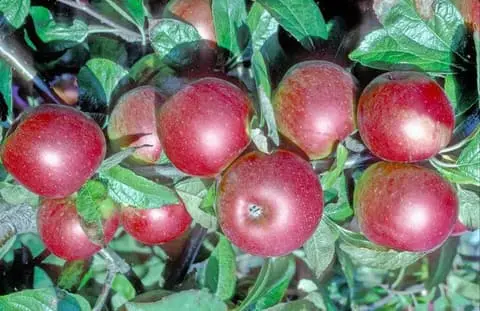
Abbondanza
-
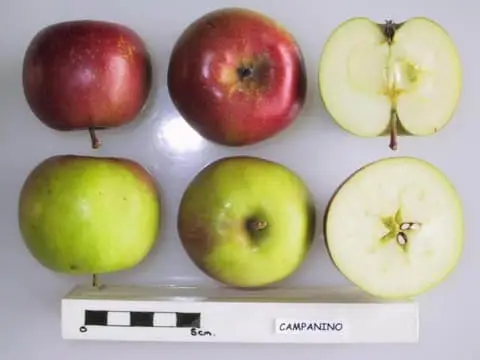
Campanino
-
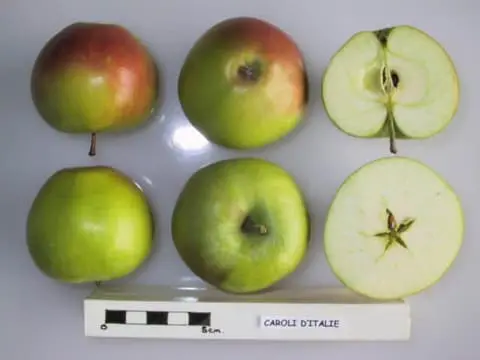
Caroli d'Italie
-
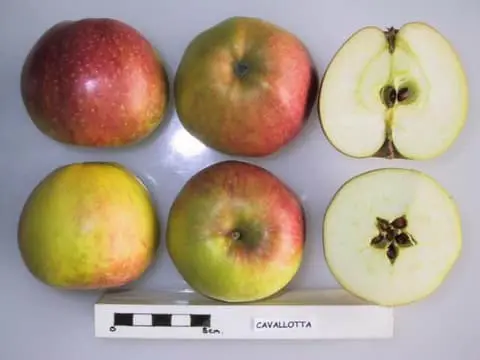
Cavallotta
-
Ciodo
-
Civni
Bred near Ferrara from a 1988 cross of Gala and Elstar; a late-summer apple run by its breeder, CIV, as a club variety
-
Cola
-
Cola Gelata