Antonovka
Central Russia's old folk apple, prized for its scent and hardiness; DNA shows Schmidt's Antonovka is the same variety
History
Antonovka is an old Russian apple of unknown parentage, a product of folk selection1,3. The National Fruit Collection says that it arose in Kursk and was recorded in 18262. VNIISPK, the fruit-breeding institute at Orel, says that it still holds a leading place among the apples of central Russia and Belarus; it entered the Russian State Register in 19471,3. VNIISPK lists it as Антоновка Обыкновенная, Common Antonovka, and central Russia also grows Antonovka Sladkaya and other Antonovkas1,3. In 1886 T. H. Hoskins described it as “the leading market apple in Russian cities”, planted in immense orchards and known as “the king apple of the steppes”5.
Offspring of Schmidt’s Antonovka were widely used in Western breeding as a source of scab resistance, but its identity was obscure. In 2014 Pikunova and colleagues showed with SSR and SNP markers that it is Common Antonovka, which Russian breeders have used widely in breeding for biotic and abiotic stresses3. SNP data confirm Antonovka as a parent of Konsta, with Lobo, and point to it as a parent of Juuso and Zimnaya Krasavica4.
The fruit
The fruit is of medium size or a little larger, round, slightly flattened and ribbed1. It is greenish yellow when picked and turns yellow in store, with no blush or only a faint one, and russet in the stalk cavity1. The yellowish flesh is juicy and sweet-sour, with a slight excess of acid: 9.22 per cent sugars and 1.0 per cent acids1. Ripe fruit has a very strong, attractive scent, to which VNIISPK credits its popularity1. The National Fruit Collection describes crisp, juicy flesh with an acid flavour that cooks well2.
North of a line through Bryansk, Orel, Lipetsk and Michurinsk it counts as a winter apple and south of it as a late-autumn one1. It is usually picked in mid-September and keeps for up to 90 days1. At the National Fruit Collection it is picked in early September2.
Growing
The tree is vigorous and grows large1. It begins to bear in its seventh or eighth year after budding, regularly at first and later in alternate years1. Average yields reach 20 tonnes a hectare, and single trees have given over 500 and even 1,000 kilograms1. Its winter hardiness matches that of the hardiest domestic apples, and it is fairly resistant to disease, scab rising to a moderate level only in years of severe epidemics1.
Uses
Antonovka is eaten fresh and made into juice, compote, jam, pastila and marmalade, and VNIISPK singles it out as especially good for soaking, мочение1.
Where the sources disagree
- Origin and date. The National Fruit Collection says Antonovka arose in Kursk and was recorded in 18262; Pikunova and colleagues call it a cultivar “of unknown origin”3, and Muranty and colleagues date it to 18484.
- Worth. VNIISPK praises a hardy, heavy-cropping apple whose scent made it exceptionally popular1. Judged in New York and England, it was “a Russian fruit of no practical value for this state” to Beach6, and to Bunyard “hardly worthy of retention”, with flesh “rather dry”7.
Family tree
Offspring in the atlas
- Antonovka Grammovaya 600 Belarus, 1888
- Pobeda Chernenko × Pepin Londondski; Russia, by 1953
- Slavyanka × Ananas Reinette; Russia, 1899
Sources
- Apple: Antonovka Obyknovennaya (in Russian), All-Russian Research Institute of Fruit Crop Breeding (VNIISPK), Orel, variety catalogue. Supports: the name Антоновка Обыкновенная; an early-winter variety of unestablished parentage created by folk selection, which still holds a leading place in the apple assortment of central Russia and Belarus, and is also recommended for parts of northern Ukraine and the Volga region; entered in the Russian State Register in 1947; other Antonovkas of central Russia (Sladkaya, Belaya, Polutorafuntovaya); a vigorous, large tree; fruit of medium or above-medium size, round and slightly flattened, ribbed, greenish yellow when picked and yellow in store, without blush or with a faint one, russeted in the stalk cavity; flesh yellowish, juicy, sweet-sour "with some excess of acid"; a very strong, attractive scent behind its exceptional popularity; 9.22% sugars and 1.0% acids; a winter apple north of the Bryansk–Orel–Lipetsk–Michurinsk line and a late-autumn one south of it; usually picked in mid-September; keeps up to 90 days; eaten fresh and made into juice, compote, jam, pastila and marmalade, and especially valued for soaking; bears from the seventh or eighth year after budding, regularly at first and then periodically; average yields up to 20 t/ha, and single trees over 500 and even 1,000 kg; winter hardiness on a level with the hardiest domestic apples; fairly resistant to disease, scab rising to medium only in years of severe epidemics.
- Antonovka (accession 1948-666), National Fruit Collection, Brogdale, Kent (Defra). Supports: "A Russian variety which arose in Kursk. Recorded in 1826"; crisp, juicy fruit with an acid flavour that cooks well; synonyms including Antonovka obyknovennaya, Antonowka, Antonovskoe yabloko, King of the Steppe and Possart's Nalivia; large, broad globose-conical fruit with prominent ribs; picked in early September.
- 'Schmidt's Antonovka' is identical to 'Common Antonovka', an apple cultivar widely used in Russia in breeding for biotic and abiotic stresses, A. Pikunova and others, Tree Genetics & Genomes 10: 261–271 (abstract), 2014. Supports: progenies of Schmidt's Antonovka widely used in Western breeding as a source of scab resistance; its identity obscure because of a series of Antonovka cultivars of different origins; shown by SSR and SNP data to be identical to Common Antonovka, "an old Russian cultivar of unknown origin", held at VNIISPK in Orel; Common Antonovka widely used in Russia in breeding for biotic and abiotic stresses.
- Using whole-genome SNP data to reconstruct a large multi-generation pedigree in apple germplasm, H. Muranty and others, BMC Plant Biology 20: 2, with Additional files 1 and 3, 2020. Supports: Antonovka Obyknovennaja diploid (2n) and dated 1848 (Table S1); confirmed as a parent of Konsta with Lobo, and inferred as a parent of Juuso (with Lobo) and of Zimnaya Krasavica (with Delicious) (Table S3).
- The Iron-Clad Tree Fruits, pp. 19–20, in Agriculture of Maine: Twenty-ninth Annual Report of the Secretary of the Maine Board of Agriculture, T. H. Hoskins, Maine Board of Agriculture (Sprague & Son, Augusta); Maine State Law and Legislative Reference Library, 1886. Supports: Antonovka "the leading market apple in Russian cities", called "the king apple of the steppes"; immense orchards of it planted, very productive, quality "only fair".
- The Apples of New York, vol. II, p. 6: Antonovka, S. A. Beach, New York Agricultural Experiment Station, Internet Archive, 1905. Supports: "A Russian fruit of no practical value for this state".
- A Handbook of Hardy Fruits, vol. I, p. 17: Antonowka, E. A. Bunyard, John Murray, Internet Archive, 1920. Supports: flesh "white, loose grained, rather dry, aromatic"; "a very popular central Russian variety"; "hardly worthy of retention" and "best described as a late edition of White Transparent".
More from Russia
-
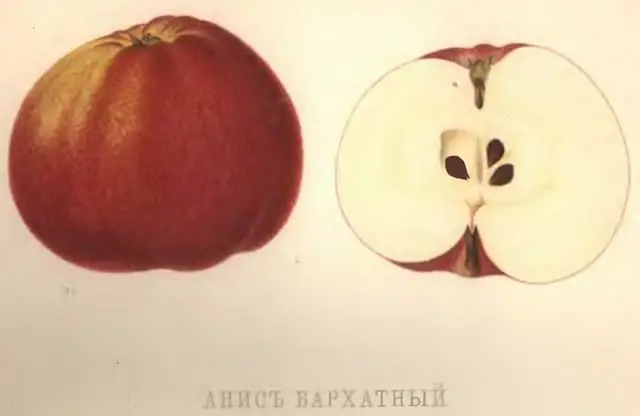
Anis
An old Volga folk apple whose clones bear small, bloom-dusted red fruit; Anis Polosaty has an anise-like scent
-
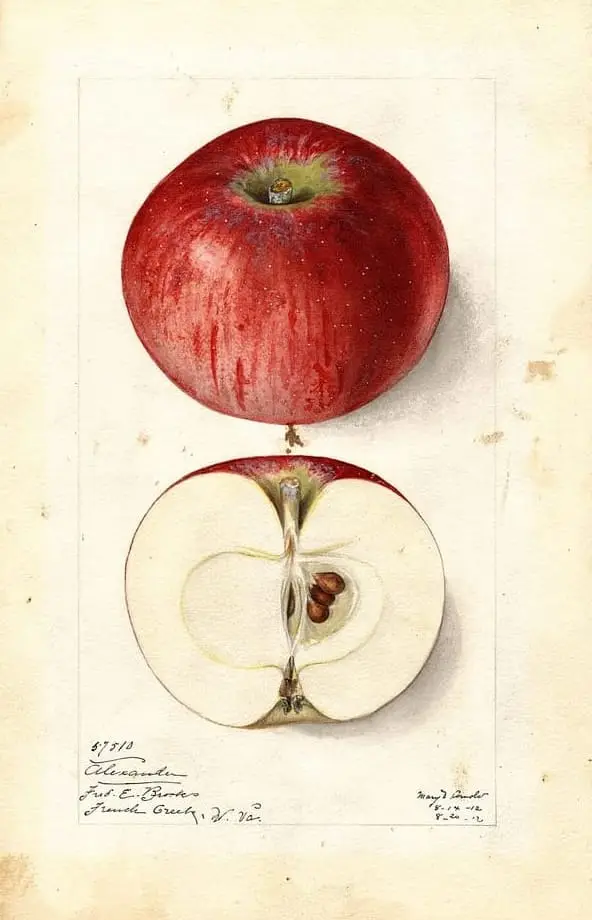
Aport
An old Russian apple, known in the West as Alexander, that became the celebrated Aport of Almaty after 1865
-
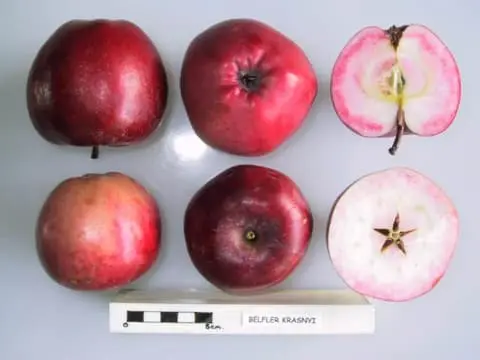
Bellefleur Krasny
-
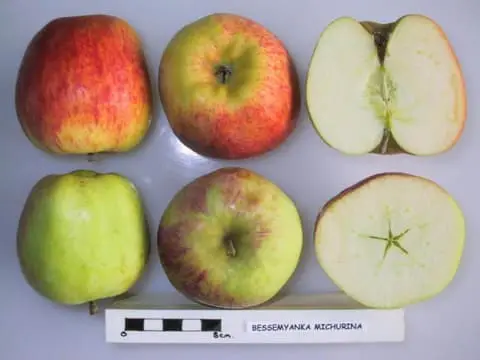
Bessemyanka Michurina
-
Byeloborodovka
-
d'Eylau
-
Dolgo
A Siberian crab brought from Russia to South Dakota in 1897 and introduced in 1917 for its ruby-red jelly
-
Duchess of Oldenburg
Borovinka at home; its hardiness in prairie test winters led Americans to import more Russian apples