Dolgo
A Siberian crab brought from Russia to South Dakota in 1897 and introduced in 1917 for its ruby-red jelly
History
Dolgo is a crab apple that the horticulturist N. E. Hansen brought to South Dakota from Russia in 1897; his station at Brookings, the South Dakota Agricultural Experiment Station, introduced it in 1917 as “a new red-jellied Siberian crab”1,2. The station listed it among its seedlings of the Siberian crab apple, Malus baccata1. A bulletin of 1958 records that the seed which gave Dolgo and its near twin, Alexis, was collected in 1897 near St Petersburg (the bulletin’s Leningrad)2,1; Hansen himself wrote in 1929 that Dolgo was a direct importation from Russia whose pedigree was not known3. The Secrest Arboretum of the Ohio State University derives the name from the Russian долго, which it translates as “long”, for the shape of the fruit, or “a long while”4.
Visitors to the station’s exhibits at the South Dakota State Fair, Hansen wrote, often asked about its “remarkably long conical, intensely bright red crabs”1. In 1924, in answer to repeated requests, the station sent out seedlings of Dolgo and other named Siberian crabs1. By 1958 more commercial nurseries listed Dolgo than Alexis, from which it is almost impossible to tell apart2.
The fruit
The fruit is long and conical, about 2.5 to 3 cm across, and brilliant red all over1,2. Hansen found it “full of juice”1. At Brookings it ripened in September and dropped freely2.
Growing
Hansen described a vigorous, productive tree, early and heavy in bearing and “thus far free from blight”, and young trees with wide forks and strong limbs unlikely to split1. In the station’s collection in the 1950s it was among the hardiest plants; it began to bear very young, its alternate bearing was very noticeable, and it showed “remarkable resistance to blight and scab”2. It has also been rated “Superior” for resistance to scab in evaluations by the International Ornamental Crabapple Society, with fewer than 5 per cent of leaves affected4. Dolgo is diploid5.
Uses
Hansen introduced Dolgo as a jelly crab, writing that the fruit “jells easily” into “a rich, ruby-red jelly”1, and the 1958 bulletin counts it among the best crabs for jelly making2. It is also an ornamental, with white flowers and, in late summer and autumn, a tree laden with red fruit2,4. Its seedlings make good rootstocks, though their wood is so hard that grafting is difficult2; the Secrest Arboretum also values it as a rootstock and recommends the fruit for cider and apple butter4.
Where the sources disagree
- How it came to South Dakota. Hansen wrote that it was brought over from Russia in 1897 and was a direct importation1,3; the 1958 bulletin says it grew from seed collected near Leningrad that year2; the Secrest Arboretum, from seed gathered at the Imperial Botanical Gardens in St Petersburg4.
- Its species. The South Dakota station counted it a Siberian crab, Malus baccata1,2. In 1929 Hansen discussed it among crosses of the Siberian crab with the orchard apple and called its pedigree unknown3. The Secrest Arboretum calls it a seedling of Malus × robusta, a hybrid of the Siberian crab and the plumleaf crab, Malus prunifolia4.
- Size and season. The 1958 bulletin’s text gives the fruit as about 2.5 cm (1 inch) across and ripe in early September; its table, about 3 cm (1¼ inches) and mature on 15 September2.
Sources
- Plant Introductions (1895–1927), Bulletin 224, pp. 6, 7 and 11: Dolgo Crabapple, N. E. Hansen, Agricultural Experiment Station, South Dakota State College, Brookings; Open PRAIRIE, South Dakota State University, 1927-05. Supports: Dolgo "Introduced 1917" as "A new red-jellied Siberian crab"; the "remarkably long conical, intensely bright red crabs" asked about at the department's exhibits at the South Dakota State Fair; "one brought over from Russia in 1897"; a vigorous, productive tree "thus far free from blight"; fruit "full of juice" that "jells easily" into "a rich, ruby-red jelly"; nursery trees with wide-spreading forks and strongly shouldered limbs, unlikely to split; winning favour for its freedom from blight and its early and heavy bearing (p. 11); listed among the station's "Siberian Crab seedlings" with Alexis, Amur, Ivan, Beauty and Nocalyx (p. 7); seedlings of Dolgo and other named Siberian crabs distributed on repeated request in 1924 (p. 6); N. E. Hansen, horticulturist, and the department's work at Brookings; Alexis from seed from the Imperial Botanic Gardens at "St. Petersburg, now Leningrad".
- Preliminary Evaluation and Description of Domestic and Introduced Fruit Plants, Bulletin 471, pp. 10–11, 13 and 16–17: Alexis and Dolgo, S. A. McCrory, Agricultural Experiment Station, South Dakota State College, Brookings (North Central Regional Publication 90); Open PRAIRIE, South Dakota State University, 1958-06. Supports: "Dolgo-M. baccata", from the same source as Alexis and introduced in 1917; the lot of seed that "produced Alexis and Dolgo" collected near Leningrad, Russia, in 1897 by N. E. Hansen (p. 13); one of the most winter-hardy plants in the collection; fruit long conic, "about 1 inch in diameter", skin brilliant red, the fruit-laden tree attractive in the fall; one of the best crabs for jelly making; ripening in early September and dropping freely; alternate bearing "very noticeable"; bearing at a very young age; "remarkable resistance to blight and scab"; almost impossible to tell from Alexis, though listed by more commercial nurseries; strong, well-spaced scaffold branches and a very vigorous tree; "Seedlings make good root stocks, but the wood is very hard making grafting a problem"; an ornamental plant (pp. 16–17); in Table 2 no fire blight or scab observed, in Table 3 mature on 9-15, 1¼ inches and red all over (pp. 10–11).
- Experiments in Plant Heredity, Bulletin 237, p. 4, N. E. Hansen, Agricultural Experiment Station, South Dakota State College, Brookings; Open PRAIRIE, South Dakota State University, 1929-04. Supports: under "Pyrus baccata x P. Malus": "Some of the best crabs, like my Dolgo, are direct importations from Russia. The pedigree is not known."; Alexis, "very similar in every respect to Dolgo", grown from seed of Pyrus baccata from the Botanical Garden at Leningrad.
- A Long While: An Ode to our Venerable Dolgo, Alexander Lavrisha, Secrest Arboretum newsletter (Fall 2024), The Ohio State University, 2024. Supports: a "Superior" rating for apple scab ("less than 5% of leaves affected and no aesthetic impact") in evaluations by the International Ornamental Crabapple Society; cold-hardy, valuable on its own and as a rootstock; white flowers; most conspicuous in late summer for its heavy crop; "a first-rate choice for cider and a very fine choice for apple butter"; seed of Malus × robusta, a hybrid of Malus baccata and Malus prunifolia, collected by N. E. Hansen at the Imperial Botanical Gardens in St Petersburg, 1897, and the variety introduced twenty years later; the name from the Russian Долго, translated "long" (of the fruit) or "a long while".
- Ploidy determination, Malus (study MALUS.PLOIDYDETERMINATION.2008), USDA Agricultural Research Service, GRIN-Global, 2008. Supports: Dolgo (PI 588870) diploid (2x), by flow cytometry.
More from Russia
-
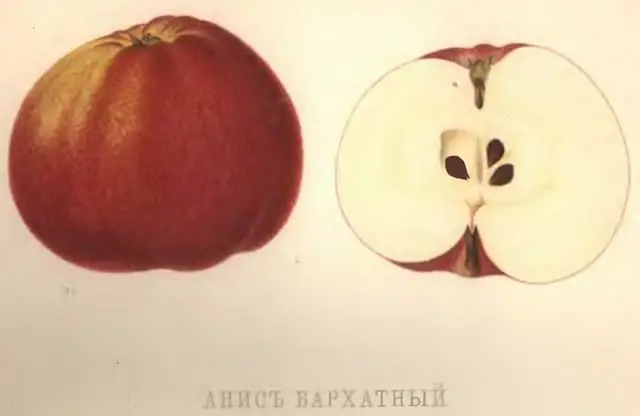
Anis
An old Volga folk apple whose clones bear small, bloom-dusted red fruit; Anis Polosaty has an anise-like scent
-
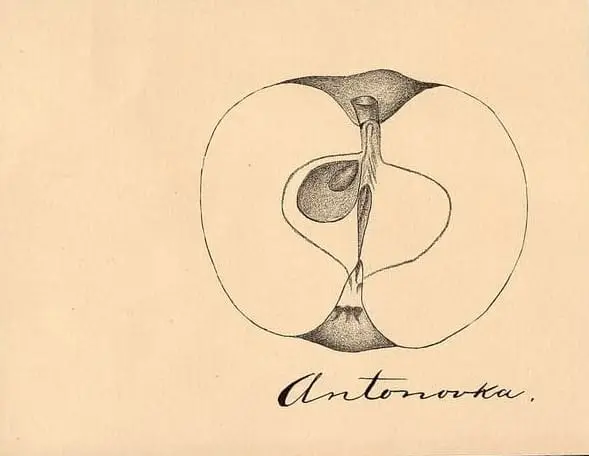
Antonovka
Central Russia's old folk apple, prized for its scent and hardiness; DNA shows Schmidt's Antonovka is the same variety
-
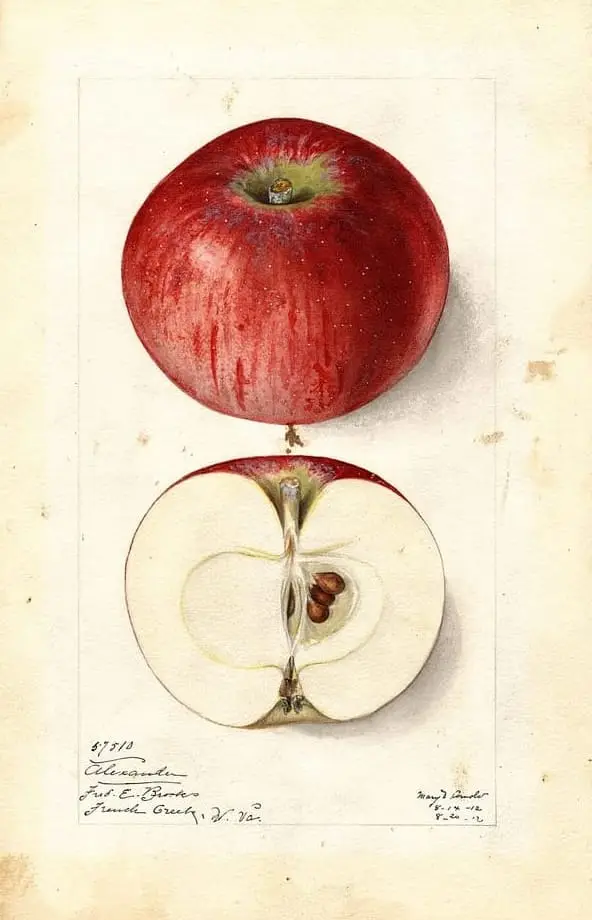
Aport
An old Russian apple, known in the West as Alexander, that became the celebrated Aport of Almaty after 1865
-
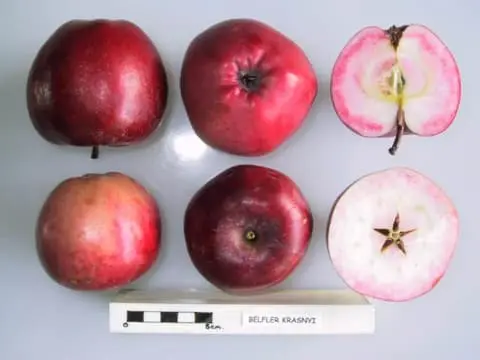
Bellefleur Krasny
-
Bessemyanka Michurina
-
Byeloborodovka
-
d'Eylau
-
Duchess of Oldenburg
Borovinka at home; its hardiness in prairie test winters led Americans to import more Russian apples