Duchess of Oldenburg
Borovinka at home; its hardiness in prairie test winters led Americans to import more Russian apples
History
Duchess of Oldenburg is an old Russian apple of folk selection whose parents are unknown; in Russia it is called Borovinka (Боровинка), a name once taken to mean an apple grown in a pine forest, a бор1. It was known in Russia in the 1700s or earlier2. Citing M. V. Rytov, VNIISPK says that it was famous in western Europe and North America from the end of the eighteenth century under several names1; European nurseries propagated it as Charlamowsky and Borowitsky3. An old account quoted by VNIISPK called it one of the commonest apples of central Russia, but said that in Oryol and Tambov provinces it was little esteemed, being worth much less than Antonovka, and was used only fresh1. Hardy and adaptable, it is now grown across Russia from north to south and is in the State Register for ten regions, from the Northern to the East Siberian1.
The National Fruit Collection says it was first known in Britain about 18172. About 1835 the Massachusetts Horticultural Society imported it from the London Horticultural Society, with Alexander, Tetofsky and Red Astrachan, and Robert Manning described it at Salem in 18383. Its hardiness in the early test winters of the prairies “kept up the hopes of prairie orchardists” and led to more imports from Russia3. In 1886 T. H. Hoskins wrote that it stood −40 °C (40° below zero Fahrenheit) unharmed, and that an exceptionally cold Minnesota winter had killed every tree in many young orchards except the Duchess6.
VNIISPK counts 19 varieties bred from it, among them Zhigulevskoe, from Borovinka and Wagner1, a parentage that SNP data support7. Larsen and colleagues’ SNP data also make it a parent of Wealthy, with Jonathan, and of Transparente de Croncels, with Calville Blanc d’Hiver8.
The fruit
The fruit is medium to large and roundish oblate, pale yellow almost covered with splashes and stripes of bright red mottled with crimson3. The flesh is tinged yellow, rather firm, crisp, juicy, sprightly and aromatic; Beach rated it good to very good for cooking but too acid for a good dessert apple3. VNIISPK finds it somewhat coarse and sour-sweet, with the acid noticeably prevailing: 9.9 per cent sugars and 0.62 per cent acids1.
In New York it ripened over several pickings in late August and September3. It is picked in mid-August at the National Fruit Collection2 and ripens in mid-August in the lower Volga, where the fruit weighs 78–113 g; in central Russia it is an autumn apple1.
Growing
The tree begins to bear in its fifth or sixth year and gives 60–80 kg at ten years and 150–200 kg at 25–30, but crops in sharply alternate years1. It is highly winter-hardy and fairly resistant to disease, but tolerates drought poorly and then drops much of its fruit1.
Uses
In the West it was valued above all for cooking3. In Russia it is mostly eaten fresh, and it suits drying and juice1.
Where the sources disagree
- Arrival in England. About 1817, according to the National Fruit Collection2; about twenty years before 1835, according to Beach3; 1824, according to Bunyard5.
- Borovinka. VNIISPK, the National Fruit Collection, Bunyard and Muranty treat Borovinka or Borowitsky as this apple1,2,5,7. Beach found the Borovinka that Budd sent to his station in 1890 distinct from Oldenburg, though Hansen thought the question unsettled4, and Hoskins called Borovinka “a late Duchess”6.
- The name. VNIISPK says Duchess of Oldenburg was named in America1; Beach’s references show the name in the London Horticultural Society’s catalogue of 18313.
- Keeping. Beach found the fruit quite perishable3; VNIISPK calls it transportable and a comparatively good keeper1.
Family tree
Offspring in the atlas
- Bessemyanka Michurina × Aport; Russia, 1912
- Cleeve × Cox's Orange Pippin; United Kingdom, before 1930
- Crimson Beauty (Canada) × Fameuse; Canada, about 1880
- Hazen × Starking; United States, by 1980
- Helios Germany, by 1969
- Joyce × McIntosh; Canada, 1898
- Mandan × Starking; United States, by 1965
- Pewaukee × Northern Spy; United States, by 1870
- Rewena × Cox's Orange Pippin; Germany, by 1991
- Transparente de Croncels × Calville Blanc d'Hiver; France, by 1869
- Wealthy × Jonathan; United States, about 1860
36 varieties in the atlas descend from Duchess of Oldenburg.
Sources
- Apple: Borovinka (in Russian), All-Russian Research Institute of Fruit Crop Breeding (VNIISPK), Orel, variety catalogue. Supports: the name Боровинка; an old Russian autumn variety of folk selection whose pedigree is not established; known, after M. V. Rytov, in western Europe and North America from the end of the 18th century under several names, Duchess of Oldenburg among them ("named in America"); the name once supposed to mean an apple grown in a pine forest (бор); an old account by Rytov, after Lodygin: one of the commonest apples of central Russia, little esteemed in Oryol and Tambov provinces, not comparable with Antonovka in taste or keeping, much cheaper, and used only fresh; now widespread in central Russia and in the south, and in the State Register for ten regions from the Northern to the East Siberian; fruit medium or above, regular, smooth, light green or yellow with a speckled, striped blush; flesh yellowish, juicy, somewhat coarse, sour-sweet with acid noticeably prevailing; 9.9% sugars and 0.62% acids; an autumn apple in the middle zone and a summer one in the south, ripening in mid-August in the lower Volga, where fruit weighs 78–113 g; transportable and comparatively good keepers; eaten fresh, suitable for drying and juice; bears from the fifth or sixth year, 60–80 kg a tree at ten years and 150–200 kg at 25–30; sharply biennial; high winter hardiness, productivity and adaptability, for which it is grown across Russia from north to south; poor drought tolerance with heavy fruit drop; fairly resistant to disease; 19 varieties bred from it, including Zhigulevskoe (Borovinka × Wagner).
- Duchess of Oldenburg (accession 1957-190), National Fruit Collection, Brogdale, Kent (Defra). Supports: "Known in Russia in the 1700s or earlier but first known in the UK in about 1817"; firm, juicy flesh with a subacid, fair flavour; synonyms including Borovinka, Borowitsky, Charlamowsky, Duchess, Oldenburg and Duchesse d'Oldenbourg; flat-globose fruit, 71 mm wide and 58 mm high, whitish yellow with an orange striped over colour; picked in mid-August; mother of Pewaukee and Zhigulevskoe.
- The Apples of New York, vol. II, pp. 150–153: Oldenburg, S. A. Beach, New York Agricultural Experiment Station, Internet Archive, 1905. Supports: the name Duchess of Oldenburgh in the London Horticultural Society's catalogue of 1831; propagated in European nurseries as Charlamowsky and Borowitsky; one of four pioneer Russian apples in America, imported with Alexander, Tetofsky and Red Astrachan by the Massachusetts Horticultural Society from the London Horticultural Society about 1835, and brought to England about twenty years earlier; Robert Manning's description at Salem in 1838; its hardiness in the early test winters "kept up the hopes of prairie orchardists" and led to more imports from Russia; fruit medium to large, roundish oblate, pale yellow almost covered with splashes and stripes of bright red mottled with crimson; flesh tinged yellow, rather firm, crisp, tender, juicy, sprightly subacid, aromatic, good to very good for cooking but too acid for a good dessert apple; valued for its excellent culinary qualities; season late August and September, several pickings; quite perishable.
- The Apples of New York, vol. II, p. 24: Borovinka, S. A. Beach, New York Agricultural Experiment Station, Internet Archive, 1905. Supports: Borovinka so like Oldenburg that Hansen thought their identity unsettled; as fruited at Beach's station from stock sent by J. L. Budd in 1890 it was distinct from Oldenburg, less uniform in size and not equal to it in flavour.
- A Handbook of Hardy Fruits, vol. I, p. 48: Duchess of Oldenburg, E. A. Bunyard, John Murray, Internet Archive, 1920. Supports: the names Borovitsky, Charlamovski and Borowinka; "Origin, Russian. Introduced into England in 1824"; palest yellow with strong red stripes.
- The Iron-Clad Tree Fruits, pp. 14–18, in Agriculture of Maine: Twenty-ninth Annual Report of the Secretary of the Maine Board of Agriculture, T. H. Hoskins, Maine Board of Agriculture (Sprague & Son, Augusta); Maine State Law and Legislative Reference Library, 1886. Supports: "the Duchess stands 40° below without harm"; an exceptionally cold winter in Minnesota destroyed every tree in many young orchards "with the exception of the Duchess"; "Borovinka, a late Duchess".
- Using whole-genome SNP data to reconstruct a large multi-generation pedigree in apple germplasm, H. Muranty and others, BMC Plant Biology 20: 2, with Additional files 1 and 3, 2020. Supports: Borowitzky, Charlamowsky and Duchess of Oldenburg synonyms; Borowitsky diploid (2n) and dated to the 1700s (Table S1); Zhigulevskoe, documented as Duchess of Oldenburg × Wagner's prize-winning, found by SNP data to be Wagener × Borowitsky (Table S3).
- Cultivar fingerprinting and SNP-based pedigree reconstruction in Danish heritage apple cultivars utilizing genotypic data from multiple germplasm collections in the world, B. Larsen and others, Genetic Resources and Crop Evolution 72: 2397, supplementary Table S5, 2025. Supports: SNP-confirmed parents Jonathan and Duchess of Oldenburg for Wealthy, and Calville Blanc d'Hiver and Duchess of Oldenburg for Transparente de Croncels; Duchess of Oldenburg diploid.
More from Russia
-
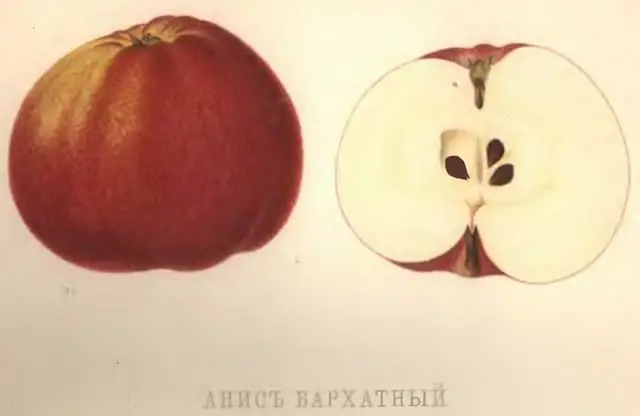
Anis
An old Volga folk apple whose clones bear small, bloom-dusted red fruit; Anis Polosaty has an anise-like scent
-
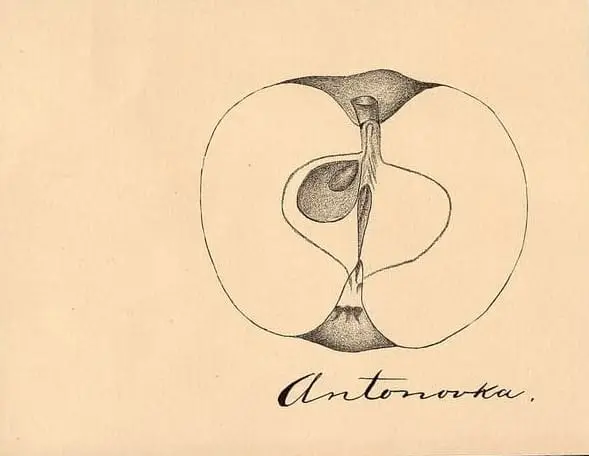
Antonovka
Central Russia's old folk apple, prized for its scent and hardiness; DNA shows Schmidt's Antonovka is the same variety
-
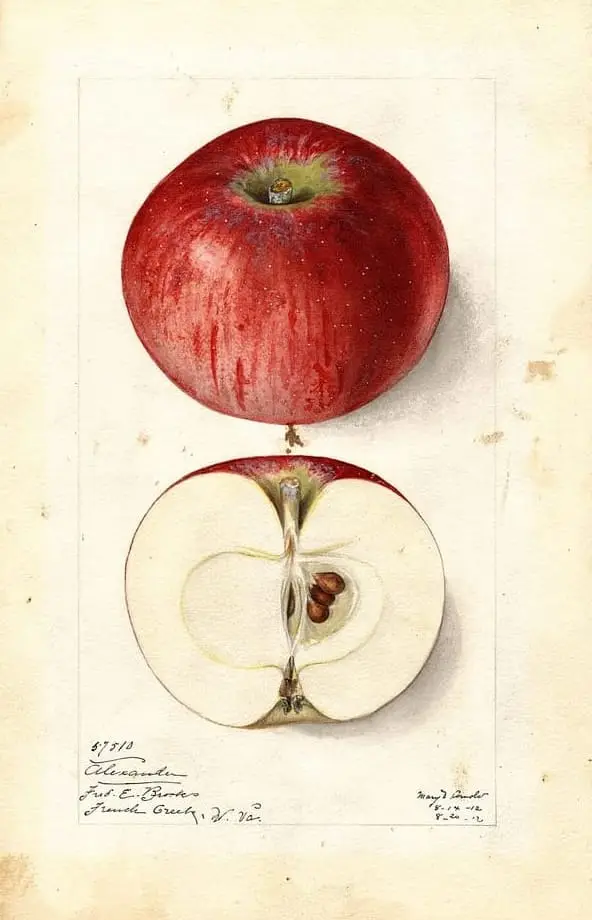
Aport
An old Russian apple, known in the West as Alexander, that became the celebrated Aport of Almaty after 1865
-
Bellefleur Krasny
-
Bessemyanka Michurina
-
Byeloborodovka
-
d'Eylau
-
Dolgo
A Siberian crab brought from Russia to South Dakota in 1897 and introduced in 1917 for its ruby-red jelly