Aport
An old Russian apple, known in the West as Alexander, that became the celebrated Aport of Almaty after 1865
History
Aport, or Aport Alexander, is the apple known in the West as Alexander or Emperor Alexander1,2,5. It arose in the late eighteenth century, in the Moscow region according to Muranty and colleagues1. In 1817 Mr Lee, a Hammersmith nurseryman, introduced it to England, showing the London Horticultural Society a fruit “five inches and a half in diameter” that weighed “nineteen ounces”, about 14 cm and 540 g3. SNP data make it a major founder of European apples, with more than 100 descendants, Peasgood’s Nonsuch and Wolf River among them1.
In 1865 Yegor Redko, a gardener who had moved from Ostrogozhsk district in Voronezh province, brought a few Aport saplings to Verny, now Almaty7. Undistinguished at home, at Verny it bore large blood-red fruit, and Redko gave cuttings to anyone who asked7. The Verny horticultural school and N. T. Moiseev’s orchard, which supplied over 100,000 young trees a year, spread it across south-eastern Kazakhstan7. From the late nineteenth century the region was known for Aport and related apples; the city’s own name comes from alma, Kazakh for apple5. In a 2022 SNP study it stood at the base of a group of Kazakh cultivars, Saltanat and Talgar among them, that lies closest of the domestic apples to the wild Malus sieversii5.
By 2022, after the economic shocks of the 1990s, the Aport of Almaty, “the most famous cultivar from Kazakhstan”, had “essentially ceased to exist in its unique form”5. Building on the old orchards, more productive varieties that keep and travel better, and disease have all reduced it7. In autumn 2023 the Almaty Aport became a geographical indication for two varieties, Aport Alexander and кроваво-красный Апорт, blood-red Aport7. A state programme for 2024–2028 began by collecting seed of the wild Sievers apple7,8; by August 2026 a 10-hectare nursery was raising young trees, and about 500 million tenge had been set aside8.
The fruit
Beach describes a very large, roundish conic fruit, pale yellow deepening to orange, often overspread with red or striped with bright carmine; the flesh is nearly white, firm, coarse, juicy and mild subacid, better for cooking than for dessert4. In New York it kept in cold store until November4. At the National Fruit Collection, where it is picked in mid-September, it measures 100 mm across, with flesh “firm, rather coarse, dry, acid”2. Almaty’s Aport growers’ association gives an average weight of 250–400 g, some reaching 900 g, and prizes its aroma and crunch7.
Growing
Around Almaty good fruit comes only from orchards between 850 and 1,250 metres above sea level, and the tree first crops in its eighth or ninth year7,8. Beach found the tree hardy, vigorous and moderately productive, but the fruit apt to crack and to drop early4.
Where the sources disagree
- Origin. Muranty and colleagues place it in the Moscow region1; the National Fruit Collection thinks it Ukrainian2.
- Arrival in England. 1805 by the National Fruit Collection’s record2; 1817 according to Hogg and Beach3,4.
- One apple or several. The National Fruit Collection, Muranty and Gritsenko treat Aport as Alexander1,2,5; Beach used the name for a group of Russian apples as well as for one variety very like Alexander4. The geographical indication covers two varieties7, and in a study of Kazakh varieties three samples of Alexander Aport proved to be hybrids of Aport and an unknown variety6.
- How much is left. In December 2024 the Ministry of Agriculture counted 2,500 hectares of Aport and about 416,000 trees in the Almaty and Zhetysu regions; the Almaty Region’s agriculture department said its Aport orchards had fallen from 1,071 to 446 hectares7.
Family tree
Offspring in the atlas
- Adersleber Calville × Calville Blanc d'Hiver; Germany, about 1870
- Belle de Pontoise France, 1869
- Bessemyanka Michurina × Duchess of Oldenburg; Russia, 1912
- Bushey Grove × Dumelow's Seedling; United Kingdom, 1897
- Gascoyne's Scarlet × Cornish Aromatic; United Kingdom, by 1871
- Geheimrat Doktor Oldenburg × Ananas Reinette; Germany, 1897
- George Neal × Fearn's Pippin; United Kingdom, 1904
- Jeanne Hardy France, 1878
- Lady Isabel × Sturmer Pippin; United Kingdom, 1939
- Lundbytorp × Pigeon Ildrød; Denmark, by 1913
- Maidstone Favourite × Beauty of Bath; United Kingdom, by 1913
- Mother × Hawthornden; United States, by 1844
- Peasgood's Nonsuch × Golden Noble; United Kingdom, about 1858
- Prinz Albrecht von Preussen Germany, 1865
- Queen × Hawthornden; United Kingdom, 1858
- Signe Tillisch × London Pippin; Denmark, 1866
- Williams Favourite × Hawthornden; United States, about 1750
- Wolf River United States, before 1875
58 varieties in the atlas descend from Aport.
Sources
- Using whole-genome SNP data to reconstruct a large multi-generation pedigree in apple germplasm, H. Muranty and others, BMC Plant Biology 20: 2, with Additional file 1, 2020. Supports: the Russian cultivar Alexander, synonyms Aport or Aporta, which "originated in the late eighteenth century in the region of Moscow"; one of the major founders of the pedigree, with more than 100 inferred offspring, among them Peasgood's Nonsuch in Britain and Wolf River in Wisconsin; Alexander diploid (2n, Table S1).
- Alexander (accession 1999-072), National Fruit Collection, Brogdale, Kent (Defra). Supports: "Thought to be Ukrainian. Known in the 1700s. Introduced to the UK in 1805"; fruit with "firm, rather coarse, dry, acid flesh with very little flavour"; synonyms including Aport, Aport Aleksandr, Aport Alexander, Aporta, Emperor Alexander, Kaiser Alexander and Grand Alexandre; large, conical fruit, 100 mm wide and 75 mm high, red over yellow; picked in mid-September.
- The Fruit Manual, 5th ed., p. 72: Emperor Alexander, Robert Hogg, Journal of Horticulture Office, Internet Archive, 1884. Supports: the names Aporta and Russian Emperor; introduced to England by Mr Lee, nurseryman, of Hammersmith, in 1817, and exhibited at the London Horticultural Society, the specimen "five inches and a half in diameter" and "weighing nineteen ounces"; more adapted for culinary than dessert use.
- The Apples of New York, vol. II, pp. 3–6: Alexander; Aport, S. A. Beach, New York Agricultural Experiment Station, Internet Archive, 1905. Supports: Alexander "a typical representative" of the Russian apples known as the Aport group; Aport "applied to a pretty well defined group of Russian apples", and also to a particular Russian variety closely resembling Alexander; introduced into England from Russia in 1817; fruit very large, roundish conic, greenish or pale yellow deepening to orange-yellow, often overspread with red or striped with bright carmine; flesh nearly white, firm, coarse, moderately crisp, juicy, mild subacid, "medium to good" in quality, better for culinary than dessert use; apt to crack and to drop early; may be held in cold storage until November; tree hardy, vigorous and moderately productive.
- Apple varieties from Kazakhstan and their relation to foreign cultivars assessed with RosBREED 10K SNP array, D. Gritsenko and others, European Journal of Horticultural Science 87 (1), ISHS, 2022. Supports: Almaty and Alma-Ata derived from the Kazakh word for apple, "alma"; the Almaty region known since the late 19th and early 20th century for Aport and related cultivars; after the economic crises of the 1990s, "the most famous cultivar from Kazakhstan, 'Aport of Almaty', has essentially ceased to exist in its unique form", its descendants of much lower quality; Alexander given as a synonym of Aport and Aport Alexander; Aport at the base of a distinct group of Kazakh cultivars (Saltanat, Zailiyskoe, Kazakh Jubilee, Talgar, Rubin), the sub-cluster closest to Malus sieversii.
- SSR genotyping of Kazakhstani apple varieties: identification of alleles associated with resistance to highly destructive pathogens, M. Y. Omasheva and others, Eurasian Journal of Applied Biotechnology, no. 2 (abstract), 2016. Supports: molecular passports for 31 Kazakh apple varieties; "Three samples of the Alexander Aport apple" identified as hybrids of the Aport variety and an unknown variety.
- What became of the legendary Almaty Aport (in Russian), Kazinform (Kazakhstan's national news agency), 2024-12-14. Supports: in 1865 the gardener Yegor Redko, who had moved from Ostrogozhsk district of Voronezh province, brought Aport saplings to Verny (now Almaty), where the variety, unremarkable at home, bore large blood-red fruit; Redko gave cuttings away and it spread through the region; the Verny horticultural school and N. T. Moiseev's large private orchard, supplying over 100,000 saplings a year, spread it across south-east Kazakhstan; fruit averaging 250–400 g, some up to 900 g, noted for aroma and crunch (Association of Almaty Aport Producers); good fruit only at 850–1,250 m; first crop in the eighth or ninth year; decline through building on the orchards, more productive varieties that keep and travel better (Aport does not keep long), and susceptibility to disease; the Ministry of Agriculture's figure of 2,500 ha and about 416,000 trees in the Almaty and Zhetysu regions, and the Almaty Region agriculture department's figure of a fall from 1,071 to 446 ha; a revival programme for 2024–2028, beginning with seed of the Sievers apple collected in 2024; registration in the previous autumn as a geographical indication for the varieties Апорт Александр and кроваво-красный Апорт.
- Kazakhstan expands efforts to revive iconic Aport apple, Fatima Kemelova, The Astana Times, 2026-08-08. Supports: trees thrive only at 850–1,250 m and first fruit after eight or nine years; the revival programme for 2024–2028, with seed of the wild Sievers apple collected in 2024; a 10-hectare nursery of two-year-old trees, ready for orchards the following year; about 500 million tenge set aside for the variety.
More from Russia
-
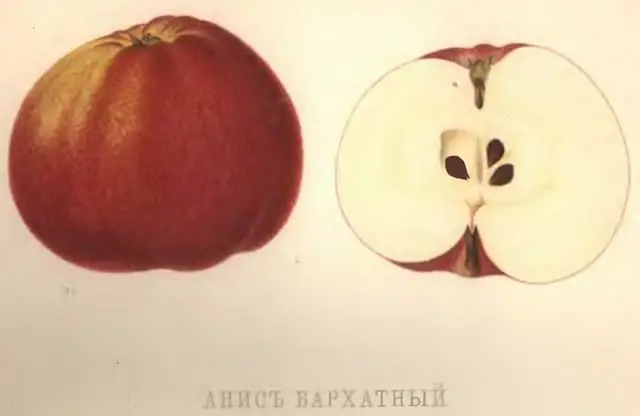
Anis
An old Volga folk apple whose clones bear small, bloom-dusted red fruit; Anis Polosaty has an anise-like scent
-
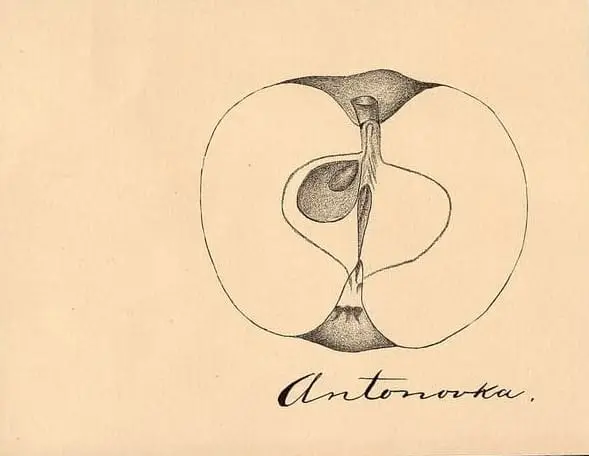
Antonovka
Central Russia's old folk apple, prized for its scent and hardiness; DNA shows Schmidt's Antonovka is the same variety
-
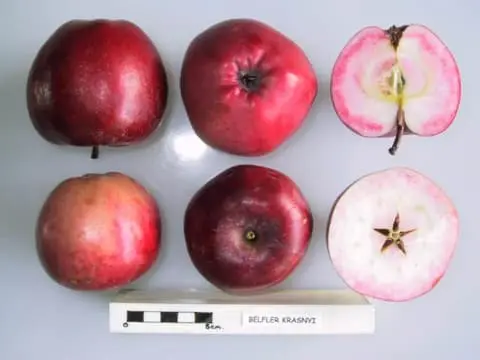
Bellefleur Krasny
-
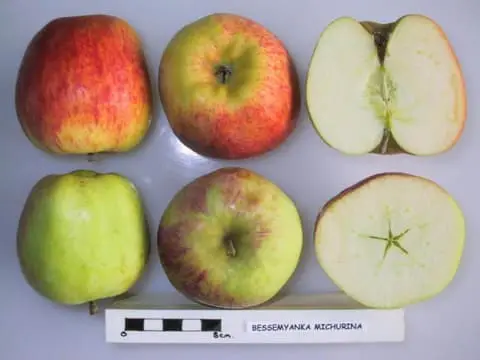
Bessemyanka Michurina
-
Byeloborodovka
-
d'Eylau
-
Dolgo
A Siberian crab brought from Russia to South Dakota in 1897 and introduced in 1917 for its ruby-red jelly
-
Duchess of Oldenburg
Borovinka at home; its hardiness in prairie test winters led Americans to import more Russian apples