Apple varieties, United Kingdom
Peasgood's Nonsuch
Grown from a pip sown at Stamford about 1858; DNA shows its parents are Alexander and Golden Noble, not Catshead
History
Peasgood’s Nonsuch was raised by Mrs Peasgood at Stamford, Lincolnshire, from a seed sown about 18581,4. The Herefordshire Pomona, which credited the apple to Mr Peasgood, said that his wife had sown the pip in a garden pot when she was a child3. Bunyard gave 1858 for the sowing and 1872 for the first fruit, and wrote in 1920 that the original tree was still growing at Stamford4. On 18 September 1872 the apple was shown to the Royal Horticultural Society’s Fruit Committee and received a First Class Certificate1,2; the Pomona adds a similar award at the Crystal Palace show in September 18743.
Its parentage was recorded as Catshead × unknown1, and Bunyard wrote that it came from a seed of the Catshead Codlin4. Two SNP studies have since identified both its parents: Alexander, also called Aport, an apple of the late eighteenth century, and Golden Noble5,6. Hillestedæble, an apple found in Danish collections, has the same two parents6.
Peasgood’s Nonsuch has been a parent in its turn. The collection lists it as the mother of eight varieties1, and SNP data confirm two of them, Charles Ross and Rival, as children of Peasgood’s Nonsuch and Cox’s Orange Pippin5. The same data make it a parent of Howgate Wonder, with Annie Elizabeth5. It holds the Royal Horticultural Society’s Award of Garden Merit as a cooking and dessert apple7.
The fruit
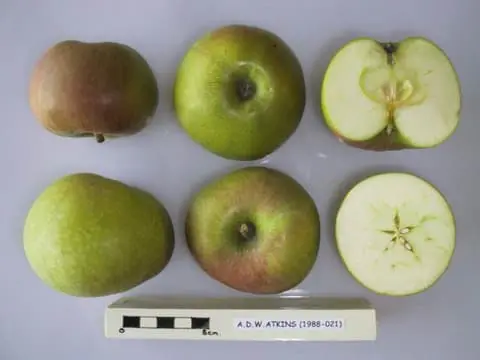
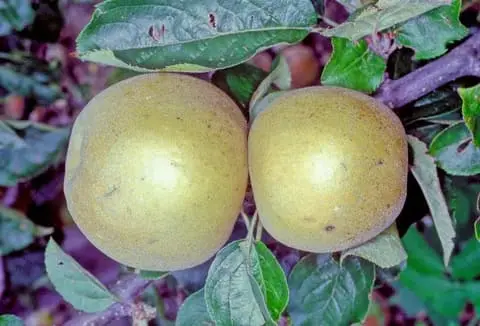
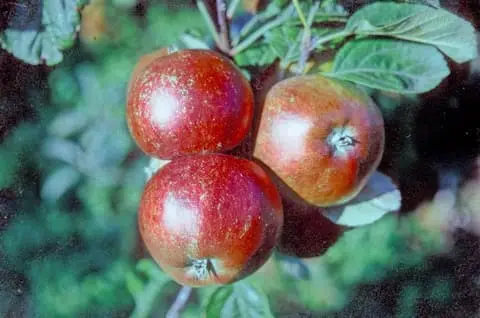
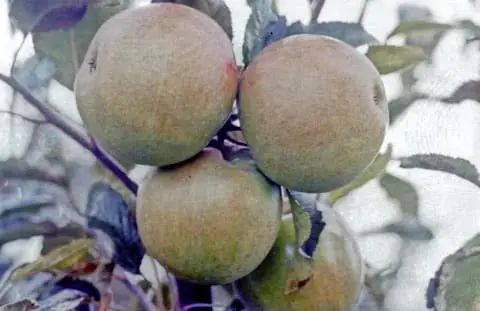
The fruit is large, round and flattened, and “remarkably regular”4. The 1971 National Apple Register gives it as 80 mm wide and 65 mm high, and the collection’s own characterisation as about 95 mm wide and 76 mm high1. The skin is yellow, overspread with red on the sunny side and copiously streaked with bright crimson2,3; Bunyard saw only a faint flush and a few broad, broken stripes on a golden-yellow ground4. The flesh is yellowish, tender and very juicy, with an agreeable acid flavour2,3; the collection finds it a little coarse, moderately juicy and a little sweet1. Hogg likened it to “a very large and highly coloured Nonesuch”2.
Hogg said that it kept until Christmas2, and Bunyard gave its season as September to November4. At Brogdale, Kent, it reaches 10 per cent flowering around 6 May and is picked in mid September1.
Growing
Bunyard found it vigorous and fertile, making a flat, spreading tree, but “rather liable to canker”4. The Pomona reported that the tree grew freely but was said not to bear well until full-grown3. It is diploid5.
Uses
Hogg called it “a fine culinary or dessert apple”2. The Pomona allowed that its beauty earned it a place on the dessert table, “though its best virtues are culinary”3. Bunyard, who listed it for cooking and exhibition, called it “one of the most beautiful fruits grown” and “first rate for cooking”, and noted that it cooks to a froth4.
Where the sources disagree
- Who raised it. Mrs Peasgood according to the collection and Bunyard1,4; Mr Peasgood according to Hogg and the Pomona2,3.
- The certificate. Hogg and the collection date the Royal Horticultural Society’s certificate to 18721,2; the Pomona gives 18 September 18783.
- Parents. Catshead in the older record1,4; Alexander and Golden Noble according to SNP data5,6.
- Flavour. Agreeably acid to Hogg and the Pomona2,3; a little sweet to the collection1.
Family tree
Parents, grandparents and great-grandparents, as the entries in the atlas record them.
- Peasgood's Nonsuch United Kingdom, about 1858
- Parent Aport Russia, late 18th century
- Parent Golden Noble United Kingdom, by 1803
- Parent Reinette de Hollande
Offspring in the atlas
- Charles Ross × Cox's Orange Pippin; United Kingdom, by 1890
- Colonel Yate × Lane's Prince Albert; United Kingdom, 1905
- George Carpenter × Reine des Reinettes; United Kingdom, 1902
- Houblon × Cox's Orange Pippin; United Kingdom, by 1901
- Howgate Wonder × Annie Elizabeth; United Kingdom, 1915-16
- Mere de Baia × Margil; Romania, by 1934
- Monarch × Dumelow's Seedling; United Kingdom, 1888
- Paroquet × Cox's Orange Pippin; United Kingdom, by 1897
- Prince George × Lane's Prince Albert; United Kingdom
- Renown × Cox's Orange Pippin; United Kingdom, by 1908
- Reverend W. Wilks × Ribston Pippin; United Kingdom, by 1904
- Rival × Cox's Orange Pippin; United Kingdom, by 1900
23 varieties in the atlas descend from Peasgood's Nonsuch.
Sources
- Peasgood's Nonsuch (accession 2000-075), National Fruit Collection, Brogdale, Kent (Defra). Supports: "Raised by Mrs Peasgood at Stamford, Lincolnshire, England from seed sown in about 1858"; "Received First Class Certificate from Royal Horticultural Society in 1872"; "a little coarse textured, moderately juicy and a little sweet. Cooks well"; parentage "Catshead x Unknown"; listed as mother of eight varieties, among them Charles Ross and Rival, and father of two; the sport Crimson Peasgood; synonyms including Peasgood's Nonesuch, Sans Pareille de Peasgood and Goldreinette von Peasgood; from the National Apple Register (Smith, 1971), a large, flat fruit 80 mm wide and 65 mm high, greenish yellow with carmine flush and stripes, yellowish white flesh; in the collection's own characterisation 95.35 mm wide and 75.71 mm high; 10% flowering on 6 May and picking in mid September at Brogdale; a culinary apple.
- The Fruit Manual, 5th ed., p. 170: Peasgood's Nonesuch, Robert Hogg, Journal of Horticulture Office, Internet Archive, 1884. Supports: large, roundish, somewhat oblate and very handsome; skin yellow, overspread on the sunny side with red and copiously streaked with bright darker crimson; flesh yellowish, tender, very juicy, with an agreeable acid flavour; "A fine culinary or dessert apple. It is like a very large and highly coloured Nonesuch, and keeps till Christmas"; presented before the Fruit Committee of the Royal Horticultural Society on "September 18th, 1872" and awarded a first-class certificate; raised by Mr Peasgood of Stamford.
- The Herefordshire Pomona, vol. II, plate LXI, no. 8: Peasgood's Nonesuch, Robert Hogg and H. G. Bull (eds), Woolhope Naturalists' Field Club, Internet Archive, 1876–1885. Supports: raised by Mr Peasgood of Stamford "from a pip sown in a garden pot by his wife, when a child"; first presented before the Royal Horticultural Society's Fruit Committee on "September 18th, 1878" and awarded a first-class certificate; a similar distinction at the Crystal Palace Show "in September, 1874"; skin yellow, overspread on the sunny side with red and copiously streaked with crimson; flesh yellowish, tender, very juicy, agreeably acid; its beauty gives it a place on the dessert table, "though its best virtues are culinary"; the tree grows freely but "is said not to bear well, until it has attained its full growth".
- A Handbook of Hardy Fruits, vol. I, p. 102: Peasgood's Nonsuch, E. A. Bunyard, John Murray, Internet Archive, 1920. Supports: French name Sanspareille de Peasgood; "Culinary and exhibition, September to November"; large, round flattened, "remarkably regular"; golden-yellow with faint flush and a few broad broken stripes; flesh tender, yellowish, of pleasant flavour, "cooks frothily"; growth vigorous, fertile; "raised by Mrs. Peasgood, of Stamford, in 1858, from a seed of the Catshead Codlin. First fruited in 1872. The original tree is still growing at Stamford"; "One of the most beautiful fruits grown; first rate for cooking"; "a flat spreading tree"; "Rather liable to canker".
- Using whole-genome SNP data to reconstruct a large multi-generation pedigree in apple germplasm, H. Muranty and others, BMC Plant Biology 20: 2, with Additional files 1 and 3 (Tables S1 and S3), 2020. Supports: Peasgood's Nonsuch inferred from SNP data as the offspring of Alexander and Golden Noble (15 Mendelian errors, against a threshold of 600), the recorded parent Catshead not confirmed (Table S3); Alexander, synonyms Aport or Aporta, which "originated in the late eighteenth century" (text); Charles Ross and Rival confirmed as children of Peasgood's Nonsuch and Cox's Orange Pippin, and Howgate Wonder inferred as a child of Annie Elizabeth and Peasgood's Nonsuch (Table S3); Peasgood's Nonsuch diploid (Table S1).
- Cultivar fingerprinting and SNP-based pedigree reconstruction in Danish heritage apple cultivars utilizing genotypic data from multiple germplasm collections in the world, B. Larsen and others, Genetic Resources and Crop Evolution 72: 2397, supplementary Table S5, 2025. Supports: Peasgood's Nonsuch with SNP-confirmed parents Alexander and Golden Noble; Hillestedæble, a genotype found in this Danish study, with the same two parents (Table S5).
- RHS Recommended: Award of Garden Merit. Fruit, vegetables and herbs, Royal Horticultural Society. Supports: 'Peasgood's Nonsuch' (culinary / dessert) among the apples on the list of plants holding the Award of Garden Merit.