Apple varieties, United Kingdom
Golden Noble
From an old orchard at Downham, Norfolk; a clear golden cooker without red, and a parent of Peasgood's Nonsuch
History
The Herefordshire Pomona called the origin of Golden Noble “not known”3. It was first brought to notice by Sir Thomas Harr of Stowe Hall, Norfolk, whose gardener took it from a tree, thought to be the original, in an old orchard at Downham, and sent it to the Horticultural Society of London in 18202,3. The National Fruit Collection credits its discovery to Patrick Flanagan, Sir Thomas Harr’s head gardener, and notes that William Forsyth had mentioned the apple in 18031; the Pomona judged it “probably therefore an old variety”3.
SNP data published in 2025 identify Reinette de Hollande as one of its parents; the other is an unidentified cultivar whose genotype has been inferred from its offspring6. The same genotype as Golden Noble’s is held in the University of Copenhagen’s heritage collection under the name Pilehaveæble6.
Golden Noble has been a notable parent. With Alexander it produced Peasgood’s Nonsuch5,6, and SNP data also make it a parent of Schoolmaster, with Dumelow’s Seedling, and of the Belgian Président Roulin, with Bismarck5. The collection lists it as the father of Shoesmith and Edward VII1.
Bunyard’s key to apples has a “Golden Noble Group” of apples with a markedly golden skin, sometimes flushed but not striped4. It holds the Royal Horticultural Society’s Award of Garden Merit7.
The fruit
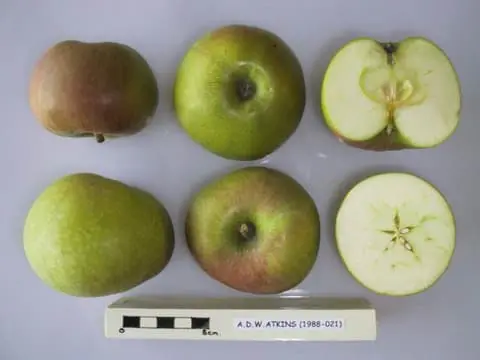
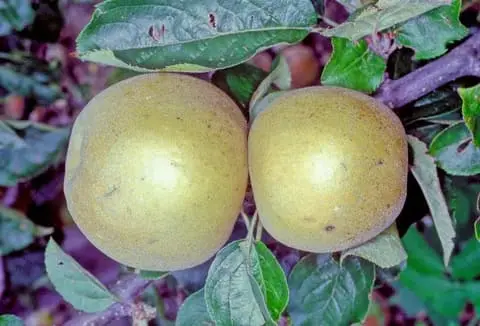
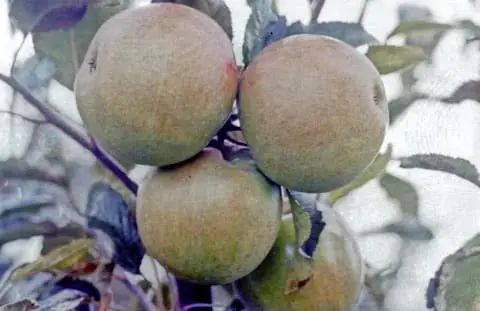
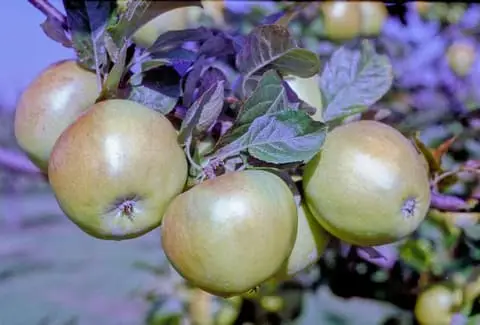
The fruit is round, narrowing towards the eye, handsome and symmetrical2,3. Hogg and the Pomona called it large2,3 and Bunyard medium4; the 1971 National Apple Register, quoted on the collection’s record, gives it as 70–76 mm wide and 57–70 mm high1. The smooth skin is clear, bright golden yellow with no red flush, only a few small reddish spots and a little russet2,3. The flesh is yellow, tender and acid2,4; the collection describes it as a little soft, fairly fine-textured and very juicy1.
Hogg found that it baked “of a clear amber colour, perfectly melting, with a rich acidity”2. Bunyard wrote that it cooks frothily and golden, and thought it “one of the very best cooking apples for colour and flavour”4; the collection notes that it “cooks extremely well, breaking up completely”1.
Hogg gave its season as September to December, the Pomona as the end of September to the middle of December, and Bunyard as September to January2,3,4. At Brogdale, Kent, it reaches 10 per cent flowering around 10 May and is picked in early October1.
Growing
The Pomona found that the tree grew freely and bore abundantly, and thought that it should be “grown much more generally than it is”3. Bunyard described its growth as vigorous and fertile4. It is diploid5.
Where the sources disagree
- Who found it, and when. The collection names Patrick Flanagan as its discoverer and cites a mention by Forsyth in 18031; Hogg and the Pomona leave the gardener unnamed, and they and Bunyard date its coming to notice to 18202,3,4.
- Size. Large to Hogg and the Pomona2,3; medium to Bunyard4.
- Flesh colour. Yellow to Hogg and Bunyard2,4; white in the 1971 register and cream in the collection’s own notes1.
- Identity. Hogg found it much confused with Waltham Abbey Seedling and Dr. Harvey, and set out how to tell the three apart2.
- The name Drap d’Or. The collection gives Drap d’Or among its other names1; Bunyard reported Boisbunel’s view that Golden Noble is the Drap d’Or of France, but not the apple that Hogg described under that name4.
Family tree
Parents, grandparents and great-grandparents, as the entries in the atlas record them.
- Golden Noble United Kingdom, by 1803
- Parent Reinette de Hollande
Offspring in the atlas
- Edward VII × Blenheim Orange; United Kingdom, by 1902
- Peasgood's Nonsuch × Aport; United Kingdom, about 1858
- Robert Blatchford × Hawthornden; United Kingdom, by 1914
- Schoolmaster × Dumelow's Seedling; United Kingdom, by about 1880
- Shoesmith × Lane's Prince Albert; United Kingdom, by 1930
28 varieties in the atlas descend from Golden Noble.
Sources
- Golden Noble (accession 1974-407), National Fruit Collection, Brogdale, Kent (Defra). Supports: "Discovered by Patrick Flanagan, head gardener to Sir Thomas Harr, Stowe Hall, Downham, Norfolk"; "It was mentioned by William Forsyth in 1803"; introduced by Flanagan to the Horticultural Society of London in 1820; "a little soft, fairly fine-textured, very juicy, and acid. Cooks extremely well, breaking up completely"; father of Shoesmith and Edward VII; synonyms including Drap d'Or, Gelber Edelapfel, John Peel, Lord Clyde, Lord Stanwick and Rutlandshire Foundling; from the National Apple Register (Smith, 1971), a large fruit 70–76 mm wide and 57–70 mm high, golden yellow with occasional russet, white flesh, an acid flavour; cream flesh in the collection's own characterisation; 10% flowering on 10 May and picking in early October at Brogdale; a culinary apple.
- The Fruit Manual, 5th ed., pp. 89–90: Golden Noble, Robert Hogg, Journal of Horticulture Office, Internet Archive, 1884. Supports: large, round and narrowing towards the eye, handsome and symmetrical, without ribs; skin smooth, clear bright golden-yellow, "without any blush of red", with a few small reddish spots and small patches of russet; flesh yellow, tender, with a pleasant acid juice, "baking of a clear amber colour, perfectly melting, with a rich acidity"; "A valuable culinary apple; in use from September to December"; "Much confusion exists" between Golden Noble, Waltham Abbey Seedling and Dr. Harvey, with the marks that tell them apart; "first brought into notice by Sir Thomas Harr, of Stowe Hall, Norfolk, whose gardener procured it from a tree supposed to be the original, in an old orchard at Downham", and sent it to the Horticultural Society of London "in 1820".
- The Herefordshire Pomona, vol. I, plate XXIII, no. 2: Golden Noble, Robert Hogg and H. G. Bull (eds), Woolhope Naturalists' Field Club, Internet Archive, 1876–1885. Supports: synonym Edelapfel gelber; "The origin of this apple is not known"; brought into notice by Sir Thomas Harr of Stow Hall, Norfolk, whose gardener took it from a tree supposed to be the original in an old orchard at Downham and sent it to the Horticultural Society of London in 1820; "It is probably therefore an old variety"; large and round, slightly narrowing towards the eye; skin smooth, clear bright yellow, without any blush of red; in season "from the end of September to the middle of December"; the tree "grows freely and bears abundantly" and "should be grown much more generally than it is".
- A Handbook of Hardy Fruits, vol. I, pp. 13 and 62: key to apples, Table IV; Golden Noble, E. A. Bunyard, John Murray, Internet Archive, 1920. Supports: Table IV of the key, the "Golden Noble Group" of apples with "a markedly golden skin, such as Golden Noble and Golden Spire", occasionally flushed "but not striped" (p. 13); German name Gelber Edel Apfel and other names Lord Clyde, Lord Stanwick, John Peel and Rutlandshire Foundling; culinary, September to January; medium, round, slightly flattened, regular; clear yellow with slight russet; flesh tender, yellow, acid; growth vigorous, fertile; "Cooks frothily and of golden colour"; "Origin, uncertain: brought to notice in 1820"; "According to Boisbunel, this is the Drap d'Or of France (not of Hogg)"; "One of the very best cooking apples for colour and flavour" (p. 62).
- Using whole-genome SNP data to reconstruct a large multi-generation pedigree in apple germplasm, H. Muranty and others, BMC Plant Biology 20: 2, with Additional files 1 and 3 (Tables S1 and S3), 2020. Supports: Golden Noble diploid (Table S1); inferred from SNP data as a parent of Peasgood's Nonsuch, with Alexander, of Schoolmaster, with Dumelow's Seedling, and of Président Roulin, with Bismarck (Table S3); Président Roulin a Belgian cultivar (text).
- Cultivar fingerprinting and SNP-based pedigree reconstruction in Danish heritage apple cultivars utilizing genotypic data from multiple germplasm collections in the world, B. Larsen and others, Genetic Resources and Crop Evolution 72: 2397, with supplementary Tables S1 and S5, 2025. Supports: Golden Noble with SNP-confirmed parent Reinette de Hollande and, as its other parent, "Unknown Founder 1", an unknown common parent whose genotype was imputed from a group of half-siblings (Table S5 and text); an accession named Pilehaveæble in the heritage collection of the Pometum, University of Copenhagen, matching the genotype of Golden Noble (Table S1); Golden Noble a parent of Peasgood's Nonsuch, with Alexander (Table S5).
- RHS Recommended: Award of Garden Merit. Fruit, vegetables and herbs, Royal Horticultural Society. Supports: 'Golden Noble' (culinary) among the apples on the list of plants holding the Award of Garden Merit.