Signe Tillisch
Raised in Denmark in 1866 and named after the grower's daughter; DNA shows it a child of Alexander and London Pippin
History
By the first account, Chamberlain Tillisch raised this Danish apple in 1866 on his property at Bjerre, near Horsens, and it was later named after his daughter1,3; the Pometum, the University of Copenhagen’s fruit genebank, also gives Bjerre and 18662. Later writers said instead that it was raised on Count Rantzau’s estate at Rosenvold, where the mother tree was still to be found in the 1930s1. It came on the market in 1889 through Mathiesen’s nursery at Korsør1, the year to which the National Fruit Collection dates its first description3.
It was widely planted in Denmark1, and was last recommended for Danish orchards in 19572. In Norway, where it was planted from the 1880s and more widely around 1900, mostly in the east and south, it is now seldom if ever planted, though old trees survive, mostly in private gardens1.
The National Fruit Collection records it as a seedling of Calville Blanc d’Hiver3, but SNP data show its parents to be Alexander and London Pippin5,6. The 2020 study counts it among the many offspring of Alexander, a Russian apple5, which had reached Denmark around 18506.
Its own offspring include Astillisch, dated 1929, whose other recorded parent, Red Astrachan, is confirmed by SNP data3,5, and two more, Prinsesse Anne Marie and Prinsesse Margrethe, whose other parent is Kasseler Renette6.
The fruit
The fruit is medium-sized to large, sometimes very large, rounded-conical and somewhat flattened, and always broader than high1; the Pometum gives 86 mm across and 70 mm high2. It is ribbed, with strong ribs around the eye2,4. The thin skin is glossy and very greasy1,3,4, pale greenish or milky yellow with a faint orange-red or brownish-red flush1,4, and the Pometum rates its looks as not very attractive2. The flesh is greenish to yellowish white, fine, tender and juicy, with green vascular strands1. It is sweet and weakly acid with a good, distinctive aroma1,2,3, and the Pometum notes a slight taste of grapes2; Bunyard found it only “a little sweet”4.
In Norway it is picked at the end of September and eaten in November and December1. In Denmark it is picked from late September to early October and is ready to eat from November or December2. At Brogdale, in Kent, it is picked in early September3; Bunyard gave its season as October to December4.
Growing
The tree is vigorous, with a broad, drooping crown1,2. It begins to bear moderately early and gives medium crops1,2, with a tendency to crop in alternate years1. It flowers late2. It is prone to scab: NIBIO calls the fruit very susceptible1, and in unsprayed trials in 2006–2009 recorded by the Pometum about half the fruit and nearly half the leaves were scabbed, and mildew affected about half the shoots2. Signe Tillisch is diploid2,5.
Uses
Signe Tillisch is used both for dessert and for cooking2,3; NIBIO treats it as a dessert apple1, Bunyard as a culinary one4.
Where the sources disagree
- Where it was raised. The first account and the Pometum place it at Bjerre, near Horsens1,2; a later account places it at Count Rantzau’s Rosenvold1.
- Parentage. The National Fruit Collection records Calville Blanc d’Hiver as the mother3; SNP data name Alexander and London Pippin instead5,6.
- Canker. NIBIO says the tree is often attacked by canker1; the Pometum rates it very robust, with canker on very few branches in its unsprayed trials2.
Family tree
Parents, grandparents and great-grandparents, as the entries in the atlas record them.
- Signe Tillisch Denmark, 1866
- Parent Aport Russia, late 18th century
- Parent London Pippin United Kingdom, by 1580
Offspring in the atlas
- Astillisch × Red Astrachan; Germany, 1929
Sources
- Apple varieties: Signe Tillisch (in Norwegian), NIBIO (Norwegian Institute of Bioeconomy Research), plant genetic resources: fruit varieties, 2020-03-30. Supports: a Danish variety; first said to have been raised in 1866 by Chamberlain (kammerherre) Tillisch on his property at Bjerre, near Horsens, and later named after his daughter; later said to have been raised on Count Rantzau's estate at Rosenvold, where the mother tree was still to be found in the 1930s; on the market in 1889 through Mathiesen's nursery at Korsør, and widely planted in Denmark; planted in Norway from the 1880s, more widely about 1900, mostly in the east and south, now seldom or never planted, old trees surviving mostly in private gardens; tree vigorous with a broad crown, bearing moderately early with medium crops, tending to biennial bearing, often attacked by scab and canker; fruit medium to large, sometimes very large, rounded conical, a little flattened, always broader than high; greenish yellow to yellow, often with a weak orange-red flush on the sunny side; fine lenticels; skin thin, often very greasy, glossy; flesh greenish to yellowish white, fine, tender and juicy, sweet, weakly acid, with a good, distinctive aroma; green vascular strands; fruit very susceptible to scab; picked at the end of September, eating ripe in November and December; a dessert apple.
- The Pometum's apple key: Signe Tillisch (in Danish), University of Copenhagen, the Pometum (Pometets æblenøgle); Internet Archive copy of 3 August 2025, 2025. Supports: origin Bjerre near Horsens, 1866; a seedling of Alexander × London Pippin; known in Denmark since 1889; grown to some extent, last recommended for Danish growing in 1957; used for dessert and cooking; vigorous, drooping growth, medium yield; susceptible to scab and mildew, very robust against canker; in unsprayed trials in 2006–2009 scab on a little under half the leaves and about half the fruit, canker on very few branches, mildew on about half the shoots; late flowering; diploid; picked from the second half of September to the first half of October, eating ripe from November or December; appearance not very attractive; flesh very juicy, very sweet, weakly acid, with some aroma and a slight taste of grapes; large to very large, 70 mm high and 86 mm across, flat-round conical; strong ribs around the eye; greasy skin.
- Signe Tillisch (accession 1927-007), National Fruit Collection, Brogdale, Kent (Defra). Supports: "Raised in about 1866 by Councillor Tillisch and named after his daughter. First described in 1889. Fruits have loose, soft, creamy white flesh with a sweet, subacid, aromatic flavour."; synonyms Signe Tillish and Sini Tillis; a culinary and dessert apple; parentage "Calville Blanc d'Hiver x Unknown"; father to Astillisch; National Apple Register: large, flat globose, 75 mm high and 84 mm wide, medium ribbing, whitish yellow with a little pink, strongly greasy; picked in early September at Brogdale.
- A Handbook of Hardy Fruits, vol. I, p. 120: Signe Tillisch, E. A. Bunyard, John Murray; Internet Archive, 1920. Supports: culinary, October to December; fairly large, round conical, ribbed and angular; "pale milky-yellow with faint brown-red flush, very greasy"; flesh white, moderately firm, "a little sweet"; eye closed in a deep, much ribbed basin; growth upright, spreading, moderately vigorous.
- Using whole-genome SNP data to reconstruct a large multi-generation pedigree in apple germplasm, H. Muranty and others, BMC Plant Biology 20: 2, with Additional files 1 and 3, 2020. Supports: Table S3: Signe Tillisch inferred from London Pippin and Alexander, the documented Calville Blanc d'Hiver not confirmed; Astillisch from Red Astrachan and Signe Tillisch, as documented; the text: the Russian Alexander, a major founder with more than 100 offspring, among them Signe Tillisch in Denmark; Table S1: Signe Tillisch diploid, Astillisch dated 1929.
- Cultivar fingerprinting and SNP-based pedigree reconstruction in Danish heritage apple cultivars utilizing genotypic data from multiple germplasm collections in the world, B. Larsen and others, Genetic Resources and Crop Evolution 72: 2397–2411, with supplementary file 2, 2025. Supports: Table S5: Signe Tillisch with the SNP-confirmed parents Alexander and London Pippin, diploid; Prinsesse Anne Marie and Prinsesse Margrethe both from Signe Tillisch and Kasseler Renette; text: Alexander introduced to Denmark around 1850.
More from Denmark
-
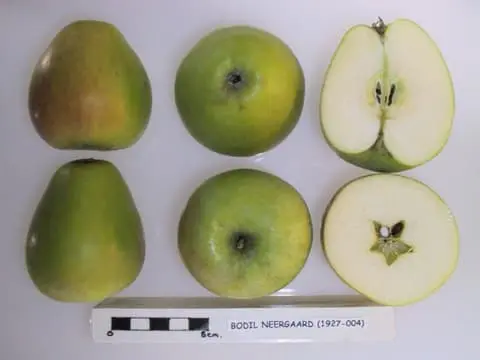
Bodil Neergaard
-
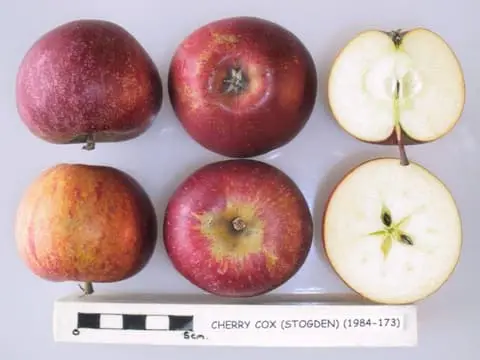
Cherry Cox
-
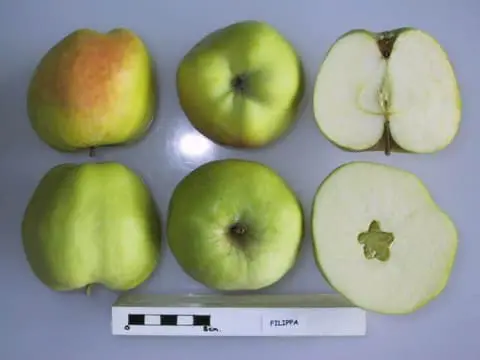
Filippa
Grown from pips sown in a pot by Filippa Johannsen at Hundstrup, Fyn, about 1880; a parent of Aroma
-
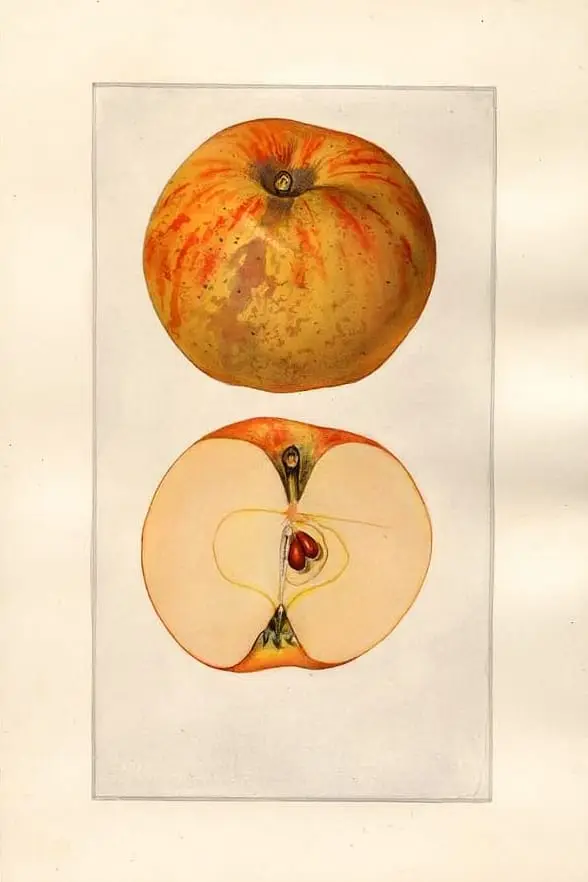
Gravenstein
A triploid of disputed origin, linked to Gråsten Castle and to Italy; Danish growers named it the national apple in 2005
-
Guldborg
-
Ildrod Pigeon
-
Ingrid Marie
Found in a Fyn school garden about 1910; Denmark's most widespread apple until 1997 and still Sweden's in 2023
-
Josefine Kallehave