Gravenstein
A triploid of disputed origin, linked to Gråsten Castle and to Italy; Danish growers named it the national apple in 2005
History
The Gravenstein’s origin is uncertain. Hovey’s account of 1851, quoted by Beach, placed it in the Duke of Augustenberg’s garden at Gravenstein, in Holstein, or at the castle of Grafenstein, in Schleswig, and reported Diel’s note that some thought it had come from Italy2. The National Fruit Collection adds a story of scions from Italy sent home by a brother of Count Chr. Ahlefeldt of Graasten Castle, in South Jutland, and thinks that it reached Denmark in about 16691.
The Danish tradition, as told in a 2011 encyclopaedia of South Jutland, has a scion sent to Count Frederik Ahlefeldt the Younger at Gråsten by his brother Carl, during a two-year journey abroad, from the abbey of Hautecombe on the Lac du Bourget, in the Duchy of Savoy. The apple was developed in the castle garden and spread through Denmark and northern Germany in the 18th century as scions from N. Vothmann’s nursery at Sønderborg4. In Danish it is gråstenæblet, the Gråsten apple, also called gravensten, and in 2005 Danish apple growers named it Denmark’s national apple4.
By 1851 it was common throughout Germany and Sweden2. In 1857 an importer said that he had brought it to the United States from Denmark in May 1826, and Hovey judged that it had probably reached the Albany area before then2.
The Gravenstein is triploid1,5, and Bunyard noted that it very rarely sets seed3. A 2025 study of SNP data found no parent, offspring, grandparent or grandchild for it; its closest relative was the diploid Prinzenapfel, in a relationship that could not be determined5. The University of Copenhagen’s genebank, the Pometum, keeps 14 accessions of it, some of them colour sports such as Red Gravensteiner; such sports are of regional commercial importance in Denmark5.
The fruit
The fruit is large, irregular and angular, broad at the base and somewhat flattened1,2; the National Apple Register of 1971 gives it as 64 mm high and 74 mm wide1. The thin skin is greenish- to orange-yellow, overlaid with broken stripes of light and dark red2. Red-fruited bud sports have arisen several times, among them Banks in Nova Scotia2, and the National Fruit Collection lists All-Red Gravenstein and Morkrod as sports1. The yellowish flesh is firm, crisp and very juicy2,3, with a mixture of sweetness and acidity and a distinctive, aromatic flavour1,2,3; Beach rated it “very good to best”2.
At Brogdale, Kent, the tree reaches 10 per cent flowering on 28 April and the fruit is picked in early September1. In New York the crop ripened over several weeks from the second half of September, needing two or three pickings, and stayed in season until early November2; in Denmark it ripens in September and keeps until Christmas4.
Growing
Beach described a large, vigorous tree that comes into bearing moderately early and crops well and reliably; but in many parts of New York it was not quite hardy, being somewhat subject to sunscald and canker, and much fruit dropped before it coloured2. Bunyard found its growth moderate and the tree fertile3.
Uses
It is a dessert and cooking apple1,3; for cooking, Beach thought it “perhaps unexcelled by any variety of its season”2.
Where the sources disagree
- When. The National Fruit Collection has it in Denmark by about 16691; Hovey put the original tree in the middle of the 18th century2, and Bunyard dated its introduction to about 17603.
- Who sent the scion. The National Fruit Collection names a brother of Count Chr. Ahlefeldt1; the Danish account names Carl, brother of Count Frederik Ahlefeldt the Younger4.
- Offspring. The National Fruit Collection lists it as the mother of Filippa and Dülmener Rosenapfel and the father of James Lawson and Adersleber Calville1. SNP studies give Adersleber Calville the parents Calville Blanc d’Hiver and Alexander5,6 and Dülmener Rosenapfel the parents Dutch Mignonne and White Astrachan6, and make Prinzenapfel a parent of Filippa5,6; the 2025 study found no offspring of the Gravenstein at all5.
Family tree
Offspring in the atlas
- All-Red Gravenstein United States
Sources
- Gravenstein (accession 1957-215), National Fruit Collection, Brogdale, Kent (Defra). Supports: "Triploid"; "Said to have originated either in the garden of the Duke of Augustenberg, Castle of Graefenstein, Schleswig-Holstein or in Italy or Southern Tyrol and sent to Schleswig-Holstein, or scions from Italy sent home by a brother of Count Chr. Ahlefeldt of Graasten Castle, South Jutland"; "thought to have arrived in Denmark in about 1669"; crisp, rather coarse-textured, juicy flesh with "a pleasant mixture of sweetness and acidity with a distinctive flavour"; a culinary and dessert apple; synonyms including Gravensteiner, Graasten, Grafensteiner, Blumen Calvill, Diels Sommerkonig, Ohio Nonpareil, Sabine of the Flemings and Early Congress; mother to Filippa and Dulmener Rosenapfel and father to James Lawson and Adersleber Calville; sports All-Red Gravenstein and Morkrod; Smith's National Apple Register of 1971 (b): large, truncate-conical, 64 mm high and 74 mm wide, medium-strong ribbing, crisp, yellowish flesh; 10% flowering on 28 April and picking in early September at Brogdale.
- The Apples of New York, vol. II, pp. 84–87: Gravenstein, S. A. Beach, New York Agricultural Experiment Station; Internet Archive, 1905. Supports: for culinary purposes "perhaps unexcelled by any variety of its season"; tree large and vigorous, regarded in many sections of New York as not quite hardy, "somewhat subject to sunscald and canker"; bearing moderately early, productive and a reliable cropper; the crop ripening over several weeks and needing two or three pickings, in season from the latter half of September till early November; much fruit dropping before it colours; Hovey's account of 1851: origin "in some doubt", said to have been found in the Duke of Augustenberg's garden at Gravenstein, in Holstein, the original tree growing there "in the middle of the last century", or named from the garden of the castle of Grafenstein, in Sleswick, and Diel reporting that some supposed it introduced from Italy; "a common apple throughout Germany and Sweden"; an 1857 statement that it had been imported from Denmark in May 1826, and Hovey's view that it reached the Albany area probably before 1826; fruit large to above medium, oblate to roundish, irregular, broad at the base, slightly angular; thin skin, greenish-yellow to orange-yellow with broken stripes of light and dark red; flesh yellowish, firm, crisp, juicy, sprightly subacid, aromatic, "very good to best"; highly coloured red bud sports, one from Nova Scotia grown as Banks.
- A Handbook of Hardy Fruits, vol. I, pp. 65–66: Gravenstein, E. A. Bunyard, John Murray; Internet Archive, 1920. Supports: dessert or culinary, October to December; crisp, yellowish-white, "extremely juicy" flesh "of most distinct flavour"; growth moderate, fertile; "said to have been found at the Castle of Grafenstein, in Schleswig-Holstein"; "Introduced about 1760"; a fragrant aroma; a much redder form that arose as a bud sport; "It very rarely sets any seed".
- The Gråsten apple (in Danish), Inge Adriansen, in Sønderjylland A–Å (Historisk Samfund for Sønderjylland), Grænseforeningen online encyclopaedia, 2011. Supports: also called gravensten; designated Denmark's national apple in 2005 by the Danish apple growers; ripening in September and keeping until Christmas; developed in the castle garden at Gråsten and spread through Denmark and northern Germany in the 1700s as scions (podekviste) from N. Vothmann's nursery at Sønderborg; by tradition a scion sent to Count Frederik Ahlefeldt the Younger at Gråsten by his brother Carl during a two-year journey abroad, from the abbey of Hautecombe (L'Abaye de Hautcombe) on the Lac du Bourget in the Duchy of Savoy.
- Cultivar fingerprinting and SNP-based pedigree reconstruction in Danish heritage apple cultivars utilizing genotypic data from multiple germplasm collections in the world, B. Larsen and others, Genetic Resources and Crop Evolution 72: 2397, with supplementary tables, 2025. Supports: Gravensteiner triploid, with no SNP-validated parent–offspring or grandparent–grandchild relationship; its closest relative the diploid Prinzenapfel, the exact relationship undetermined; the Pometum at the University of Copenhagen, founded in 1863, keeping 14 Gravensteiner accessions, some of them, such as Red Gravensteiner, well-described colour sports; colour sports of Gravensteiner regionally important commercially in Denmark; Table S5: Filippa with Prinzenapfel as one parent, and Adersleber Kalvill with Calville Blanc d'Hiver and Alexander as parents.
- Using whole-genome SNP data to reconstruct a large multi-generation pedigree in apple germplasm, H. Muranty and others, BMC Plant Biology 20: 2, with Additional files 3 and 6, 2020. Supports: Table S3: Adersleber Calville inferred from Calville Blanc d'Hiver and Alexander, not the recorded Gravenstein; Dülmener Rosenapfel inferred from Dutch Mignonne and White Astrachan, where the literature gave Gravenstein or Dutch Mignonne; Additional file 6 (Table S5, parent–offspring pairs): Filippa paired with Prinzen Apfel as offspring and parent, where the literature named Gravenstein.
More from Denmark
-
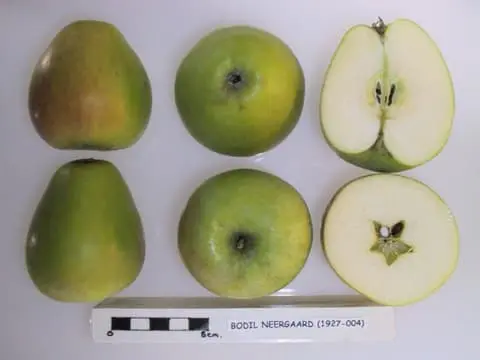
Bodil Neergaard
-
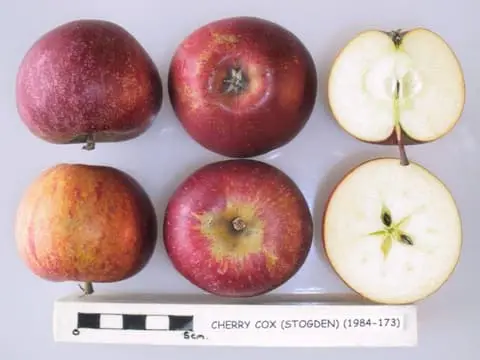
Cherry Cox
-
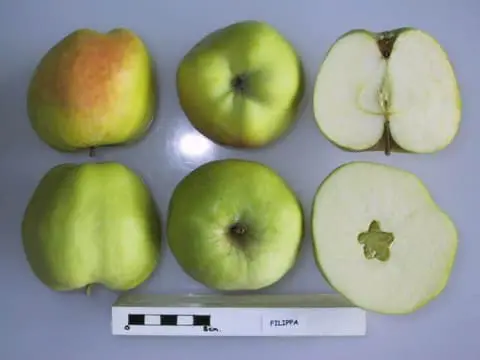
Filippa
Grown from pips sown in a pot by Filippa Johannsen at Hundstrup, Fyn, about 1880; a parent of Aroma
-
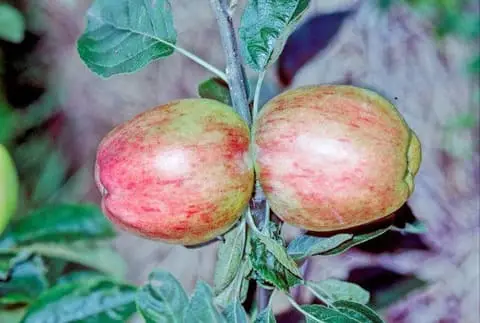
Guldborg
-
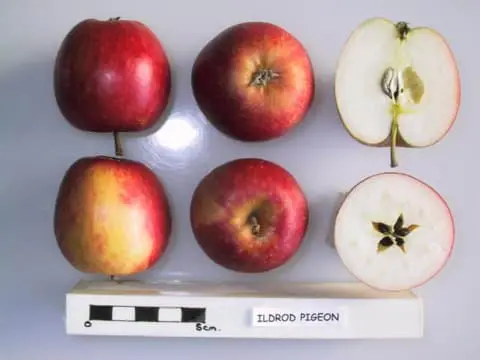
Ildrod Pigeon
-
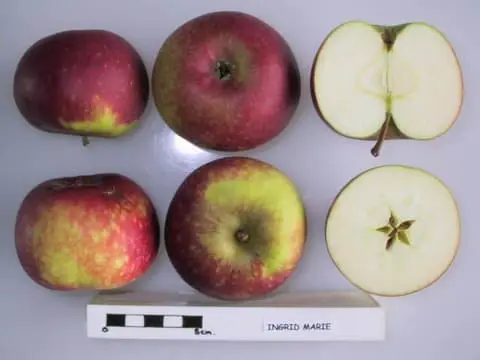
Ingrid Marie
Found in a Fyn school garden about 1910; Denmark's most widespread apple until 1997 and still Sweden's in 2023
-
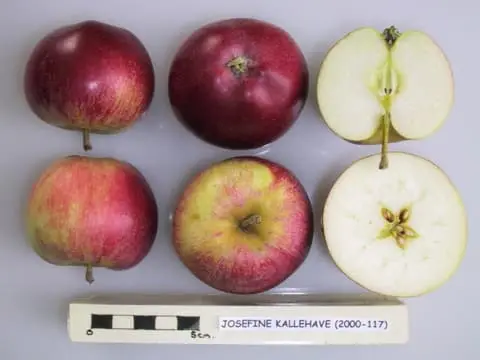
Josefine Kallehave
-
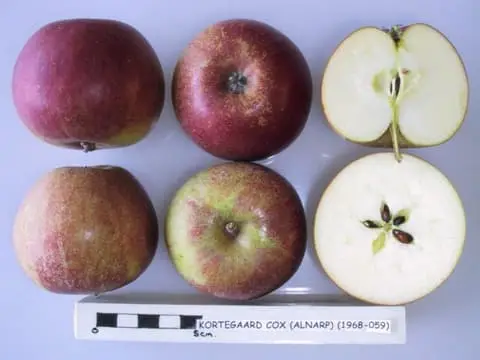
Kortegaard Cox