Filippa
Grown from pips sown in a pot by Filippa Johannsen at Hundstrup, Fyn, about 1880; a parent of Aroma
History
Filippa comes from Hundstrup, in the south of the Danish island of Fyn1,2,3. Around 1880 Filippa Johannsen, the daughter of a schoolteacher there, sowed some apple pips in a pot, and one of the seedlings became the mother tree of the variety1,3. It was described in 1893 and named after her1, and it received a First Class Certificate from the Danish Horticultural Society3. The mother tree was protected in 1937, and Norway’s Institute of Bioeconomy Research (NIBIO) reported in 2020 that it still stood in the school garden at Hundstrup1.
The apple spread quickly through Scandinavia, reaching Norway about 1890, though it was planted widely there only from the early 20th century1. In Denmark it was widely grown and was last recommended for planting in 19872; Danish orchards still held 17 hectares of it in 20236.
Its parentage has been recorded in three ways. The National Fruit Collection gives it as a seedling of Gravenstein3, NIBIO says that the pips came from an unknown variety1, and the Pometum, the University of Copenhagen’s fruit genebank, names Flaskeæble as the seed parent2. SNP data identify one parent as Prinzenapfel4,5, an apple introduced to Denmark in the 18th century4; the other parent has not been found. The Pometum’s own tree of Flaskeæble has the genotype of Prinzenapfel4, which squares its record with the DNA, while the 2025 study found no parent–offspring link at all for Gravenstein4.
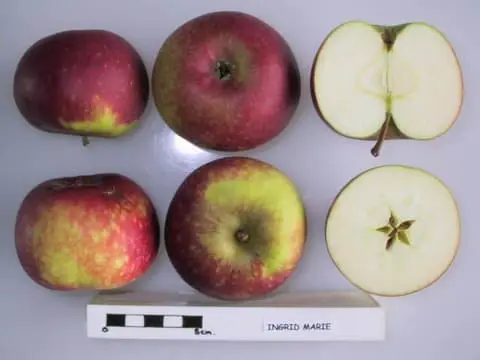
Filippa has itself been a parent. Crossed with Ingrid Marie, it gave Aroma4,5, and SNP data make it a parent of several apples found only in Danish collections, among them Stenstrup æble and Bredstedæble4.
The fruit
The fruit is medium-sized to large and cylindrical to conical, often lopsided1,2,3; the Pometum gives 79 mm across and 67 mm high2. The thin, smooth skin is glossy and somewhat greasy or waxy1,2, greenish to whitish yellow, with red flames or marbling on the sunny side1,3. The apples have a strong scent1. The flesh is white and fine1,3, crisp and juicy to NIBIO1 and tender to the National Fruit Collection3. It is sweet and somewhat sharp, with a distinctive aroma1,2; the National Fruit Collection finds it subacid and slightly sweet3.
In Denmark it is picked in the first half of September2, at Brogdale, in Kent, in mid-September3, and in Norway from mid to late September, to be eaten in November and December1. Stored at 2 °C, colder than many varieties allow, it keeps considerably longer1.
Growing
The tree is of medium to strong vigour, with thin, often drooping branches and a broad crown1,2. It comes into bearing moderately early and later crops heavily and regularly1, and it flowers early2. NIBIO finds it resistant to fungal diseases, though somewhat prone to brown rot (Monilia) in wet districts1, and in unsprayed trials in 2006–2009 recorded by the Pometum it showed no scab, canker or mildew at all2. In store the fruit can rot from Gloeosporium1. Filippa is diploid2,5.
Uses
Filippa is mainly a dessert apple and suits private gardens1,3; the Pometum also lists it for cooking and for juice or cider2.
Where the sources disagree
Family tree
Parents, grandparents and great-grandparents, as the entries in the atlas record them.
- Filippa Denmark, about 1880
- Parent Prinzen Apfel Germany, 1700s
- Parent Prinzen Apfel Germany, 1700s
- Parent Boiken Germany, by 1828
- Parent Prinzen Apfel Germany, 1700s
Offspring in the atlas
- Aroma × Ingrid Marie; Sweden, 1947
2 varieties in the atlas descend from Filippa.
Sources
- Apple varieties: Filippa (in Norwegian), NIBIO (Norwegian Institute of Bioeconomy Research), plant genetic resources: fruit varieties, 2020-03-30. Supports: a Danish variety; about 1880 Miss Filippa Johannsen, daughter of a schoolteacher at Hundstrup on Fyn, sowed apple pips of an unknown variety in a pot, and one seedling became the mother tree; described in 1893 and named after her; the mother tree protected in 1937 and still standing in the school garden at Hundstrup; spread quickly in Scandinavia, reaching Norway about 1890 but better known and planted only from the early 1900s; tree of medium vigour with thin, often drooping branches and a broad crown; bearing moderately early, later usually heavily and regularly; resistant to fungal diseases but somewhat prone to Monilia in wet districts; fruit medium-sized, cylindrical to conical, often lopsided and irregular, greenish to whitish yellow with red flames or marbling on the sunny side; skin thin, smooth, somewhat greasy and glossy; a strong scent; flesh white, fine, crisp and juicy, sweet and somewhat acid with a distinctive aroma; prone to Gloeosporium rot; picked from mid to late September, eating ripe in November and December; can be stored at 2 °C, lower than many varieties, and then keeps considerably longer; mostly a dessert apple, suited to private gardens.
- The Pometum's apple key: Filippa (in Danish), University of Copenhagen, the Pometum (Pometets æblenøgle); Internet Archive copy of 3 August 2025, 2025. Supports: origin Hundstrup, South Fyn, 1850; "a seedling of Flaskeæble x ?"; known in Denmark since 1889; widely grown, last recommended for Danish growing in 1987; used for dessert, cooking and juice or cider; vigorous, drooping growth; very robust against scab, mildew and canker, with no scab, canker or mildew at all in unsprayed trials in 2006–2009; early flowering; diploid; picked in the first half of September; flesh medium to very juicy, medium sweetness, weak acidity, "good, distinctive aroma"; large, 67 mm high and 79 mm across, flat-round conical; skin green-yellow with up to a quarter red, waxy; flesh greenish, medium firm and fine.
- Filippa (accession 1927-023), National Fruit Collection, Brogdale, Kent (Defra). Supports: "Raised in about 1880 by Filippa Johannsen of Hundstrup, South Fyn Island, Denmark. Received a First Class Certificate by the Danish Horticultural Society. Fruits have fine, tender flesh, with a subacid and slightly sweet flavour."; synonyms Danskt Filippeapple, Filippa's Aeble and Filippa's Apfel; parentage "Gravenstein x Unknown"; a dessert apple; National Apple Register: medium-large, oblong, whitish yellow with an orange striped flush, white flesh; picked in mid-September at Brogdale.
- Cultivar fingerprinting and SNP-based pedigree reconstruction in Danish heritage apple cultivars utilizing genotypic data from multiple germplasm collections in the world, B. Larsen and others, Genetic Resources and Crop Evolution 72: 2397–2411, with supplementary file 2, 2025. Supports: Table S5: Filippa with one SNP-confirmed parent, Prinzenapfel, diploid; Filippa a parent of Aroma (with Ingrid Marie), Stenstrup æble (with Cox's Pomona), Bredstedæble (with Scarlet Pearmain) and other genotypes unique to the Danish collections studied; Table S1: the Pometum accession Flaskeæble with the genotype of Prinzenapfel (MUNQ 81); text: Prinzenapfel introduced to Denmark in the 18th century; Gravensteiner with no SNP-validated parent–offspring relationship.
- Using whole-genome SNP data to reconstruct a large multi-generation pedigree in apple germplasm, H. Muranty and others, BMC Plant Biology 20: 2, with Additional files 1, 3 and 6, 2020. Supports: Additional file 6 (Table S5): Filippa and Prinzen Apfel a parent–offspring pair, Prinzen Apfel taken as the parent by date, where the literature named Gravenstein; Table S3: Aroma from Ingrid Marie and Filippa, as documented; Table S1: Filippa diploid.
- Orchards 2023: Elstar is the largest apple variety in Denmark (in Danish), Danmarks Statistik (Statistics Denmark), Nyt fra Danmarks Statistik no. 202, 2024-07-01. Supports: Filippa on 17 hectares of Denmark's 1,285 hectares of apples in 2023 (agricultural and horticultural census 2023).
More from Denmark
-
Bodil Neergaard
-
Cherry Cox
-
Gravenstein
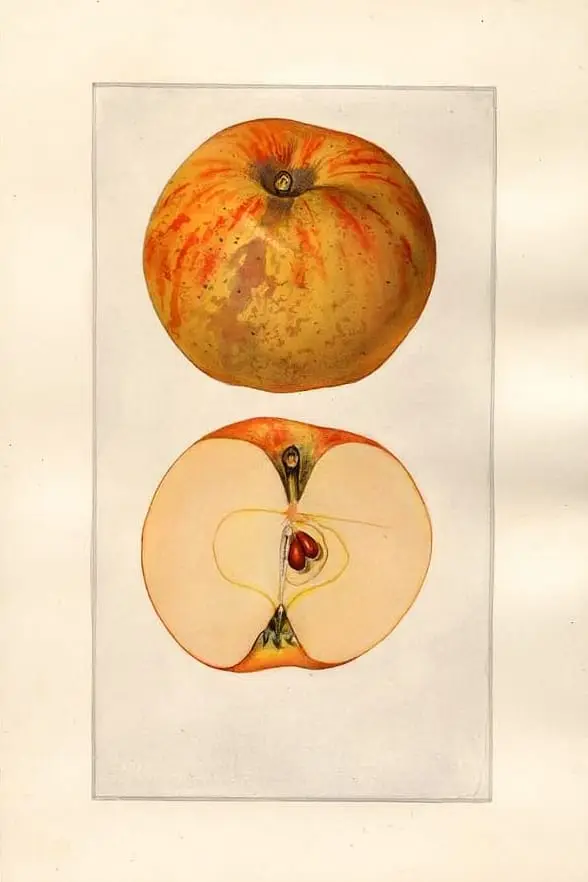
A triploid of disputed origin, linked to Gråsten Castle and to Italy; Danish growers named it the national apple in 2005
-
Guldborg
-
Ildrod Pigeon
-
Ingrid Marie
Found in a Fyn school garden about 1910; Denmark's most widespread apple until 1997 and still Sweden's in 2023
-
Josefine Kallehave
-
Kortegaard Cox