Cider apples
Apples grown to be pressed and fermented, many of them small and bitter with tannin. Below are notes on how they are classed, then the varieties in the atlas that their sources describe as cider apples.
Cider apples are the varieties grown to make cider1. Many of the traditional English and French ones are rich in polyphenols, the tannins that give cider its bitterness and astringency, and cider apples may hold more acid and sugar than apples grown for eating2. Their fruit is generally smaller and more bitter than a dessert apple’s, with a fibrous structure that keeps longer1. In Andrew Lea’s figures a typical bittersweet juice has about 15% sugar, against about 10% in Bramley’s Seedling3.
Sweets, sharps, bittersweets and bittersharps
When the Long Ashton Research Station was founded near Bristol in 1903 to work on cider, its first director, B. T. P. Barker, set out to bring order to what Lea calls “the then-prevailing chaos of nomenclature” by classing cider apples on the acid and tannin in their juice4:
- Sweet: under 0.45% acid, under 0.2% tannin4.
- Sharp: over 0.45% acid, under 0.2% tannin4.
- Bittersweet: under 0.45% acid, over 0.2% tannin4.
- Bittersharp: over 0.45% acid, over 0.2% tannin4.
It remains the most widely recognised system2, used by cider makers internationally5. Few cider apples have the ideal balance, so cider is nearly always blended; Lea names the bittersharp Kingston Black as one that comes close3, though a Somerset list in Hogg’s Fruit Manual (1884) said that it “of itself makes a thin cider”6. Hogg’s lists, older than Barker’s classes, already named Wilding Bitter-sweet and Tremlett’s Bitter6. Sweets and sharps are generally culinary varieties2: in Long Ashton’s analyses both Bramley’s Seedling and the dessert apple Cox’s Orange Pippin came out as sharps4.
Vintage quality
Cider makers also speak of “vintage quality”: there is general agreement that some varieties make better cider than others, but no clear understanding of it in chemical terms3. Varieties held to have it come from all four classes, among them Sweet Alford, Frederick, Dabinett and Kingston Black4. Not every true cider apple has it: Michelin, widely planted in Hereford and Somerset, gives “mere bulk without any distinction”3.
In early New York the name meant something else: the fruit of ungrafted seedling trees, fed to stock or pressed, was “often called cider apples”7.
93 varieties Filter them with the finder
-
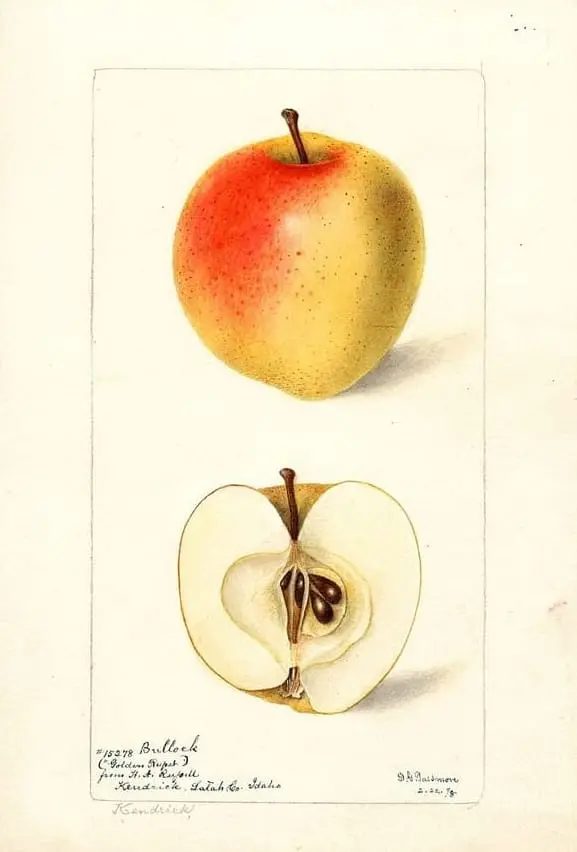
American Golden Russet
A small New Jersey russet whose flesh Downing likened to a buttery pear; Coxe knew it in 1817 as Sheep-nose
-
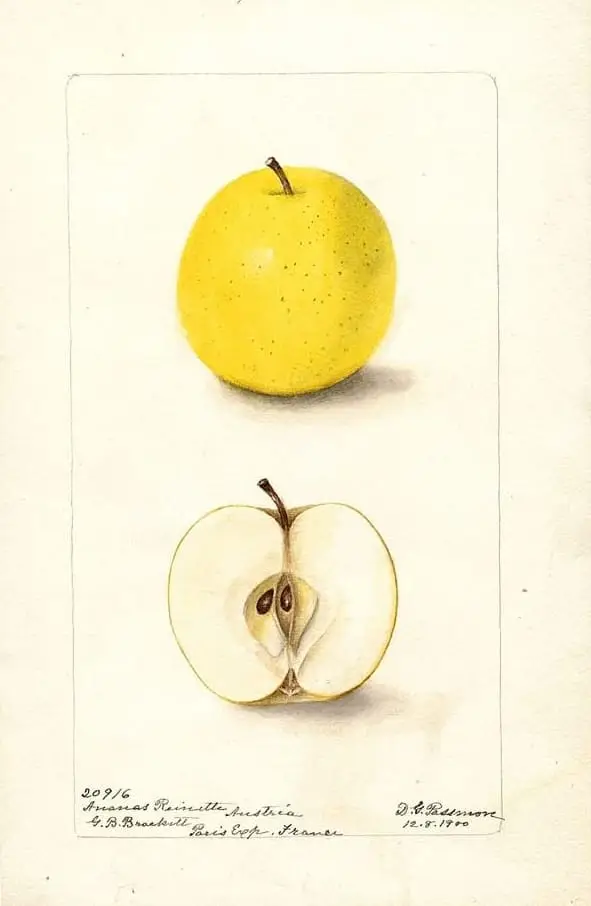
Ananas Reinette
Long thought Dutch, first described in Germany in 1826; DNA names Golden Harvey as one of its parents
-
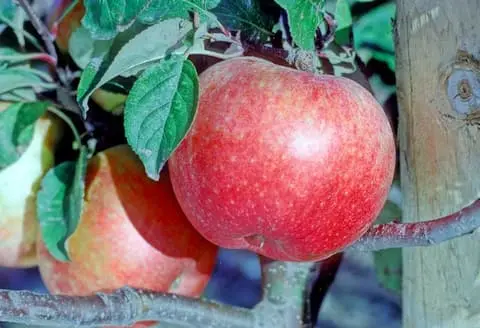
Aroma
Crossed in 1947 from Ingrid Marie and Filippa and released by Balsgård in 1973; second in Swedish orchards in 2023
-
Binet Rouge
Red-striped Norman cider apple of unknown origin, the seventh most planted cider apple in France in 1997
-
Bisquet
Old yellow-green Norman bittersweet, cited in 18th- and 19th-century monographs; its name is said to come from Biscay
-
Dabinett
A Somerset bittersweet believed to be named after a Mr Dabinett; a small tree with soft, full-bodied juice for blending
-
Dolgo
A Siberian crab brought from Russia to South Dakota in 1897 and introduced in 1917 for its ruby-red jelly
-
Douce Moën
A bittersweet despite its name, from southern Finistère; the most planted cider apple in France in 1997
-
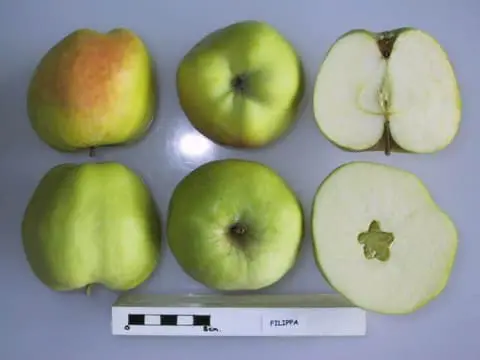
Filippa
Grown from pips sown in a pot by Filippa Johannsen at Hundstrup, Fyn, about 1880; a parent of Aroma
-
Foxwhelp
First recorded in 1664 and long Herefordshire's favourite cider apple; its origin and its odd name are both obscure
-
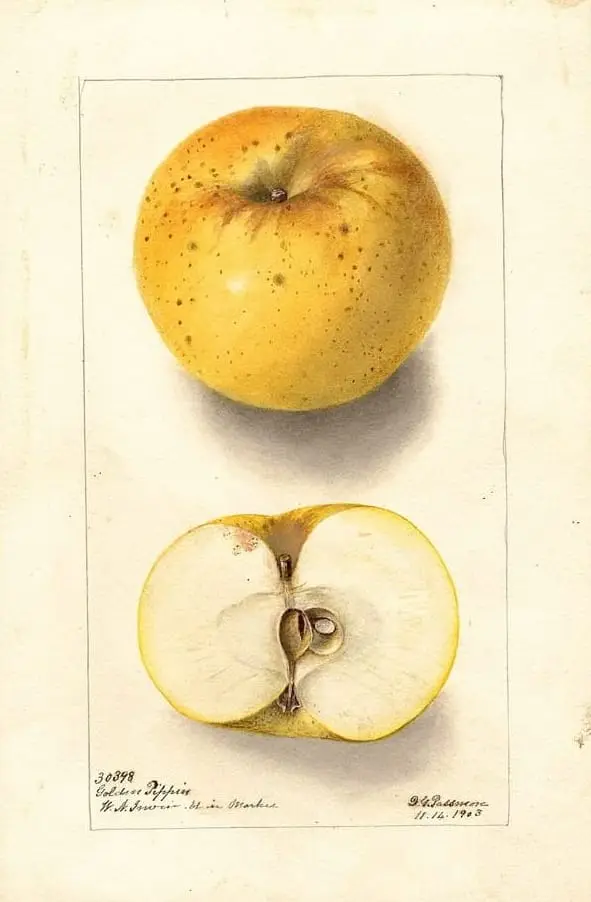
Golden Pippin
Small, golden and very old; to English connoisseurs, wrote Downing, the queen of all dessert apples
-
GoldRush
A late yellow apple of the Purdue–Rutgers–Illinois programme, named for its gold colour and "rush" of flavour
-
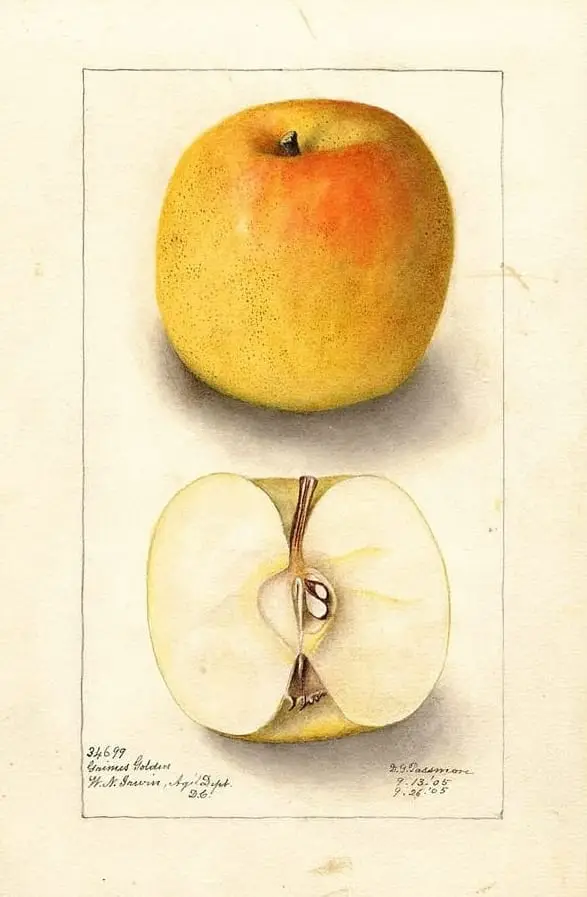
Grimes Golden
A West Virginia apple sold to New Orleans traders by 1804; DNA confirms it as a parent of Golden Delicious
-
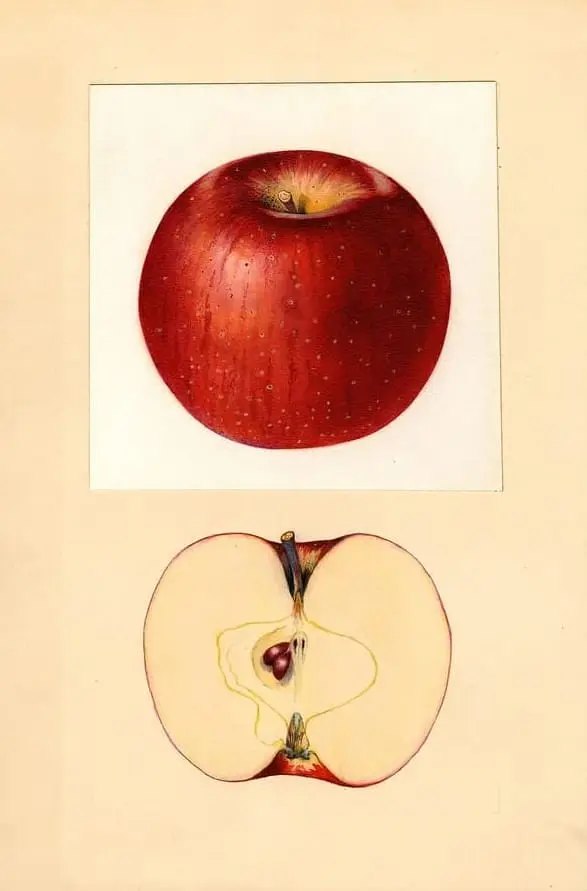
Haralson
A Malinda seedling named after the first head of Minnesota's fruit breeding farm; DNA names Wealthy as its other parent
-
Hewe's Crab
Colonial Virginia's prized cider crab, recorded from 1744; the tree now grown as Virginia Crab is another apple
-
Ilzer Rosenapfel
A perfumed chance seedling of about 1840 from eastern Styria, by 1920 one of the region's main apples
-
Kermerrien
Bitter cider apple of Finistère, among the most planted in Brittany in the 1990s and much used in French breeding
-
Kingston Black
A Somerset bittersharp whose juice comes close to the ideal for cider; its origin near Taunton rests on tradition
-
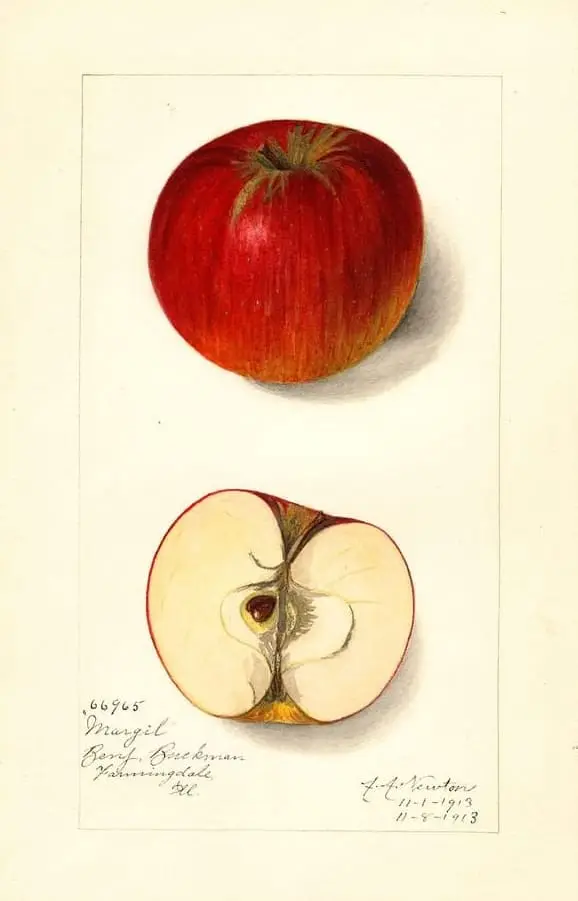
Margil
A small, ribbed, richly aromatic old apple that DNA shows to be a parent of both Ribston Pippin and Cox's Orange Pippin
-
Newell-Kimzey
Red-fleshed chance seedling recorded at Airlie, Oregon, in 1960; seed parent of Bill Howell's red-fleshed apples
-
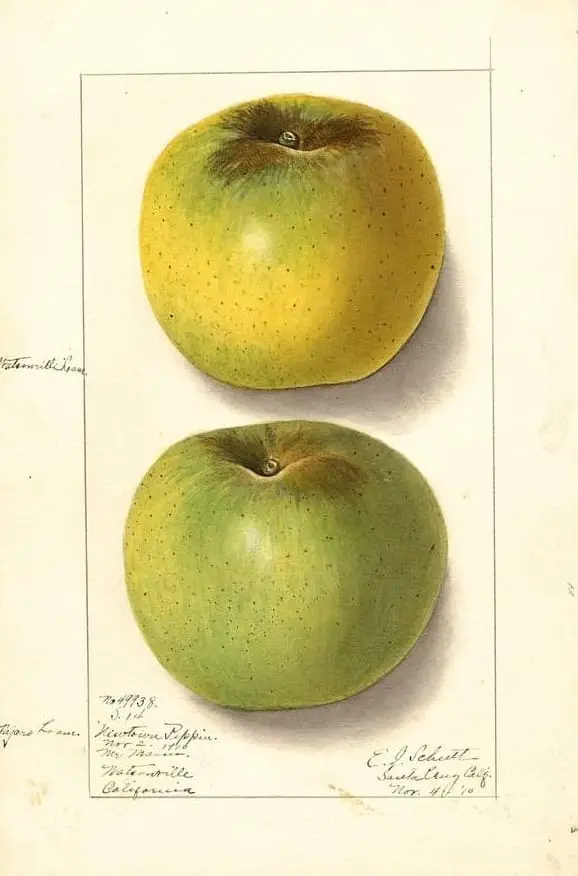
Newtown Pippin
From Newtown, Long Island: the first American apple to draw notice in Europe, sent to Franklin in London in 1759
-
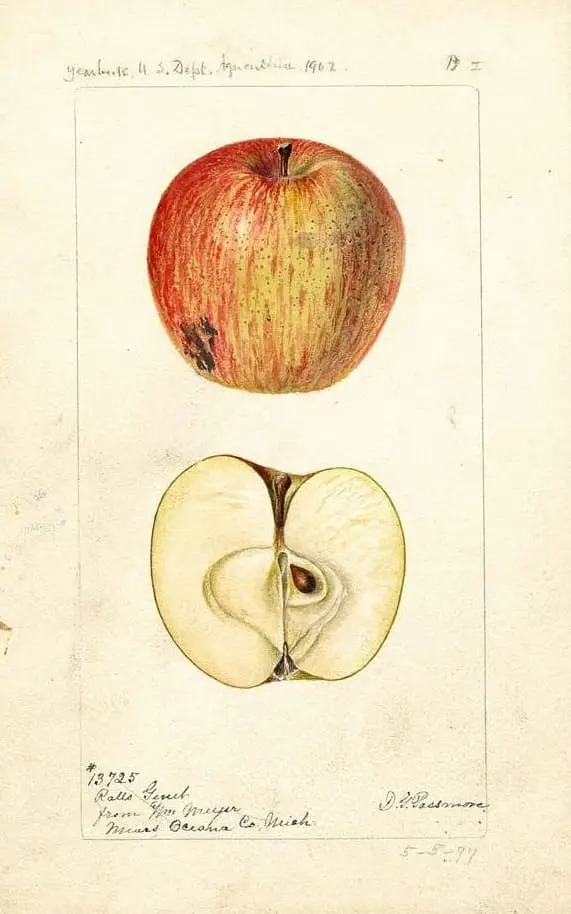
Ralls Janet
A late-blooming Virginia apple known by about 1800; in Japan, as Kokko, it became a parent of Fuji
-
Raxao
Sharp, late-flowering Asturian cider apple, the variety most used in orchards of the Sidra de Asturias designation
-
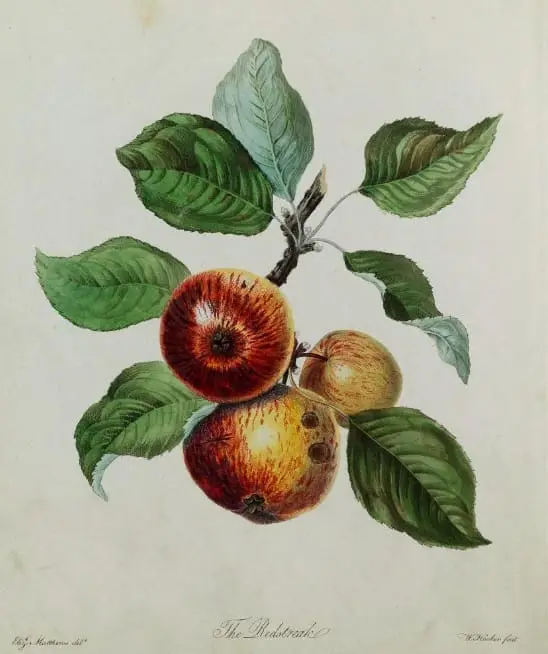
Redstreak
The celebrated cider apple of 17th-century Herefordshire, spread by Lord Scudamore; by 1885 it was no longer grown
-
Regona
A very sharp, slightly bitter Asturian cider apple, the second most used in Sidra de Asturias orchards
-
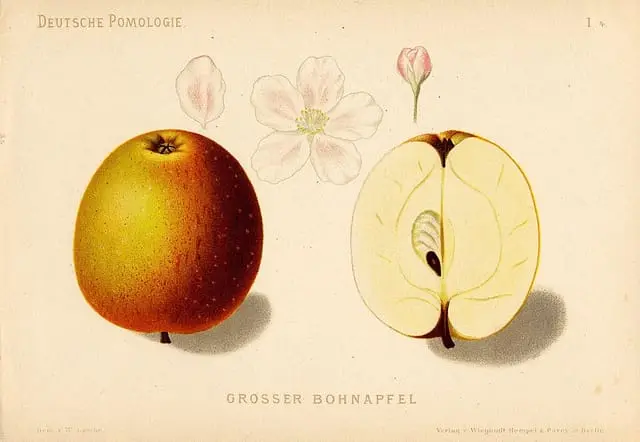
Rheinischer Bohnapfel
A triploid Rhineland apple described by Diel in 1797; hard and sour when picked, it was said to keep over a year
-
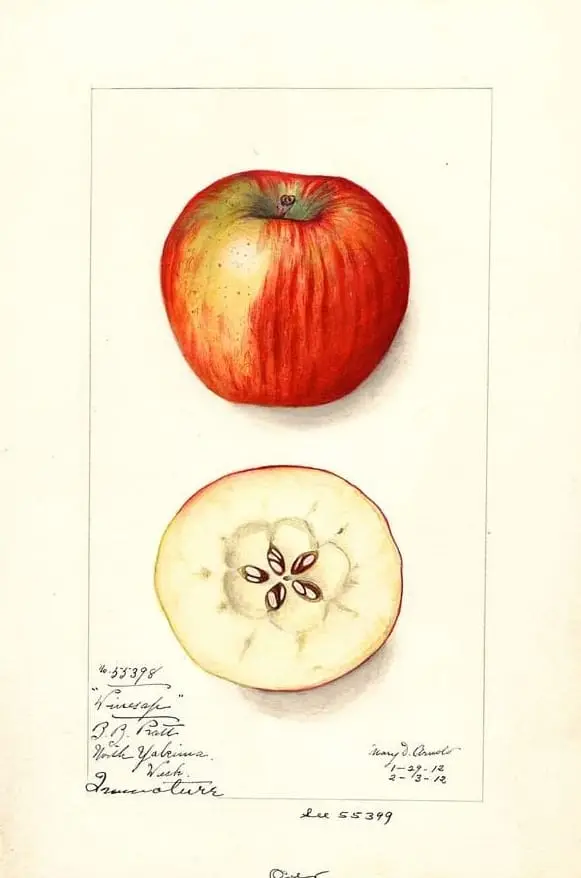
Winesap
Of unknown origin, it was "the most favored cider fruit in West Jersey" in 1817 and a parent of Delicious
-
Yarlington Mill
A bittersweet cider apple from the Somerset village of Yarlington; it makes a light, aromatic cider
-
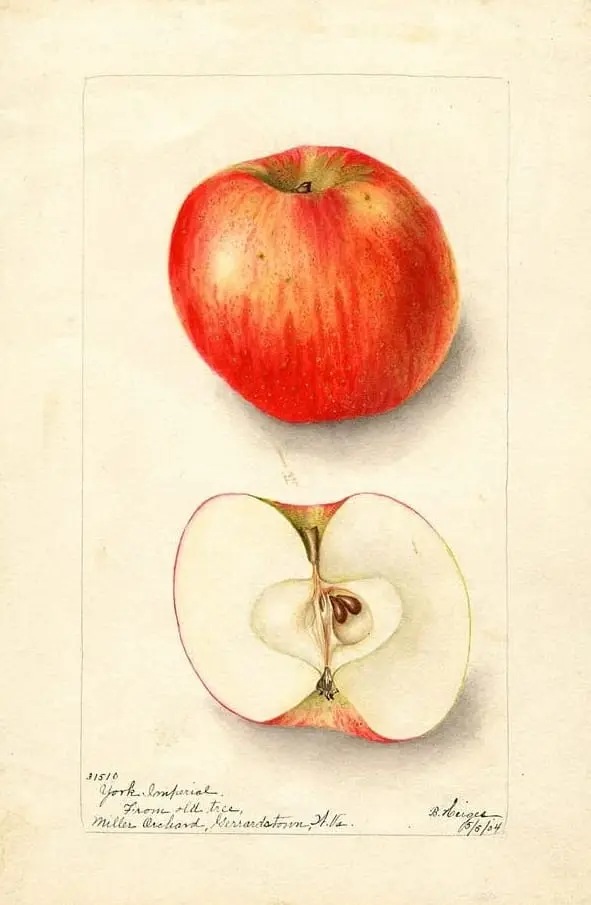
York Imperial
A lopsided Pennsylvania winter apple, named after Charles Downing called it the "imperial of keepers"
And 64 more in the catalogue, A to Z
- Ashton Bitter 1947
- Backwell Red
- Belle Fille de la Manche
- Black Dabinett
- Breakwell's Seedling late 1800s
- Broadleaf Norman
- Brown Snout by the mid 1800s
- Bulmer's Norman
- Captain Broad
- Chaxhill Red by 1873
- Cider Lady's Finger
- Coat Jersey by 1989
- Collington Big Bitters
- Crimson Victoria by 1992
- Cummy Norman
- Doux Normandie
- Dove by 1899
- Dufflin
- Dymock Red
- Ellis Bitter
- Fair Maid of Taunton by 1831
- Fillbarrel 19th century
- Frederick 19th century
- Gennet Moyle (of Taylor) by the 17th century
- Golden Harvey 1600s
- Golden Spire about 1850
- Hangdown
- Improved Dove early 1900s
- Improved Lambrook Pippin
- John Broad
- Le Bret mid 1900s
- Major
- Medaille d'Or 1865
- Michelin by 1872
- Morgan's Sweet (1) 18th century
- Muscadet de Dieppe
- Nehou by the 1920s
- Northwood 18th century
- Omont
- Paignton Marigold before 1834
- Perthyre by the late 1920s
- Pig's Snout
- Porter's Perfection 19th century
- Red Jersey
- Reine des Pommes by 1903
- Rouget by 1948
- Rougette Douce by 1893
- Royal Somerset (Copas)
- Severn Bank (LARS) by 1989
- Slack-my-Girdle
- Somerset Redstreak by 1917
- Sops-in-Wine (1)
- Stable Jersey
- Stembridge Clusters
- Stembridge Jersey
- Strawberry Norman 19th century
- Sweet Coppin
- Tale Sweet
- Tardive de la Sarthe
- Tardive Forestier
- Taylor's
- Tom Putt late 1700s
- Tremlett's Bitter
- Vilberie by the end of the 19th century
Sources
- Genomic basis of the differences between cider and dessert apple varieties, Diane Leforestier and others, Evolutionary Applications 8(7): 650–661; PubMed Central, 13 June 2015. Supports: "bitter cider apples are used to produce cider"; the fruits of cider varieties "are smaller and bitter", though not all are extremely bitter; cider apples "known for their fibrous structure, which allows longer storage".
- A bittersweet symphony: genetic insights into cider apple fruit quality, Pierre Bouillon and others, G3: Genes, Genomes, Genetics 16(1): jkaf241; PubMed Central, 19 October 2025. Supports: many traditional French and English cider apples high in polyphenols; total polyphenols "a key determinant of bitterness and astringency"; cider apples "may have greater polyphenol, organic acid, and sugar concentration than fresh-market apples"; the Long Ashton classification "the most widely recognized system"; sweets and sharps used for cider "are generally culinary cultivars".
- The Science of Cidermaking, Part 2: Fruit and Cultivation, Andrew Lea, The Wittenham Hill Cider Portal (cider.org.uk), 1997, updated 2009. Supports: approximate sugar in the juice: typical bittersweet 15%, Cox 12%, Bramley 10%; "very few 'true' cider apples" match the ideal juice, so "a blend of cider apples is nearly always necessary"; the bittersharp Kingston Black "does approximate to the ideal"; vintage quality an "elusive characteristic", with "no clear understanding of what this means in chemical terms" but "general agreement that certain cultivars produce a superior quality of cider"; Michelin, "widely planted for cidermaking in Hereford and Somerset", gives "mere bulk without any distinction".
- Cider Apple Compositional Data, Andrew Lea, The Wittenham Hill Cider Portal (cider.org.uk). Supports: the Long Ashton Research Station, near Bristol, founded to work on cider in 1903, its first director B. T. P. Barker; his classification, made "to try and impose some order on the then-prevailing chaos of nomenclature": sharp (acid over 0.45%, tannin under 0.2%), bittersharp (over 0.45%, over 0.2%), bittersweet (under 0.45%, over 0.2%), sweet (under 0.45%, under 0.2%); in the Long Ashton data Bramley's Seedling (culinary) and Cox's Orange Pippin (dessert) both class as sharps; the cultivars "generally regarded as having" vintage quality: sweets (Sweet Alford, Sweet Coppin), sharps (Frederick, Browns Apple), bittersweets (Dabinett, Yarlington Mill and others) and bittersharps (Kingston Black, Stoke Red, Broxwood Foxwhelp).
- Commonly Grown Cider Apple Cultivars in the U.S. (CIDER Report 202), C. Miles, J. King and G. Peck, Washington State University Mount Vernon NWREC, 2015. Supports: the classification by acid and tannin in the pressed juice, developed at Long Ashton Research Station, "is used by cider makers internationally".
- The Fruit Manual, fifth edition, pp. 259–260: The best cider apples, Robert Hogg, Journal of Horticulture Office, London; Internet Archive, 1884. Supports: the lists of the best cider apples of Herefordshire (with Wilding Bitter-sweet), Devonshire (with Tremlett's Bitter) and Somersetshire (with Lurley Bitter-sweet); in the Somerset list, Kingston Black: "This of itself makes a thin cider".
- The Apples of New York, vol. I, p. 8: Primitive orchards, S. A. Beach, New York Agricultural Experiment Station; Internet Archive, 1905. Supports: the fruit of seedling trees, as against grafted fruit, used "chiefly for feeding to stock and for cider-making, being on that account often called cider apples".