Apple varieties, United Kingdom
Foxwhelp
First recorded in 1664 and long Herefordshire's favourite cider apple; its origin and its odd name are both obscure
History
The Herefordshire Pomona found that “its origin and its singular name are alike obscure”1. The earliest known record of it is a passing line in Evelyn’s Pomona, first published in 1664: “Some commend the Fox-whelp”1,2. In Evelyn’s time it seems to have been thought a Gloucestershire apple: an appendix to the 1706 edition of his Pomona praised the cider of “the Fox-whelp of the Forest of Deane”1. In 1727 Hugh Stafford of Pynes, in Devon, reported that a hogshead of its cider had sold in London for £8 or eight guineas, and called it “of Herefordshire extraction”; Knight agreed in 18111. The Pomona could only guess at the name: a seedling near a fox’s earth, perhaps, or one found by a fox-hunter1.
When the Pomona appeared, between 1876 and 1885, the Foxwhelp had been Herefordshire’s favourite apple “for some hundred and fifty years past” and was still propagated3. Hogg counted it among the most valuable cider apples of the county2. Young trees were scarce, because grafts had lately done badly1. In the early nineteenth century growers at Cowarne and Canon Pyon had grafted and regrafted the old Foxwhelp on healthy stocks until it grew vigorously, and by 1823 their Rejuvenated Foxwhelp, also called the Canon Apple or Crowe’s Kernel, was established4.
The only Foxwhelps in the National Fruit Collection’s records are Broxwood Foxwhelp, planted in the orchard of H. P. Bulmer & Co. in the 1920s and thought to be a sport of Foxwhelp, and Red Foxwhelp, a red sport of “the old English cider variety”5,6,7.
The fruit
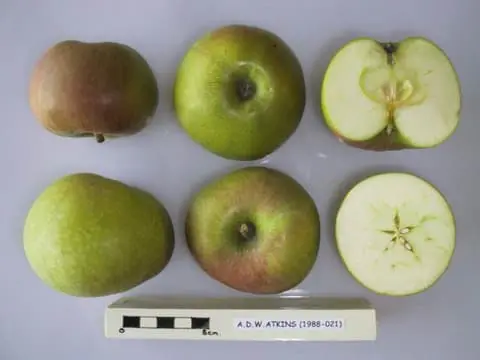
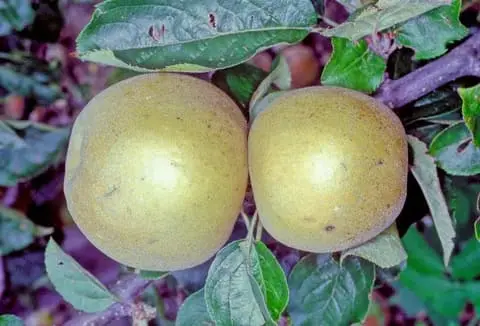
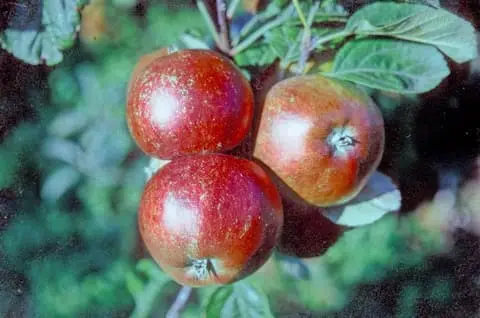
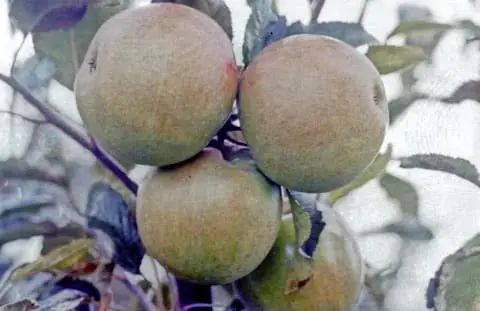
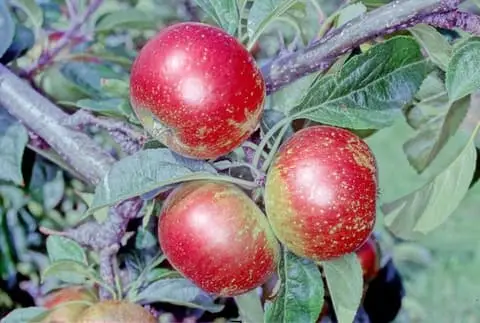
Hogg described the fruit as medium-sized, “two inches and a half wide, by the same high” (about 64 mm), roundish to ovate and unevenly ribbed2. The skin is striped with deep bright crimson and yellow, more crimson on the sunny side; the flesh is yellow tinged with red, tender, with a rough, acid flavour1,2. An analysis of the crop of the sunless, wet summer of 1877 found 14.4 per cent sugar in the juice1.
Growing
The Pomona found its home in the deep clay loam of the Old Red Sandstone in central Herefordshire, above all in the valleys of the Lugg and the Frome1. The tree is upright, slow-growing, hardy and “a shy capricious bearer”1.
Uses
Pure Foxwhelp cider, the Pomona wrote, was very strong and rough, with “a peculiar vinous musky flavour”, and could go on improving for three or four decades; more often the juice gave strength and flavour to cider of mixed fruit1. Long Ashton’s juice analyses class Bulmers or Broxwood Foxwhelp as an early bittersharp with 1.91 per cent malic acid and 0.22 per cent tannin, and Andrew Lea marks it among the cultivars of “vintage quality”8.
Where the sources disagree
- Where it came from. Writers of Evelyn’s time linked it with Gloucestershire and the Forest of Dean; Stafford and Knight called it a Herefordshire apple; the Pomona sided with the Forest of Dean1.
- The scabs. Hogg took the dark, scab-like patches on the skin for “a never-failing character” of the variety2; the Pomona blamed a fungus, Spilocaea pomi, common on the fruit of very old trees, and denied that they were characteristic1.
- The Rejuvenated Foxwhelp. Growers argued over whether it was a seedling or the old variety restored by regrafting. The Pomona thought there could “scarcely be a doubt” that it was the old variety, though its cider was sweeter and lacked the true Foxwhelp flavour4.
- Seedlings or sports. The Pomona inferred that the other apples bearing the name, among them Red Foxwhelp, were seedlings of the Foxwhelp, as tradition supposed4; the National Fruit Collection calls its Red Foxwhelp a red sport, and thinks Broxwood Foxwhelp a sport6,7.
Sources
- The Herefordshire Pomona, vol. I, plate I: The Fox-whelp Apple, Robert Hogg and H. G. Bull (eds), Woolhope Naturalists' Field Club, Internet Archive, 1876–1885. Supports: "the favourite cider Apple of Herefordshire. Its origin and its singular name are alike obscure"; the earliest record in Evelyn's Pomona, first published in 1664 ("Some commend the Fox-whelp"); no mention by Austen (1653) or Beale (1656); Worledge (1676): "esteemed among the choice cider fruits"; regarded in Evelyn's time as a native of Gloucestershire, Dr Smith writing of "the best fruit (with us in Gloucestershire)" and the appendix to Evelyn's Pomona (1706 edition) quoting "the Fox-whelp of the Forest of Deane", whose cider was not drunk till two or three years old; Hugh Stafford of Pynes, Devonshire, 1727: its reputation lately much greater, a hogshead of its cider sold in London for £8 or eight guineas, "It is of Herefordshire extraction"; Knight, Pomona Herefordiensis (1811): "certainly a true Herefordshire Apple"; the merit of its production resting with the Forest of Dean; no record of the origin of the name, perhaps a seedling near a fox's earth or found by a fox-hunter; the description of the fruit; the dark scab-like patches formed by the fungus Spilocaea pomi, common on fruit of very aged trees, and not characteristic; the plate drawn from fruit grown at Withington on trees believed planted about 1690; juice of specific gravity 1068 from a fruit of 1876, Knight giving 1076 to 1080; With's analysis of the 1877 crop, a sunless and very wet season: sugar 14.400 parts in 100; its home in the deep clay loam of the Old Red Sandstone in central Herefordshire, especially the valleys of the Lugg and Froome; the tree upright and handsome until rugged with age, slow growing, "a shy capricious bearer", hardy; a want of young trees, grafts of late years not succeeding well; pure Fox-whelp cider of great strength, with a peculiar aroma noticed when the cork is drawn, rough and strong with "a peculiar vinous musky flavour", improving for "some three or four decades of years"; the juice most used to give strength and flavour to cider of mixed fruit; the cider changing colour in the air to "the dusky greenish tint"; "beyond all question, is the most valuable cider apple".
- The Fruit Manual, 5th ed., pp. 81–82: Fox-whelp, Robert Hogg, Journal of Horticulture Office, Internet Archive, 1884. Supports: fruit medium sized, "two inches and a half wide, by the same high", roundish inclining to ovate, unevenly ribbed, one side convex and the other flattened in good specimens; skin striped deep bright crimson and yellow, darker crimson on the sunny side; dark scab-like patches "which are a never-failing character"; flesh yellow tinged with red, tender, "with a rough acid flavour"; "one of the most valuable of the cider apples of Herefordshire"; the same history as the Pomona, from Evelyn (1664) to Stafford (1727).
- The Herefordshire Pomona, vol. I, p. 127: Orchard trees, varieties of the 19th century, Robert Hogg and H. G. Bull (eds), Woolhope Naturalists' Field Club, Internet Archive, 1876–1885. Supports: "The Foxwhelp, which has been the favourite apple for some hundred and fifty years past, still lives and is still propagated".
- The Herefordshire Pomona, vol. I, plate VIII: Rejuvenated Foxwhelp; Bastard, Red and Black Foxwhelp, Robert Hogg and H. G. Bull (eds), Woolhope Naturalists' Field Club, Internet Archive, 1876–1885. Supports: Rejuvenated Foxwhelp, also called The Canon Apple and Crowe's Kernel; growers' warm dispute whether it is a seedling or the old Foxwhelp restored by grafting and regrafting; its tree and fruit more luxuriant, the fruit larger and broader; a farmer named Yeomans, at Cowarne "between 60 and 70 years ago" and later at Canon Pyon, grafting and regrafting the old Foxwhelp on healthy stocks until its luxuriance of growth returned; Mr Crowe and the wheelwrights Skidmore, Miles and Williams of Canon Pyon carrying on the regrafting, "beginning at Canon Pyon on seedlings of the 'old' Foxwhelp"; success well established by 1823; "there can scarcely be a doubt" that it is the old variety rejuvenated, the doubt arising because its cider lacks the true Foxwhelp flavour and is sweeter, more like that of Cowarne Red; the apples bearing the Foxwhelp name (Bastard, Red and Black Foxwhelp) inferred to be, "what tradition supposes them to be", seedlings from the Foxwhelp.
- Name search: foxwhelp (apple), National Fruit Collection, Brogdale, Kent (Defra). Supports: two matches among the collection's apple names, Broxwood Foxwhelp and Red Foxwhelp, and none under the plain name Foxwhelp.
- Broxwood Foxwhelp (accession 1989-124), National Fruit Collection, Brogdale, Kent (Defra). Supports: "Known to have been planted in the orchard of H.P. Bulmer & Co. Ltd., in the 1920s. Thought to be a sport of Foxwhelp"; small fruits giving "a medium bittersharp cider and a full-bodied juice"; picking in mid-September.
- Red Foxwhelp (accession 1989-128), National Fruit Collection, Brogdale, Kent (Defra). Supports: "A red sport of the old English cider variety"; picking in mid-October.
- Cider Apple Compositional Data, Andrew Lea, cider.org.uk, from Long Ashton Research Station data, 2015-04-21. Supports: composite juice analyses at Long Ashton from 1905 to 1975: Bulmers / Broxwood Foxwhelp an early bittersharp with 1.91 per cent malic acid and 0.22 per cent tannin, shown among the cultivars "generally regarded as having" vintage quality.