Apple varieties, United States
Newell-Kimzey
Red-fleshed chance seedling recorded at Airlie, Oregon, in 1960; seed parent of Bill Howell's red-fleshed apples
History
The tree grew at Airlie, a hamlet just north of Corvallis, Oregon, where the rancher Lucky Newell bought 80 acres in 19592,3. His daughter recalled him picking an apple from the young tree, by a well, and finding it red inside2; the cultivar register records the chance seedling as growing by Newell’s orchard in 19601. The Newells sold the land in 1966 and left the tree behind2,4.
In the 1980s Louis Kimzey, a former field manager at Thomas Paine Farms, came upon the grown tree2,3; the register says about 19851. He at first took it for Pink Pearl, another red-fleshed apple, but it was judged new2,3,4. Kimzey grafted it, called it Hidden Rose and shared it with other growers, among them Eric Schwartz of Thomas Paine Farms in Kings Valley, who planted it in 19942. Schwartz took out a trade mark on the name in 20012, and the fruit is sold under the registered trade mark Hidden Rose1,4. The register names the cultivar Newell-Kimzey, with Airlie Red Flesh as a synonym1, and the marketer of Hidden Rose calls its fruit Newell-Kimzey apples4.
Other growers use other names. Mount Hood Organic Farm near Parkdale has grown it since 1993 as Mountain Rose, a name John Jacobson chose after digging up about 20 trees from Kimzey2,3. RainShine Family Farm in Kings Valley, which bought a farm where the apples were called Hidden Rose, calls them Airlie Red Flesh3.
Bill Howell of Prosser, Washington, raised red-fleshed apples from open-pollinated seed of Airlie Red Flesh from 2001: Howell TC2 and Howell TC3, sold under the trade marks Lucy Rose and Lucy Glo5,6, and Howell TC7, sold under the trade mark Lucy Gem7.
The fruit
The register describes an oblong to conical apple, 55–75 mm wide and 60–80 mm high, with light green to yellowish, pale-dotted skin, sometimes reddened1. The flesh ranges from light pink to deep red and is firm and moderately dense, moderately acid, mildly sweet and tart, with a fragrance of strawberry and lemon1. The juice is a deep magenta, and ciders made from it often keep a rosy colour3.
It ripens in mid-season1; in 2024 it was picked at Parkdale on 9 October and at Kings Valley on 21 October3. The comparisons in Howell’s patent put it about three days after Honeycrisp, and give it about two months in common storage5.
Growing
The tree is moderately vigorous, with pink to light red petals1; Howell’s patent describes dark pink blossom opening about two days before Honeycrisp’s5.
Uses
It is eaten fresh, though a cider maker found it “very acidic and very floral” as an eating apple, and Northwest cider makers seek it out for its juice3. OPB reported in 2024 that it had been the basis of the last two Best of Show winners at the NW Cider Cup3.
Where the sources disagree
- When it was found. The register has the seedling growing by Newell’s orchard in 19601, and the marketer says it was still young when the Newells moved there that year4; Portland Monthly dates only Newell’s purchase of the land, in 1959, and its sale in 19662, while OPB, from local tradition, gives the 1950s or 1960s3. The rediscovery is dated to the 1980s2 or about 19851.
- Oregon State University. The marketer says the Newells showed the apple to horticulturists there in the early 1960s4; OPB says Kimzey took it there after finding it again3.
- Name. The register’s cultivar name is Newell-Kimzey1; Howell’s patent and the register’s entries for his apples call it Airlie Red Flesh5,6,7.
- Flavour. Mildly sweet and tart in the register1, sweet in Howell’s patent5, very acidic to a cider maker3.
Family tree
Offspring in the atlas
- Howell TC2 × Honeycrisp; United States, 2001
- Howell TC3 × Honeycrisp; United States, 2001
- Howell TC7 × Honeycrisp; United States, 2001
Sources
- Newell-Kimzey (Airlie Red Flesh; Hidden Rose), Fruit and Nut Cultivars Database (the American Pomological Society's register of fruit and nut cultivars); choose Apple, then Newell-Kimzey. Supports: the cultivar name Newell-Kimzey, with Airlie Red Flesh as a synonym and Hidden Rose as a registered trade mark; "Airlie, Oregon chance seedling growing by Lucky Newell's orchard in 1960, discovered anew by L. Kimzey Jr. in approximately 1985"; light green to yellowish skin with light-coloured dots and some reddening on some fruits; ripens mid-season; fruit oblong to conical, 55–75 mm across and 60–80 mm high; flesh light pink to deep red, firm, moderately dense, moderately acidic, mildly sweet, tart, "fragrant overtones such as strawberry-lemon"; tree moderately vigorous, with pink to light red petals.
- The Curious Case of the Hidden Rose, Regina Winkle-Bryan, Portland Monthly, 2016-10-04. Supports: Airlie "a hamlet just north of Corvallis", where Lucky Newell bought 80 acres in 1959; his daughter's account of his finding the young tree near a well and its red flesh; the farm sold in 1966 with the tree left behind; Louis Kimzey, a former field manager at Thomas Paine Farms, finding the grown tree in the 1980s and first thinking it a Pink Pearl, then realising it was different; Kimzey grafting it in his nursery, naming it Hidden Rose and sharing it with Eric Schwartz of Thomas Paine Farms in Kings Valley, who planted it in 1994; "In 2001, Schwartz trademarked the Hidden Rose name"; Mount Hood Organic Farm near Parkdale growing it as Mountain Rose since 1993.
- An Oregon apple with a hidden surprise, Crystal Ligori, Oregon Public Broadcasting (OPB), 2024-11-27. Supports: the names Hidden Rose, Mountain Rose and Airlie Red Flesh; the local story of a find by Lucky and Audrey Newell "sometime in the 1950's or '60's"; the Newells ranchers, not farmers; Kimzey's rediscovery two decades later, his first thought that it was Pink Pearl, and his taking it to Oregon State University, which judged it a new chance seedling; John Jacobson of Mt. Hood Organic Farms digging up about 20 trees from Kimzey and calling them Mountain Rose; RainShine Family Farm in Kings Valley, which bought a farm where the apples were called Hidden Rose, "a name trademarked by the previous owner", now calling them Airlie Red Flesh; Northwest cider makers coming for the apples and their juice; green, freckled skin; Christine Walter: "very acidic and very floral" as an eating apple; the "rich magenta" juice and the rosy colour of its ciders; the variety the foundation of the last two Best of Show winners of the NW Cider Cup; photographs of fruit picked at Parkdale on 9 October and harvested at Kings Valley on 21 October 2024.
- Hidden Rose Apples: Our Legacy, Hidden Rose Apples, Philomath, Oregon (the marketer's website). Supports: the original tree on Lucky and Audrey Newell's land at Airlie, still young in 1960 when the Newells moved there; the Newells selling the 80 acres in the mid-1960s; Louis Kimzey Jr. thinking in the 1980s that it might be a Pink Pearl, and Bill Schulz judging it a new variety; the claim that the Newells showed the apple to horticulturists at Oregon State University in the early 1960s; "The Hidden Rose Apples brand of Newell-Kimzey cv. apples"; Hidden Rose and Hidden Rose Apples "federally registered trademarks".
- Apple tree named 'Howell TC2' (US Plant Patent 28,545), William Edward Howell, inventor; Google Patents, 2017-10-24. Supports: Howell TC2 raised at Prosser, Washington, from "an open pollination cross in 2001" of Airlie Red Flesh as seed parent; Table 1 (written 'Airlie's Red Flesh'): dark pink bloom 2 days before Honeycrisp, pink flesh, light green skin, fruit maturity 3 days after Honeycrisp, "Crunchy, sweet", moderate vigour, "Okay for 2 months" in common storage.
- Register of New Fruit and Nut Cultivars List 50: Apple (Howell TC2, Howell TC3), Ksenija Gasic, John E. Preece and David Karp; apple section by Sarah Kostick and Kate Evans; HortScience 55(7): 1164–1201 (read in the Internet Archive's copy of the journal page), 2020. Supports: Howell TC2 (Lucy Rose) and Howell TC3 (Lucy Glo), both "Airlie Red Flesh O.P.; crossed 2001", raised at Prosser, Washington, by W. E. Howell.
- Register of New Fruit and Nut Cultivars List 52: Apple (Howell TC7), David Karp and Ksenija Gasic; apple section by Christopher Gottschalk; HortScience 59(8): 1220–1292 (read in the Internet Archive's copy of the journal page), 2024-08-02. Supports: Howell TC7, sold as LucyGem, from "'Airlie Red Flesh' × 'Honeycrisp'; crossed 2001".
More from United States
-
All-Red Gravenstein
-
Alton
-
American Beauty
-
American Golden Russet
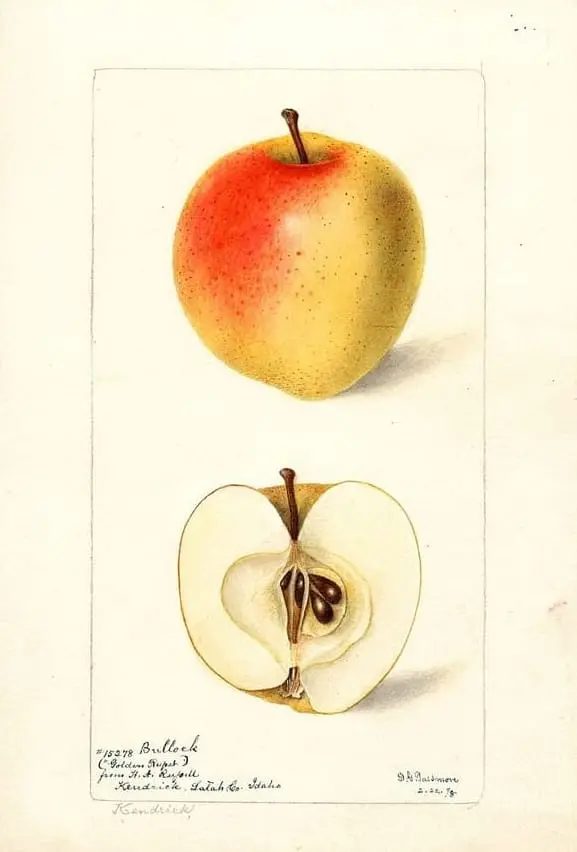
A small New Jersey russet whose flesh Downing likened to a buttery pear; Coxe knew it in 1817 as Sheep-nose
-
American Grindling
-
American Summer Pearmain
-
Ames
-
Arkansas