Apple varieties, United States
American Golden Russet
A small New Jersey russet whose flesh Downing likened to a buttery pear; Coxe knew it in 1817 as Sheep-nose
History
William Coxe of Burlington, New Jersey, described this apple in 1817 as Bullocks Pippin, or Sheep Nose, calling it “one of the finest apples in New-Jersey” in the autumn and early winter, and a native of Burlington County1. One name came from a family called Bullock, he wrote; the commoner one, Sheep-nose, from a supposed likeness between the heart-shaped fruit and a sheep’s nose; and it was sometimes called Long Tom1. The National Fruit Collection dates its origin to the late 1700s7.
In New England and the West it came to be called Golden Russet, and A. J. Downing renamed it American Golden Russet to tell it from the English Golden Russet2,4. Beach kept Coxe’s name Bullock instead, because “There are so many Golden Russets”2. One of them, the Golden Russet of Western New York, is a different apple, which Beach described separately and Downing took for an old English variety3.
It was much admired: Buel in 1826 counted it “among the best fruit for table”, and Downing, for whom it was “one of the most delicious and tender” apples, with flesh more like a buttery pear’s than an ordinary apple’s, found it a favourite everywhere for its productiveness and flavour, though neither handsome nor large2,4. It was known in the West and the South and as far north as Ontario and Quebec, but by 1905 New York grew it only on a small scale, chiefly in the Hudson and Champlain valleys, and Beach recommended it for the home orchard rather than for market2.
The fruit
The fruit is below medium size and roundish conic to ovate2,4; the National Fruit Collection records it as small and conical7. The pale or dull yellow skin is thinly sprinkled and splashed with russet2,4, which Hogg described as pale brown or “ashen grey”6. The flesh is yellowish, fine, crisp, very tender and juicy, with a rich, aromatic, mildly subacid flavour that Beach rated “very good to best”2 and Downing found spicy4. Warder noted that when fully ripe it was almost melting, like a pear, but that it turned dry when overripe5.
Beach, Downing and Hogg give its season as October to January2,4,6. At Brogdale, Kent, it begins to flower around 4 May and is picked in early October7.
Growing
Coxe described a handsome tree with a round, regular head and dark, luxuriant foliage, “a great and constant bearer”1. Beach found it not large but a fairly strong grower, and by some accounts best on sandy or gravelly soil2. Warder saw a small, vigorous, upright tree, and judged the variety unprofitable for orchards because its fruit was so apt to be imperfect; the best he had seen came from the South and from sandstone soils5.
Uses
Warder and Hogg classed it as a dessert apple5,6. Coxe also thought it an excellent cider apple, and when baked “the best apple I am acquainted with”1.
Where the sources disagree
- Origin. Coxe called it a native of Burlington County, and Beach and the National Fruit Collection follow him1,2,7; Hogg wrote that its origin was unknown, though it had long existed in America6.
- Cropping. Coxe called it a great and constant bearer, and Downing praised its productiveness1,4; Beach and Warder found it unprofitable as a commercial apple, Warder because its fruit was so apt to be imperfect2,5.
Sources
- A View of the Cultivation of Fruit Trees, p. 125: Bullocks Pippin, or Sheep Nose, William Coxe, M. Carey and Son, Philadelphia, Internet Archive, 1817. Supports: "one of the finest apples in New-Jersey, in the autumn and early winter months"; below middling in size; skin yellow inclining to russet; flesh yellow, rich, juicy, tender and sprightly; "an excellent cider apple, and when baked, is the best apple I am acquainted with"; heart-shaped, pointed towards the crown; the tree handsome, with a round, regular top and dark, luxuriant foliage, "a great and constant bearer"; "a native of Burlington county"; sometimes called the Long Tom; one name from the family of Bullock, and the commoner name Sheep-nose from a supposed resemblance of the fruit's form to a sheep's nose.
- The Apples of New York, vol. I, pp. 89–91: Bullock, S. A. Beach, New York Agricultural Experiment Station, Internet Archive, 1905. Supports: the synonyms American Golden Russet, Bullock's Pippin, Bullock's Pepping, Pippin Bullok, Little Pearmain, Sheepnose, Sheep's Nose and Sheep's Snout (p. 89); Buel's description of 1826, "tender, juicy and high flavored; among the best fruit for table"; still grown to a limited extent in New York, chiefly in the Hudson and Champlain valleys; recommended for the home orchard but not found profitable as a commercial sort; succeeding best, by some accounts, on sandy or gravelly soil; originated in Burlington County, New Jersey, "more than a century ago"; favourably known in the West and the South and as far north as Ontario and Quebec; known as Golden Russet in New England and the West, and called American Golden Russet by Downing to distinguish it from the English Golden Russet; Coxe's name Bullock kept because "There are so many Golden Russets"; tree not large but a fairly strong grower; fruit below medium, roundish conic to ovate; skin pale yellow or greenish yellow, more or less overspread and splashed with thin russet (p. 90); flesh slightly tinged with yellow, firm, fine, crisp, very tender, juicy, with a rich, aromatic, mild subacid flavour, "very good to best"; season October to January (p. 91).
- The Apples of New York, vol. I, pp. 143–144: Golden Russet, S. A. Beach, New York Agricultural Experiment Station, Internet Archive, 1905. Supports: a separate Golden Russet, called Golden Russet of New York or of Western New York to distinguish it from other apples sold under the name Golden Russet; Downing's identification of it with "the old English variety described by Ronalds and Lindley as Golden Russet".
- The Fruits and Fruit Trees of America, pp. 76–77: American Golden Russet, A. J. Downing, revised by Charles Downing, John Wiley & Sons, Internet Archive, 1900. Supports: the synonyms Golden Russet, Bullock's Pippin, Sheep Nose and Little Pearmain; "one of the most delicious and tender Apples", its flesh resembling in texture "that of a buttery Pear" more than an ordinary apple's; widely grown in the West and in New England as the Golden Russet; "neither handsome nor large" but a "universal favorite" for its great productiveness and flavour; Coxe's name Sheep-nose nearly obsolete except in New Jersey; fruit below medium size, roundish-ovate, dull yellow sprinkled with a very thin russet; flesh yellowish, very tender, juicy, with a mild, rich, spicy flavour; October to January.
- American Pomology: Apples, pp. 521–522: American Golden Russet, J. A. Warder, Orange Judd, Internet Archive, 1867. Supports: a "delicious table apple" and universal favourite, yet not a profitable variety for orchard planting "because the fruit is very apt to be imperfect"; the best seen came from the South and from sandstone soils; tree vigorous, upright, round-headed, small; fruit small to medium, round-conic, yellow covered with thin russet, sometimes faintly blushed; flesh yellowish, very fine-grained, tender, "when fully ripe almost melting, like a pear", juicy, becoming dry when overripe; quality very best; use dessert; season November and December.
- The Fruit Manual, 5th ed., p. 7: American Golden Russet, Robert Hogg, Journal of Horticulture Office, Internet Archive, 1884. Supports: fruit about the size of Golden Harvey, roundish ovate; skin yellow when ripe, with patches of pale brown or "ashen grey" russet; flesh yellowish, very tender, fine-grained, juicy, rich and aromatic; "a very valuable dessert apple", in use from October to January; "The origin of this variety is unknown", though it had long existed in America, being mentioned by Coxe in 1817.
- American Golden Russet (accession 1950-229), National Fruit Collection, Brogdale, Kent (Defra). Supports: "Originated in the late 1700s in Burlington County, New Jersey, USA"; the synonyms Bullock, Bullock's Peppin, Bullock's Pepping, Bullock's Pippin, de Vin, Fox Apple and Golden Americ; small, conical fruit with a yellow ground colour and much russet; 10% flowering on 4 May and picking in early October at the collection.
More from United States
-
All-Red Gravenstein
-
Alton
-
American Beauty
-
American Grindling
-
American Summer Pearmain
-
Ames
-
Arkansas
-
Arkansas Black
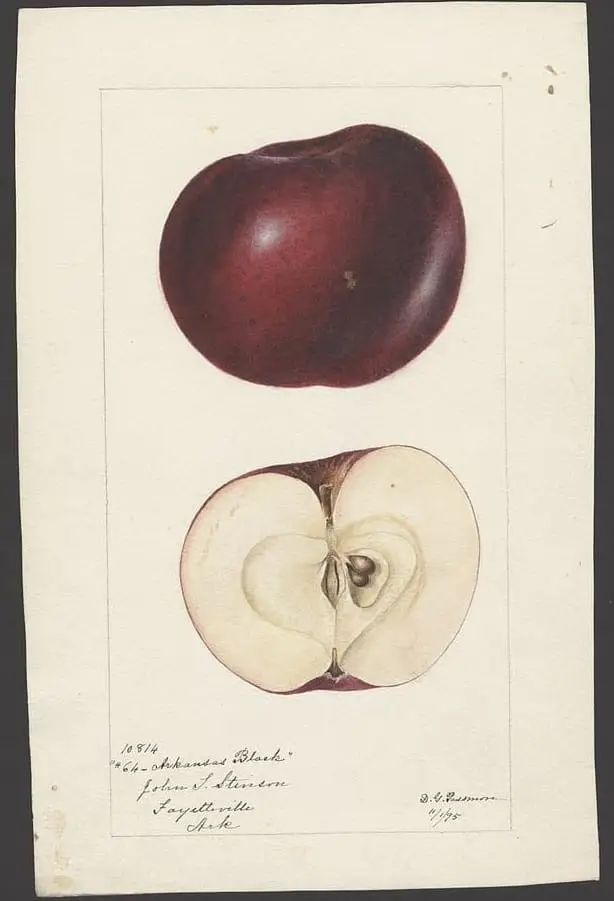
From Benton County, Arkansas, about 1870; in the sun its red skin deepens to purplish red or almost black