Apple varieties, United States
Howell TC7
Pink-blushed apple with white and red flesh, raised at Prosser, Washington, from Airlie Red Flesh seed
History
Howell TC7 was raised at Prosser, Washington, by Bill Howell, from open-pollinated seed of Airlie Red Flesh from 2001, with Honeycrisp the likely pollen parent1,2. Howell had worked at Washington State University’s research centre in Prosser as a technologist in plant virology until 2012, and raised his red-fleshed seedlings from trees that Honeycrisp had pollinated4. TC7 was selected in 20131,2, according to the patent for the quality of its fruit and its white and red flesh1.
Howell Fruit Advantage, of Prosser, applied for a patent on 22 January 2019, and US Plant Patent 31,606 was granted on 31 March 20201,2. The fruit is sold under the trade mark Lucy Gem, alongside the trade marks Lucy Rose and Lucy Glo3; the cultivar register writes the mark as one word, LucyGem2. The trees are offered for contract growing, and to growers who sell at farmers’ markets, pick-your-own orchards and fruit stands3.
The fruit
The fruit is conical, about 6.7 cm wide and 6.8 cm high, and weighs about 180 g1,2. A light, even red blush that looks pink covers about 90 per cent of the yellow-green skin; the skin has no bloom, and russet only in the stalk cavity1,2. The flesh is white and red, fine-textured and moderately juicy, with a sweet-tart flavour1,2, which Proprietary Variety Management says many people find berry-like3. In the 2018 trials at Prosser and Wapato it was harvested on 25 September, two weeks after Honeycrisp and Howell TC21.
Growing
The tree is moderately vigorous and semi-spreading, about 2.5 m tall in the trials, and was hardy where tested, in USDA zone 6b1,2. In 2018 it began to flower on 4 April and was in full bloom on 10 April, with petals white at the centre and pale red, looking pink, towards the edges1. No resistance or susceptibility to disease was noted1.
Uses
The patent gives it for fresh eating and for processing1.
Where the sources disagree
- Harvest. The patent and the register put it in late September1,2; Proprietary Variety Management gives early October3.
- Parentage. The patent names Honeycrisp only as the likely pollen parent of an open-pollinated seedling1; the register and Proprietary Variety Management give Airlie Red Flesh × Honeycrisp without qualification2,3.
Family tree
Parents, grandparents and great-grandparents, as the entries in the atlas record them.
- Howell TC7 United States, 2001
- Seed parent Newell-Kimzey United States, about 1960
- Pollen parent Honeycrisp United States, about 1960
- Parent Keepsake United States, 1936
- Parent MN 447
- Parent Northern Spy United States, about 1800
- Parent MN1627
- Parent Keepsake United States, 1936
Sources
- Apple tree named 'Howell TC7' (US Plant Patent 31,606), William Edward Howell, inventor; Howell Fruit Advantage LLC; Google Patents, 2020-03-31. Supports: variety denomination 'Howell TC7'; inventor William Edward Howell; application filed by Howell Fruit Advantage LLC on 22 January 2019, granted 31 March 2020; created in a planned breeding programme at Prosser, Washington, from "an open pollination cross in 2001" of Airlie Red Flesh (seed parent) and Honeycrisp "as the likely pollen parent"; selected in 2013 for fruit quality and its white and red flesh; description from the 2018 season at Prosser and Wapato; tree of moderate vigour, semi-spreading, 2.5 m tall; "Hardy in area tested (USDA Zone 6B)"; first bloom 4 April and full bloom 10 April 2018; petals white near the centre and pale red, appearing pink, towards the edges; fruit 6.7 cm wide and 6.8 cm high, about 180 g, conic; russet in the stalk cavity only; no bloom on the skin; ground colour yellow-green with a light, evenly distributed red over colour on 90 per cent, "pale red, appears pink"; flesh white and red, fine, of medium juiciness; "appealing sweet/tart flavor"; harvested 25 September 2018, two weeks after Honeycrisp and Howell TC2; no disease resistance or susceptibility noted; market use fresh and processed.
- Register of New Fruit and Nut Cultivars List 52: Apple (Howell TC7), David Karp and Ksenija Gasic; apple section by Christopher Gottschalk; HortScience 59(8): 1220–1292 (read in the Internet Archive's copy of the journal page), 2024-08-02. Supports: entry "'Howell TC7' (LucyGem)" and the cross-reference "LucyGem. See 'Howell TC7'", the mark written as one word and marked as registered; yellow-green-skinned with white and red flesh and a sweet-tart flavour; origin Howell Fruit Advantage, Prosser, Washington, by W. E. Howell; "'Airlie Red Flesh' × 'Honeycrisp'; crossed 2001; selected 2013"; USPP 31,606 of 31 March 2020; fruit 6.7 cm across (length given as "6.8 in", 6.8 cm in the patent), conical, 90 per cent light red over yellow-green; flesh white and red; juiciness medium; "ripens late September"; vigour moderate; semi-spreading; blooms early April.
- Lucy Gem, Proprietary Variety Management (PVM), Brandt's Fruit Trees. Supports: "Howell TC7 cv" sold under the trade mark Lucy Gem; the Lucy family "licensed under the tradenames" Lucy Glo, Lucy Rose and Lucy Gem, all available for contract growing at Brandt's Fruit Trees and to farm-gate growers serving farmers' markets, pick-your-own operations and fruit stands; parentage given as "Arlie Red Flesh x Honeycrisp"; breeder and owner the Howell Breeding Program; "Crisp and juicy with a sweet/tart flavor", which many call berry-like; colour "Greenish-yellow"; medium size; harvest "Early October".
- New apple varieties red inside and out, Dan Wheat, Capital Press, 2019-12-31. Supports: Bill Howell a research technologist in plant virology at Washington State University's research and extension centre in Prosser from 1973 to 2012; his red-fleshed seedlings raised from trees pollinated by Honeycrisp.
More from United States
-
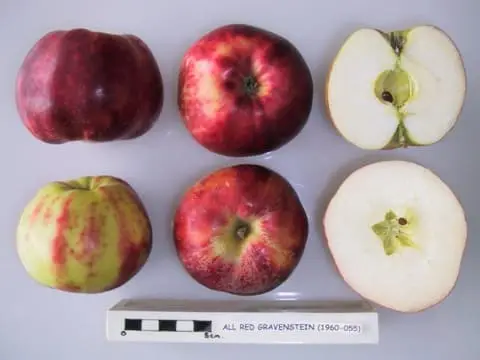
All-Red Gravenstein
-
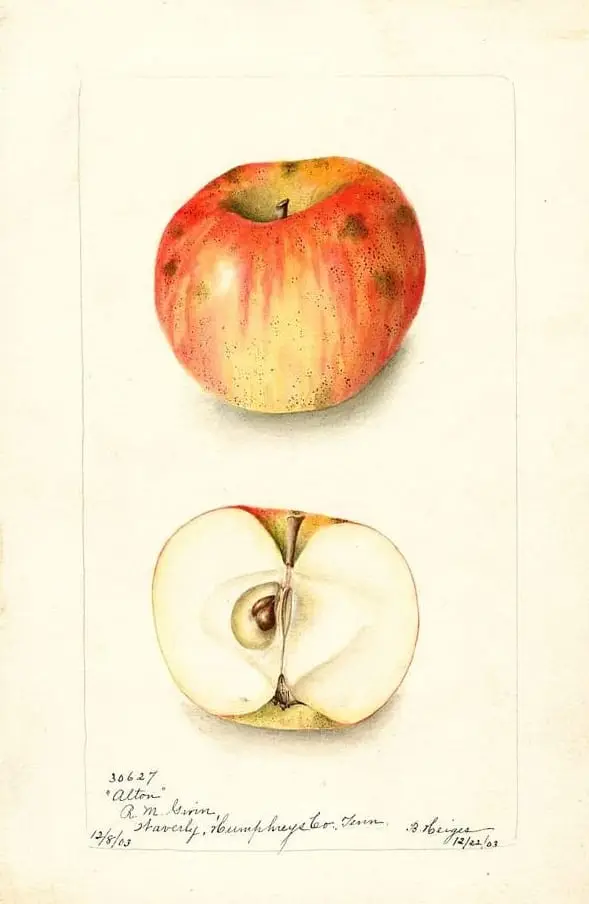
Alton
-
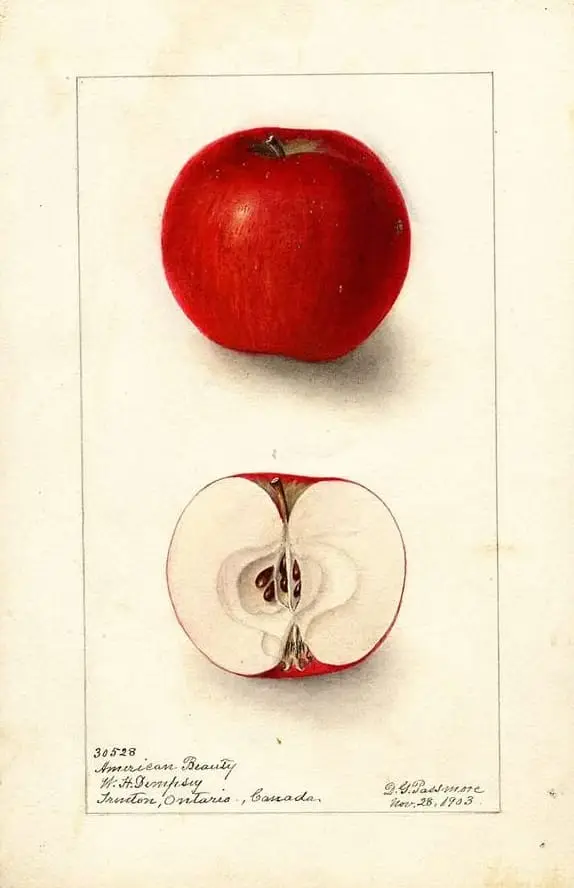
American Beauty
-
American Golden Russet
A small New Jersey russet whose flesh Downing likened to a buttery pear; Coxe knew it in 1817 as Sheep-nose
-
American Grindling
-
American Summer Pearmain
-
Ames
-
Arkansas