Apple varieties, United States
Honeycrisp
Nearly discarded after winter injury, it became Minnesota's state fruit; DNA showed its recorded parents were wrong
History
Honeycrisp came out of the University of Minnesota’s apple breeding programme, which aimed at winter-hardy apples of high quality1. The cross that produced it was probably made about 1960, although records from the period are lacking2. The seedling was planted in 1962 at the University’s Horticultural Research Center near Excelsior and picked out in September 1974 for testing as MN 17111. The original tree was discarded after winter injury in 1977, and four grafted copies in a test orchard were also marked for removal; David Bedford, newly appointed as breeder, spared them because they stood on a poor site and too few notes had been taken on the selection2. MNopedia dates the rescue to 19823.
The University filed for a plant patent in November 1988, granted in March 1990 with Jim Luby and David Bedford as inventors1, and introduced the variety in 19912. In 2006 the Minnesota legislature made it the state fruit4, after a letter-writing campaign by a class of fourth-graders at Andersen Elementary School in Bayport3. By 2019 the University had received $16.5 million in royalties; the US patent expired in 20083.
The parentage recorded for the seedling, Macoun × Honeygold1, soon looked doubtful, and DNA markers showed it to be wrong2. A marker study identified Keepsake as one parent, and in 2017 a study of 3,435 SNP markers confirmed Keepsake and identified the other parent as MN1627, an unreleased University selection from Duchess of Oldenburg × Golden Delicious, selected in 1951 and probably now extinct2.
Honeycrisp became one of the main American apples: the US industry’s forecast for the 2026/27 crop put it fourth among US varieties, after Gala, Red Delicious and Granny Smith, with 10 per cent of production (“approximately 27 million bushels”)5. Most of the US crop is grown in the Pacific Northwest, and in 2022 it was the most valuable of the five leading US apples, worth roughly twice as much per pound as Fuji6. Nine cultivars bred from it were then on the market6, among them Minneiska and WA 382.
The fruit
The fruit is medium to large, 7.0 to 10.2 cm across, and oblate to roundly oblate7. The thin skin is 50 to 90 per cent mottled red over yellow, more coloured where the sun reaches it1, and it may colour less well in warmer climates7. The cream-coloured flesh is coarse-grained, extremely crisp and very juicy, its large cells bursting with juice when bitten1,7. The flavour is sweet-tart and mildly aromatic1,7; fruit picked early is mild, while later pickings can be strongly aromatic1. Above all a dessert apple, it is also good for pies, crisps, apple sauce and salads1,7.
At Excelsior it can be picked from 10 September to 15 October, best in the fourth week of September, about five days after McIntosh; the fruit ripens evenly and does not drop1. It holds its crispness in store: the patent recorded at least five months at about 1 °C without controlled atmosphere1, and the University now gives about seven months in cold air at about 3 °C and ten months or more in controlled atmosphere7.
Growing
The tree is moderately vigorous; the patent describes it as slightly upright1, the University’s growing notes as somewhat spreading7. It is hardy in USDA zone 4, about −32 to −34 °C (“-25 to -30°F”)7. The patent recorded annual crops without thinning; the trees set up to 5 per cent of fruit with their own pollen, but cross-pollination is desirable for commercial crops1.
Awais Khan of Cornell has called it “one of the most difficult apple cultivars to grow”8. It needs careful nutrient management to limit bitter pit, is prone to zonal leaf chlorosis, and suffers several storage disorders, among them bitter pit, soft scald and soggy breakdown6. Bitter pit is worst on young trees; soft scald can be reduced by holding the fruit at 10 °C for five to seven days before cold storage, and the fruit should not be stored at 0 °C or below7. Vigorous young trees on susceptible rootstocks can be badly hit by fire blight in severe years, while older trees show moderate to good resistance7. Honeycrisp is diploid6,8.
Where the sources disagree
- Parentage. The patent records the cross as Macoun × Honeygold1. DNA studies show instead that Honeycrisp is Keepsake × MN16272; the DNA evidence is much the better supported.
- Who made the cross. MNopedia says Cecil Stushnoff made the cross in 1960, yet the archive it lists describes him as joining the University’s horticulture department in 19673. The breeders’ own study says only that the records point to a cross made around 19602.
- Apple scab. The patent described the variety as slightly susceptible to scab1; later work reports it as resistant2,6.
Family tree
Parents, grandparents and great-grandparents, as the entries in the atlas record them.
- Honeycrisp United States, about 1960
- Parent Keepsake United States, 1936
- Parent MN 447
- Parent Northern Spy United States, about 1800
- Parent MN1627
- Parent Keepsake United States, 1936
Offspring in the atlas
- CN 121 United States, 1994
- Howell TC2 × Newell-Kimzey; United States, 2001
- Howell TC3 × Newell-Kimzey; United States, 2001
- Howell TC7 × Newell-Kimzey; United States, 2001
- MAIA-1 × Fuji; United States, 1999
- MAIA-L United States, 1999
- Minneiska × Minnewashta; United States, 1988
- MN55 × AA-44; United States, 1997
- New York 1 × NY 752; United States, 1998
- WA 38 × Enterprise; United States, 1997
Sources
- Apple tree: Honeycrisp (US Plant Patent 7197), Jim Luby and David S. Bedford, inventors; University of Minnesota; Google Patents, 1990-03-20. Supports: application filed on 7 November 1988 and granted on 20 March 1990, inventors Jim Luby and David S. Bedford, assigned to the Regents of the University of Minnesota; the breeding aim of "winter hardy varieties with high fruit quality"; the seedling planted in 1962 at the Horticultural Research Center in Carver County near Excelsior, discovered in September 1974 and tested as MN 1711; the recorded cross "Macoun x Honeygold"; harvest "September 10 to October 15 at Excelsior", optimum in the fourth week of September about 5 days after McIntosh, with even ripening and no drop; crisp texture kept "for at least 5 months" at 34 °F without atmosphere modification; 50–90% red over a yellow background, more where exposed to the sun; thin skin; cream-coloured, coarse-grained, extremely crisp, juicy flesh; subacid, mildly aromatic flavour, mild when picked early and strongly aromatic when picked late; moderately vigorous, slightly upright tree bearing annually without thinning; up to 5% fruit set with its own pollen, cross-pollination desirable for commercial production; "slightly susceptible to apple scab"; excellent for dessert, good for pies, apple crisp desserts and applesauce.
- Elucidation of the 'Honeycrisp' pedigree through haplotype analysis with a multi-family integrated SNP linkage map and a large apple (Malus × domestica) pedigree-connected SNP data set, N. P. Howard and others, Horticulture Research 4: 17003, 2017. Supports: introduction by the University of Minnesota in 1991; the cross "likely made around 1960", with records from the period lacking; first selected as MN1711 in 1974; the original tree discarded after winter injury in 1977; four clones flagged for removal but spared by the newly appointed breeder David Bedford because of a poor site and insufficient evaluation notes; the recorded parentage doubted and shown wrong by SSR markers, which identified Keepsake as one parent; the study of 3,435 SNPs confirming Keepsake and identifying the other parent as MN1627 (Duchess of Oldenburg × Golden Delicious, selected in 1951, probably extinct), written 'Keepsake'×MN1627; Honeycrisp a parent of released cultivars including Minneiska and WA 38; its reported resistance to apple scab.
- Honeycrisp apple, Rita Pyrillis, MNopedia, Minnesota Historical Society, 2024-07-22. Supports: MN 1711 saved from the reject pile in 1982 by David Bedford; state fruit in 2006 after a letter-writing campaign by a class of fourth-graders at Andersen Elementary School in Bayport; $16.5 million in royalties to the University by 2019; the patent expired in 2008; the 1960 cross credited to Cecil Stushnoff, and the Stushnoff papers it lists describing him as joining the Department of Horticultural Science in 1967.
- Minnesota Statutes, section 1.1475: State fruit, Office of the Revisor of Statutes, Minnesota Legislature, 2025. Supports: "The Honeycrisp apple is the official fruit of the state of Minnesota" (2006 c 229 s 1).
- USApple Releases 2026 Industry Outlook Report, U.S. Apple Association (USApple), 2026-08-21. Supports: the 2026/27 forecast placing Honeycrisp fourth, at "approximately 27 million bushels (10%)", after Gala, Red Delicious and Granny Smith.
- A phased, chromosome-scale genome of 'Honeycrisp' apple (Malus domestica), A. Khan and others, GigaByte, 2022-09-19. Supports: the genome assembled as two phased haplomes, each of 17 chromosomes; most US Honeycrisp grown in the Pacific Northwest; of the five leading US cultivars, Honeycrisp "by far the most valuable", with "roughly twice the value per pound" of Fuji; "nine new cultivars derived from 'Honeycrisp'" on the market; resistance to apple scab; careful nutrient management needed to limit bitter pit; tendency to zonal leaf chlorosis; storage disorders including bitter pit, soft scald and soggy breakdown.
- Honeycrisp, Minnesota Hardy, University of Minnesota. Supports: fruit 7.0–10.2 cm, oblate to round oblate; poorer colour in warmer climates; large cells that "explode with juice"; sweet-tart, mildly aromatic flavour; seven months in common storage at 37 °F and ten or more in CA storage; somewhat spreading habit; hardy in USDA zone 4 ("-25 to -30°F"); bitter pit mainly on young trees; soft scald reduced by holding fruit at 50 °F for 5 to 7 days before cold storage, and no storage at 32 °F or lower; serious fire blight possible on vigorous young trees on susceptible rootstocks, older trees moderately to well resistant; uses for fresh eating, cooking and salad.
- Honeycrisp genome will help scientists breed better apples, Cornell Chronicle, Cornell University, 2022-10-13. Supports: Awais Khan calling Honeycrisp "one of the most difficult apple cultivars to grow"; the sequencing of "the apple's diploid genome".
More from United States
-
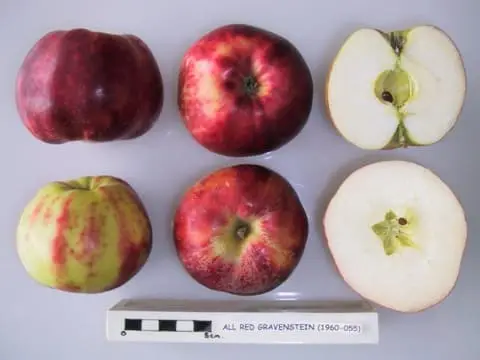
All-Red Gravenstein
-
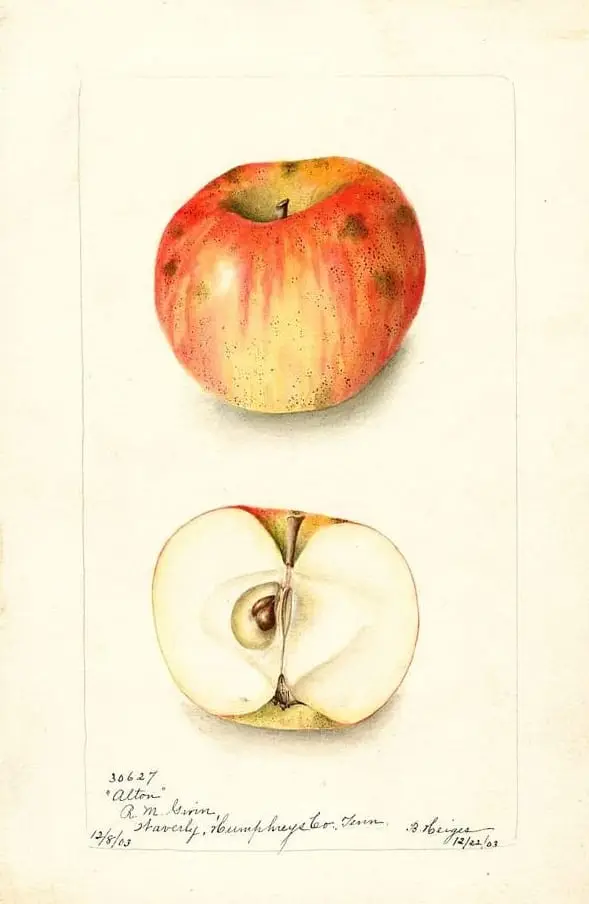
Alton
-
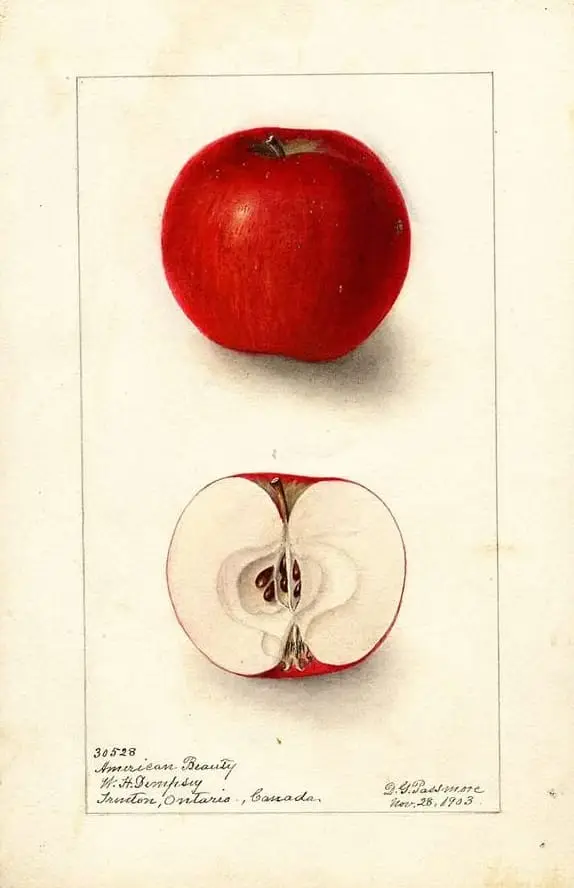
American Beauty
-
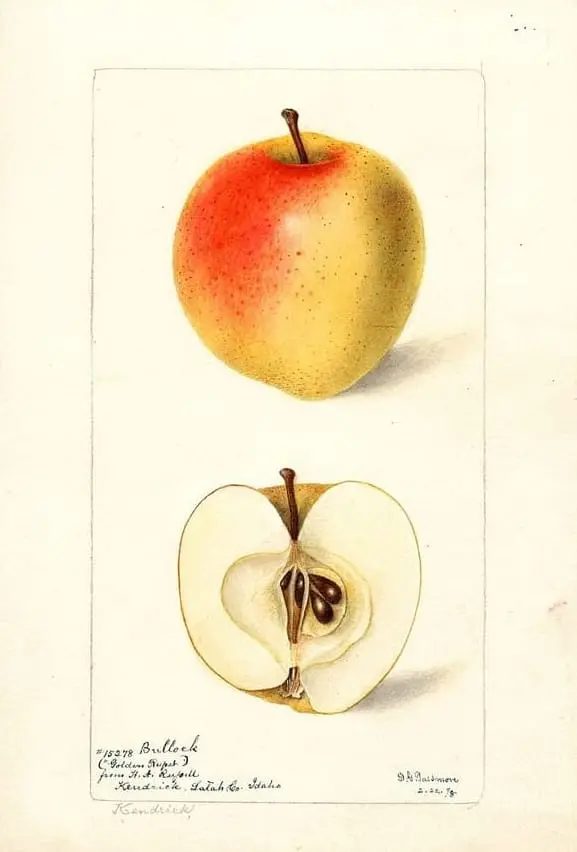
American Golden Russet
A small New Jersey russet whose flesh Downing likened to a buttery pear; Coxe knew it in 1817 as Sheep-nose
-
American Grindling
-
American Summer Pearmain
-
Ames
-
Arkansas