Apple varieties, United States
Minneiska
An early, very crisp Minnesota apple from a 1988 cross of Honeycrisp and Minnewashta, sold as SweeTango
History
Minneiska comes from cross AE 8808, made in 1988 between Honeycrisp, the seed parent, and Minnewashta, the pollen parent1. Minnewashta is another of the University’s apples2. The breeders David Bedford and James Luby found the seedling in 1999, as tree 46 in row 23 of block 86 at Excelsior, and propagated it there by budding and grafting1. They chose it for an unusual combination: early ripening, a very crisp and juicy texture that lasts in store, and a storage life long for an early apple1.
The University applied for a plant patent in October 2006, claiming priority from October 2005, and US Plant Patent 18,812 was granted on 13 May 2008, with Bedford and Luby as inventors, assigned to the University’s Regents1. The fruit is sold under the trade mark SweeTango, registered to the Regents, and the variety, protected by plant breeders’ rights in other countries, is licensed exclusively by the University2. Howard and colleagues list it among the cultivars bred from Honeycrisp3.
The fruit
The fruit is medium to large, 7.1 to 7.9 cm across and 6.0 to 7.0 cm high, round-conical and mostly asymmetric at the eye end1. The pale yellow to yellow-green skin is 70 to 95 per cent covered by a red blush with faint stripes, and the lenticels stand out; there is always some russet around the stalk, and on some fruit it spreads widely1. The flesh is creamy white, coarse, very crisp and juicy1. The flavour ranges from slightly tart to evenly balanced between sweet and tart; in the patent’s tests its acidity was higher than Honeycrisp’s (0.70 against 0.50 per cent titratable acid) and its soluble solids about the same (14.8° against 14.7° Brix)1. The University describes it as juicy and sweet with hints of autumn spice, its flavour balanced by lively acidity, and as having inherited Honeycrisp’s crispness and Minnewashta’s juiciness4.
At Excelsior it ripens about the first week of September, just after Minnewashta and two to three weeks before Honeycrisp, and the fruit seldom drops before harvest1,4. It keeps for 90 to 120 days in common storage at about 1–3 °C with little change in texture or flavour, against two months for Minnewashta, one or two for State Fair and Arends, and seven for Honeycrisp1.
Growing
The tree is spreading to slightly upright, of medium-high vigour, and cropped every year in the inventors’ six years of trials at Excelsior1. It is more vigorous than Honeycrisp and more susceptible to apple scab, with average susceptibility to scab and fire blight, and is hardy in USDA zone 41. At Excelsior it begins to flower around 8 May, three to five days after Minnewashta and at about the same time as Honeycrisp1.
Family tree
Parents, grandparents and great-grandparents, as the entries in the atlas record them.
- Minneiska United States, 1988
- Seed parent Honeycrisp United States, about 1960
- Parent Keepsake United States, 1936
- Parent MN 447
- Parent Northern Spy United States, about 1800
- Parent MN1627
- Parent Keepsake United States, 1936
- Pollen parent Minnewashta
- Seed parent Honeycrisp United States, about 1960
Sources
- Apple tree named 'Minneiska' (US Plant Patent 18,812), David S. Bedford and James J. Luby, inventors; Regents of the University of Minnesota; Google Patents, 2008-05-13. Supports: priority date 13 October 2005, application filed on 13 October 2006 and granted on 13 May 2008, inventors David S. Bedford and James J. Luby, assigned to the Regents of the University of Minnesota; selected for its early ripening, very crisp and juicy texture kept in storage, and "unusually long storage life for an early ripening variety"; discovered in 1999 as Tree 46 in Row 23 of Block 86 at Excelsior; cross AE 8808 made in 1988 between female parent Honeycrisp and male parent Minnewashta; propagated by budding and grafting at Excelsior; observed for six years at Excelsior; ripening about the first week of September at Excelsior, slightly after Minnewashta and two to three weeks before Honeycrisp; fruit 7.1–7.9 cm in diameter and 6.0–7.0 cm high, globose conical; skin pale yellow to yellow-green with a red overcolour on 70 to 95% of the surface, "blushed with faint striping"; lenticels medium to large and prominent; russet always around the stalk cavity, sometimes extensive; flesh creamy white, "Coarse, crisp, and juicy"; flavour "slightly tart to a well-balanced flavor between sweetness and tartness"; titratable acidity 0.70% against 0.50% in Honeycrisp, Brix 14.8° against 14.7°; storage life "90 to 120 days in common stage (34 to 37° F.)", against 7 months for Honeycrisp, two months for Minnewashta and one or two months for State Fair and Arends; fruit seldom dropping before harvest; tree spreading to slightly upright, of medium-high vigour, cropping annually; more vigorous and more susceptible to apple scab than Honeycrisp, with average susceptibility to scab and fire blight; hardiness USDA zone 4; flowering from about 8 May at Excelsior, 3 to 5 days after Minnewashta and similar to Honeycrisp.
- Apple licensing & commercialization, Minnesota Hardy, University of Minnesota. Supports: the SweeTango apple, "Minneiska variety (US Plant Patent 18,812)", SweeTango a registered trade mark of the Regents of the University of Minnesota; the variety protected by the US Plant Patent Act and by plant breeders' rights in other countries, and exclusively licensed by the University; Zestar! ("Minnewashta variety") also a registered trade mark of the Regents.
- Elucidation of the 'Honeycrisp' pedigree through haplotype analysis with a multi-family integrated SNP linkage map and a large apple (Malus × domestica) pedigree-connected SNP data set, N. P. Howard and others, Horticulture Research 4: 17003, 2017. Supports: Honeycrisp a parent of multiple released cultivars, among them Minneiska; Honeycrisp itself shown by SNP data to come from Keepsake × MN1627.
- All University of Minnesota Apple Varieties, Minnesota Hardy, University of Minnesota. Supports: the Minneiska apple (listed as SweeTango): juicy and sweet "with hints of fall spices", deep red over a yellow background, its flavour "balanced by vibrant acidity", with the crisp texture of Honeycrisp and the juiciness of Minnewashta (listed as Zestar!); ripens early September.
More from United States
-
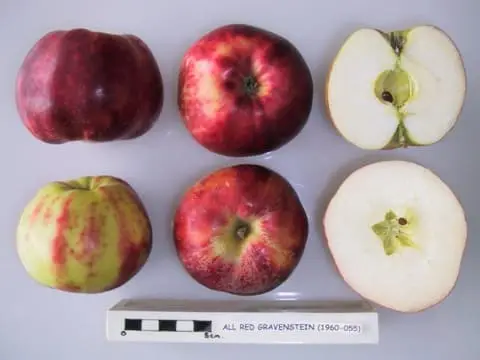
All-Red Gravenstein
-
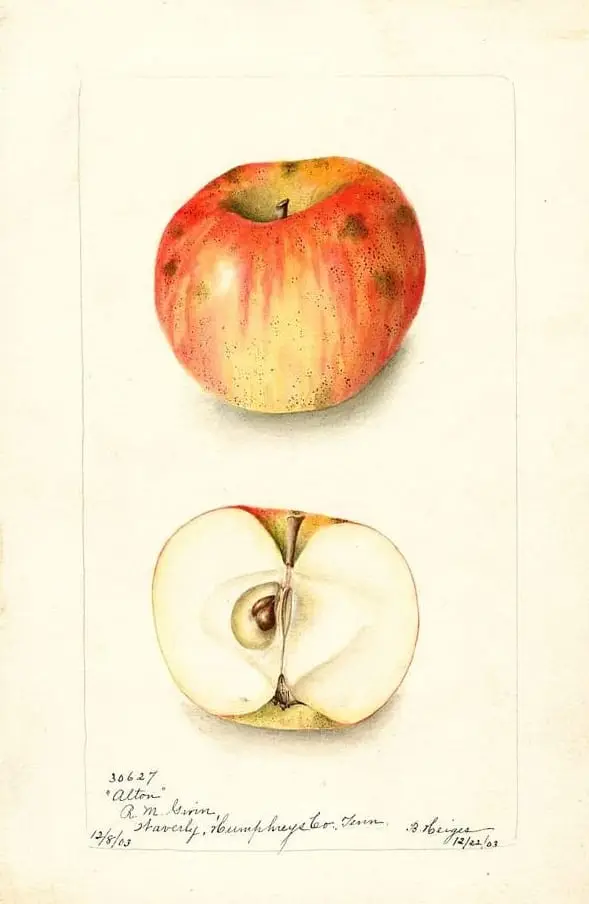
Alton
-
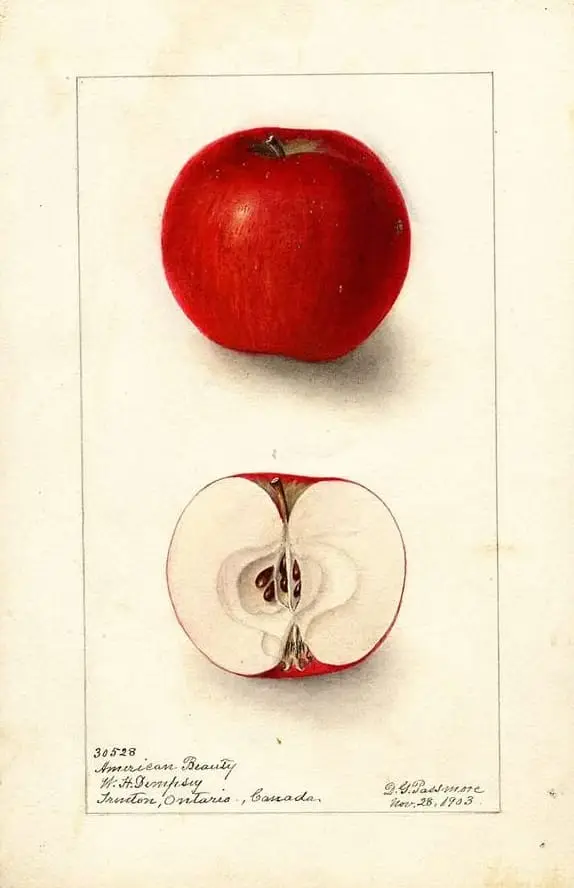
American Beauty
-
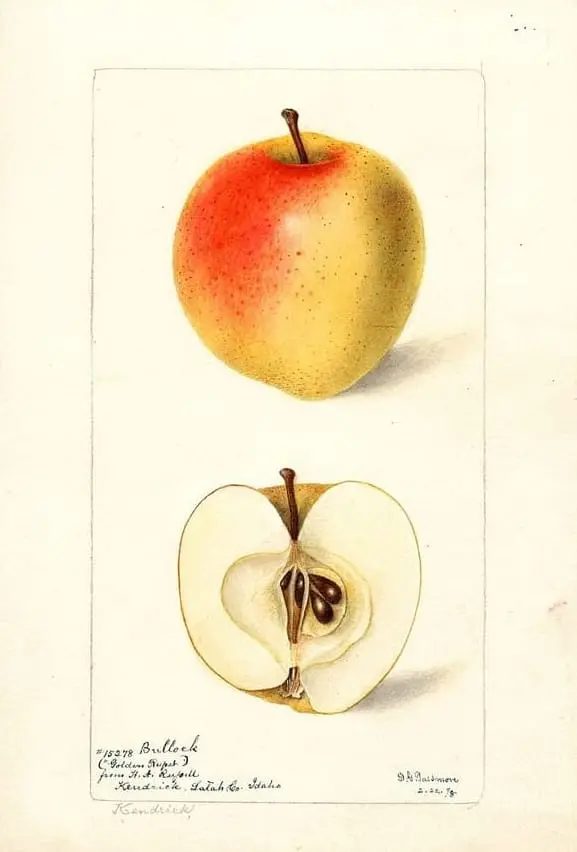
American Golden Russet
A small New Jersey russet whose flesh Downing likened to a buttery pear; Coxe knew it in 1817 as Sheep-nose
-
American Grindling
-
American Summer Pearmain
-
Ames
-
Arkansas