Apple varieties, United States
Golden Delicious
A West Virginia seedling that Stark Bro's bought for $5,000 and guarded in a locked cage with a burglar alarm
History
In the autumn of 1905, according to a 1987 account from West Virginia University, Anderson Mullins noticed a young tree bearing large yellow apples on a farm near Porter’s Creek in Clay County, West Virginia1. It had not been planted; as Mullins put it, “It just growed there”1. For nine years it cropped every year, even when the other trees in the orchard were bare, and its fruit kept in the family’s cellar until April; he called it Mullins Yellow Seedling1.
In the spring of 1914 Mullins posted three of the apples to Stark Bro’s Nurseries at Louisiana, Missouri1. Paul Stark travelled to West Virginia to find the tree, and the firm paid $5,000 for it1 and introduced it as Golden Delicious3,4. The Starks enclosed the tree in a locked steel cage with a burglar alarm wired to the farmhouse, which the family cow set off once, and for thirty years paid Mullins’s nephew Bewel $100 a year to tend it1,2. It won praise at once and was soon a leading apple at home and abroad1. The original tree died in the spring of 19581, and in 1995 West Virginia made Golden Delicious its state fruit2.
It is a popular parent in apple breeding1: DNA studies confirm it as a parent of Gala and of the triploid Jonagold5, and Mutsu is another of its offspring1. A draft sequence of the apple genome, published in 2010, was made from Golden Delicious6. In 2024 the European Union harvested 2,078,000 tonnes of it, more than of any other variety7. It made up 5 per cent of the US crop in 2024/25, and, according to USDA, roughly 56 per cent of Mexico’s in 20238.
The fruit
The fruit is of medium size and oblong, yellow with an orange flush, and its flesh is yellowish, crisp, sweet and juicy, with a good aromatic flavour4; the Starks were struck by its “spicy” taste1. It keeps three to four months in cold air storage and eight to ten in controlled atmosphere9. It shrivels faster than other varieties because its cuticle has breaks in it9.
Growing
West Virginia University found Golden Delicious as good a pollinator for other varieties as Ben Davis or Grimes Golden1. The tree bears on one-year shoots and branch tips as well as on spurs, gives heavy crops two to three years after planting, and adapts to a wide range of soils and climates1. Its chief weakness is that the skin russets in humid climates1.
Uses
Baugher and Blizzard called it a multi-purpose apple, popular both fresh and for processing1. In the United States, 51 per cent of the crop went to the fresh market and 49 per cent to processing on average in 2020–20248.
Where the sources disagree
- When it was found. Baugher and Blizzard date Mullins’s first sight of the tree to the autumn of 19051. The National Fruit Collection says it was found in 18904. The West Virginia Encyclopedia gives 1912, though it says the seedling had sprouted around the turn of the century2.
- When Stark Bro’s took it up. Baugher and Blizzard have Mullins sending his apples in the spring of 19141, and the National Fruit Collection dates the introduction to 19144; Warmund has Mullins sending them in April 1912 and the firm buying the rights in 19153.
- Its parents. Baugher and Blizzard reported a seedling of Golden Reinette pollinated by Grimes Golden1; the National Fruit Collection records Grimes Golden and an unknown variety4. DNA confirms Grimes Golden as a parent, without showing whether mother or father, and names no second parent5. The DNA evidence is the better supported.
Family tree
Parents, grandparents and great-grandparents, as the entries in the atlas record them.
- Golden Delicious United States, 1905
- Parent Grimes Golden United States, by 1804
Offspring in the atlas
- Arlet × Idared; Switzerland, by 1995
- Charden × Reinette Clochard; France, 1959
- Chehalis United States, 1955
- Clear Gold United States
- Cloden × Reinette Clochard; France
- Cripps Pink × Lady Williams; Australia, 1973
- Cripps Red × Lady Williams; Australia, 1973
- Criterion × Delicious; United States, 1968
- Doud Golden Delicious United States, by 1952
- Ed Gould Golden Italy, by 1971
- Elbee Switzerland
- Elstar × Ingrid Marie; Netherlands, 1955
- Freyberg × Cox's Orange Pippin; New Zealand, 1934
- Gala × Kidd's Orange Red; New Zealand, about 1934
- Golden Melon × Indo; Japan, 1931
- Goldensheen France
- Goldjon × Jonathan; Italy
- GoldRush × Co-op 17; United States, 1972
- Goldspur United States, 1960
- Goro × Schweizer Orange; Switzerland, 1951
- Greensleeves × James Grieve; United Kingdom, 1966
- Hatsuaki × Jonathan; Japan, 1939
- Herefordshire Russet × Cox's Orange Pippin; United Kingdom, 1975
- Honeygold × Haralson; United States, 1935
- Horei × Ralls Janet; Japan, 1931
- Huaguan × Fuji; China, by 1990
- Ingol × Ingrid Marie; Germany, 1954
- Ivette × Cox's Orange Pippin; Netherlands, 1950
- Jonagold × Jonathan; United States, 1943
- Kinrei × Delicious; Japan, 1932
- Korei × Indo; Japan, 1935
- Kougetsu × Jonathan; Japan
- Ligol × Linda; Poland, 1972
- Lysgolden France, by 1977
- Magnolia Gold United States, 1960s
- Mahe × Indo; Japan, 1956
- Meran × Jonathan; Italy, 1966
- Mollie's Delicious × Edgewood; United States, 1948
- Mutsu × Indo; Japan, 1930
- Nugget United States, 1954
- Odin × Ingrid Marie; Netherlands, 1953
- Ōrin × Indo; Japan, first fruited 1943
- Ozark Gold × Delicious; United States, by 1970
- Penco Belgium
- Pinova × Clivia; Germany, 1965
- Priolov Delises × Yellow April; Slovenia, by 1972
- Qinguan × Jiguan; China, by 1967
- Redgold × Richared Delicious; United States, by 1946
- Rubin × Lord Lambourne; Czechia, 1960
- Šampion × Cox's Orange Pippin; Czechia, 1960
- Sekai Ichi × Delicious; Japan, 1930
- Shin Indo × Indo; Japan, 1930
- Shinano Gold × Senshu; Japan, 1983
- Shinsei × Early McIntosh; Japan, 1930
- Sinta × Grimes Golden; Canada, 1955
- Skinlite × Collins; Italy, 1947
- Smoothee United States, 1958
- Spencer × McIntosh; Canada, 1926
- Spigold × Rodluvan; United States
- Starkspur Golden Delicious United States
- Summerland × McIntosh; Canada, 1926
- Sungold × Delicious; United States, 1960
- Telstar × Kidd's Orange Red; New Zealand, 1934
- Tsugaru × Jonathan; Japan, 1930
- UEB 32642 × Topaz; Czechia, 1999
102 varieties in the atlas descend from Golden Delicious.
Sources
- 'Golden Delicious' Apple: Famous West Virginian Known around the World, Tara Auxt Baugher and Steve Blizzard, Fruit Varieties Journal 41(4):130–132, American Pomological Society, 1987. Supports: "In the autumn of 1905" Anderson Mullins noticed the seedling on a 36-acre farm in Clay County, the tree standing on a hill near Porter's Creek; nine years of annual crops and fruit kept in the cellar until April; the name Mullins Yellow Seedling; "It just growed there"; three apples sent to Stark Brothers in spring 1914; Stark's journey; the "spicy" flavour; "Stark Brothers paid $5,000"; Bewel Mullins, Anderson's nephew, paid $100 a year for thirty years to tend the tree; the locked cage and burglar alarm, set off once by the family cow; the parentage then reported (Golden Reinette pollinated by Grimes Golden); value as a pollinator; bearing on one-year wood and spurs, heavy crops two to three years after planting, wide adaptability; russeting in humid climates; Mutsu, Jonagold and Gala among its offspring; immediate acclaim; multi-purpose use; the tree's death in spring 1958.
- Golden Delicious, e-WV: The West Virginia Encyclopedia, West Virginia Humanities Council, 2024-02-08. Supports: discovery "in 1912 by Anderson Mullins on a hill near Porter Creek in Clay County"; the seedling sprouted "around the turn of the century"; purchase by Stark Brothers Nursery and the thirty years' care by Bewel Mullins, Anderson's nephew; the tree dead "by the late 1950s"; designation as West Virginia's state fruit on 20 February 1995.
- Stark Brothers' Nurseries & Orchards: Two Centuries of New Fruit Cultivars and Innovations, Michele R. Warmund, Journal of the American Pomological Society 75(2):115–129, 2021. Supports: three yellow apples sent by A. H. Mullins "In April 1912"; Paul Stark Sr.'s journey in the autumn of 1912; "In 1915, Stark Bros. acquired the rights to Mullins' tree" for $5,000; the apple "named 'Golden Delicious'".
- Golden Delicious (accession 1979-162), National Fruit Collection, Brogdale, Kent. Supports: "A chance seedling found in 1890 by A.H. Mullins, Clay County"; "introduced in 1914 by Stark Brothers"; parentage recorded as "Grimes Golden x Unknown"; the synonym Yellow Delicious; medium, oblong fruit, yellow with orange over-colour; yellowish flesh, "crisp, sweet, juicy" with "a good aromatic flavour"; picking time "Late October" at Brogdale.
- Using whole-genome SNP data to reconstruct a large multi-generation pedigree in apple germplasm, Hélène Muranty and others, BMC Plant Biology 20:2, with Additional files 1, 3 and 6, 2020. Supports: the parent–offspring relationship of Grimes Golden and Golden Delicious, consistent with earlier marker studies; mother and father "cannot be identified with our data"; Gala confirmed as Kidd's Orange Red × Golden Delicious and the triploid Jonagold as Golden Delicious × Jonathan; Golden Delicious diploid.
- The genome of the domesticated apple (Malus × domestica Borkh.), Riccardo Velasco and others, Nature Genetics 42:833–839, 2010. Supports: "a high-quality draft genome sequence of the diploid apple cultivar 'Golden Delicious'".
- Prognosfruit 2025: EU Production Stable for Apples, Up for Pears (E42025-0004), USDA Foreign Agricultural Service, Berlin, from World Apple and Pear Association data, 2025-09-17. Supports: Table 2: EU production of Golden Delicious "2,078" thousand tonnes in 2024, the largest of any variety, out of a total of 10,468 thousand tonnes.
- Industry Outlook 2025, Christopher Gerlach, U.S. Apple Association, 2025. Supports: Table 6: Golden Delicious 5 per cent of US production in 2024/25; Table 9: 51 per cent fresh and 49 per cent processing, 2020–2024 average; USDA's report that Golden Delicious was "roughly 56 percent" of Mexican production in 2023.
- Apple, in The Commercial Storage of Fruits, Vegetables, and Florist and Nursery Stocks (Agriculture Handbook 66), Chris B. Watkins, Eugene Kupferman and David A. Rosenberger, USDA Agricultural Research Service, 2016. Supports: Golden Delicious "tends to shrivel faster than other varieties because of breaks in the cuticle" (p. 176); Table 2 (pp. 181–182): "3-4" months at 0 °C in air and "8-10" in controlled atmosphere, susceptible to skin shrivel.
More from United States
-
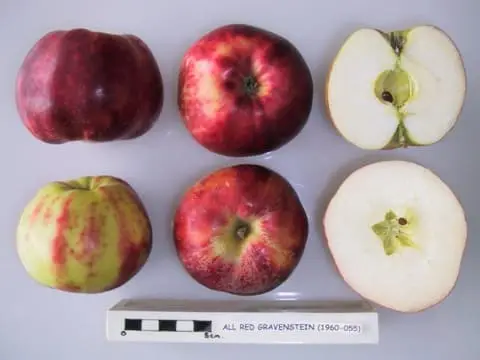
All-Red Gravenstein
-
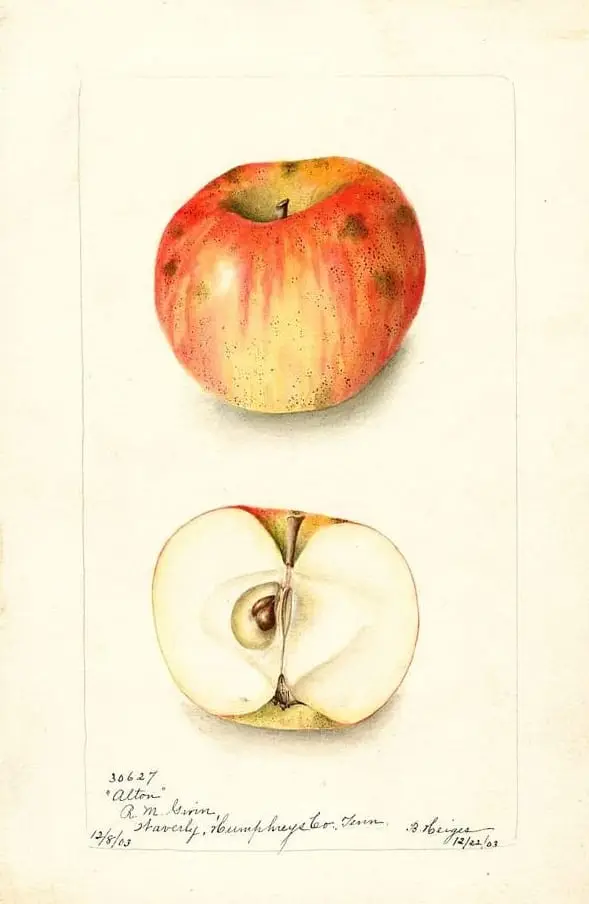
Alton
-
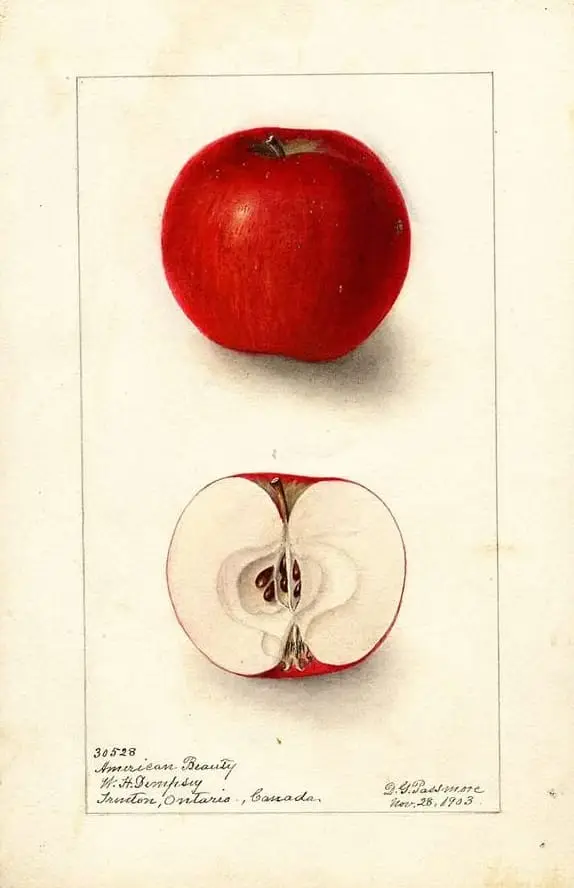
American Beauty
-
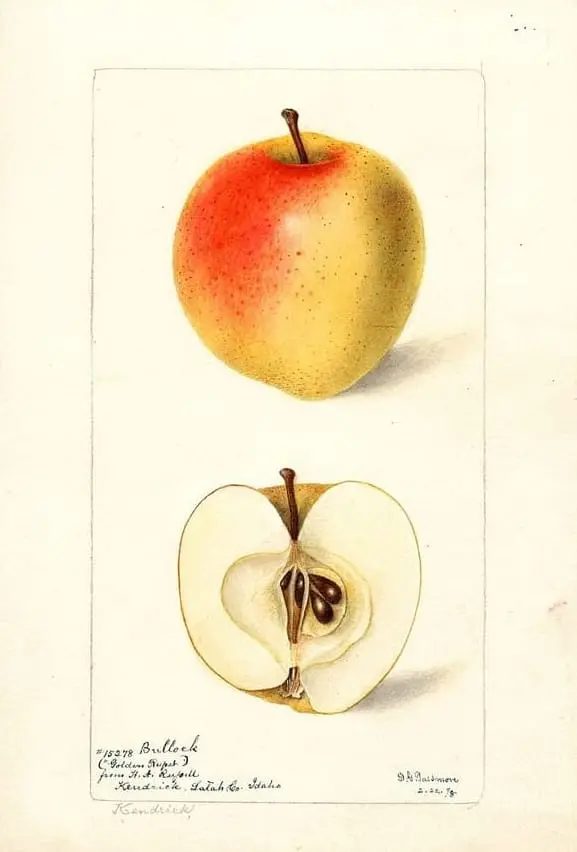
American Golden Russet
A small New Jersey russet whose flesh Downing likened to a buttery pear; Coxe knew it in 1817 as Sheep-nose
-
American Grindling
-
American Summer Pearmain
-
Ames
-
Arkansas