Šampion
Raised privately by Otto Louda at Střížovice from a 1960 cross; third in Poland's apple orchards in 2017
History
Šampion was raised at Střížovice, near Turnov, by Otto Louda, who was born there in 19132. Trained as a tinsmith, he gave up his workshop in 1949 to live as a smallholder and fruit grower, helped to set up a research station of the Czechoslovak Academy of Sciences in the village, and worked there until he retired in 19752. In 1966 the first fruits appeared on seedlings from a cross he had made in 1960 between Golden Delicious and Cox’s Orange Pippin, and after further trials he named one of them, marked out by its early and heavy cropping, Šampion2. It was the first well-known variety from Střížovice and was entered in Czechoslovakia’s list of approved varieties in 19772. Louda bred it privately, outside his employment at the academy’s institute2. It soon found a place in gardens and in large commercial orchards, and it is a parent of later Střížovice apples, among them Melodie and the scab-resistant Vesna2. Britain’s National Fruit Trials received it from Prague University in 19741.
In Poland, where it is called Szampion, it has been on the national register since 14 December 19904. Its share of the country’s apple-orchard area rose from 4.8 per cent in 1998 to 11.2 per cent in 2017, when it ranked third, after Idared and the Jonagold group5. Varieties bearing its name, such as Szampion Reno (2005) and Red Szampion (2023), have since joined the register4.
The fruit
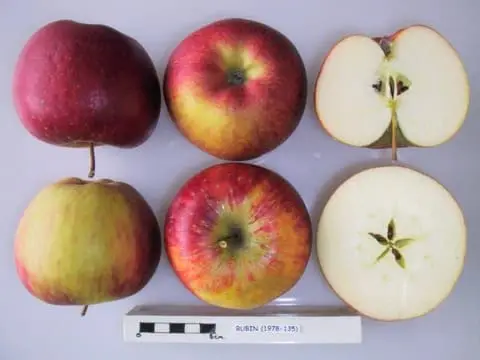
The National Fruit Collection describes the fruit as sweet and juicy with a pleasant flavour1. Its staff characterised a second accession, which the collection no longer holds: large and flat-round, 72 mm wide and 59 mm high, weakly ribbed, yellow with an orange striped flush and little russet1. The Holovousy institute calls the fruit medium to large, with cream, crisp, juicy flesh and a harmonious taste, sweet with a mild acidity3; a Polish guide gives 180–210 grams and a carmine-red flush6.
In Czechia it ripens about two weeks before Golden Delicious: it is picked at the beginning of October, is ready to eat in November and keeps until March3. At Brogdale in Kent it starts to flower around 2 May and is picked in mid-October1.
Growing
The tree is moderately vigorous and crops early, heavily and regularly3. The Holovousy institute rates its resistance to scab as low and to powdery mildew as medium, and recommends warm or moderate sites, or higher ground only with thorough spraying3. A Polish guide for home orchards rates Šampion and its sports as little susceptible to scab and mildew but highly susceptible to fire blight, and of low frost hardiness6.
Where the sources disagree
- Scab. The Holovousy institute rates its resistance to scab as low3; the Polish guide rates its susceptibility as low6.
- Juiciness. The National Fruit Collection’s description calls the fruit juicy, but the staff characterisation of its second accession scored the flesh soft and dry1; the Holovousy institute calls it crisp and juicy3.
Family tree
Parents, grandparents and great-grandparents, as the entries in the atlas record them.
- Šampion Czechia, 1960
- Seed parent Golden Delicious United States, 1905
- Parent Grimes Golden United States, by 1804
- Pollen parent Cox's Orange Pippin United Kingdom, about 1825
- Parent Margil France, probably by 1608
- Parent Rosemary Russet United Kingdom, by 1831
- Parent Nonpareil France, by the mid 1500s
- Seed parent Golden Delicious United States, 1905
Sources
- Sampion (accession 1974-207), National Fruit Collection, Brogdale, Kent (Defra). Supports: "Received by the National Fruit Trials in 1974 from Prague University, Czechoslovakia. Fruits are sweet and juicy with a pleasant flavour"; a dessert apple; 10% flowering on 2 May and picking in mid-October; the staff characterisation of accession 1994-056 (marked as not held): large, flat globose, 59.45 mm high and 71.96 mm wide, weak ribbing, yellow with an orange striped flush, little russet, soft and dry.
- History of Czech apple breeding (in Czech), Jan Krekule and Jan Kolář, excerpt from Experimentální botanika ve vzpomínkách vědců (Academia, 2022), Sciencemag.cz, 2022-04-22. Supports: Otto Louda, born at Střížovice near Turnov in 1913, trained as a tinsmith and from 1949 a smallholder, fruit grower and breeder; his part in founding the Czechoslovak Academy of Sciences station at Střížovice, where he worked until he retired in 1975; first fruits in 1966 from a 1960 cross of Golden Delicious × Coxova reneta; one seedling, marked by early and heavy cropping, named Šampion; the first better-known Střížovice variety; entered in the list of approved varieties (LPO) in 1977; soon grown in gardens and large commercial orchards; bred privately, outside Louda's employment at the institute; a parent of Melodie and of the scab-resistant Vesna.
- Variety catalogue: apples (in Czech), Research and Breeding Institute of Pomology Holovousy (VŠÚO). Supports: Šampion: moderately vigorous; early, heavy and regular cropping; ripening two weeks before Golden Delicious; picking at the beginning of October, eating from November, keeping until March; fruit medium to large, with cream, crisp, juicy flesh and a harmonious, subacid-sweet to sweet taste; low resistance to scab and medium resistance to powdery mildew; for warm and medium sites, and higher sites only with thorough spraying.
- List of fruit plant varieties entered in the national register in Poland, 2024 (in Polish and English), Research Centre for Cultivar Testing (COBORU), Słupia Wielka; Internet Archive copy, 2024. Supports: Szampion entered in the national register on 14 December 1990 (entry S 101) as a winter variety; Szampion Reno entered on 17 February 2005 and Red Szampion on 24 March 2023.
- Horticultural production: orchard survey in 2017 (in Polish), Statistics Poland (Główny Urząd Statystyczny), Informacje sygnalne, 2018-11-30. Supports: Table 4: Szampion on 4.8% of the apple-orchard area in 1998, 9.0% in 2004, 10.1% in 2007, 10.7% in 2012 and 11.2% in 2017, third after Idared (21.6%) and the Jonagold group (17.5%).
- Apple and pear varieties for home gardens and orchards (in Polish), Józef Rusnak, Wieś i Doradztwo 3–4 (71–72), pp. 40–43, Małopolskie Stowarzyszenie Doradztwa Rolniczego, 2012. Supports: Table 2, Šampion and its mutants: picked in September; medium vigour; fruit 180–210 g with a carmine-red flush; low susceptibility to scab and powdery mildew, high susceptibility to fire blight; low frost hardiness.