Topaz
A scab-resistant Czech apple from Rubín × Vanda; in 2026 second only to Gala among organic apples in Europe
History
Topaz was bred at the apple-breeding station of the Czech Academy of Sciences’ Institute of Experimental Botany at Střížovice, near Turnov1,2. Breeding there began with Otto Louda, whose Rubín came from a cross of Golden Delicious and Lord Lambourne made in 19602. Under Jaroslav Tupý the station turned to resistance to apple scab, using OR-38 T-16, an American hybrid with the scab-resistant crab Malus floribunda in its ancestry, obtained in 19652. Crosses of 1966 gave Jolana, a seedling of Spartan and OR-38 T-16, and a second generation begun in 1977 gave Vanda, from Jolana and Lord Lambourne2. Topaz, Rubín × Vanda, belongs to the third generation, from crosses made after 19842, and SNP data confirm both parents4.
It was first sold in October 1994 in the Czech Republic and in November 1994 in Germany3. The institute applied for Community plant variety rights in August 1995, and they were granted on 4 May 1998, to run until the end of 20283,1. A red sport, Red Topaz, received Community rights of its own in 20063,1.
A history of the institute published in 2022 calls Topaz the world’s best-selling scab-resistant apple, with about 400,000 trees sold a year and more than 2,000 hectares planted2. In the 2026 forecast of the European Organic Fruit Forum, which represents about three-quarters of Europe’s organic apple and pear production, it was the most important variety after Gala5. In Germany’s 2022 orchard survey it covered 476 hectares in Baden-Württemberg and 171 in Lower Saxony6. Topaz has also become a parent: UEB 32642 is a seedling of Golden Delicious and Topaz2.
The name has been used for another apple. The UK National Fruit Collection’s Topaz, accession 1948-737, is recorded as raised by W. Seabrook & Sons at Boreham, Essex, and received by the National Fruit Trials in 19367; DNA shows it to be a different variety8,4, apparently from Worcester Pearmain and Cox’s Orange Pippin8.
The fruit
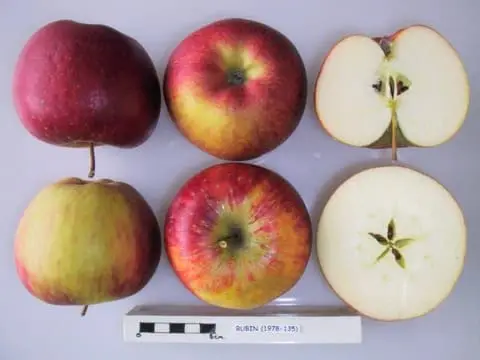
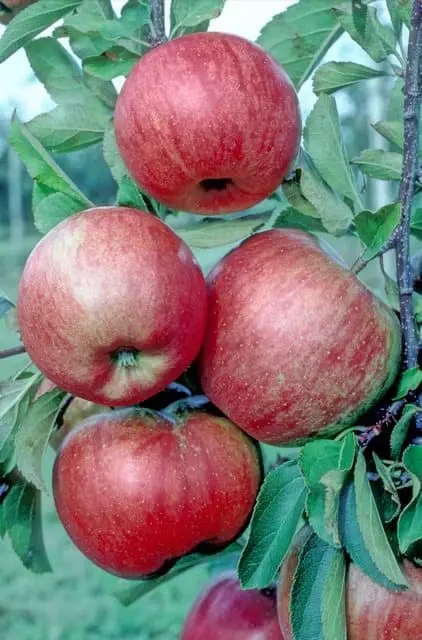
The fruit is medium to large and flat-round, on a stalk of medium length1. Its greenish-yellow skin turns bright yellow when fully ripe and is a quarter to three-quarters covered with a diffuse flush striped bright orange-red; there is sometimes russet in the stalk cavity1. The flesh is cream to yellowish, firm, crisp and very juicy, sweet with a light acidity and strongly aromatic, and its breeders rate the flavour excellent1. It ripens at the turn of September and October, shortly before or with Golden Delicious, and keeps until March in a cellar store1.
Growing
Topaz carries a single-gene resistance to scab and has low susceptibility to powdery mildew1. The tree is moderately vigorous, with a branched habit, upright at first and spreading later1. It flowers fairly early to mid-late and is a good pollinator, and it bears very early, with moderate to heavy crops every year, without needing to be thinned1. It is diploid1,4. With Red Topaz it is among the most widely grown scab-resistant apples in organic orchards, and it suits home gardens well1.
Uses
Topaz is a dessert apple1.
Family tree
Parents, grandparents and great-grandparents, as the entries in the atlas record them.
- Topaz Czechia, after 1984
- Seed parent Rubin Czechia, 1960
- Seed parent Lord Lambourne United Kingdom, 1907
- Seed parent James Grieve United Kingdom, by 1892
- Pollen parent Worcester Pearmain United Kingdom, by 1873
- Pollen parent Golden Delicious United States, 1905
- Parent Grimes Golden United States, by 1804
- Seed parent Lord Lambourne United Kingdom, 1907
- Pollen parent Vanda
- Seed parent Rubin Czechia, 1960
Offspring in the atlas
- UEB 32642 × Golden Delicious; Czechia, 1999
Sources
- Topaz, a dessert apple variety (in Czech), Apple Breeding Station for Disease Resistance, Institute of Experimental Botany, Czech Academy of Sciences. Supports: parents "'Rubín' × 'Vanda'"; Community plant variety rights granted on 4 May 1998; with its red mutation Red Topaz among the most widespread scab-resistant varieties in organically managed orchards, and suited to home gardens; monogenic resistance to scab and low susceptibility to powdery mildew; branched habit, upright and later spreading, moderately vigorous growth; diploid; flowering semi-early to mid-late, a good pollinator; ripening at the turn of September and October, shortly before or with Golden Delicious; fruit medium to large, flat-globose, stalk of medium length; ground colour greenish yellow, bright yellow at full ripeness, 25–75% covered with a diffuse flush with bright orange-red stripes, sometimes russet in the stalk cavity; flesh cream to yellowish, firm, crisp, very juicy, sweet with a light acidity, strongly aromatic, "výborné chuti" (of excellent flavour); cropping very early, moderately high to high and regular, without the need for thinning; keeps until March in a cellar store; a dessert (table) variety.
- History of Czech apple breeding (in Czech), Excerpt from Jan Krekule and Jan Kolář, Experimentální botanika ve vzpomínkách vědců: historie Ústavu experimentální botaniky AV ČR (Academia, 2022), published by Sciencemag.cz, 2022-04-22. Supports: the research station of the Institute of Experimental Botany at Střížovice, near Turnov; Otto Louda's apple breeding there, and Rubín from a cross of Golden Delicious and Lord Lambourne made in 1960; Jaroslav Tupý's leadership of the station; the American hybrid OR-38 T-16, a third generation of crosses between Malus domestica and the scab-resistant Malus floribunda, obtained in 1965, and breeding for scab resistance from 1966; Jolana (Spartan × OR-38 T-16) from the crosses of 1966; second-generation crosses from 1977, giving Vanda (Jolana × Lord Lambourne); "Třetí generace, vzniklá z křížení po roce 1984" (the third generation, from crosses after 1984), including Topaz (Rubín × Vanda); the fourth generation, from crosses after 1992, including UEB 32642 (Golden Delicious × Topaz); the institute's varieties protected nationally, by Community plant variety rights and by US plant patents, and propagated under licence; Topaz and its red mutation Red Topaz the institute's most successful varieties commercially, Topaz still the world's best-selling scab-resistant variety, with about 400,000 trees sold a year, grown on more than 2,000 ha in all.
- Community plant variety rights register, public search: Topaz (Malus), Community Plant Variety Office (CPVO). Supports: denomination Topaz, breeder's reference Topas; applicant the Institute of Experimental Botany AS CR v.v.i.; application of 31 August 1995; first sale outside the EU on 24 October 1994, in the Czech Republic, and inside the EU on 15 November 1994, in Germany; grant 2777 of 4 May 1998; protection to 31/12/2028; Red Topaz granted Community rights (grant 17000) on 27 February 2006.
- Cultivar fingerprinting and SNP-based pedigree reconstruction in Danish heritage apple cultivars utilizing genotypic data from multiple germplasm collections in the world, B. Larsen and others, Genetic Resources and Crop Evolution 72: 2397–2411, with supplementary file 2, 2025. Supports: Table S5: Topaz (MUNQ 1213) diploid, with SNP-confirmed parents Rubin (Parent1, the column for the mother where pedigree records exist) and Vanda.
- EBF publishes crop forecast for organic apples and pears, European Fruit Magazine (EFM), 2026-07-01. Supports: the European Organic Fruit Forum (EBF), representing about three quarters of European organic apple and pear production, and its 2026 forecast; "The most important variety in organic farming is Gala, followed by Topaz"; Topaz forecast 7% down on the previous year.
- Growth and harvest: tree fruit 2022 (Fachserie 3, Reihe 3.2.1), table 3 (in German), Statistisches Bundesamt (Destatis), 2023-01-09. Supports: table 3, the 2022 apple harvest by variety in the main growing states, with planted areas from the 2022 orchard survey: Topaz on 476 ha in Baden-Württemberg and 171 ha in Lower Saxony.
- Topaz (accession 1948-737), National Fruit Collection, Brogdale, Kent (Defra). Supports: "Received by NFT 1936. From Essex, Chelmsford, Boreham, England. Raised by W. Seabrook & Sons Ltd.".
- Using whole-genome SNP data to reconstruct a large multi-generation pedigree in apple germplasm, H. Muranty and others, BMC Plant Biology 20: 2, with Additional file 3, 2020. Supports: the National Fruit Collection's accession 1948-737 named Topaz (MUNQ 1973) found to differ from another accession of that name (MUNQ 1213), "Topaz" being "a homonym that has been applied to at least two different cultivars"; Additional file 3 (Table S3): Worcester Pearmain and Cox's Orange Pippin inferred as the parents of MUNQ 1973.