Apple varieties, United Kingdom
James Grieve
Raised in Edinburgh by the nurseryman James Grieve and shown in 1892; DNA finds Cox's Orange Pippin among its parents
History
James Grieve was raised in Edinburgh by the man whose name it bears, and introduced by his employers, the nursery firm of Dickson1,2. Grieve, who died in 1924, worked for Dickson and Sons of Edinburgh before setting up his own nursery at Pilrig in 1896, and also raised a rhododendron3. The apple is first documented in 18926: on 18 October that year Dickson & Co. of Edinburgh showed the Royal Horticultural Society’s Fruit Committee a seedling “named James Grieve, a pale yellow fruit”4. The society gave it an Award of Merit in 1897 and a First Class Certificate in 19061. In 1920 Bunyard called it “quite the best of its season”2, and it holds the society’s Award of Garden Merit5.
Its parentage was long uncertain, but DNA studies show it to be a child of Pott’s Seedling and Cox’s Orange Pippin: Ordidge and colleagues proposed this in 2018 from DNA markers of the National Fruit Collection’s trees6, and SNP studies of 2020 and 2025 inferred the same pair7,8.
It has had many offspring. The collection lists Lord Lambourne, Greensleeves and Katja among its offspring1, and the 2020 study found it a parent in eight complete families, among them those of Katja, Jamba and Balder7. Ordidge’s team also proposed it as the unknown pollen parent of Sunset6, and the 2025 study found it a parent of nine cultivars found only in the Danish collections it examined8. Its sports include Redcoat Grieve and Erich Neumanns Roter James Grieve1.
The fruit
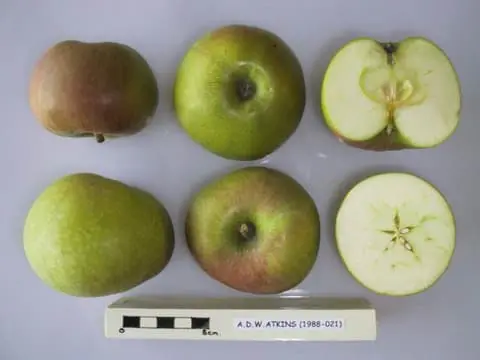
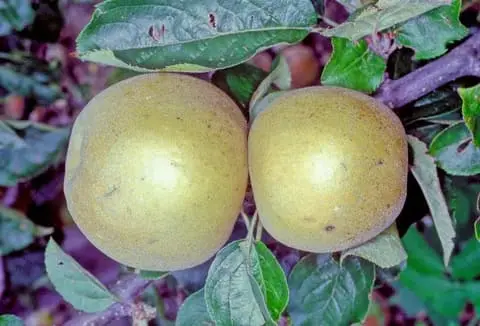
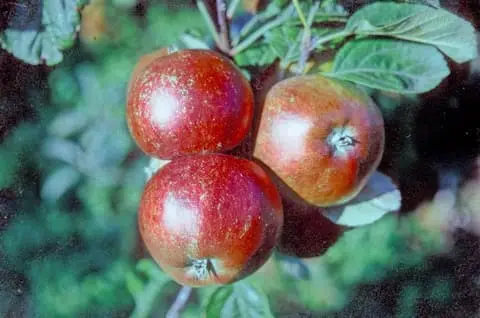
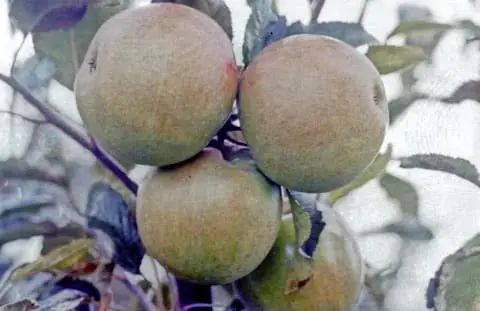
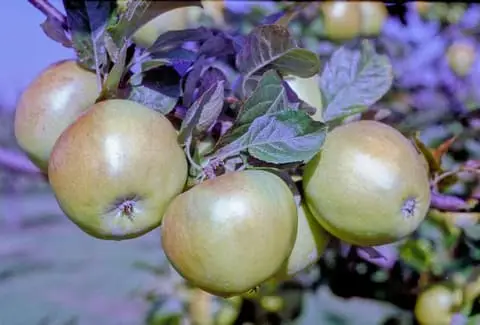
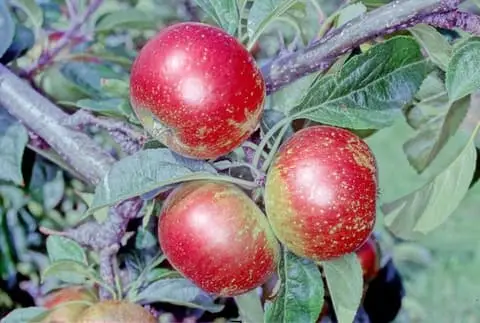
The fruit is medium to large and round-conical2, about 70 mm wide and 62 mm high in the 1971 National Apple Register1. The pale creamy-yellow skin is flushed and striped with crimson or red1,2. The flesh is cream to yellow1,2; Bunyard found it tender and very juicy2, the collection “rather soft but very juicy”, with “a good refreshing flavour”, and the 1971 register sweet and subacid1.
At Brogdale, Kent, it reaches 10 per cent flowering about 5 May and is picked in early September1; Bunyard gave its season as September to October2. UK storage recommendations of 1978 and 1986 keep it in a cold air store at 3.0–3.5 °C only until October9.
Growing
Bunyard found the tree vigorous, rather upright and very fertile, but in the south of England liable to rot and to drop its fruit early2. It is diploid7.
Uses
The National Fruit Collection classes it as both a dessert and a culinary apple1; Bunyard and the Royal Horticultural Society list it for dessert2,5.
Where the sources disagree
- Date. Bunyard has it introduced about 18902 and the National Fruit Collection first recorded in 18931; the society’s proceedings show it exhibited in October 18924.
- Parentage. Bunyard recorded a seedling of Pott’s Seedling2, while the society’s journal, as cited in the 1971 National Apple Register, named Cox’s Orange Pippin6; the collection still gives one or the other, with the second parent unknown1. The DNA studies find both6,7,8.
Family tree
Parents, grandparents and great-grandparents, as the entries in the atlas record them.
- James Grieve United Kingdom, by 1892
- Parent Potts' Seedling United Kingdom, about 1849
- Parent Cox's Orange Pippin United Kingdom, about 1825
- Parent Margil France, probably by 1608
- Parent Rosemary Russet United Kingdom, by 1831
- Parent Nonpareil France, by the mid 1500s
Offspring in the atlas
- Baker's Delicious × Mother; United Kingdom, by 1932
- Balder × Jonathan; Netherlands, 1950
- Elton Beauty × Worcester Pearmain; United Kingdom, by 1952
- Erich Neumanns Roter James Grieve Germany, 1953
- Eva Lotta × Cortland; Sweden
- Fairie Queen × Cox's Orange Pippin; United Kingdom, by 1937
- Florence Bennett × Golden Spire; United Kingdom, by 1971
- Greensleeves × Golden Delicious; United Kingdom, 1966
- Hood's Supreme × Charles Ross; United Kingdom, 1924
- Jamba 69 × Melba; Germany, 1954
- James Grieve Lired Netherlands
- Katja × Worcester Pearmain; Sweden, 1947
- Lord Lambourne × Worcester Pearmain; United Kingdom, 1907
- Redcoat Grieve United Kingdom, 1916
- Saint Ailred × Ellison's Orange; United Kingdom, 1942
- Sunset × Cox's Orange Pippin; United Kingdom, about 1918
23 varieties in the atlas descend from James Grieve.
Sources
- James Grieve (accession 1974-349), National Fruit Collection, Brogdale, Kent (Defra). Supports: "Raised by James Grieve in Edinburgh, Scotland and introduced by his employers, Dickson's nurserymen"; "first recorded in 1893"; Award of Merit in 1897 and First Class Certificate in 1906 from the RHS; "rather soft but very juicy flesh with a good refreshing flavour"; a culinary and dessert apple; the synonym Grieve; parentage "Pott's Seedling or Cox's Orange Pippin x Unknown"; offspring including Lord Lambourne, Greensleeves and Katja; sports including Redcoat Grieve and Erich Neumanns Roter James Grieve; from the National Apple Register (Smith, 1971), marked b: height 62 mm, width 70 mm, a pale yellow ground flushed, striped and blotched red, cream flesh tinged yellow, sweet and subacid; 10% flowering on 5 May (accession 1974-349); picking in early September (NFC staff, marked a, Brogdale).
- A Handbook of Hardy Fruits, vol. I, p. 73: James Grieve, E. A. Bunyard, John Murray, Internet Archive, 1920. Supports: a dessert apple, September to October; medium to large, round, conical; pale creamy yellow with crimson flush and stripes; flesh tender, very juicy, yellow; growth vigorous, rather upright, very fertile; "a seedling from Pott's Seedling, raised by Mr. James Grieve, and introduced by Messrs. Dickson, of Edinburgh, about 1890"; "quite the best of its season"; "its faults in the South are liability to rot and to fall prematurely".
- Rhododendron Cultivars G: Grievei, Trees and Shrubs Online, International Dendrology Society (entry derived from W. J. Bean). Supports: the hybrid rhododendron Grievei "raised by James Grieve (d. 1924), who also bred the well-known apple named after him"; "He set up his own nursery at Pilrig in 1896", having earlier worked "for Messrs Dickson and Sons of Edinburgh".
- Journal of the Royal Horticultural Society, vol. XV, Proceedings, pp. lxxxi–lxxxii: Fruit Committee, 18 October 1892, Royal Horticultural Society, Internet Archive, 1893. Supports: at the Fruit Committee of 18 October 1892 (heading on p. lxxxi), among the seedling apples exhibited: "Messrs. Dickson & Co., Edinburgh, who staged one named James Grieve, a pale yellow fruit" (p. lxxxii, misprinted xxxii).
- RHS Recommended: Award of Garden Merit. Fruit, vegetables and herbs, Royal Horticultural Society. Supports: James Grieve (dessert) on the list of apples holding the Award of Garden Merit.
- Genetic analysis of a major international collection of cultivated apple varieties reveals previously unknown historic heteroploid and inbred relationships, M. Ordidge and others, PLoS ONE 13(9): e0202405, 2018. Supports: "fruit of 'James Grieve' being first documented in the UK in 1892"; documented records listing it as a seedling of either Pott's Seedling (Bunyard) or Cox's Orange Pippin (Journal of the Royal Horticultural Society, cited in Smith, 1971); from DNA-marker similarity among National Fruit Collection accessions, the proposal that it "is potentially an offspring of both 'Pott's Seedling' and 'Cox's Orange Pippin'", and "also the previously unknown paternal parent of 'Sunset'".
- Using whole-genome SNP data to reconstruct a large multi-generation pedigree in apple germplasm, H. Muranty and others, BMC Plant Biology 20: 2, with Additional files 1 and 3 (Tables S1 and S3), 2020. Supports: James Grieve diploid (Table S1, dated 1893); inferred as the offspring of Potts' Seedling and Cox's Orange Pippin (Table S3, 28 Mendelian errors), in agreement with Ordidge and others; inferred as a parent in eight trios, among them those of Katja, Jamba and Balder (Table S3).
- Cultivar fingerprinting and SNP-based pedigree reconstruction in Danish heritage apple cultivars utilizing genotypic data from multiple germplasm collections in the world, B. Larsen and others, Genetic Resources and Crop Evolution 72: 2397, supplementary Tables S5 and S7, 2025. Supports: Table S5: James Grieve, ploidy 2, with SNP-confirmed parents Cox's Orange Pippin and Potts Seedling; Table S7: nine offspring among the genotypes unique to the Danish germplasm studied.
- Storage of organically produced crops (MAFF project OF0127T), Table 25, p. 144: recommendations for air storage of apples, J. R. Bevan, C. Firth and M. Neicho, Henry Doubleday Research Association, for the Ministry of Agriculture, Fisheries and Food; Organic Eprints, December 1997. Supports: Table 25, compiled from Sharples and Stow (1978 and 1986) and Johnson (1997): James Grieve stored in air at 3.0–3.5 °C, with "Oct" as the terminate month (1978 and 1986).