Apple varieties, United Kingdom
Sunset
A Cox's Orange Pippin seedling raised at Ightham, Kent, about 1918; DNA markers suggest James Grieve as its other parent
History
Sunset was raised about 1918 by G. C. Addy at Ightham in Kent, as a seedling of Cox’s Orange Pippin, and named in 19331. The Royal Horticultural Society gave it an Award of Merit in 19601, and it holds the society’s Award of Garden Merit2.
Its other parent was not recorded1. In 2018 Ordidge and colleagues, comparing DNA markers across the National Fruit Collection, found Sunset and James Grieve more alike than half-siblings would be. They proposed James Grieve, which they take to be a child of Cox’s Orange Pippin itself, as the missing pollen parent, which would make Sunset inbred3.
The fruit
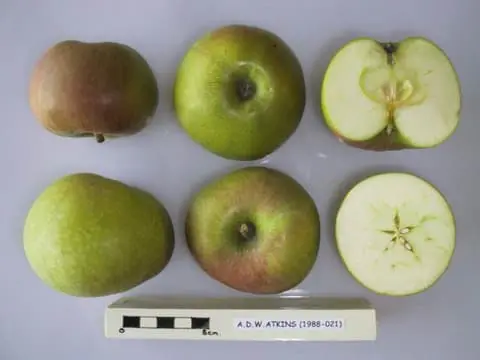
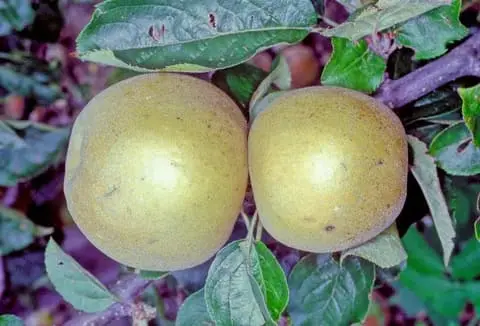
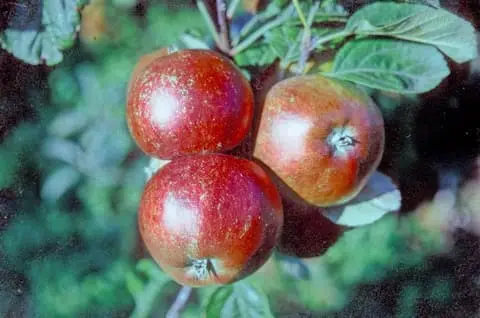
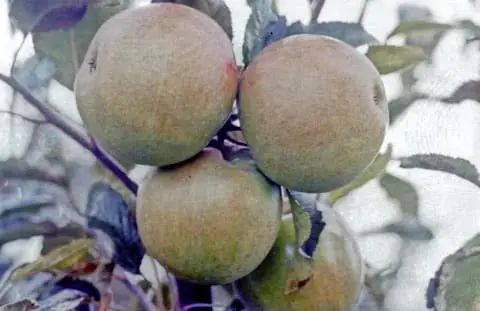
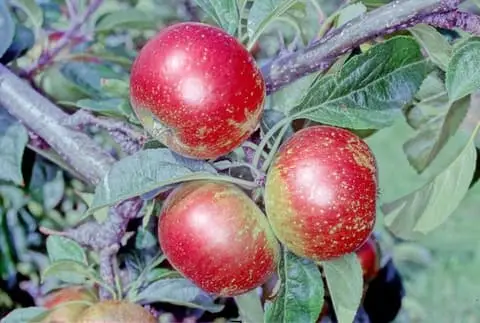
The 1971 National Apple Register describes a medium-sized, broadly rounded-conical fruit with a yellow ground striped with orange1. The cream flesh is firm, crisp and fine-textured, with “a good aromatic Cox-like flavour”1.
At Brogdale, Kent, it reaches 10 per cent flowering about 3 May and is picked in late September1. The Royal Horticultural Society gives its season of use as October to December5, and UK storage recommendations of 1978 and 1986 keep it in a cold air store at 1.5–2.0 °C until January4.
Growing
The Royal Horticultural Society describes a compact, spur-bearing tree suited to every trained form, in pollination group 3, with pale pink flowers, and rates it hardy throughout the United Kingdom and northern Europe (H6)5.
Uses
Family tree
Parents, grandparents and great-grandparents, as the entries in the atlas record them.
- Sunset United Kingdom, about 1918
- Seed parent Cox's Orange Pippin United Kingdom, about 1825
- Parent Margil France, probably by 1608
- Parent Rosemary Russet United Kingdom, by 1831
- Parent Nonpareil France, by the mid 1500s
- Pollen parent James Grieve United Kingdom, by 1892
- Parent Potts' Seedling United Kingdom, about 1849
- Parent Cox's Orange Pippin United Kingdom, about 1825
- Parent Margil France, probably by 1608
- Parent Rosemary Russet United Kingdom, by 1831
- Seed parent Cox's Orange Pippin United Kingdom, about 1825
Sources
- Sunset (accession 1979-190), National Fruit Collection, Brogdale, Kent (Defra). Supports: "Raised in about 1918 by G.C.Addy at Ightham, Kent. Named in 1933"; an Award of Merit from the RHS in 1960; "firm crisp, fine-textured flesh with a good aromatic Cox-like flavour"; a dessert apple; parentage "Cox's Orange Pippin x Unknown"; from the National Apple Register (Smith, 1971), marked b: medium, broad globose conical, a yellow ground with orange stripes, firm, crisp, fine, cream flesh; 10% flowering on 3 May (accession 1979-190); picking in late September (NFC staff, marked a, Brogdale).
- RHS Recommended: Award of Garden Merit. Fruit, vegetables and herbs, Royal Horticultural Society. Supports: Sunset (dessert) on the list of apples holding the Award of Garden Merit.
- Genetic analysis of a major international collection of cultivated apple varieties reveals previously unknown historic heteroploid and inbred relationships, M. Ordidge and others, PLoS ONE 13(9): e0202405, 2018. Supports: Sunset (1918) documented as "Cox's Orange Pippin x unknown"; "The similarity of 'James Grieve' and 'Sunset' would suggest a closer relationship than that of a half-sibling", with a proposed "(and inbred) parentage"; James Grieve "potentially an offspring of both 'Pott's Seedling' and 'Cox's Orange Pippin'", and "also the previously unknown paternal parent of 'Sunset'" (Table 2: proposed parentage Cox's Orange Pippin x James Grieve).
- Storage of organically produced crops (MAFF project OF0127T), Table 25, p. 144: recommendations for air storage of apples, J. R. Bevan, C. Firth and M. Neicho, Henry Doubleday Research Association, for the Ministry of Agriculture, Fisheries and Food; Organic Eprints, December 1997. Supports: Table 25, compiled from Sharples and Stow (1978 and 1986) and Johnson (1997): Sunset stored in air at 1.5–2.0 °C, with "Jan" as the terminate month (1978 and 1986).
- Malus domestica 'Sunset' (D), Royal Horticultural Society, plant database. Supports: "A compact dessert apple"; "Pollination group 3, pale pink flowers are followed by fruit that can be used from October to December"; "Compact plant, suitable for all training forms"; spur bearing; hardiness rating H6, "hardy in all of UK and northern Europe".