Apple varieties, United Kingdom
Rosemary Russet
An English russet first recorded in 1831; DNA shows it a child of Nonpareil and a parent of Cox's Orange Pippin
History
Its origin is unknown; Bunyard names Ronalds as the first to record it, in 18313. The National Fruit Collection gives the same year and says it was raised in England1.
Cox’s Orange Pippin was recorded as an offspring of the triploid Ribston Pippin4. In 2022 Howard and colleagues showed from SNP array data that this was false, identified Rosemary Russet as Cox’s previously unreported second parent, the other being Margil, and found Rosemary Russet itself to be an offspring of Nonpareil4. A 2025 study of Danish and other heritage apples gives the same pedigree, in which Reinette Franche is in turn Nonpareil’s parent5. Through Cox, Rosemary Russet has ten grandchildren among the apples found only in Danish collections5.
The fruit
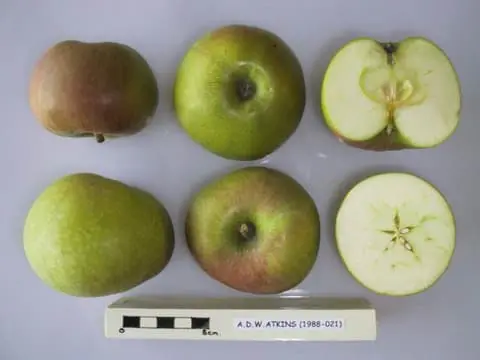
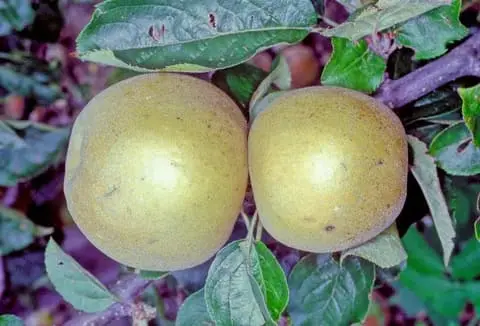
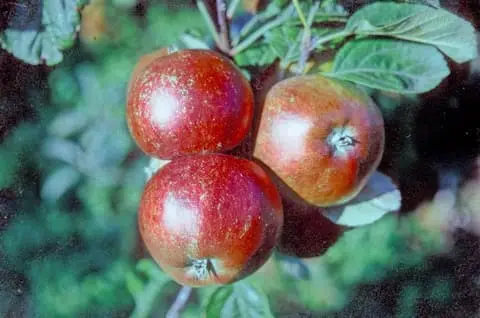
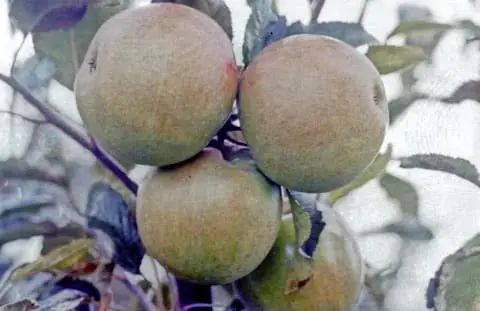
Hogg described a fruit below medium size, ovate, broadest at the base and narrowing bluntly to the eye, much the shape of Scarlet Nonpareil2; Bunyard a small to medium, round-conical fruit, flattened at the base3; and the National Fruit Collection’s record a medium, truncate-conical one, 70 mm wide and 55 mm high1. The skin is yellow, green-tinged on the shaded side and faintly flushed red in the sun, and covered with thin, pale brown russet, especially round the eye and the stalk2,3. The stalk is unusually long2,3. The flesh is yellowish, crisp, tender and very juicy, brisk and sugary, and “charged with a peculiarly rich and highly aromatic flavour”2; Bunyard found it very rich and brisk3, and the National Fruit Collection firm and fine-textured, with a rather acid, good flavour1.
Hogg rated it “a most delicious and valuable dessert apple of the very first quality”, in use from December to February2, and Bunyard “quite the best of late winter apples”, keeping until February3. At Brogdale it begins to flower about 6 May and is picked in early October1.
Growing
Bunyard rated both its growth and its cropping moderate3. It is diploid5.
Where the sources disagree
Family tree
Parents, grandparents and great-grandparents, as the entries in the atlas record them.
- Rosemary Russet United Kingdom, by 1831
- Parent Nonpareil France, by the mid 1500s
Offspring in the atlas
- Cox's Orange Pippin × Margil; United Kingdom, about 1825
198 varieties in the atlas descend from Rosemary Russet.
Sources
- Rosemary Russet (accession 1973-143), National Fruit Collection, Brogdale, Kent (Defra). Supports: "Raised in England. First described in 1831"; "firm, fine-textured, juicy flesh with a rather acid and good flavour"; a dessert apple; the other names Benskin's Russet, Buzzan, Rosemary and Rosemary Apple; medium, truncate conical, 55 mm high and 70 mm wide, green-yellow ground, brown over-colour and high to very high russet, white flesh (given as from the National Apple Register, Smith, 1971); 10% flowering on 6 May and picking in early October at Brogdale.
- The Fruit Manual, 5th ed., p. 198: Rosemary Russet, Robert Hogg, Journal of Horticulture Office, Internet Archive, 1884. Supports: fruit below medium size, ovate, broadest at the base and narrowing bluntly to the apex, much the shape of a Scarlet Nonpareil; skin yellow, tinged green on the shaded side, flushed faint red in the sun, covered with thin pale brown russet, especially round the eye and the stalk; stalk very long; flesh yellowish, crisp, tender, very juicy, brisk and sugary, "charged with a peculiarly rich and highly aromatic flavour"; "A most delicious and valuable dessert apple of the very first quality", in use from December till February.
- A Handbook of Hardy Fruits, vol. I, p. 113: Rosemary Russet, E. A. Bunyard, John Murray, Internet Archive, 1920. Supports: dessert, till February; small to medium, round conical, flattened at the base, regular; yellowish green with slight red flush, covered with light russet; flesh crisp, yellow, very rich and brisk; stem unusually long, in a wide cavity; growth moderate, fertility moderate; "Origin, unknown; first recorded by Ronalds, in 1831"; "Quite the best of late winter apples".
- Pedigree reconstruction for triploid apple cultivars using single nucleotide polymorphism array data, N. P. Howard and others, Plants, People, Planet 5: 98–111; University of Reading repository, 2022. Supports: the recorded pedigree of Cox's Orange Pippin, from the triploid Ribston Pippin, false; Rosemary Russet identified as the previously unreported second parent of Cox's Orange Pippin, Margil being the first, and as an offspring of Nonpareil; Rosemary Russet first recorded in 1831 (Smith, 1971).
- Cultivar fingerprinting and SNP-based pedigree reconstruction in Danish heritage apple cultivars utilizing genotypic data from multiple germplasm collections in the world, B. Larsen and others, Genetic Resources and Crop Evolution 72: 2397, with supplementary tables, 2025. Supports: Rosemary Russet (held at the University of Copenhagen) diploid, with Nonpareil as its SNP-confirmed parent and no second parent identified; Margil and Rosemary Russet the parents of Cox's Orange Pippin; Reinette Franche the parent of Nonpareil (Table S5); Rosemary Russet with one child (Cox's Orange Pippin) and ten grandchildren among the genotypes unique to the Danish collections (Table S7).