Margil
A small, ribbed, richly aromatic old apple that DNA shows to be a parent of both Ribston Pippin and Cox's Orange Pippin
History
Hogg found no record of the Margil before the Pomona Londinensis, though it had been known for many years: Rogers had seen an espalier of it at Sheen planted by Sir William Temple, and the Brompton Park nursery was growing it in quantity by 17502. Hogg could not trace its origin, but suggested that George London, who had worked at Versailles before running Brompton Park with Henry Wise, might have brought it from the Continent, the name sounding more French than English2. André Leroy knew it as the Reinette Musquée, in Normandy since time immemorial and valued there as the cider apple Muscadet, especially in the Orne, the Eure and the Manche4. He thought it very probably the Muscate of Olivier de Serres in 1608, and noted that in England and America it had at first been thought Scottish4.
In 2020 Muranty and colleagues found from SNP data that Margil gave the triploid Ribston Pippin an unreduced gamete, the other parent being Nonsuch Park, and that it is also a parent of Cox’s Orange Pippin, through which came most of its 87 descendants over four generations6. In 2022 Howard and colleagues showed that one set of Cox’s chromosomes came wholly from Margil, named Rosemary Russet as the other parent, and suggested that Cox had been taken for a seedling of Ribston Pippin because Ribston probably resembles Margil7; a 2025 study found the same parents for both8. Margil is also an inferred parent of Mere de Baia and of Dronning Louise6,8, and the National Fruit Collection lists Saint Everard as its offspring1.
The fruit
The fruit is small and conical, distinctly five-sided, with sharp angles ending in five ridges round the eye2. The skin is orange, streaked with deep red and patched with russet1,2; Bunyard saw pale yellow with a dull brownish-red flush3. The flesh is yellow and firm1,2,3. Hogg found it juicy, rich and sugary, with “a powerful and delicious aromatic flavour”, and ranked it “one of the finest dessert apples, a rival of the Ribston Pippin”2; Bunyard thought it “of the highest possible quality”3. To Leroy it was very sweet, without acidity, with a delicate musky, aniseed taste, first-rate for lovers of sweet apples4. At Brogdale it begins to flower about 4 May and is picked in early October1.
Growing
Hogg found the tree hardy and generally an abundant bearer, though liable to have its blossom caught by frost; small and slender, it suited dwarf trees and espaliers on paradise stock2. Bunyard found its growth very weak and its cropping moderate, but thought it worth trying in every garden3. Leroy found it very fertile, but best as a cordon, bush or espalier on paradise stock4. It is diploid6,8.
Where the sources disagree
- Origin. English to Downing5, probably Norman to Bunyard3, unknown to Hogg, though the name suggested France2, and Norman since time immemorial to Leroy4; the National Fruit Collection says only Europe1. The 2020 DNA study calls it, in one place, one of “two Renaissance cultivars of French and English origin” and, in another, a Norman apple6.
- First record. Leroy judged de Serres’s Muscate of 1608 very probably, not certainly, this apple4, but the DNA study takes 1608 as its date6; Hogg found no record before the Pomona Londinensis2, and the National Fruit Collection says it was known in England before 17501.
- Juiciness. Juicier than Ribston Pippin to Hogg2, rather dry to the National Fruit Collection1.
- Cropping. Abundant to Hogg and very abundant to Leroy2,4, moderate to Bunyard3.
Family tree
Offspring in the atlas
- Cox's Orange Pippin × Rosemary Russet; United Kingdom, about 1825
- Mere de Baia × Peasgood's Nonsuch; Romania, by 1934
- Ribston Pippin × Nonsuch Park; United Kingdom, about 1707
- Saint Everard × Cox's Orange Pippin; United Kingdom, by 1900
206 varieties in the atlas descend from Margil.
Sources
- Margil (accession 1984-011), National Fruit Collection, Brogdale, Kent (Defra). Supports: "Thought to have originated in Europe. It was known in England before 1750"; synonyms including Margille, Muscadet, Reinette Musquee, Never Fail, Neverfail, Fail-me-Never and Small Ribston; "firm, rather dry flesh with a sweet and rich aromatic flavour"; a dessert apple; father to Saint Everard; from the National Apple Register (Smith, 1971): small to medium, prominent ribs at the eye and on the body, orange ground streaked deep red, russet patches, yellow flesh; 10% flowering on 4 May and picking in early October at Brogdale.
- The Fruit Manual, 5th ed., pp. 141–142: Margil, Robert Hogg, Journal of Horticulture Office, Internet Archive, 1884. Supports: synonyms Margin, Never Fail, Munches Pippin and Small Ribston; fruit small, conical, distinctly five-sided, with acute angles ending in five ridges at the crown; skin orange, streaked with deep red, with patches of russet on one side; flesh yellow, firm, juicy, rich and sugary, "with a powerful and delicious aromatic flavour"; "One of the finest dessert apples, a rival of the Ribston Pippin", juicier and of a better size for dessert; in use from November to February; tree quite hardy, generally an abundant bearer except when frost injures the blossom, to which it is liable; small and slender in habit, suited to dwarfs or espaliers on paradise stock; no record before the Pomona Londinensis, though known long before; Rogers's account of an espalier at Sheen planted by Sir William Temple; grown to a considerable extent in the Brompton Park nursery by 1750; origin untraced, perhaps brought from the Continent by George London, who worked in the gardens at Versailles and later ran the Brompton Park nursery with Henry Wise, the name suggesting a French rather than an English origin.
- A Handbook of Hardy Fruits, vol. I, p. 87: Margil, E. A. Bunyard, John Murray, Internet Archive, 1920. Supports: French name Reinette Musquée, German Muskat Reinette, other names Reinette d'Hiver Musquée and Small Ribston; dessert, October to January; small, rounded conical, angular; pale yellow with dull brown-red flush and russet; flesh firm, yellow, highly flavoured; growth very weak, fertility moderate; "Origin, doubtless Continental (probably Norman)"; "Of the highest possible quality"; a small tree that "should be given a trial in every garden".
- Dictionnaire de pomologie, vol. IV, pp. 713–715: Reinette Musquée (in French), André Leroy, Paris and Angers, Internet Archive, 1873. Supports: entry no. 425, with synonyms including Muscate? (Olivier de Serres, 1608), Musquée? (Claude Saint-Étienne, 1670), Reinette d'Hiver Sucrée, Muscadet, Sucrée d'Hiver, Muscateller-Reinette, Margil (Hooker, Pomona Londinensis), Munche's Pippin, Small Ribston, Never-Fail and Fail-me-Never; fertility very abundant; better as cordon, bush or espalier than as a standard, on paradise stock; fruit medium, conical-rounded, golden yellow in sun, washed with brownish red and streaked with carmine; flesh yellowish or greenish, fairly firm; juice without acidity, very sweet, with a delicate musky, aniseed flavour; ripe November to February; first quality for lovers of sweet apples; identical with the Margil of the English, in Normandy "depuis un temps immémorial" and valued there as a cider apple under the name Muscadet, especially in the Orne, the Eure and the Manche; very probably the Muscate of Olivier de Serres in 1608 and the Musquée of Claude Saint-Étienne in 1670; at first thought Scottish in England and America.
- The Fruits and Fruit Trees of America, p. 266: Margil, A. J. Downing, revised by Charles Downing, John Wiley & Sons, Internet Archive, 1900. Supports: synonyms Neverfail and Munche's Pippin; "An old English dessert Apple, of slender growth"; fruit small, roundish oblate, yellow, striped with red; flesh yellow, firm, aromatic; good; October, November.
- Using whole-genome SNP data to reconstruct a large multi-generation pedigree in apple germplasm, H. Muranty and others, BMC Plant Biology 20: 2, with Additional files 1, 3 and 6, 2020. Supports: the abstract's "two Renaissance cultivars of French and English origin, namely 'Reinette Franche' and 'Margil'"; the discussion's Margil, after Leroy, a very old variety described in 1608 by Olivier de Serres, from Normandy, where it was often used for apple juice or cider; Margil the parent that gave the triploid Ribston Pippin an unreduced gamete, with Nonsuch Park the other parent; Margil a parent of Cox's Orange Pippin; a founder with 87 inferred descendants over four generations, mostly through Cox's Orange Pippin; Margil diploid and dated 1608 (Table S1); Peasgood's Nonsuch and Margil inferred as the parents of Mere de Baia, and Prinzen Apfel and Margil of Dronning Louise (Table S3).
- Pedigree reconstruction for triploid apple cultivars using single nucleotide polymorphism array data, N. P. Howard and others, Plants, People, Planet 5: 98–111; University of Reading repository, 2022. Supports: one chromosome complement of Cox's Orange Pippin made up entirely of haplotypes from Margil; Rosemary Russet the second parent of Cox's Orange Pippin; the recorded descent of Cox's Orange Pippin from Ribston Pippin false, the error probably arising because Ribston Pippin resembles Margil.
- Cultivar fingerprinting and SNP-based pedigree reconstruction in Danish heritage apple cultivars utilizing genotypic data from multiple germplasm collections in the world, B. Larsen and others, Genetic Resources and Crop Evolution 72: 2397, with supplementary tables, 2025. Supports: Margil diploid, with no parents identified; Margil and Rosemary Russet the parents of Cox's Orange Pippin, Margil and Nonsuch Park of Ribston Pippin, and Prinzenapfel and Margil of Dronning Louise (Table S5).
More from France
-
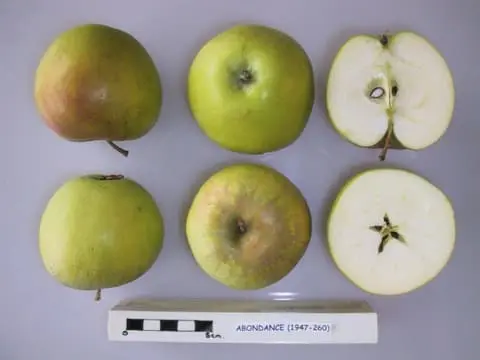
Abondance
-
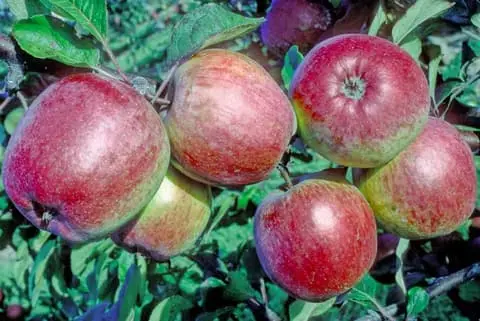
Alfred Jolibois
-
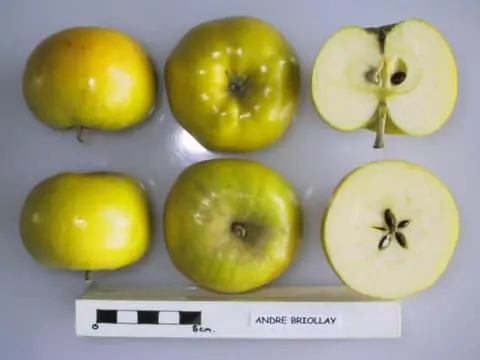
Andre Briollay
-
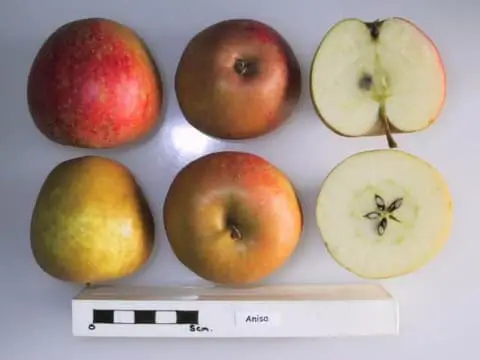
Anisa
-
Api
A tiny, glossy, red-cheeked apple recorded in 1628 and said to have been found wild in a forest in Brittany
-
Api Noir
-
Barre
-
Bassard