Api
A tiny, glossy, red-cheeked apple recorded in 1628 and said to have been found wild in a forest in Brittany
History
André Leroy traced the Api to the last years of the sixteenth century and found it first named in 1628, when Le Lectier of Orléans listed a Petit Apis and a Gros Apis among his keeping apples2. The National Fruit Collection and a 2020 DNA survey also give 16281,6.
A Roman origin goes back to 1600, when Olivier de Serres derived the name of a “pomme Appie” from Appius Claudius, said to have brought it from the Peloponnese to Rome; Leroy thought de Serres probably meant another apple, but the story still clung to the Api in 18672. Hogg repeated it without vouching for it3, and Bunyard thought the Api might date from Roman times4. Leroy rejected this: Pliny’s Appian apples smelled of quince, while the Api’s flesh and juice have no scent2. Muranty and colleagues likewise found “little tangible evidence” for a Roman origin6. Leroy preferred Merlet, who in 1667 called it a wild apple from the forest of Apis and in 1690 put that forest in Brittany; Leroy could not find it, but noted a hamlet called Apigné near Rennes2.
In England, Hogg found it first mentioned late in the seventeenth century, by Worlidge, as the “Pomme Appease” that “the Madams of France carry in their pockets”3. In 1884 he wrote that large quantities came each year from the United States, where as the Lady Apple it fetched the highest price of any fancy apple; in winter they stood, in coloured tissue paper, in Covent Garden fruiterers’ windows3. In New York it was grown in only a few places, but was long a favourite of the holiday trade5.
The fruit
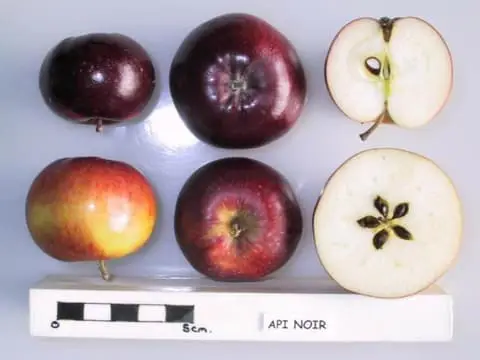
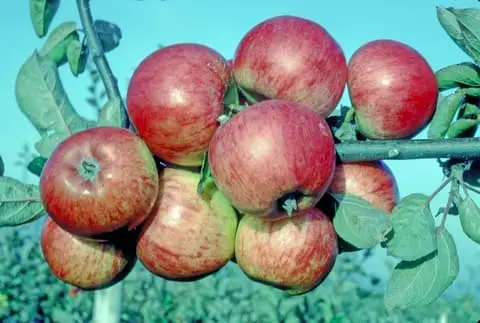
The fruit is very small and flat, about 50 mm wide and 30 mm high1,4. Its smooth, glossy skin is pale yellow or waxy white, with a deep crimson cheek on the sunny side, often sharply outlined2,3,5. The white flesh is fine-grained, crisp and juicy, sweet and mild2,3,5. Hogg advised eating it with the skin, “as it is there that the perfume is contained”3. The skin is so sensitive to shade that a design could be printed on it by sticking paper shapes to the sunny side before it reddened3.
At Brogdale it begins to flower about 27 April, and the fruit is picked in mid-October1. Leroy advised picking it as late as possible; it hangs firmly enough to withstand autumn gales2,3. Its season ran from autumn or early winter into April or May, and in cold storage it kept until summer2,3,5.
Growing
The tree is small, upright and slender, and bears its fruit in clusters on short spurs2,4,5. Hogg and Leroy found it a heavy cropper2,3; Beach found it slow to start bearing, then reliable, with heavy crops usually every other year5. Its upright limbs and small fruit made picking costly, and it needed guarding against scab5. It is diploid6.
Uses
It is a dessert apple, valued also for decoration1,5.
Where the sources disagree
- Roman or Breton. Hogg and Bunyard left room for a Roman origin3,4; Leroy rejected it, and Muranty and colleagues found little evidence for it2,6. The Breton forest rests on Merlet’s word, which Leroy and the National Fruit Collection accept1,2.
- Scent. Hogg found the flesh slightly perfumed, and Beach and the National Fruit Collection call it aromatic1,3,5; Leroy insisted that it has no scent at all2.
- More than one Api. The tree grown as Api in Copenhagen is a different genotype from the Api in Muranty’s survey, and is filed as Api Rose6,7, a name that Leroy and the National Fruit Collection give as a synonym of Api1,2.
Family tree
Offspring in the atlas
- Bebe Rose × Imperiale; France, by 1947
Sources
- Api (accession 1982-288), National Fruit Collection, Brogdale, Kent (Defra). Supports: "Also known as Lady Apple"; "thought to have been found in the Forest of Apis, Brittany, France. Recorded in 1628"; fruit "sweet, crisp and juicy with an aromatic flavour"; "Highly decorative fruits"; a dessert apple; synonyms including Lady, Pomme d'Api, Api rouge, Petit Api, Api Petit, Petit Api rouge, Api rose and Christmas Apple; from the National Apple Register (Smith, 1971; set b): small and flat, 30 mm high and 50 mm wide, yellow ground with red over-colour, white flesh; 10% flowering on 27 April and picking in mid-October at Brogdale.
- Dictionnaire de pomologie, vol. III, pp. 65–67: Pomme d'Api (in French), André Leroy, Paris and Angers, Internet Archive, 1873. Supports: entry no. 10, with the synonyms Petit-Apis (le Lectier, 1628), Api rose (1821) and De Lady (1852); weak wood, slender, mostly erect shoots; fertility "remarquable"; most often grown as a cordon; fruit small, round and always much flattened; skin straw-yellow or waxy white, largely covered on the sunny side with bright carmine; flesh white, very fine and close, firm or fairly tender but crisp; juice abundant, sweet and refreshing; ripe January to May; going back to the last years of the sixteenth century, and first named in 1628 by le Lectier of Orléans, who listed a Petit Apis and a Gros Apis as keeping apples; Olivier de Serres (1600) deriving the name of a "pomme Appie" from Appius Claudius, who brought it from the Peloponnese to Rome, which Leroy thought probably meant the Apion, though the story was still told of the Api in 1867; Leroy's rejection of a Roman origin, since Pliny's Appian apples smelled of quince and the Api's flesh and juice are scentless; Merlet (1667) calling it a wild apple found in the forest of Apis, placed in Brittany in 1690; Leroy unable to find the forest, noting a hamlet named Apigné near Rennes; to be picked as late as possible; firmly enough attached to withstand the winds of late autumn.
- The Fruit Manual, 5th ed., pp. 8–9: Api, Robert Hogg, Journal of Horticulture Office, Internet Archive, 1884. Supports: synonyms Lady Apple, Api Rouge, Pomme d'Api, Petit Api Rouge and Api Petit; skin smooth and shining, yellowish green turning pale yellow, deep glossy red approaching crimson in the sun; flesh white, crisp, tender, sweet, very juicy and slightly perfumed; "A beautiful little dessert apple", in use from October to April, to be eaten with the skin on, "as it is there that the perfume is contained"; designs formed on the skin by sticking paper shapes to the sunny side before it colours; tree pyramidal and an abundant bearer; fruit firmly attached, resisting high winds; the claim that Appius Claudius brought it from the Peloponnese to Rome reported with "Whether this be true or not"; Merlet's account of a wilding in the Forest of Api in Brittany; first mentioned in England by Worlidge, late in the seventeenth century, as "Pomme Appease", which "the Madams of France carry in their pockets"; large quantities imported each year from the United States, where as Lady Apple it is grown extensively and "always commands the highest price of any other fancy apple in the market", and seen in winter in coloured tissue paper in Covent Garden fruiterers' windows.
- A Handbook of Hardy Fruits, vol. I, p. 18: Api, E. A. Bunyard, John Murray, Internet Archive, 1920. Supports: synonyms Api rouge, Api petit and Lady; dessert, November to April; very small and flat, 2 by 1¼ inches; growth upright and very slender, making a small close tree, fertile; "Origin, of great antiquity; possibly dating from Roman days".
- The Apples of New York, vol. I, pp. 180–183: Lady, S. A. Beach, New York Agricultural Experiment Station, Internet Archive, 1905. Supports: "especially suitable for decorative use and for dessert"; grown in New York only to a limited extent, often selling at very high prices; long one of the most desirable apples in the New York market for the holiday trade; fruit borne in clusters on short spurs; a moderate grower, slow to come into bearing but then a reliable cropper, with heavy crops usually every other year; picking costly because of the upright limbs and small fruit; often seriously damaged by scab; may be held in cold storage till summer; skin smooth and glossy, with a deep red blush often sharply outlined against a clear pale yellow or whitish ground; flesh white, firm, fine-grained, crisp, juicy and pleasantly aromatic, mild subacid becoming nearly sweet; season December to May.
- Using whole-genome SNP data to reconstruct a large multi-generation pedigree in apple germplasm, H. Muranty and others, BMC Plant Biology 20: 2, with Additional files 1 and 3, 2020. Supports: Pomme d'Api (synonyms Api Rose, Lady Apple) said to be of Roman origin, "although there is little tangible evidence for this"; Api (genotype MUNQ 10) diploid and dated 1628 (Table S1); parent–offspring links with Api Noir and others, not oriented, and with Pomme d'Adam and Rosa Mantovana, taken to be its offspring (Table S6).
- Cultivar fingerprinting and SNP-based pedigree reconstruction in Danish heritage apple cultivars utilizing genotypic data from multiple germplasm collections in the world (Supplementary Table S2), B. Larsen and others, Genetic Resources and Crop Evolution 72: 2397, 2025. Supports: the tree named Api in the University of Copenhagen's Pometum (DNK1018) assigned to genotype MUNQ 394, under the name Api Rose (accession and pedigree tables).