Apple varieties, United Kingdom
Ribston Pippin
Grown at Ribston Hall, Yorkshire, from a pip said to come from Normandy; its DNA parents are Margil and Nonsuch Park
History
Ribston Pippin takes its name from Ribston Hall, near Knaresborough in Yorkshire, where by tradition the original tree grew from a pip brought from Rouen, in Normandy1,2,3. The Herefordshire Pomona quotes a note attributed to Sir John Goodricke, who died in 1789: three pips were sent to Sir Henry Goodricke from Normandy about 1709, and only one succeeded1. The tree blew down in a gale in 1810 and, propped on stakes, went on fruiting until it died1,2; a sucker from its root bore “two pecks of very fine fruit” in 18751.
Its fame grew slowly. The Brompton Park nursery did not grow it in 1770, but by 1794 it filled five rows there, and in 1847 the nursery raised about 2,500 a year1,2. Hogg found it “so well known as to require neither description nor encomium”2. An American handbook said it stood “as high in Great Britain as the Bank of England”, though in the United States it ranked below the Newtown Pippin and the Baldwin; in Maine and parts of Canada it was “very fine and productive”5.
Ribston Pippin is triploid6. In 2020 an SNP study found its parents to be Margil, which passed on an unreduced gamete, and Nonsuch Park6; a 2025 study found the same pair7. Margil is an old variety from Normandy, described in 1608, while Nonsuch Park is recorded only from 18316. The National Fruit Collection still lists Ribston Pippin as a parent of Cox’s Orange Pippin, Cox’s Pomona, Sturmer Pippin and others3, but the 2020 study did not find it among the parents of any of seven reputed offspring6. Howard and colleagues found every recorded pedigree they examined that made a triploid the parent of a diploid to be false, and suggest that the error may come from its likely resemblance to Margil8.
The fruit
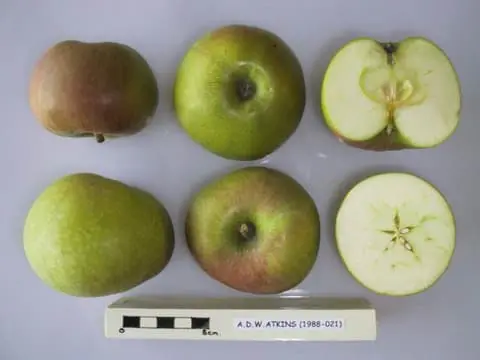
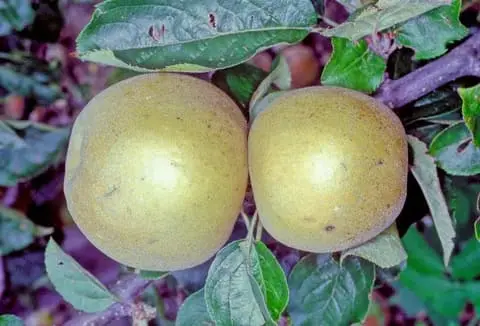
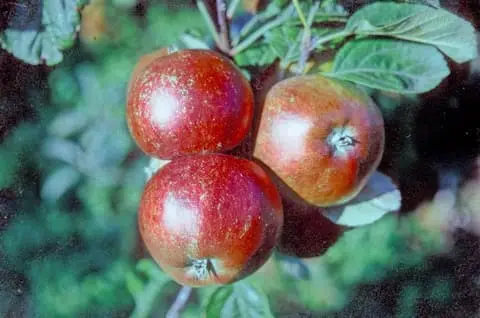
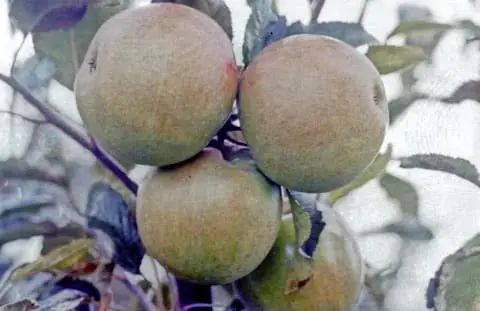
The fruit is medium-sized, roundish and irregular in outline2,4; the 1971 National Apple Register calls it flat, 66.5 mm wide and 55.5 mm high3. The skin ripens from greenish to dull yellow, with a dull red to crimson flush and deeper streaks on the sunny side and russet over the base2,4. The yellow flesh is firm, crisp, rich and sugary, with “a powerful aromatic flavour”2; the collection finds it fine-textured and moderately juicy3. Bunyard counted it “one of the richest flavoured apples when well ripened”4. Hogg found it best in November and December, keeping until March with good management2; Bunyard gave its season as until January4.
At Brogdale, Kent, it reaches 10 per cent flowering about 3 May and is picked in late September3. The Royal Horticultural Society gave it an Award of Merit in 19623, and it holds the society’s Award of Garden Merit9.
Growing
Hogg found the tree hardy, vigorous and a good bearer on dry soil, but on any other “almost sure to canker”; it did well as an open standard in the south and middle of England, but needed a wall in the north and in Scotland2. Bunyard rated its growth moderate and its cropping medium4.
Where the sources disagree
- Date. Hogg has pips from Rouen sown about 16882, the National Fruit Collection seed from Rouen planted about 17073, and the Pomona and Bunyard about 17091,4.
- The original tree. It died in 1835 by Hogg’s account and in 1840 by the Pomona’s1,2.
- Brompton Park. Hogg dates its first plants there to 1785, the Pomona to 17751,2.
- Raiser. Hogg names the gardener at Ribston Hall, father of a Hampton Wick nurseryman named Lowe2; the Pomona also reports a tradition at Ribston naming Robert Clemesha1.
Family tree
Parents, grandparents and great-grandparents, as the entries in the atlas record them.
- Ribston Pippin United Kingdom, about 1707
- Parent Margil France, probably by 1608
- Parent Nonsuch Park United Kingdom, by 1831
Offspring in the atlas
- Cox's Orange Pippin Red Sport (Potter) United Kingdom, by 1957
- Cox's Pomona United Kingdom, about 1825
- Jennifer Wastie × Barnack Beauty; United Kingdom, by 1945
- Reverend W. Wilks × Peasgood's Nonsuch; United Kingdom, by 1904
19 varieties in the atlas descend from Ribston Pippin.
Sources
- The Herefordshire Pomona, vol. I, plate XXV: Ribston Pippin, Robert Hogg and H. G. Bull (eds), Woolhope Naturalists' Field Club, Internet Archive, 1876–1885. Supports: the original tree in the park at Ribston Hall, near Knaresborough; the tradition of a pip from Normandy; the account attributed to Sir John Goodricke, "who died in 1789", of three pips sent to Sir Henry Goodricke from Normandy "about the year 1709", of which only one succeeded; the synonyms Glory of York and Travers' Pippin; the tree blown down in 1810, propped on stakes, and dying "in the year 1840"; a sucker from the root that "In the year 1875 ... bore two pecks of very fine fruit"; the tradition naming Robert Clemesha as the gardener who raised it, and the second account naming the father of Lowe; not grown at Brompton Park in 1770, appearing there "In 1775" as a quarter-row of about 25 plants, five rows by 1794; 3,000 plants propagated a year by Richard Smith and Co. of Worcester (text continued on the following two pages).
- The Fruit Manual, 5th ed., pp. 194–195: Ribston Pippin, Robert Hogg, Journal of Horticulture Office, Internet Archive, 1884. Supports: the synonyms Glory of York and Travers' Pippin; the original tree at Ribston Hall, near Knaresborough; one account of pips "brought from Rouen and sown at Ribston Hall" about 1688; the tree blown down in 1810, propped on stakes, and dying in 1835; the raiser the gardener at Ribston Hall, father of Lowe, nurseryman at Hampton Wick; not at Brompton Park in 1770, there "In 1785" as about 25 plants, five rows by 1794 and "2,500 plants annually" in 1847; "An apple so well known as to require neither description nor encomium"; a medium-sized, roundish, irregular fruit; the skin greenish yellow ripening to dull yellow, dull red to faint crimson with deeper streaks in the sun, russety over the base; flesh "yellow, firm, crisp, rich, and sugary, charged with a powerful aromatic flavour"; best in November and December, keeping "till March" with good management; the tree hardy, vigorous and a good bearer on dry soil, otherwise "almost sure to canker"; an open standard in the south and middle of England, a wall needed in the north and in Scotland.
- Ribston Pippin (accession 1973-142), National Fruit Collection, Brogdale, Kent (Defra). Supports: "Raised at Ribston Hall, Yorkshire, England from seed brought from Rouen, and planted in about 1707"; Award of Merit from the Royal Horticultural Society in 1962; "firm, fine-textured, moderately juicy flesh with a rich aromatic flavour"; a dessert apple; synonyms including Ribston, Formosa Pippin and Nonpareille d'Angleterre; listed as mother to Cox's Orange Pippin, Cox's Pomona and Sturmer Pippin, among others, and father to Freiherr von Berlepsch and others; from the National Apple Register (Smith, 1971), marked b: flat, height 55.50 mm, width 66.50 mm; 10% flowering on 3 May (accession 1973-142); picking in late September (NFC staff, marked a, Brogdale).
- A Handbook of Hardy Fruits, vol. I, p. 111: Ribston Pippin, E. A. Bunyard, John Murray, Internet Archive, 1920. Supports: the names Pepin Ribston and Englische Granat Reinette, with Formosa Pippin, Nonpareille d'Angleterre and Travers Pippin; a dessert apple, in season "till January"; medium to fairly large, round conical, irregular; yellow with a dull brownish-red flush, few stripes and russet; flesh firm, yellow, highly aromatic; growth moderate, fertility medium; raised at Ribston Hall, Knaresborough, "about 1709, from seeds brought from Rouen"; "One of the richest flavoured apples when well ripened".
- The Fruits and Fruit Trees of America, pp. 333–334: Ribston Pippin, A. J. Downing, revised by Charles Downing, John Wiley & Sons, Internet Archive, 1900. Supports: the Ribston Pippin "stands as high in Great Britain as the Bank of England"; in the United States it must "give place" to the Newtown Pippin, Swaar, Spitzenburgh or Baldwin; "In Maine, and parts of Canada, it is very fine and productive".
- Using whole-genome SNP data to reconstruct a large multi-generation pedigree in apple germplasm, H. Muranty and others, BMC Plant Biology 20: 2, with Additional file 1 (Table S1), 2020. Supports: Ribston Pippin triploid (Table S1, 3n); its parents "Margil", which contributed a 2n gamete, and "Nonsuch Park" (in agreement with Ordidge and others for Margil); Margil a very old variety from Normandy, described in 1608; Nonsuch Park documented only as "Described [in] 1831"; Ribston Pippin reputed to be the parent of at least 16 cultivars, seven of them in the sample, and "never among the identified parents".
- Cultivar fingerprinting and SNP-based pedigree reconstruction in Danish heritage apple cultivars utilizing genotypic data from multiple germplasm collections in the world, B. Larsen and others, Genetic Resources and Crop Evolution 72: 2397, supplementary Table S5, 2025. Supports: Table S5: Ribston Pippin, ploidy 3, with SNP-confirmed parents Margil and Nonsuch Park.
- Pedigree reconstruction for triploid apple cultivars using single nucleotide polymorphism array data, N. P. Howard and others, Plants, People, Planet 5; University of Reading repository, 2022. Supports: Margil the parent that gave Ribston Pippin an unreduced gamete, and also a parent of Cox's Orange Pippin; "All the pedigree records considered from literature that list triploids as one or both parents of diploids were identified as false"; triploids likely resembling their unreduced-gamete parents in some cases, "which was likely the case between 'Ribston Pippin' and 'Margil'".
- RHS Recommended: Award of Garden Merit. Fruit, vegetables and herbs, Royal Horticultural Society. Supports: Ribston Pippin (dessert) on the list of apples holding the Award of Garden Merit.