Apple varieties, United States
Rhode Island Greening
Probably from Green's End near Newport; second only to the Baldwin in New York in 1905, and Rhode Island's state fruit
History
Where the Rhode Island Greening began is not known for certain, but Beach had little doubt that it came from Rhode Island, probably from near Newport at the place called Green’s End1,4. An account of 1901 that he quoted tells how a Mr Green, who kept a tavern there, raised apple trees from seed; one bore a large green apple, and his guests took so many grafts that the tree died of the cutting1. The same account records a tree of the variety planted at Fruit Hill in 1748 and felled in 1889, and has the apple carried to Ohio in 17961.
It spread widely through the older parts of New York during the eighteenth century1, and reached England through the Horticultural Society of London2. In 1905 New York grew it more than any apple except the Baldwin1. In 1909–13 it ranked fifth among the apples of the United States, and in 1928 American commercial orchards held 1,451,000 trees, 1.8 per cent of the total5; in 1941 it was still one of the leading varieties of the north-east5. In 1991 Rhode Island made it the official state fruit6.
The fruit
The fruit is above medium to very large, roundish and somewhat flattened1; at Brogdale it measures about 83 mm across and 66 mm high4. The tough, smooth, waxy skin is deep grass-green in autumn and turns yellowish as it ripens; it may have a dull blush, rarely a bright red cheek, but is never striped1. The yellowish flesh is firm, moderately fine-grained, crisp, tender and juicy, rich and sprightly subacid1. Hovey wrote that “As a cooking apple, the Greening is unsurpassed”, while allowing that to some tastes it is rather acid1.
At Brogdale it flowers around 4 May and is picked in early October4. In New York its commercial limit was January or early February in ordinary storage, and March or April in cold storage1. It ripens fast in warm autumn weather and scalds badly in store, turning yellow and mealy1,5.
Growing
The tree is hardy, vigorous and long-lived, eventually large, with long, spreading branches that droop, so Beach advised heading young trees high1. It is slow to begin bearing and often biennial, though in good conditions it crops almost every year; the fruit drops readily as it ripens, especially in high winds1. It suffers more than the Baldwin from scab, and in some places from canker1. Farther south it ripens earlier and keeps less well1. It is a triploid4, a poor polliniser and self-unfruitful5.
Uses
Beach counted it one of the very best cooking apples, almost the equal of the Esopus Spitzenburg and better than the Baldwin, and very good for dessert as well1. In England Hogg found it first-rate for every kind of cooking and excellent at table from November to April2.
Where the sources disagree
- Age. The National Fruit Collection says it was already known by 16504. The earliest date in the account Beach quoted is the planting of a tree at Fruit Hill in 17481, and Bunyard in 1920 thought the variety probably more than 150 years old3.
- The first tree. An old tree on the Drowne farm at Foster, said to be nearly 200 years old, was thought by some to be the original, but trees Beach raised from its top and from a sprout at its base differed, showing it to be grafted1.
- Another name. Hogg and the National Fruit Collection give Green Newtown Pippin as a synonym2,4; Beach records that earlier writers applied the name to it in error1.
Sources
- The Apples of New York, vol. I, pp. 282–287: Rhode Island Greening, S. A. Beach, New York Agricultural Experiment Station, Internet Archive, 1905. Supports: the synonyms, including Green Newtown Pippin as used by Hogg and applied "erroneously" by earlier writers (pp. 282–283); grown in New York more than any apple but Baldwin; deep grass-green turning yellow, a dull blush, rarely a bright red cheek, never striped; one of the very best cooking apples, almost the peer of Esopus Spitzenburg and decidedly superior to Baldwin, and very good for dessert; Hovey: "As a cooking apple, the Greening is unsurpassed", and to some tastes it is rather acid (p. 283); earlier ripening and poorer keeping farther south; long-lived, eventually large, hardy, strong and vigorous; scab, more than on Baldwin, and canker in some locations; not bearing very young, biennial or almost annual; dropping as it ripens, especially in high winds; long, wide-spreading, drooping branches and the advice to head the tree high (pp. 283–285); in ordinary storage a common commercial limit of January or early February, and in cold storage March or April; rapid ripening in warm autumn weather; scalding badly, turning yellow and mealy in storage (p. 285); origin probably near Newport at Green's End, with the 1901 account of Mr Green's tavern, the seedling and the cutting of scions, the mother tree at Fruit Hill planted in 1748 and cut down in 1889, and the variety carried into Ohio in 1796; wide dissemination in New York in the eighteenth century; the Drowne tree at Foster, "supposed to be nearly 200 years old", and Beach's test of scions from its upper branches and from a sprout at its base (pp. 285–286); the description of the fruit and its moderately fine-grained, rich, sprightly subacid flesh (pp. 286–287).
- The Fruit Manual, 5th ed., p. 194: Rhode Island Greening, Robert Hogg, Journal of Horticulture Office, Internet Archive, 1884. Supports: the synonym Green Newtown Pippin; in England an apple of first-rate quality for all culinary purposes and excellent for dessert, in use from November to April; introduced to England by the London Horticultural Society.
- A Handbook of Hardy Fruits, vol. I, p. 110: Rhode Island Greening, E. A. Bunyard, John Murray, Internet Archive, 1920. Supports: origin American, "probably over 150 years old".
- Rhode Island Greening (accession 1945-176), National Fruit Collection, Brogdale, Kent (Defra). Supports: triploid; thought to have originated at Green's End, Newport, Rhode Island; "already known by 1650"; the synonym Green Newtown Pippin; width 83.15 mm and height 66.23 mm; 10% flowering on 4 May and picking in early October at the collection.
- Apple Varieties and Important Producing Sections of the United States (Farmers' Bulletin 1883), pp. 7, 21–22, 26, 29, J. R. Magness, U.S. Department of Agriculture, Internet Archive, 1941. Supports: one of the most important varieties of the north-eastern section (p. 7); 1,451,000 trees in commercial orchards in 1928, 1.8 per cent of the total (Table 1, p. 21); fifth of the ten leading United States varieties in 1909–13 (p. 22); triploid, poor polliniser, self-unfruitful (Table 4, p. 26); severe tendency to storage scald (Table 5, p. 29).
- Rhode Island General Laws § 42-4-13: Official state fruit, State of Rhode Island General Assembly, 1991. Supports: "The variety of apple known as the Rhode Island greening is hereby designated as the official state fruit"; enacted by P.L. 1991, ch. 402.
More from United States
-
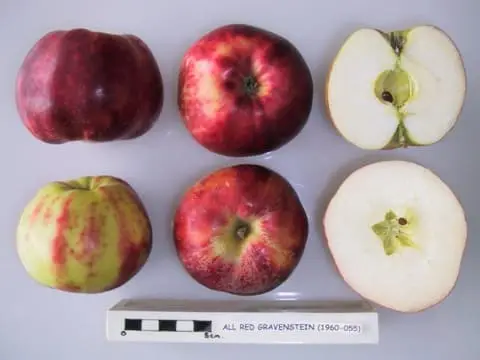
All-Red Gravenstein
-
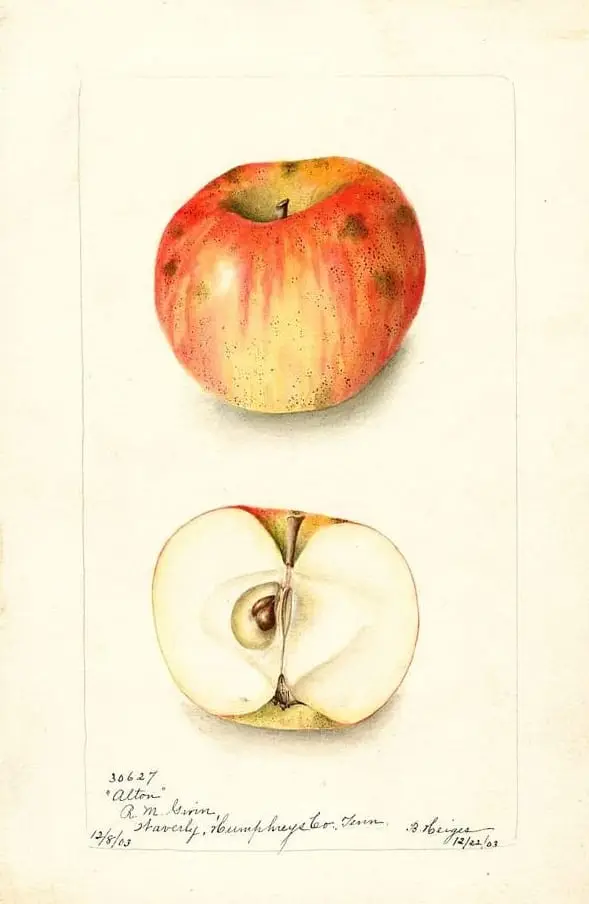
Alton
-
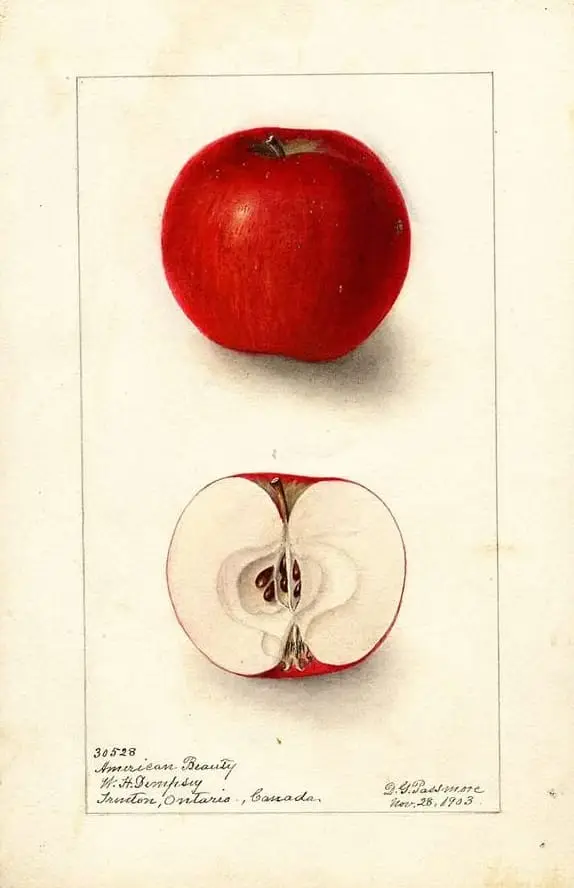
American Beauty
-
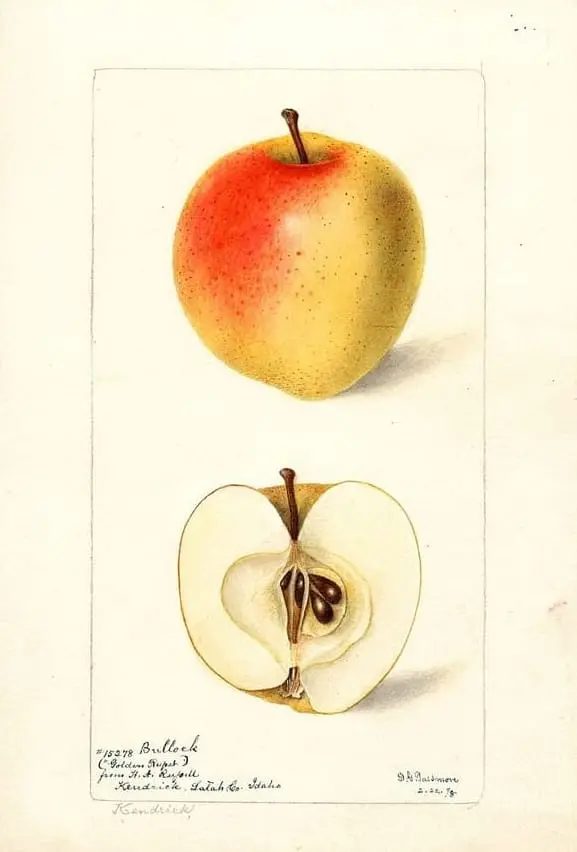
American Golden Russet
A small New Jersey russet whose flesh Downing likened to a buttery pear; Coxe knew it in 1817 as Sheep-nose
-
American Grindling
-
American Summer Pearmain
-
Ames
-
Arkansas