Apple varieties, United States
Esopus Spitzenburg
A Hudson valley apple known before 1790; DNA shows it a parent of Jonathan and probably a child of Reinette Franche
History
The Esopus Spitzenburg arose at Esopus, in Ulster County, New York1,4, a noted apple district on the Hudson first settled by the Dutch2. Its date is unknown, but it grew in the oldest orchards of the state1 and was known before 17904. Downing reported that good judges ranked it with the Newtown Pippin2, and it was one of Thomas Jefferson’s two favourite table apples, the other being the Albemarle, or Newtown, Pippin6.
In 1905 Beach called it “the standard of excellence for apples of the Baldwin class”1. In 1928 American commercial orchards held 592,000 trees of it, 0.7 per cent of the total, and by 1941 their number was thought to have fallen markedly5.
SNP data published in 2020 place it in a parent–offspring pair with Reinette Franche, a French apple known by 1540, and the dates of record make Reinette Franche the parent7; a 2025 study agrees8. Both studies support its recorded role as a parent of Jonathan7,8, and the 2025 study also names it as a parent of the triploid Tompkins King8.
The fruit
The fruit ranges from below medium to large, broad at the base and oblong to roundish-conical1. The tough, deep yellow skin is almost covered with bright red, faintly striped with darker red and deepening in the sun to an almost purplish blush, with small pale yellow and russet dots1. The yellowish flesh is firm, crisp, rather tender, juicy and aromatic, with a sprightly subacid flavour, and Beach found it, when well grown, “unexcelled in flavor and quality”1.
At Brogdale it flowers around 6 May and is picked in early October4. In New York it lasted from November to February or later, and until June in cold storage1.
Growing
Scab attacks the fruit, blossoms and leaves, and apple canker often injures the tree, so Beach advised grafting or budding it on a healthier variety1. In good conditions it crops fairly regularly, but on average only moderately, and growers found it less profitable than Baldwin or Rhode Island Greening; it did particularly well in Schoharie and Greene counties and along Lake Champlain1. Magness classed it as upright, first bearing at 6 to 8 years, a good polliniser and partly self-fruitful5. It is diploid7.
Uses
Beach counted it a choice dessert apple and one of the best for canning and general cooking; it stored and shipped well and often fetched fancy prices1.
Where the sources disagree
- Vigour. Beach found the tree a moderately slow grower1; Magness classed it as vigorous and large5.
- Away from the Hudson. Warder wrote in 1867 that as it spread west and south its fruit grew larger but less brightly coloured, less highly flavoured and less productive, and that in some regions the tree suffered from blight3. Yet in 1905 it was a commercial apple in parts of the Rocky Mountain region, Washington and Oregon1, and in 1941 still important in Oregon’s Hood River Valley5.
- Juiciness. Beach found the flesh juicy1; the National Fruit Collection’s characterisation at Brogdale records it as dry4.
Family tree
Parents, grandparents and great-grandparents, as the entries in the atlas record them.
- Esopus Spitzenburg United States, before 1790
- Parent Reinette Franche France, by 1540
- Parent Reinette de Saintonge
- Parent Reinette Franche France, by 1540
Offspring in the atlas
- Idagold × Wagener; United States, by 1939
- Jonathan United States, by 1826
- Stearns United States, by 1900
- Tompkins King United States, before 1804
98 varieties in the atlas descend from Esopus Spitzenburg.
Sources
- The Apples of New York, vol. I, pp. 120–122: Esopus Spitzenburg, S. A. Beach, New York Agricultural Experiment Station, Internet Archive, 1905. Supports: the synonyms (pp. 120–121); "the standard of excellence for apples of the Baldwin class", "unexcelled in flavor and quality", a choice dessert fruit and one of the best for canning or general culinary use, good in cold storage and in shipping, often bringing fancy prices; scab on fruit, blossoms and foliage; apple canker and the advice to graft or bud it on a healthier variety; a fairly regular but on average rather moderate cropper, less profitable than Baldwin and Rhode Island Greening; doing particularly well in Schoharie and Greene counties and along Lake Champlain (pp. 121–122); origin at Esopus, Ulster County, with no authentic date of origin, in the oldest orchards of the state; a commercial variety in parts of the Rocky Mountain region, Washington and Oregon; a moderately slow grower in the orchard; the description of the fruit, its flesh juicy; season November to February or later, in cold storage until June (p. 122).
- The Fruits and Fruit Trees of America, p. 164: Esopus Spitzenburgh, A. J. Downing, revised by Charles Downing, John Wiley & Sons, Internet Archive, 1900. Supports: considered by all good judges equal to the Newtown Pippin; originated at Esopus, a famous apple district on the Hudson originally settled by the "Low Dutch".
- American Pomology: Apples, pp. 539–540: Esopus Spitzenberg, J. A. Warder, Orange Judd, Internet Archive, 1867. Supports: the fruit becoming larger and more irregular, less brilliantly coloured, less highly flavoured and less productive as the variety spread westward and southward; the tree subject to blight in some regions.
- Esopus Spitzenburg (accession 1950-033), National Fruit Collection, Brogdale, Kent (Defra). Supports: originated at Esopus, Ulster County, New York; "Known before 1790"; the synonyms; juiciness characterised as "dry"; 10% flowering on 6 May and picking in early October at the collection.
- Apple Varieties and Important Producing Sections of the United States (Farmers' Bulletin 1883), pp. 18, 21, 23, 26, J. R. Magness, U.S. Department of Agriculture, Internet Archive, 1941. Supports: Esopus Spitzenburg among the important varieties of the Hood River Valley, Oregon (p. 18); 592,000 trees in commercial orchards in 1928, 0.7 per cent of the total, with a marked decrease since (Table 1, p. 21); upright, vigorous, large tree, first bearing at 6 to 8 years (Table 2, p. 23); good polliniser, partially self-fruitful (Table 4, p. 26).
- Malus pumila 'Albemarle Pippin', Monticello Gardens Garden Explorer, Thomas Jefferson Foundation, 2026-03-19. Supports: "Albemarle Pippin" (the Newtown Pippin) one of Thomas Jefferson's two favourite table apples, "the other being 'Esopus Spitzenburg'".
- Using whole-genome SNP data to reconstruct a large multi-generation pedigree in apple germplasm, H. Muranty and others, BMC Plant Biology 20: 2, Additional files 1 and 6, 2020. Supports: Esopus Spitzenburg diploid (Table S1); a parent–offspring duo with Reinette Franche, oriented by the documented dates (1540 and 1790) to make Reinette Franche the parent, and a duo with Jonathan, agreeing with Jonathan's recorded descent from Esopus Spitzenburg (Table S5); Reinette Franche, an old French cultivar "probably already 30 years old in 1540", as the ancestor of Jonathan "through 'Esopus Spitzenburg'" (text).
- Cultivar fingerprinting and SNP-based pedigree reconstruction in Danish heritage apple cultivars utilizing genotypic data from multiple germplasm collections in the world, B. Larsen and others, Genetic Resources and Crop Evolution 72: 2397, supplementary table S5, 2025. Supports: SNP-confirmed parentage: Reinette Franche a parent of Esopus Spitzenburg, and Esopus Spitzenburg a parent of Jonathan and of the triploid Tompkins King.
More from United States
-
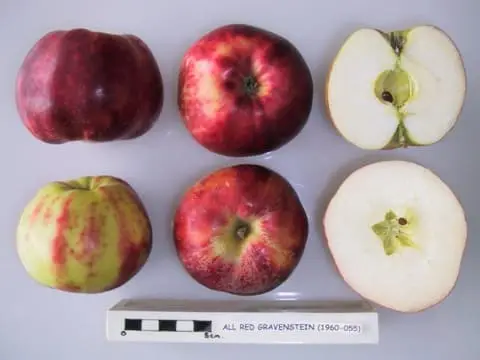
All-Red Gravenstein
-
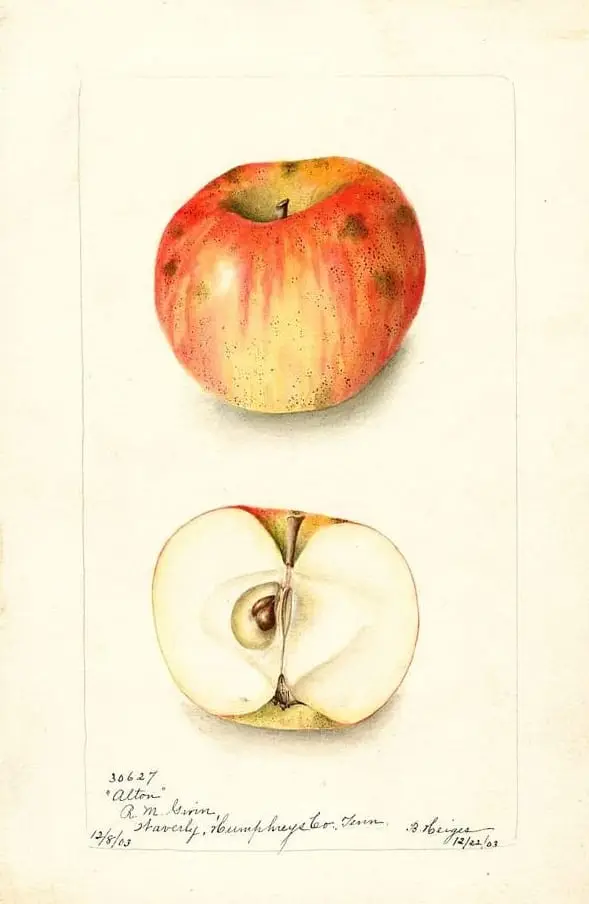
Alton
-
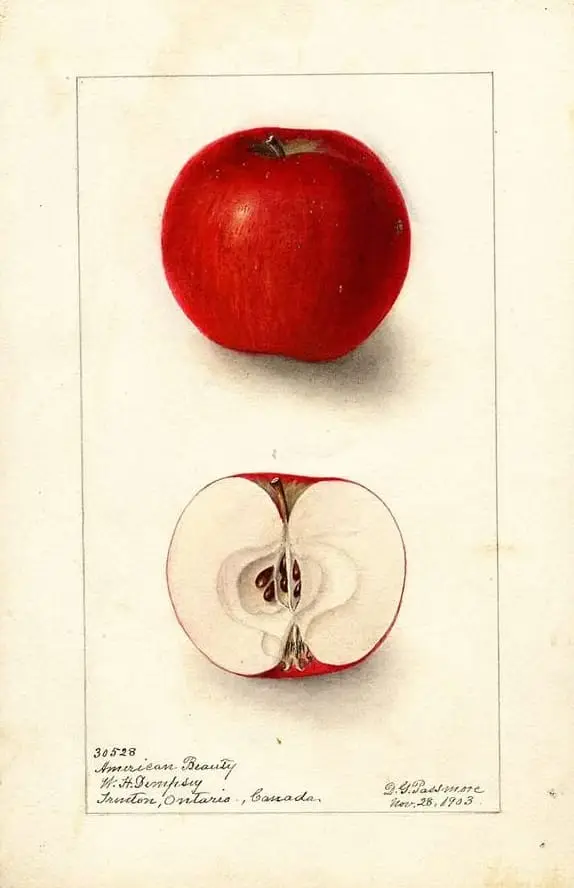
American Beauty
-
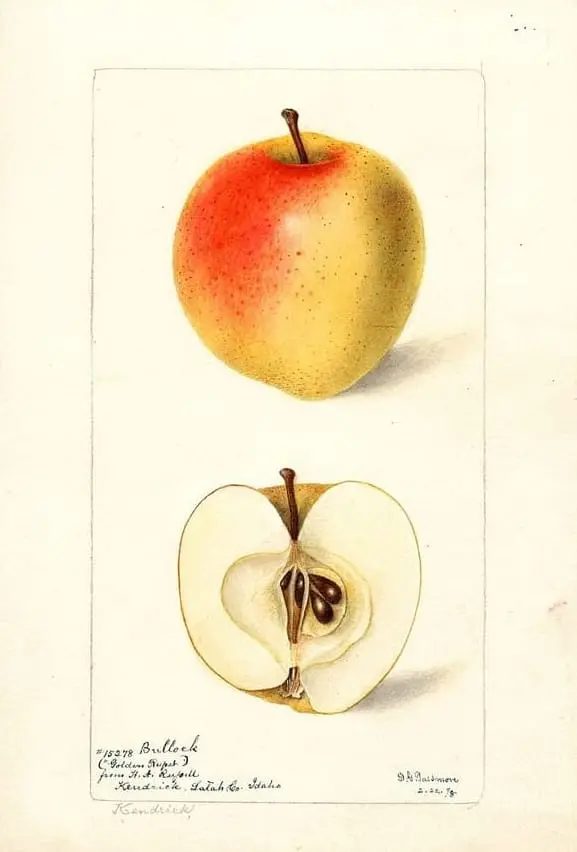
American Golden Russet
A small New Jersey russet whose flesh Downing likened to a buttery pear; Coxe knew it in 1817 as Sheep-nose
-
American Grindling
-
American Summer Pearmain
-
Ames
-
Arkansas