Apple varieties, United States
Newtown Pippin
From Newtown, Long Island: the first American apple to draw notice in Europe, sent to Franklin in London in 1759
History
The Newtown Pippin is said to have grown as a seedling near a swamp on Gershom Moore’s estate at Newtown, Long Island, early in the eighteenth century; the first tree died about 1805, exhausted by the cutting of grafts1,5.
It was the first American apple to attract attention in Europe1. Fruit of the 1758 crop reached Benjamin Franklin in London, and his friend Collinson then ordered grafts2; by 1768 the Brompton Park nursery was growing it as “Newtown Pippin from New York”4. Thomas Jefferson had grafts of it worked in 1772 and planted out at Monticello in 17781, and the Monticello gardens count it, with the Esopus Spitzenburg, as one of his two favourite table apples8.
In Albemarle County, Virginia, it was long grown as a local variety, the Albemarle Pippin; its identity with the Yellow Newtown was first recorded in 18571. Samuel B. Woods, writing in 1898, dated its rise in the English market to the first year of Queen Victoria’s reign, when the American minister gave her several barrels and she lifted a small duty on them1,8.
By 1905 it did well in parts of the Hudson valley and on Long Island’s north shore; most of the crop was exported, fetching the best prices paid in Europe for American apples1. In 1928 American commercial orchards held 2,326,000 Yellow Newtown trees, 2.9 per cent of the total, and in 1941 it led the Hood River Valley in Oregon and, with Yellow Bellflower, the Watsonville district of California7. SNP data suggest it is a parent of York Imperial9, and the National Fruit Collection records the Yellow Newtown Pippin as the pollen parent of Spartan6.
The fruit
The fruit is medium-sized to very large, roundish, flattened and somewhat angular, often lopsided1,3. The green form is grass-green when picked and may turn quite yellow later; the yellow form ripens bright yellow, often with a pinkish blush1. The flesh is firm, crisp, tender and juicy, with a sprightly, aromatic, subacid flavour, milder and more aromatic in the yellow form1,6. Downing wrote that it “stands at the head of all Apples”, keeping without shrivelling from December to May3.
Magness gave the Yellow Newtown 150 to 180 days in cold storage7. At Brogdale it flowers around 9 May and is picked in mid-October5.
Growing
Beach thought its success depended more on local conditions than that of any other standard commercial apple in New York1. Downing advised a strong, deep, warm soil, regularly manured; the tree grows slowly and has rough bark3. It is quite susceptible to scab, especially on heavy clay1. It is diploid9; Magness classed the Yellow Newtown as a good polliniser and partly self-fruitful7. In England it seldom ripened, and even on a wall lacked the aroma of imported fruit1,4.
Uses
Beach rated it of the highest quality for dessert and excellent for cooking; its cider was very clear and fine, and much fruit once went into it1.
Where the sources disagree
- Green or yellow. Coxe described a Large Yellow and a Green Newtown Pippin as separate varieties in 18171, and Downing kept them apart3. Beach thought one probably a sport or strain of the other and could not say which was the original1; the National Fruit Collection records the yellow as thought to be a sport6.
- The Albemarle Pippin. Most pomologists accepted it as the Yellow Newtown, but many Virginian growers went on believing it a distinct local variety1. Of two local traditions, Woods preferred grafts brought home by Dr Thomas Walker of Castle Hill after Braddock’s defeat in 1755 to a supposed seedling near North Garden known by 17651.
Family tree
Offspring in the atlas
- Lamb Abbey Pearmain United Kingdom, 1804
- May Beauty × Golden Pippin; United Kingdom, by 1945
- Newtosh × McIntosh; Canada, by 1922
- Storey's Seedling United Kingdom, 1927
- York Imperial United States, 1820
10 varieties in the atlas descend from Newtown Pippin.
Sources
- The Apples of New York, vol. I, pp. 145–150: Green Newtown and Yellow Newtown, S. A. Beach, New York Agricultural Experiment Station, Internet Archive, 1905. Supports: the synonyms; the two forms "so much alike" that one is probably "a sport or strain of the other", and the original impossible to determine; success more limited by local conditions than with any other standard commercial variety in New York, grown with success in parts of the Hudson valley and on the north shore of Long Island; susceptibility to scab, especially on heavy clay; the best prices paid in Europe for American apples, the crop largely exported; commercial season February to March in ordinary storage and March to May in cold storage; highest quality for dessert, excellent for cooking, very clear cider of high quality and much early fruit used for cider; Taylor's account (pp. 147–148): the first American apple to attract attention in Europe, specimens received by Franklin in London in 1759, Forsyth's remark that in England it "seldom ripens", Jefferson's grafts from Mordecai Debnam worked in March 1772 and planted out at Monticello in March 1778, Coxe's separate Large Yellow and Green Newtown Pippin (1817), the original seedling near a swamp on Gershom Moore's estate at Newtown, dead about 1805 from excessive cutting of scions and exhaustion, its origin in the early 18th century, and the Albemarle Pippin long propagated in Albemarle County as a distinct local variety; identity with Yellow Newtown first recorded by Franklin Davis in the Horticulturist in 1857 (p. 149); most pomologists accepting the identity while many orchardists in the Piedmont and mountain regions still believed the Albemarle a distinct local variety; S. B. Woods's letters of 1898: the duty lifted by Queen Victoria in the first year of her reign after the minister Andrew Stevenson gave her several barrels, the Albemarle Pippin growing in favour in English markets from that time, and the two traditions of its arrival, a supposed seedling in the North Garden neighbourhood noted in 1765 and, "the most authentic", Dr Thomas Walker's grafts brought home after Braddock's defeat in 1755; the descriptions of both forms (pp. 149–150).
- The Apples of New York, vol. I, p. 11: introduction, S. A. Beach, New York Agricultural Experiment Station, Internet Archive, 1905. Supports: Taylor: "a package of Newtown Pippins of the crop of 1758 sent to Benjamin Franklin while in London", and the resulting order for grafts placed with John Bartram of Philadelphia by Franklin's friend Collinson.
- The Fruits and Fruit Trees of America, pp. 201–202 and 419: Green Newtown Pippin; Yellow Newtown Pippin, A. J. Downing, revised by Charles Downing, John Wiley & Sons, Internet Archive, 1900. Supports: the Newtown Pippin "stands at the head of all Apples" and keeps without shrivelling, December to May; a strong, deep, warm soil manured every two or three years; a slow-growing tree with rough bark; russet at the stalk; the green form described as distinct from the yellow, which is flatter and always oblique (p. 419).
- The Fruit Manual, 5th ed., pp. 155–156: Newtown Pippin, Robert Hogg, Journal of Horticulture Office, Internet Archive, 1884. Supports: grown at the Brompton Park nursery by 1768 under the name "Newtown Pippin from New York"; not succeeding in England, and lacking the aroma of imported fruit even against a wall.
- Newtown Pippin (accession 1963-025), National Fruit Collection, Brogdale, Kent (Defra). Supports: originated on the estate of Gersham Moore at Newtown, Long Island; well known in 1759; 10% flowering on 9 May and picking in mid-October at the collection.
- Yellow Newtown Pippin (accession 2000-103), National Fruit Collection, Brogdale, Kent (Defra). Supports: "Thought to be a sport of Newtown Pippin"; fruits less acid than Newtown Pippin with a more aromatic flavour; recorded as the father (pollen parent) of Spartan and Newtosh.
- Apple Varieties and Important Producing Sections of the United States (Farmers' Bulletin 1883), pp. 18–19, 21, 26, 29, J. R. Magness, U.S. Department of Agriculture, Internet Archive, 1941. Supports: Yellow Newtown "by far the leading variety" of the Hood River Valley, Oregon (p. 18), and with Yellow Bellflower one of the two leading varieties of the Watsonville district, California (p. 19); 2,326,000 trees in commercial orchards in 1928, 2.9 per cent of the total, with a moderate decrease since (Table 1, p. 21); diploid, good polliniser, partially self-fruitful (Table 4, p. 26); 150 to 180 days of normal cold storage (Table 5, p. 29).
- Malus pumila 'Albemarle Pippin', Monticello Gardens Garden Explorer, Thomas Jefferson Foundation, 2026-03-19. Supports: one of Thomas Jefferson's two favourite table apples, the other being Esopus Spitzenburg; Queen Victoria's exemption of the apples from an import tax.
- Using whole-genome SNP data to reconstruct a large multi-generation pedigree in apple germplasm, H. Muranty and others, BMC Plant Biology 20: 2, Additional files 1 and 6, 2020. Supports: Newtown Pippin diploid (Table S1); a parent–offspring duo of Newtown Pippin and York Imperial, oriented by their dates (1759 and 1820) to make Newtown Pippin the parent (Additional file 6, Table S5).
More from United States
-
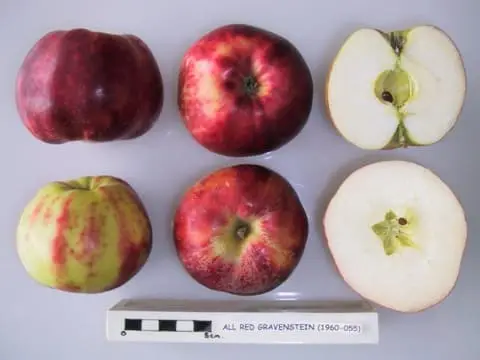
All-Red Gravenstein
-
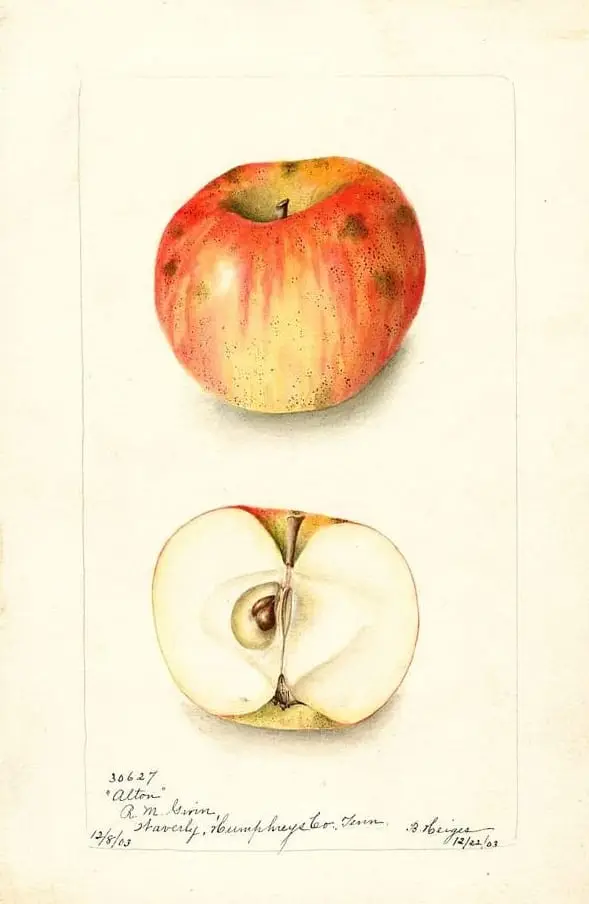
Alton
-
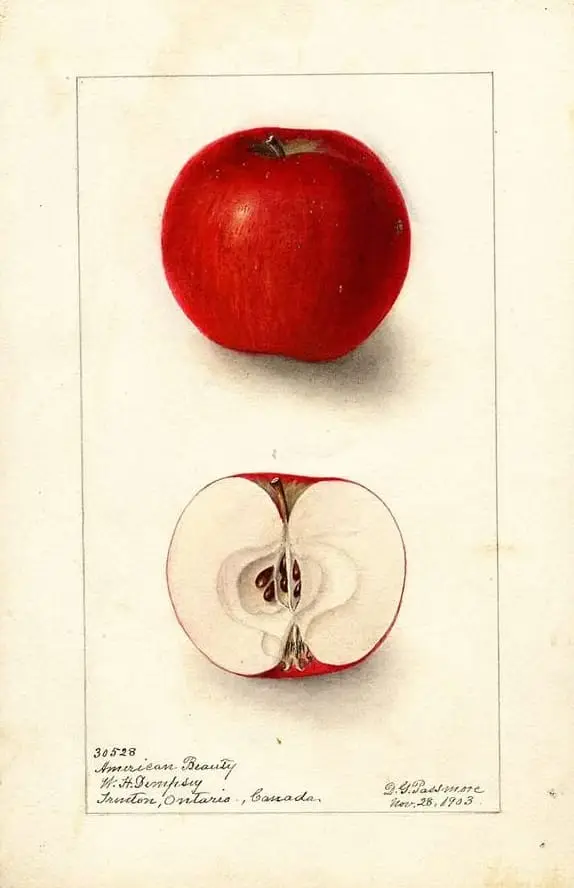
American Beauty
-
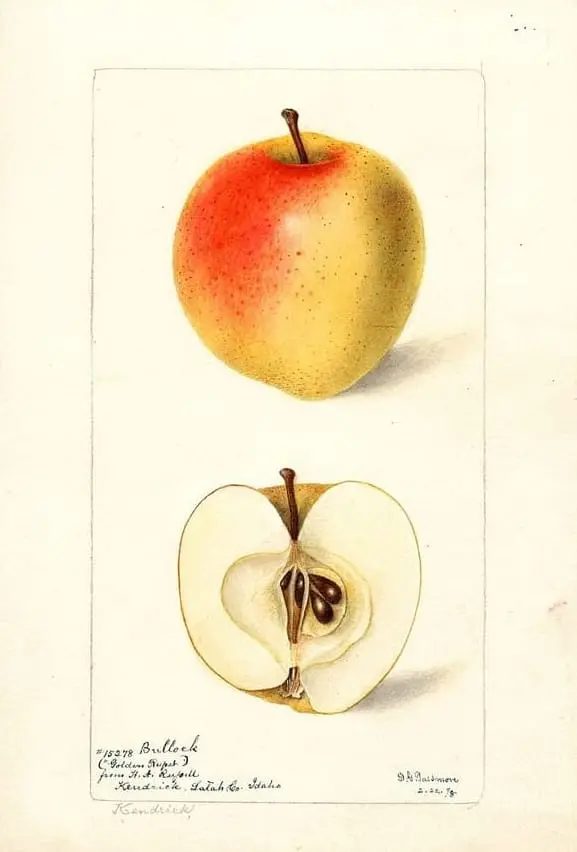
American Golden Russet
A small New Jersey russet whose flesh Downing likened to a buttery pear; Coxe knew it in 1817 as Sheep-nose
-
American Grindling
-
American Summer Pearmain
-
Ames
-
Arkansas