Apple varieties, United States
York Imperial
A lopsided Pennsylvania winter apple, named after Charles Downing called it the "imperial of keepers"
History
Taylor’s account of 1898, quoted by Beach, says the apple arose early in the nineteenth century on a farm next to the then borough of York, Pennsylvania, whose owner, a Mr Johnson, noticed schoolboys visiting the tree in early spring for apples that had wintered on the ground under the leaves1. Finding the fruit in fine condition, he took specimens to Jonathan Jessop, a local nurseryman, who began propagating it before 1830 as Johnson’s Fine Winter1. A state historical marker, dedicated in 1948 at the site of Jessop’s nursery on Springwood Farms, gives 1820 as the year he propagated it2.
Jessop’s trees sold slowly at first, and he dumped the surplus in a hollow beside the turnpike, where farmers coming home from market picked them up and planted them in the lower end of York County1. After the middle of the century Charles Downing examined the fruit, called it the “imperial of keepers” and proposed the name York Imperial; the marker dates the naming to 18551,2. The earliest printed description Taylor knew of was W. D. Brincklé’s, in 1853; the apple became a leading market variety in Pennsylvania, Maryland and Virginia and from about 1880 spread through the Middle West1.
In 1928 American commercial orchards held 3,604,000 trees, 4.5 per cent of the total4. In 1941 it and Stayman Winesap were the leading varieties of the central Atlantic region, and it led in West Virginia and northern Virginia4. In 2024/25 it made up 1 per cent of US production; Pennsylvania was expected to grow 2,699,655 of the 3,707,493 bushels forecast for 2025/26, more than of any other variety in the state5.
SNP data published in 2020 show York Imperial and Newtown Pippin to be parent and offspring, with Newtown Pippin, the older, taken to be the parent3.
The fruit
Well grown, the fruit is above medium to large, roundish-oblate and lopsided, with an oblique axis that made it hard to pare by machine1. The tough, bright, smooth skin is green or yellow, blushed with light or pinkish red and faintly striped with carmine1. The yellowish flesh is firm, crisp, a little coarse and moderately juicy, sprightly subacid at first but becoming mild or almost sweet, and somewhat aromatic1.
It was valued as a keeper: in New York it kept in ordinary storage until April or May unless it scalded, with March its commercial limit1. It scalded badly, however, and once it began to deteriorate went down quickly1,4; Magness gave 120 to 150 days in cold storage4.
Growing
The tree is vigorous and upright-spreading1,4. It prefers heavy clay and seldom does well on light, thin or leachy soils, and in New York the fruit lacked colour, size and quality1. Magness rated it resistant to scab and bitter rot but susceptible to fire blight, cedar rust and spray injury; probably a diploid, it was a good pollinator and partially self-fruitful, blooming in midseason or late4. Colour strains were on sale by 19414.
Uses
The marker’s account calls it an all-purpose apple, excellent for cider and cooking2; Magness rated it fair for dessert and good for cooking4. On average in 2020–2024, 97 per cent of the US crop went to processing5; in Pennsylvania many are grown specifically for juice or applesauce2.
Where the sources disagree
- The farm. Taylor names a Mr Johnson’s farm next to York1; the marker’s account has Jessop working from grafts of a tree on John Kline’s farm at Hellam2.
- The first name. Taylor gives Johnson’s Fine Winter1; the marker’s account, citing the York Daily Record, gives Jonathan’s Fine Winter, after Jessop2.
- Who named it. Taylor credits Charles Downing1; the marker’s account credits Andrew Jackson Downing2.
- Bearing. Beach found it a fairly regular annual or biennial bearer1; Magness put first bearing at six to eight years and classed it as biennial4.
Family tree
Parents, grandparents and great-grandparents, as the entries in the atlas record them.
- York Imperial United States, 1820
- Parent Newtown Pippin United States, early 18th century
Offspring in the atlas
- Imperiale France, by 1947
- Sissons's Worksop Newtown × Grimes Golden; United Kingdom, about 1910
- West View Seedling × Ben Davis; United Kingdom, 1932
- York-a-Red United States, 1931
5 varieties in the atlas descend from York Imperial.
Sources
- The Apples of New York, vol. I, pp. 385–387: York Imperial, S. A. Beach, New York Agricultural Experiment Station, Internet Archive, 1905. Supports: the synonym Johnson's Fine Winter; grown commercially in the Middle Atlantic states and westward into Missouri and Kansas; a thrifty, vigorous tree, a fairly regular annual or biennial bearer; preferring heavy clay, seldom doing well on light, thin or leachy soils; the fruit "oblique or lopsided" and so hard to pare by machine; scalding badly and going down quickly once it starts to deteriorate (p. 385); keeping in ordinary storage until April or May unless it scalds, commercial limit March; deficient in colour, size and quality in New York; Taylor's account (1898): origin "early in the present century" on a farm adjoining the borough of York, Pa.; Mr Johnson and the schoolboys; Jonathan Jessop propagating it "before 1830" as Johnson's Fine Winter; Charles Downing's "imperial of keepers" and the name York Imperial; the surplus trees dumped beside the turnpike and planted by farmers in the lower end of York county; spread through Pennsylvania, Maryland and Virginia; "So far as known" first described in print by Dr W. D. Brincklé in 1853; widely disseminated in the Middle West since about 1880 (p. 386); fruit roundish oblate with an oblique axis; skin tough, bright, smooth, green or yellow blushed with light or pinkish red, faintly striped with carmine; flesh yellowish, firm, crisp, a little coarse, moderately juicy, sprightly subacid becoming mild subacid or nearly sweet, somewhat aromatic (p. 387).
- York Imperial Apple Historical Marker, Pennsylvania Historical and Museum Commission marker, dedicated 5 April 1948; text and essay on ExplorePAhistory.com (WITF). Supports: the marker on S. George St., 2 miles south of York (map position 39.92337, −76.71844): "Here, at a nursery located on Springwood Farms, a new variety of apple was propagated by Jonathan Jessop in 1820. In 1855 it was named the 'York Imperial.'"; the essay: Jessop working from grafts of a tree on John Kline's farm at Hellam; the original name "Jonathan's Fine Winter" (citing the York Daily Record); Andrew Jackson Downing calling it the "Imperial of Keepers"; an all-purpose apple, excellent for cider and cooking; many raised in Pennsylvania specifically to be processed into juice or applesauce.
- Using whole-genome SNP data to reconstruct a large multi-generation pedigree in apple germplasm, Hélène Muranty and others, BMC Plant Biology 20:2, with Additional files 1 and 6, 2020. Supports: York Imperial and Newtown Pippin a parent–offspring duo with 5 Mendelian errors, oriented by documented dates (Newtown Pippin 1759, York Imperial 1820), so that Newtown Pippin is the probable parent (Additional file 6, Table S5); York Imperial diploid, dated 1820 (Table S1).
- Apple Varieties and Important Producing Sections of the United States (Farmers' Bulletin 1883), pp. 9–31, J. R. Magness, U.S. Department of Agriculture, Internet Archive, 1941. Supports: York Imperial and Stayman Winesap the two leading varieties of the central Atlantic section, York Imperial leading in West Virginia and northern Virginia (p. 9); 3,604,000 trees in 1928, 4.5 per cent of the total (Table 1, p. 21); upright spreading, vigorous, large tree, first bearing at 6 to 8 years, biennial (Table 2, p. 23); resistant to scab and bitter rot, susceptible to fire blight, cedar rust and spray injury (Table 3, p. 25); "D ?" (not counted, but probably diploid), good pollinator, partially self-fruitful, blooming midseason to late (Table 4, p. 26); dessert quality fair, cooking quality good; 120 to 150 days in cold storage, at most 150 to 180; tendency to storage scald severe (Table 5, pp. 28–29); colour strains on sale (p. 31).
- Industry Outlook 2025, Christopher Gerlach, U.S. Apple Association, 2025. Supports: Table 6: York 3,971,765 bushels, 1 per cent of US production in 2024/25; Table 7: Pennsylvania 2,699,655 of the 3,707,493 bushels of York forecast for 2025/26, more than of any other variety in the state; Table 9: York 3 per cent fresh and 97 per cent processing, 2020–2024 average.
More from United States
-
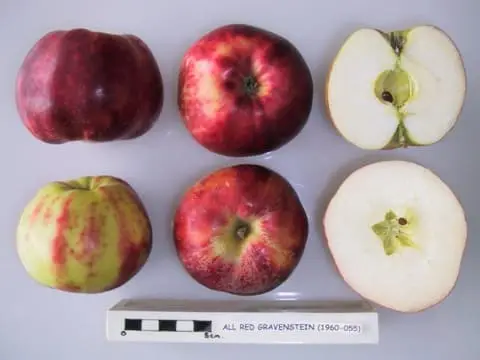
All-Red Gravenstein
-
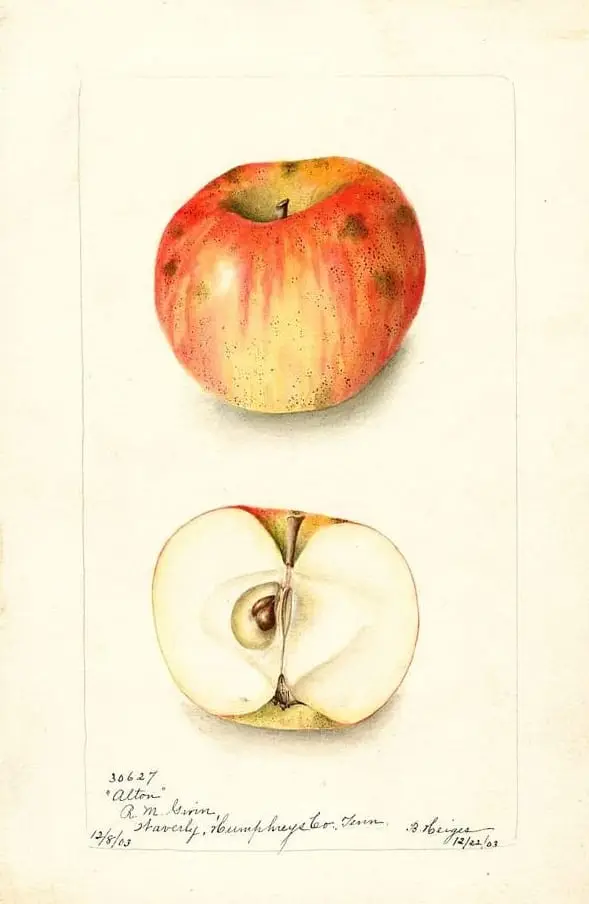
Alton
-
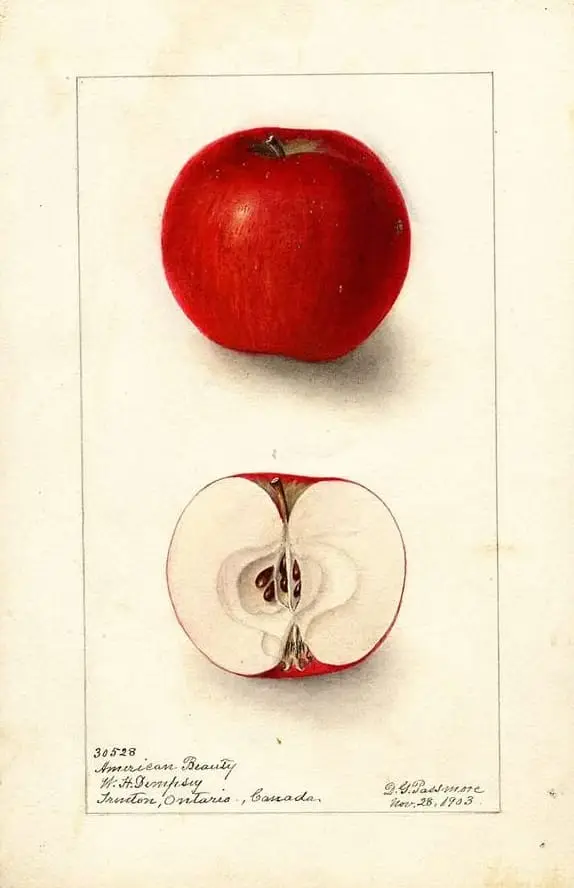
American Beauty
-
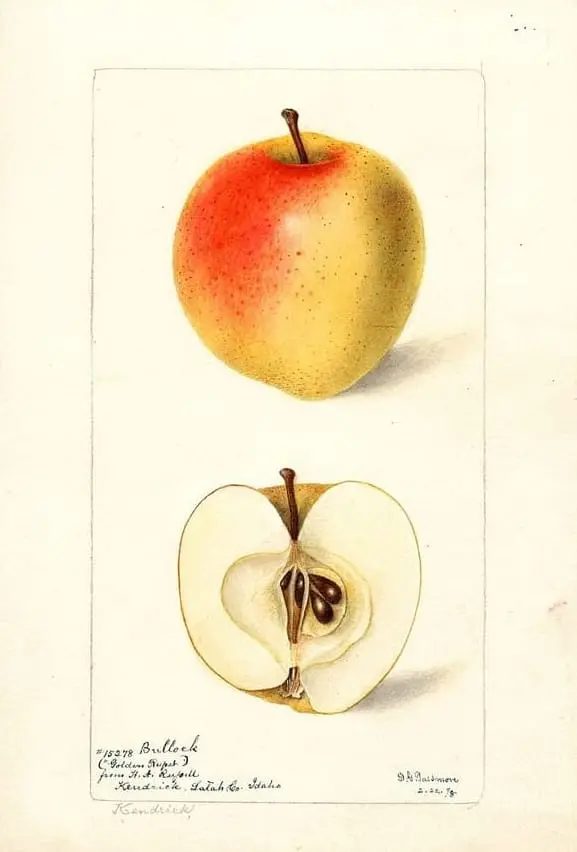
American Golden Russet
A small New Jersey russet whose flesh Downing likened to a buttery pear; Coxe knew it in 1817 as Sheep-nose
-
American Grindling
-
American Summer Pearmain
-
Ames
-
Arkansas