Apple varieties, United States
Baldwin
The United States' leading apple in 1909–13; the freezes of 1933–34 killed or ruined nearly two million of its trees
History
The Baldwin came up as a chance seedling soon after 1740 on John Ball’s farm at Wilmington, near Lowell, Massachusetts, and for about forty years it was grown only in that neighbourhood1. When the farm passed to a Mr Butters, the apple was called the Woodpecker, or Pecker, after the birds that visited the tree, and also the Butters1. Deacon Samuel Thompson, a surveyor from Woburn, brought it to the notice of Colonel Loammi Baldwin of Woburn, a Revolutionary War veteran and engineer of the Middlesex Canal, who propagated it and was spreading it through eastern Massachusetts as early as 1784; the apple took his name1,2. The original tree was alive in 1817 but dead by 18321. In 1895 the Rumford Historical Association put up a pillar to mark the site3, and a monument to the apple stands today on Chestnut Street in Wilmington, beside the William Butters II farmhouse2.
In 1852 Hovey called it “the most popular apple of New England”1. Little known in New York before 1850, it spread there with the commercial orchards, and in 1905 Beach called it “preeminently the leading variety” of New York and New England, as well as a leading export apple1. In 1909–13 it was the most important apple in the United States4. In 1928 American commercial orchards held 5,519,000 Baldwin trees, 6.8 per cent of the total and the fourth-largest number of any variety4. The freezes of the winter of 1933–34 were estimated to have killed or ruined nearly 2,000,000 Baldwin trees in New York and New England, and by 1941 the McIntosh, the favourite for new planting, had replaced it as the leading variety of the north-eastern apple region4.
DNA evidence published in 2022 identified Reinette Franche, a French apple of the early sixteenth century, as either a parent of the Baldwin or possibly a grandparent5.
The fruit
The fruit is above medium in size or large, roundish and inclined to conical1. The tough, smooth skin is pale yellow or greenish, blushed and mottled with bright red and faintly striped with deep carmine, and the general effect is bright red1. The flesh is yellowish, firm, crisp, juicy and moderately coarse, with a lively, pleasantly subacid, somewhat aromatic taste1.
In New York it normally reached picking condition between the middle and the end of October, but in Virginia between the middle and the twentieth of September6. It kept until March or April in common storage and until May or later in cold storage1, though Magness rated its tendency to storage scald as medium to severe4. Brown flecks in the flesh, known as Baldwin spot, are a physiological defect most often found in overgrown fruit1.
Growing
The tree is large, very vigorous and long-lived, with an upright, spreading habit1,4. It is slow to begin bearing, taking 8 to 10 years, and then crops heavily but tends to bear in alternate years1,4. Scab often damages its leaves and fruit1. It is apt to be killed by hard winters in many parts of northern New York and fails for the same reason west of the Great Lakes; in the South it ripens in autumn and is of poorer quality1.
The Baldwin is a triploid4,7. Its pollen is sterile, so it cannot pollinate other trees, although they can pollinate it7; Magness classed it as a poor pollinizer and only partly self-fruitful4. Beach recorded russet-skinned sports and a darker, later-keeping strain, the Dark Baldwin; another sport, Olympia, has larger, better-coloured fruit1.
Uses
Beach found it suited to market, dessert and kitchen alike, and its firm flesh and thick skin let it stand handling well1. Fruit not good enough for barrelling supplied much of the stock of New York’s apple evaporators, and some went to canneries1.
Where the sources disagree
- Its discovery. Beach (1905) has the seedling arise soon after 1740 on John Ball’s farm and reach Colonel Baldwin through Samuel Thompson, with Baldwin spreading it by 17841. The 1895 pillar said instead that Thompson “discovered the first Pecker apple tree” in 1793 while surveying the line of the Middlesex Canal3, nine years after Beach’s date for its spread. The Wilmington library observes that most versions of the story seem to agree that William Butters either found or planted the tree2.
- Its quality. Beach rated it good to very good for dessert and kitchen1. Bailey, writing in 1914 when Baldwin and Ben Davis held “the supremacy in American market apples”, thought it of “secondary quality”3. Magness rated it fair to good for dessert and good for cooking4, and Hogg, in England, treated it as a culinary apple that did not reach there the size or flavour it attained in America8.
Family tree
Offspring in the atlas
- Double-Red Baldwin United States, 1924
Sources
- The Apples of New York, vol. I, pp. 56–60: Baldwin, S. A. Beach, New York Agricultural Experiment Station, Internet Archive, 1905. Supports: the synonyms (p. 56); origin "soon after 1740" as a chance seedling on John Ball's farm at Wilmington, near Lowell, grown only locally for about 40 years; the names Woodpecker, Pecker and Butters; Deacon Samuel Thompson of Woburn and Col. Baldwin, who propagated it "as early as 1784"; the original tree alive in 1817 and dead by 1832; Hovey (1852) on its popularity; little known in New York before 1850 (pp. 58–59); "preeminently the leading variety" in the commercial orchards of New York and New England, its export, cold storage, evaporator and cannery use, firm texture and thick skin, winter-killing in northern New York, failure west of the Great Lakes and in the South, vigour, long life, slow and biennial bearing (p. 57); scab and Baldwin spot (p. 58); the description of tree and fruit, quality "good to very good", season in common and cold storage, and uses (p. 59); russet sports, Dark Baldwin and the sport Olympia (p. 60).
- Historical Town Trees, Wilmington Memorial Library, Wilmington, Massachusetts, 2026. Supports: the apple named after Loammi Baldwin, known as Col. Baldwin, a Revolutionary War veteran, prominent citizen of Woburn and engineer of the Middlesex Canal; most versions agreeing that William Butters found or planted the tree; the monument on Chestnut Street beside the William Butters II Farmhouse.
- The Standard Cyclopedia of Horticulture, vol. 1, p. 316: Apple, L. H. Bailey, Macmillan, Internet Archive, 1914. Supports: the pillar erected at Wilmington in 1895 by the Rumford Historical Association, whose inscription says Samuel Thompson, "while locating the line of the Middlesex Canal, discovered the first Pecker apple tree" in 1793; Baldwin and Ben Davis, "the former of secondary quality and the latter of worse, hold the supremacy in American market apples".
- Apple Varieties and Important Producing Sections of the United States (Farmers' Bulletin 1883), pp. 7, 21–29, J. R. Magness, U.S. Department of Agriculture, Internet Archive, 1941. Supports: Baldwin first of the ten leading US varieties in 1909–13 (p. 22); 5,519,000 trees in commercial orchards in 1928, 6.8 per cent of the total and fourth place, and "Nearly 2,000,000 Baldwin trees in New York and New England" killed or ruined by the freezes of the winter of 1933–34; McIntosh the most popular variety for planting in the north-eastern belt (p. 21); McIntosh "now the leading variety" of the north-eastern section, where Baldwin had been the principal variety (p. 7); upright spreading, very vigorous, large tree, first bearing at 8 to 10 years, biennial (Table 2, p. 23); triploid, poor pollinizer, partially self-fruitful (Table 4, p. 26); dessert quality fair to good, cooking quality good, tendency to storage scald medium to severe (Table 5, p. 29).
- Pedigree reconstruction for triploid apple cultivars using single nucleotide polymorphism array data, N. P. Howard and others, Plants, People, Planet; University of Reading repository, 2022. Supports: Reinette Franche, "a French cultivar from the early 16th century", identified as a possible grandparent of Baldwin or as its reduced-gamete-donating parent.
- The Ripening, Storage, and Handling of Apples (Department Bulletin 1406), p. 55, J. R. Magness, H. C. Diehl, M. H. Haller and W. S. Graham, U.S. Department of Agriculture, Internet Archive, 1926. Supports: Baldwin apples "normally reach picking condition from the middle to the end of October in New York State" and from the middle to the 20th of September in Virginia.
- Can you suggest a source and type of tree to pollinate with my Baldwin semi-dwarf apple tree to produce fruit?, Jonathan Foster, University of Maine Cooperative Extension, 2024-06-18. Supports: "Baldwin apples are triploid and have sterile pollen", so they cannot pollinate other trees but can be pollinated by them.
- The Fruit Manual, 5th ed., p. 13: Baldwin, Robert Hogg, Journal of Horticulture Office, Internet Archive, 1884. Supports: the synonym Red Baldwin; in England "a culinary apple, in season from November to March", which "does not attain the size or flavour" there that it does in America.
More from United States
-
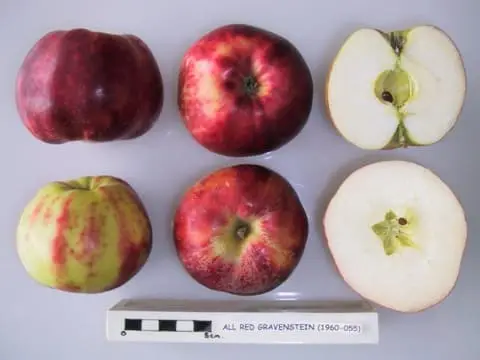
All-Red Gravenstein
-
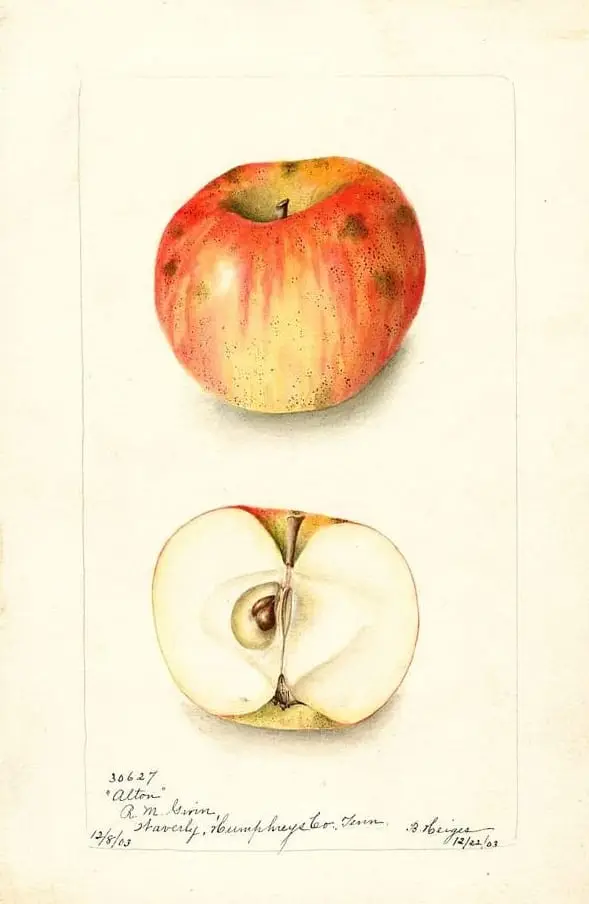
Alton
-
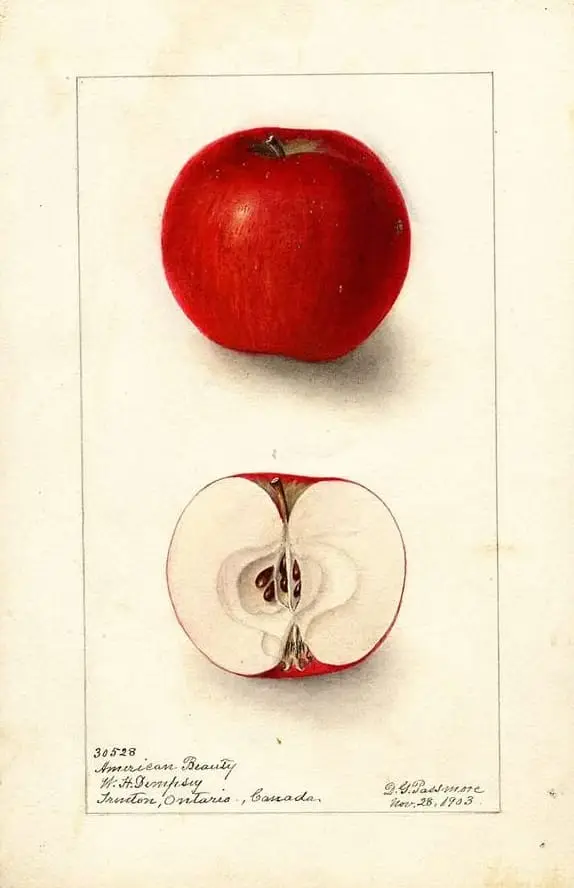
American Beauty
-
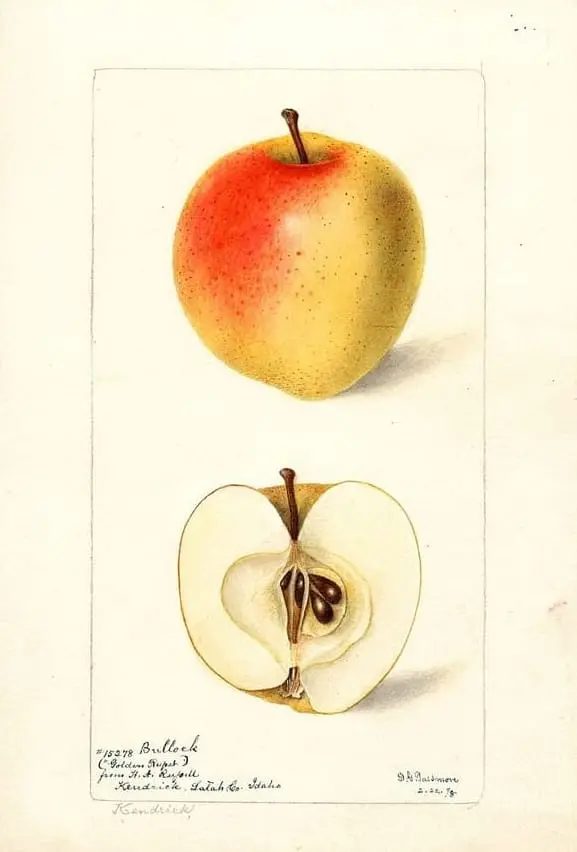
American Golden Russet
A small New Jersey russet whose flesh Downing likened to a buttery pear; Coxe knew it in 1817 as Sheep-nose
-
American Grindling
-
American Summer Pearmain
-
Ames
-
Arkansas