McIntosh
A seedling found in the Ontario bush; its discovery and development became a national historic event of Canada in 1999
History
John McIntosh, born in New York in 1777, farmed in Matilda Township, Upper Canada1. The national plaque at Dundela says that he found an apple sapling on his land in 18112. A strong tradition credits his son Allan with recognising the apple and spreading it1; the family say a travelling hired man taught them to graft in about 18353. The apples were at first called Grannys, after John’s wife Hannah3.
It was introduced and named in about 18703,5, when, according to Beach, Allan began propagating it in his nursery4; it first appeared in print, as McIntosh Red, in 18763,4. Recognition came slowly: in 1907 the Dominion Horticulturist, W. T. Macoun, wrote that it had become widely known only “during the past ten or fifteen years”1. The original tree, damaged by fire in 1894, bore its last crop in 1908 and fell two years later3. In 1999 Canada designated its discovery and development a national historic event2.
SNP data confirm it as a parent of Cortland, Lobo, Macoun, Melba and Spartan7; Parks Canada adds Empire2. In 2023 it was Canada’s second variety, with an estimated 15 per cent of the crop to Gala’s 21 per cent; Quebec grows the most, but growers are replacing it with varieties that shoppers now prefer fresh8. It made up 2 per cent of the US crop in 2024/25, and New York leads the forecast for 2025/269.
The fruit
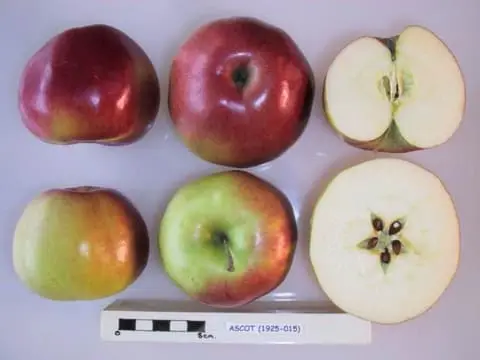
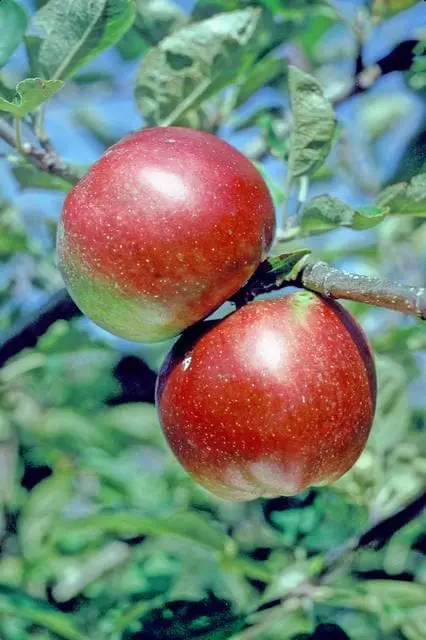
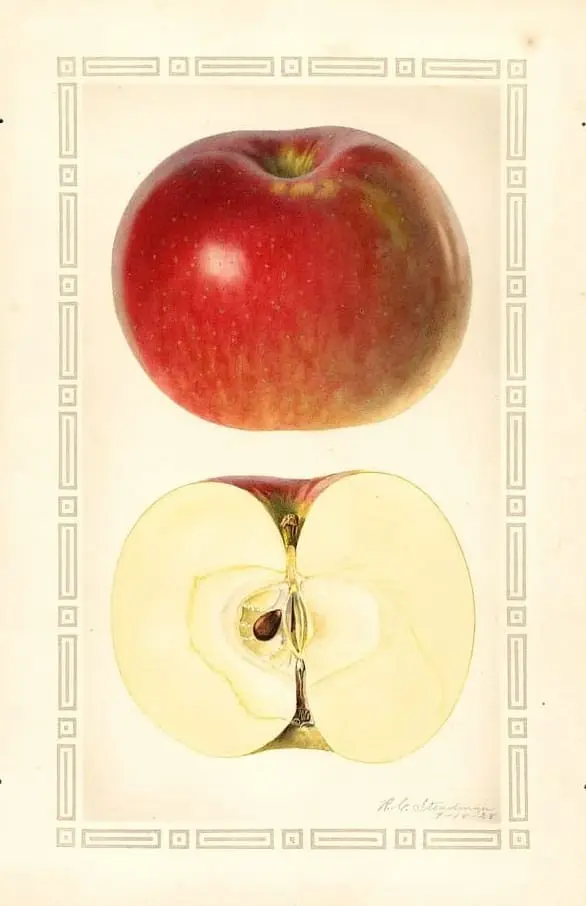
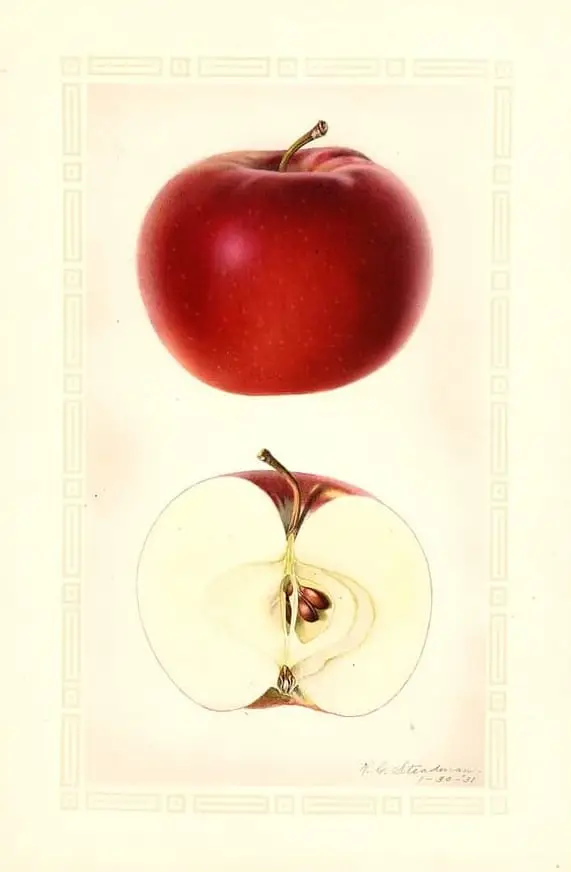
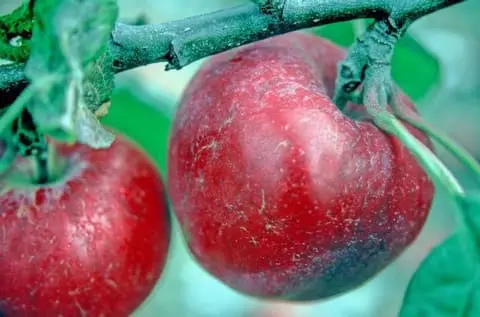
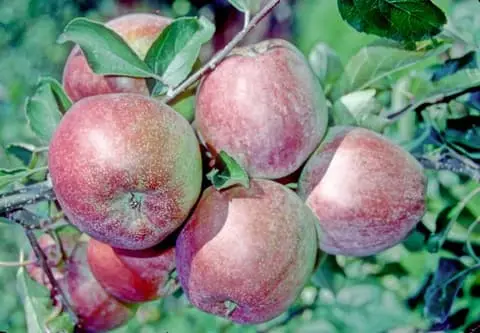
In 1905 Beach described a fruit above medium size and roundish, with a thin, smooth skin: pale yellow or greenish, flushed bright red and striped with carmine, the best-coloured fruit turning almost purplish red under a lilac bloom4. The flesh is white, sometimes veined with red, fine, tender and very juicy, “characteristically and agreeably aromatic”, and nearly sweet when fully ripe4.
It began to ripen in late September or early October at Geneva, New York4, and is picked in mid-September at the National Fruit Collection in Kent5. A USDA handbook gives two to three months in cold air storage and five to seven in controlled atmosphere, sometimes cut short by softening flesh10.
Growing
McIntosh is hardy and suited Canada’s cold climate2,4. Beach found the tree usually vigorous and healthy, bearing young and cropping reliably, often in alternate years4. Its faults were susceptibility to scab and a crop that ripens unevenly and drops early, best picked in two or three passes4. The fruit bruises easily1.
Uses
Beach rated it “very good to best for dessert”4. In the United States, 58 per cent of the crop went to the fresh market and 42 per cent to processing on average in 2020–20249.
Where the sources disagree
- The year. The plaque and Shane Peacock give 18112,3. The National Fruit Collection gives 17965, the date on the 1912 monument, which Peacock calls an error3. The Dictionary of Canadian Biography notes that McIntosh bought the lot in 1813, and calls the early date implied by a 1909 memorial resolution unlikely1.
- Who found it. Most accounts name John McIntosh2,3,5; the Dictionary of Canadian Biography finds no document deciding between John and Allan1.
- Its parents. It was long held to be a seedling of Fameuse, also called Snow1,3, and the National Fruit Collection records Fameuse or Saint Lawrence as a parent5; in 1970 W. H. Upshall, after failed trials with Fameuse, proposed Fall St. Lawrence and Alexander3. SNP studies find Fameuse more likely a grandparent6 and both parents unknown7. The DNA evidence is the better supported.
- The first tree’s end. Peacock has it bearing until 1908, but the stone marker on its site reads 1811–19063.
Family tree
Offspring in the atlas
- Alnarps Favorit × Alfa 68; Sweden, 1945
- Bancroft × Forest; Canada, by 1930
- Barry × Cox's Orange Pippin; United States, by 1936
- Black McIntosh Canada, 1928
- Black Mickey United States, 1929
- Cortland × Ben Davis; United States, 1898
- Davey United States, 1928
- Dermen McIntosh United States, by 1966
- Early McIntosh × White Transparent; United States, 1909
- Edgar (Canada) × Forest; Canada, by 1929
- Empire × Delicious; United States, 1945
- Fireside × Longfield; United States, by 1917
- Fortosh × Forest; Canada, by 1926
- Gloucester Royal United Kingdom, about 1930
- Hume Canada, 1898
- Jonamac × Jonathan; United States, 1944
- Joyce × Duchess of Oldenburg; Canada, 1898
- Kendall × Zusoff; United States, 1912
- Kimball McIntosh United States, 1948
- Kyokko × Ralls Janet; Japan, 1931
- Lobo Canada, 1898
- Macoun × Jersey Black; United States, 1909
- Macross Canada, by 1927
- Macwood × Forest; Canada, 1936
- McSweet Canada, by 1927
- Melba × Tetofsky; Canada, 1898
- Merton Charm × Cox's Orange Pippin; United Kingdom, by 1960
- Milton × White Transparent; United States, 1909
- Newtosh × Newtown Pippin; Canada, by 1922
- Niagara × Carlton; United States, 1950
- Noris × Osenee Polosatoe; Lithuania, by 1976
- Patricia Canada, 1898
- Pedro Canada, 1898
- Redhook × Carlton; United States, 1923
- Rogers McIntosh United States, before 1930
- Scotia Canada, 1948
- Sharon × Glogerovka; United States, 1906
- Spartan × Delicious; Canada, 1926
- Spencer × Golden Delicious; Canada, 1926
- Starkspur McIntosh Canada, 1968
- Stonetosh × Loddington; Canada, 1909
- Summerland × Golden Delicious; Canada, 1926
- Tydeman's Early Worcester × Worcester Pearmain; United Kingdom, 1929
- Tydeman's Michaelmas Red × Worcester Pearmain; United Kingdom, 1929
- Victory (USA) United States, by 1943
72 varieties in the atlas descend from McIntosh.
Sources
- McINTOSH, JOHN (b. 1777, d. 1845 or 1846), Robert L. Fraser, Dictionary of Canadian Biography, vol. 7, University of Toronto/Université Laval, 1988. Supports: John McIntosh, born in New York in 1777, farming in Matilda Township, where he bought the west half of lot 9, concession 5, on 8 March 1813; no documentary evidence settles whether John or his son Allan found the seedlings, which "probably derived from the Fameuse (Snow) apple"; tradition crediting Allan with its propagation; slow recognition and W. T. Macoun's 1907 remark that it had become widely known only "during the past ten or fifteen years"; the 1909 memorial resolution and its "unlikely" date; easy bruising; the names McIntosh Red and the Mac.
- Discovery and Development of the McIntosh Apple National Historic Event, Parks Canada, Directory of Federal Heritage Designations, 1999. Supports: designation under the Historic Sites and Monuments Act on 28 October 1999; the plaque at the original McIntosh farm at Dundela: "In 1811, John McIntosh discovered an apple sapling on his land in Matilda township"; its suitability for Canada's colder climate; Cortland, Empire, Lobo and Spartan derived from it; "one of the most popular varieties grown in Canada and abroad".
- The Mystery of Mr. McIntosh's Apple, Shane Peacock, Canada's History, 2016. Supports: the 1811 date; grafting learned from a travelling hired man about 1835 (family account); the first name Grannys, after Hannah McIntosh; Fameuse as the parent most often proposed; introduction and naming in 1870 and first appearance in print six years later in Fruits and Fruit Trees of America; the 1894 fire, last crop in 1908 and fall two years later; the 1912 monument's "erroneous" 1796 and the stone marker reading 1811–1906; W. H. Upshall's 1970 suggestion of Fall St. Lawrence and Alexander as parents.
- The Apples of New York, vol. II, pp. 132–134: McIntosh, S. A. Beach, New York Agricultural Experiment Station, Internet Archive, 1905. Supports: the description of tree and fruit; ripening "in late September or early October" at the Geneva station; susceptibility to scab, uneven ripening and pre-harvest drop needing two or three pickings; vigour, hardiness, early and regular (often biennial) bearing; "very good to best for dessert"; Allan McIntosh's propagation "about 1870"; the name McIntosh Red in references from Downing (1876) on.
- McIntosh (accession 2006-014), National Fruit Collection, Brogdale, Kent. Supports: discovery "in 1796 by John McIntosh near Dundela"; propagation by Allan McIntosh; introduction and naming in about 1870; parentage recorded as "Fameuse or Saint Lawrence x Unknown"; dessert use; fruit "much flushed and striped deep bright red"; flesh white, sometimes tinged red; picking time "Mid September" at Brogdale.
- The use of shared haplotype length information for pedigree reconstruction in asexually propagated outbreeding crops, demonstrated for apple and sweet cherry, Nicholas P. Howard and others, Horticulture Research 8:202, 2021. Supports: "'Fameuse' was deduced to be a likely grandparent of 'McIntosh'" from shared haplotypes in SNP data, with a double great-grandparent relationship not ruled out.
- Cultivar fingerprinting and SNP-based pedigree reconstruction in Danish heritage apple cultivars utilizing genotypic data from multiple germplasm collections in the world, Bjarne Larsen and others, Genetic Resources and Crop Evolution 72:2397, with supplementary Table S5, 2025. Supports: Table S5: McIntosh diploid, both parents unknown; McIntosh SNP-confirmed as a parent of Cortland (Ben Davis × McIntosh), Lobo, Macoun, Melba and Spartan.
- Fresh Deciduous Fruit Annual: Canada (CA2024-0054), Alexandrea Watters, USDA Foreign Agricultural Service, 2024-11-07. Supports: Figure 3, estimates of Canadian apple production by variety for 2023: Gala 21 per cent, McIntosh 15 per cent; Quebec's McIntosh acreage the largest in Canada, the variety "no longer popular with consumers for fresh consumption" and being replaced by varieties consumers prefer.
- Industry Outlook 2025, Christopher Gerlach, U.S. Apple Association, 2025. Supports: Table 6: McIntosh 2 per cent of US production in 2024/25; Table 7: New York the largest McIntosh producer in the 2025/26 forecast; Table 9: McIntosh 58 per cent fresh and 42 per cent processing, 2020–2024 average.
- Apple, in The Commercial Storage of Fruits, Vegetables, and Florist and Nursery Stocks (Agriculture Handbook 66), Chris B. Watkins, Eugene Kupferman and David A. Rosenberger, USDA Agricultural Research Service, 2016. Supports: Table 2 (pp. 181–182): McIntosh "2-3" months at 0 °C in air and "5-7" in controlled atmosphere, storage "sometimes shortened by excessive flesh softening".