Apple varieties, United States
Cortland
The first apple from the Geneva station's breeding: Ben Davis × McIntosh, crossed in 1898 and introduced in 1915
History
Cortland was the first apple to come out of the breeding programme of the New York State Agricultural Experiment Station at Geneva1. S. A. Beach crossed Ben Davis with McIntosh there in 1898, and in 1911 the apple was chosen from the cross’s eleven seedlings1,2. Introduced in 1915 with five other apples and named after Cortland County, New York, it went out to growers as nursery trees that year1. It was one of the first varieties released by a public breeding programme4. SNP data confirm its parents3.
The American Pomological Society awarded it the silver Wilder Medal in 19231. By 1965 only McIntosh and Rhode Island Greening outranked it in New York, then the second apple state of the US; at mid-century it was the most important of Geneva’s introductions, until Jonagold and Empire overtook it1.
Way and Brown blame its later decline on late picking: because Cortland does not drop, growers picked McIntosh first, and years of overripe Cortlands that kept badly cost it its popularity1. New York still grew about 36,000 tonnes (80 million pounds) in 1995, its sixth apple1,4. In the US industry’s forecast for 2025/26 it made up 1 per cent of the US crop, most of it from New York; in Canadian growers’ forecast it was the fifth named variety, mostly grown in Quebec6.
A redder mutation found in the Hudson Valley in 1983 was patented, and by 1997 it was being planted instead of the original1.
The fruit
The National Fruit Collection describes a large, broad, conical fruit, 75 mm wide and 59 mm high, greenish yellow striped with red, with a tough skin and moderately juicy, slightly coarse flesh of sweet, refreshing flavour2. Beside McIntosh it ripens a little later, hangs much better, keeps longer, bruises less, and is larger and brighter1. Its cut flesh does not brown but “remains snow white”, which suits it to salads1.
At Geneva it ripens on average on 7 October, three days before Delicious1; at Brogdale in Kent it is picked in early October2. It keeps about 120 days at −0.6 °C (31 °F)1; a USDA handbook gives two to three months in cold air and four to six in controlled atmosphere, and rates it very susceptible to scald5.
Growing
Mature trees are large, vigorous and spreading, and crop heavily every year; their drooping, almost willowy shoots make them hard to prune1. The tree is very hardy: in New York it came through the hard winter of 1933–34 unharmed, and it is grown in cold regions such as Quebec and New Brunswick1. It is diploid and self-unfruitful, and is one of the few apples known to be cross-incompatible with another, Early McIntosh1. Fruit and leaves are very susceptible to scab, the leaves also to powdery mildew, and it suffers more from fire blight than McIntosh1. In Britain it crops poorly and is troubled by Nectria canker1.
Uses
Home economists recommended Cortland for both dessert and cooking1. It rates low for processing, yet many thousands of bushels are processed in New York because it is cheap to grow1; on average in 2020–2024, 62 per cent of the US crop went to processing6.
Where the sources disagree
Family tree
Parents, grandparents and great-grandparents, as the entries in the atlas record them.
Offspring in the atlas
- Birgit Bonnier × Lord Lambourne; Sweden
- Eva Lotta × James Grieve; Sweden
- Kim × Ingrid Marie; Sweden, 1946
Sources
- 'Cortland' Apple, Roger D. Way and Susan K. Brown, Fruit Varieties Journal 51(2): 66–71, American Pomological Society, 1997. Supports: the cross Ben Davis × McIntosh made by S. A. Beach in 1898; selection in 1911 from 11 seedlings; introduction in 1915 with five other apples as the first product of the Geneva programme, which "began there in 1895"; named for Cortland County; nursery trees first distributed in 1915; the silver Wilder Medal of the American Pomological Society in 1923; New York's third cultivar by 1965, after McIntosh and Rhode Island Greening, New York then the second apple state; the most important Geneva introduction at mid-century, later surpassed by Jonagold and Empire; the decline in popularity from marketing overripe fruit, picked after McIntosh because it does not drop, and keeping badly; 80 million pounds in New York in 1995, sixth in the state; the patented red mutation found in the Hudson Valley in 1983, planted "to the exclusion of standard 'Cortland'"; compared with McIntosh, later, holding better, keeping longer, bruising less, larger and brighter; flesh that "remains snow white", excellent for salads; average ripening at Geneva on 7 October, three days before Delicious; about 120 days at 31 °F; large, vigorous, spreading, drooping trees with willowy twigs, harder to prune, annual and very productive; no injury in the 1933–34 winter in New York and popularity in very cold regions such as Quebec and New Brunswick; diploid, self-unfruitful, cross-incompatible with Early McIntosh; scab, powdery mildew and fire blight susceptibility; poor cropping and Nectria canker in the UK; recommended by home economists for culinary and dessert use; low processing rating but thousands of bushels processed in New York.
- Cortland (accession 1976-139), National Fruit Collection, Brogdale, Kent (Defra). Supports: raised in 1898 by S. A. Beach at the New York State Agricultural Experiment Station, Geneva; parentage "Ben Davis x McIntosh"; synonyms Cartland, Courtland and Courtlandt; large, broad globose-conical fruit, 59 mm high and 75 mm wide; green-yellow ground with striped red over colour; tough skin; moderately juicy, slightly coarse-textured flesh with "a sweet, refreshing flavour"; picking in early October at Brogdale.
- Cultivar fingerprinting and SNP-based pedigree reconstruction in Danish heritage apple cultivars utilizing genotypic data from multiple germplasm collections in the world, Bjarne Larsen and others, Genetic Resources and Crop Evolution 72: 2397, with supplementary Table S5, 2025. Supports: Table S5: Cortland diploid, with Ben Davis (parent 1, the mother where pedigree records give one) and McIntosh (parent 2) confirmed by SNP data.
- The Cornell University Apple Breeding Program: Past, Present, and Future, Susan K. Brown and David E. Terry, Fruit Varieties Journal 51(4): 199–204, American Pomological Society, 1997. Supports: the programme's "initiation in 1892"; Cortland, released in 1915, "one of the first cultivars released by a public breeding program", still an industry standard; New York's 1995 production of 80 million pounds.
- Apple, in The Commercial Storage of Fruits, Vegetables, and Florist and Nursery Stocks (Agriculture Handbook 66), Chris B. Watkins, Eugene Kupferman and David A. Rosenberger, USDA Agricultural Research Service, 2016. Supports: Table 2 (p. 180): Cortland "2-3" months at 0 °C in air and "4-6" in controlled atmosphere; very high susceptibility to superficial scald; "scald inhibitor essential".
- Industry Outlook 2025, Christopher Gerlach, U.S. Apple Association, 2025. Supports: Table 6: Cortland 1% of US production in the 2025/26 forecast; Table 7: 1,442,890 of the 1,719,802 bushels forecast from New York; Table 9: 38% fresh and 62% processing, 2020–2024 average; Table 15 (Canadian growers' figures): Cortland forecast at 1,444,315 bushels in Canada in 2025/26, fifth among the named varieties, with 1,067,300 in Quebec.
More from United States
-
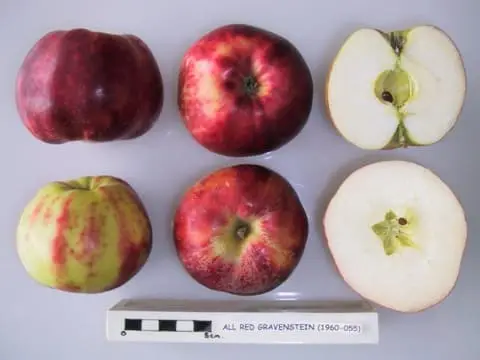
All-Red Gravenstein
-
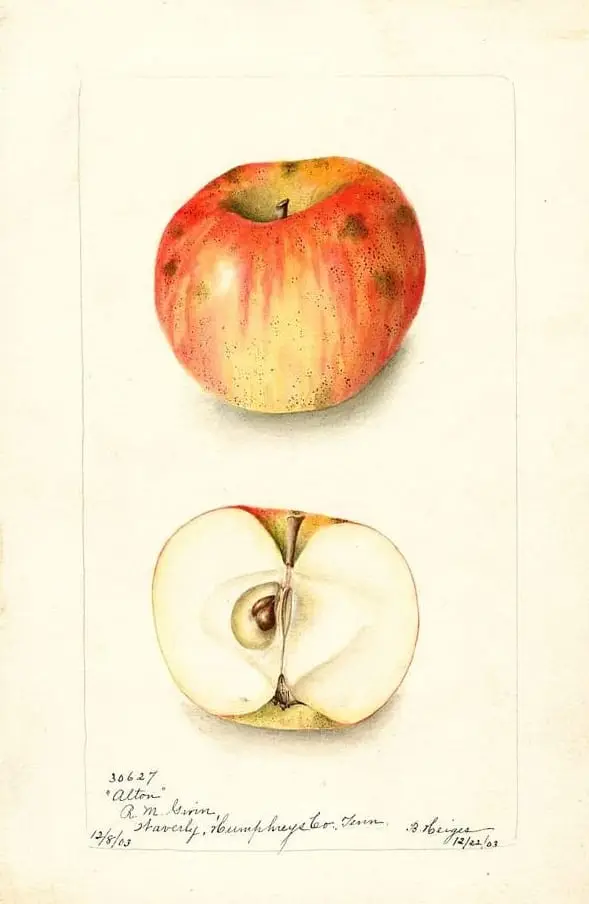
Alton
-
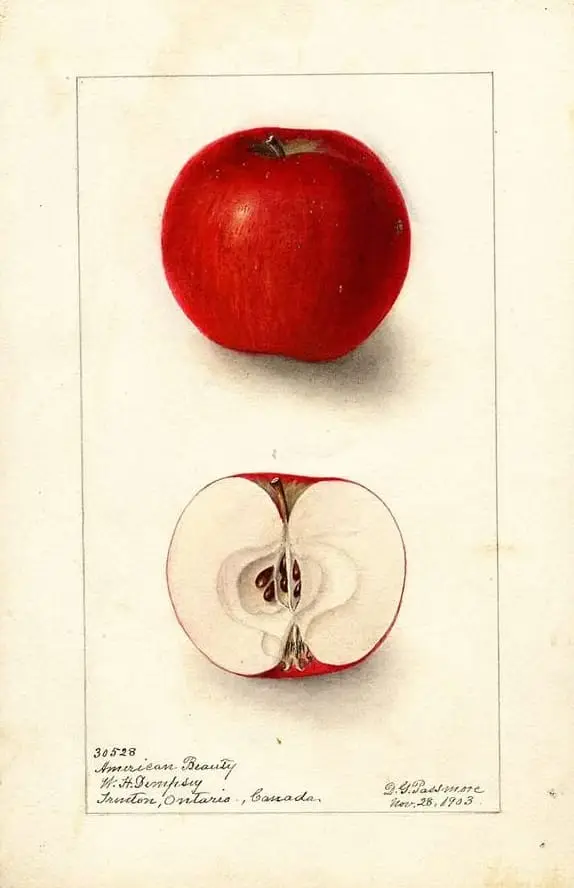
American Beauty
-
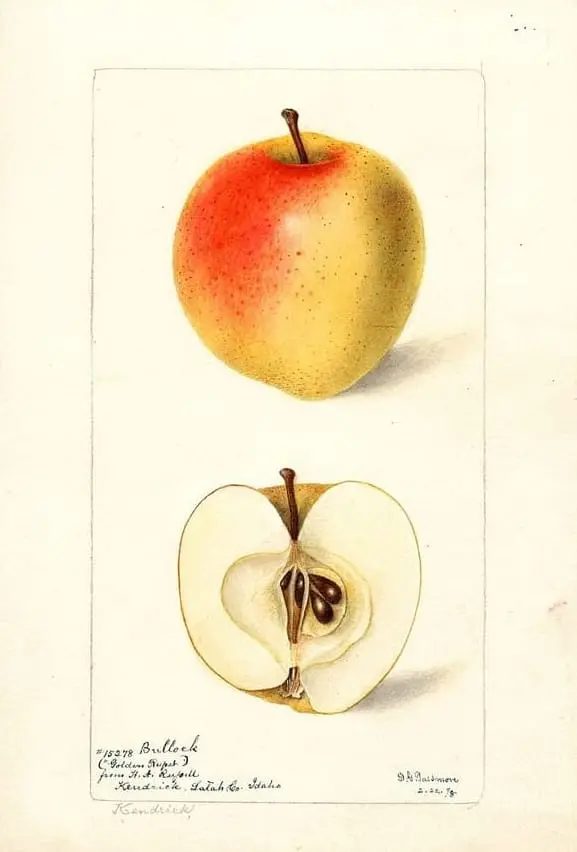
American Golden Russet
A small New Jersey russet whose flesh Downing likened to a buttery pear; Coxe knew it in 1817 as Sheep-nose
-
American Grindling
-
American Summer Pearmain
-
Ames
-
Arkansas