Apple varieties, United States
Jonagold
Golden Delicious × Jonathan, crossed at Geneva in 1943; in 1981 western Europe planted it more than any other apple
History
In 1943, at the New York State Agricultural Experiment Station in Geneva, flowers on an orchard tree of Golden Delicious were emasculated and dusted with pollen of Jonathan1. Fifty-two seedlings were planted in a first test orchard in 1946; some fruited in 1953, and one with outstanding fruit became selection N.Y. 43013-11. After ten more years in second test orchards from 1956, and at the urging of James Oakes, a grower at Lyndonville, New York, who had tried it, the station introduced it in 1968 under a name joining those of its parents; it was not patented1,3.
It was taken up faster in Europe than in the United States, where the fruit’s lack of a brilliant red colour held it back1. In 1981 more of it was being planted in western Europe than of any other apple1. In 1986 the European Economic Community produced 116,000 tonnes, 50,000 of them in Belgium, where half of all the trees planted since 1977 were Jonagold, and it made up 7 per cent of the Dutch crop1. In 1988 the American Society for Horticultural Science gave it its Outstanding Fruit Cultivar Award1.
Its skin colour proved unstable, and within two decades many redder strains had appeared1. The National Fruit Collection lists sixteen sports, among them Jonagored and Red Jonaprince3. In the European industry’s forecast for 2025/26, Jonagold made up 3 per cent of Europe’s apples, Red Jonaprince 4 per cent and Jonagored 1 per cent6.
The fruit
The fruit is very large, round-conic and only faintly ribbed1; at the National Fruit Collection it measured about 78 mm wide and 70 mm high3. The yellow skin, slightly tinged with green, is 30–80 per cent covered with a medium red, slightly striped and a little dull1. The light yellow flesh is crisp and unusually juicy, subacid to sweet and aromatic, with a sprightly flavour like Jonathan’s, and browns only slowly when cut1,2.
At Geneva it is picked on average on 12 October, two days after Delicious, and the fruit hangs well1; at Brogdale in Kent it is picked in mid-October3.
Growing
The tree resembles Golden Delicious but spreads more and bears mostly on spurs2; it is vigorous, very productive and regular, with no special resistance to pests or diseases1. In its first ten years it gave about 20 per cent more fruit than comparable McIntosh trees1. It does best in cool districts such as northern Europe and New York; in hot ones, such as eastern Washington, the fruit is often sunburnt1.
Jonagold is triploid1,2,3: SNP data show that it received an unreduced gamete from Golden Delicious and a normal one from Jonathan4. Its pollen is not viable, so it cannot pollinate other varieties; most diploid varieties that flower with it can pollinate it, but not Golden Delicious, which is cross-incompatible with it1. For the same reason it cannot serve as a parent in conventional breeding1.
Uses
It was released as a dual-purpose apple, excellent both for dessert and for processing2. In tests at Geneva it rated good for apple sauce, and in 1990 New York’s sauce makers paid more for large Jonagold than for any variety but Northern Spy1.
Where the sources disagree
Family tree
Parents, grandparents and great-grandparents, as the entries in the atlas record them.
- Jonagold United States, 1943
- Seed parent Golden Delicious United States, 1905
- Parent Grimes Golden United States, by 1804
- Pollen parent Jonathan United States, by 1826
- Parent Esopus Spitzenburg United States, before 1790
- Parent Reinette Franche France, by 1540
- Parent Esopus Spitzenburg United States, before 1790
- Seed parent Golden Delicious United States, 1905
Offspring in the atlas
- Crowngold United Kingdom
- Decosta Belgium, by 1988
- Excel United States, by 1867
- Jomured Belgium, by 1989
- Jonagored Belgium, 1980
- Jonica Germany
- Jorayca Belgium, by 1996
- Jored Belgium, 1985
- Josegold Netherlands
- King Jonagold Belgium, 1985
- New Jonagold Japan
- Red Jonaprince Netherlands, 1994
- Rubinstar Germany, 1980
- Wilmuta Netherlands
Sources
- 'Jonagold' Apple, Roger D. Way and Susan K. Brown, Fruit Varieties Journal 45(2): 62–65, American Pomological Society, 1991. Supports: flowers of an orchard tree of Golden Delicious emasculated and pollinated with Jonathan in 1943; 52 seedlings planted in 1946, first fruits in 1953, selection N.Y. 43013-1; planted in second-test orchards in 1956 and evaluated for another ten years; James Oakes, a grower at Lyndonville who tested it, urging the station to name it; introduced in 1968, the name combining its parents' names, not patented; in 1981 planted in western Europe more than any other cultivar; 116,000 tonnes in the European Economic Community in 1986, 50,000 in Belgium; "50%" of trees planted in Belgium since 1977; 7% of Dutch apple production (1986 data); slower acceptance in the US for lack of brilliant red colour; the Outstanding Fruit Cultivar Award of the American Society for Horticultural Science in 1988; average harvest at Geneva on 12 October, two days after Delicious, fruit adhering well; very large, round-conic, indistinctly ribbed fruit; skin 30–80% covered with medium red, slightly striped and slightly dull, over yellow with a slight tinge of green; flesh light yellow, semifirm, medium grain, crisp, unusually juicy, subacid to sweet, aromatic, with "a sprightly, Jonathan-like flavor", browning slowly; rated good for applesauce in processing tests at Geneva; the 1990 price for large fruit higher than any other variety except Northern Spy; "often as long as 6 months" at 31 °F; best in cool districts, sunburn in hot ones such as eastern Washington; vigorous, very productive, annual trees with no special resistances, about 20% more productive than McIntosh in the first ten years; Golden Delicious cross-incompatible with it; triploid, its pollen not viable, unusable as a parent in conventional breeding; many red strains within two decades, and genetically unstable skin colour.
- Jonagold and Spijon Apples, Journal of the American Pomological Society 23(1): 19 (journal archive), unsigned note on R. D. Way, R. L. LaBelle and J. Einset, N.Y. Agricultural Experiment Station Research Circular 12, 1969. Supports: a "dual purpose" apple introduced by the station at Geneva; Golden Delicious × Jonathan; a medium-sized tree like Golden Delicious but more spreading, bearing mostly on spurs, at least as productive as McIntosh; triploid and not a good source of pollen; ripening with Delicious; flesh firm, subacid, juicy, like Jonathan in flavour; dessert and processing quality both excellent.
- Jonagold (accession 2000-113), National Fruit Collection, Brogdale, Kent (Defra). Supports: triploid; raised in 1943 at the New York State Agricultural Experiment Station, Geneva; introduced in 1968; parentage "Golden Delicious x Jonathan"; sixteen sports listed, including Jonagored and Red Jonaprince; large fruit, 70.17 mm high and 78.18 mm wide; picking in mid-October at Brogdale.
- Pedigree reconstruction for triploid apple cultivars using single nucleotide polymorphism array data, N. P. Howard and others, Plants, People, Planet 5(1): 98–111; University of Reading repository, 2022. Supports: SNP data confirming Golden Delicious as the unreduced-gamete-donating parent of Jonagold and Jonathan as the reduced-gamete-donating parent, the Jonathan haplotype in Jonagold "nearly perfectly composed of a gamete sample from Jonathan".
- Apple, in The Commercial Storage of Fruits, Vegetables, and Florist and Nursery Stocks (Agriculture Handbook 66), Chris B. Watkins, Eugene Kupferman and David A. Rosenberger, USDA Agricultural Research Service, 2016. Supports: Table 2 (p. 180): Jonagold "2" months at 0 °C in air and "5-7" in controlled atmosphere.
- Industry Outlook 2025, Christopher Gerlach, U.S. Apple Association, 2025. Supports: Table 13, European apple production by select varieties (from the World Apple and Pear Association): Jonagold 3%, Red Jonaprince 4% and Jonagored 1% of the 2025/26 forecast.
More from United States
-
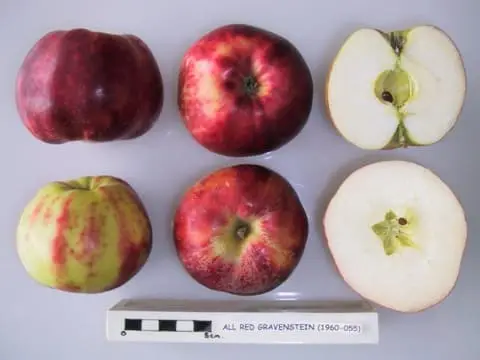
All-Red Gravenstein
-
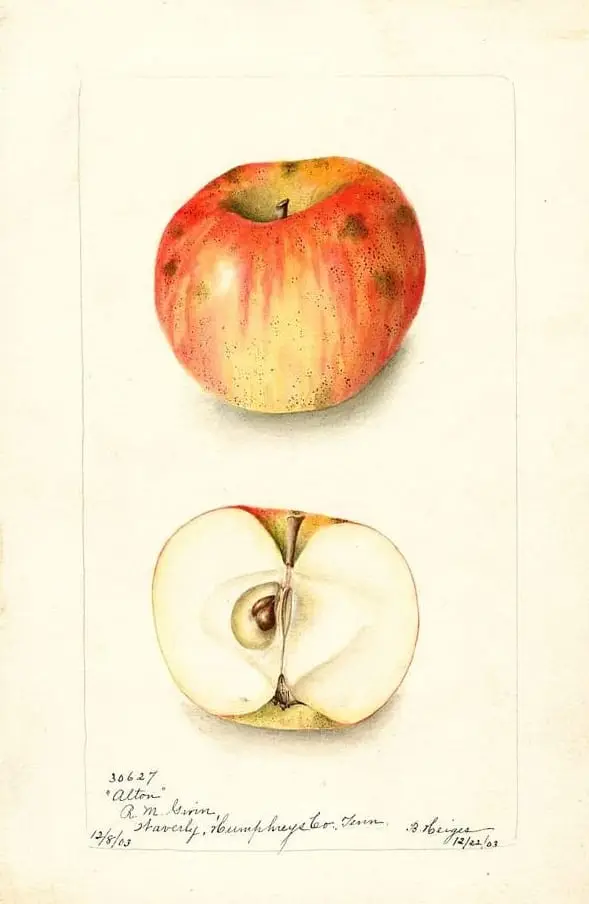
Alton
-
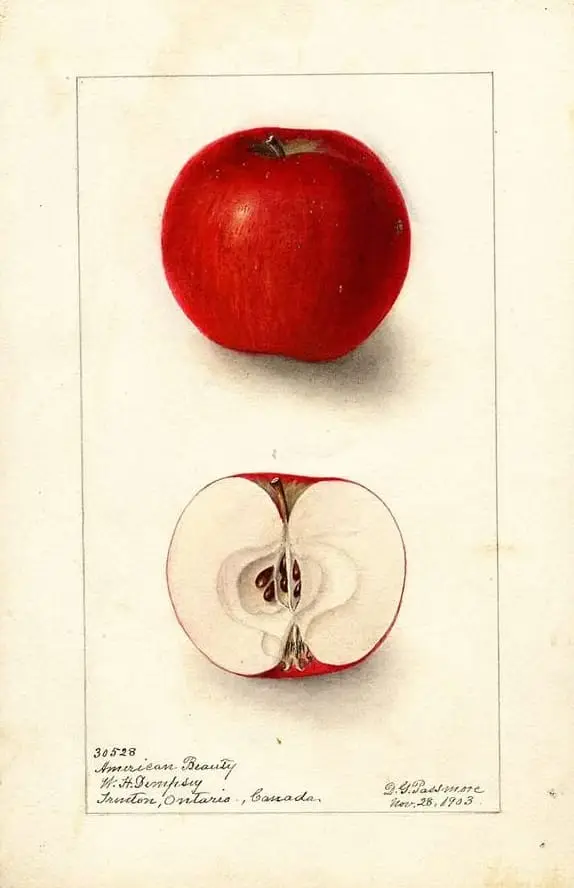
American Beauty
-
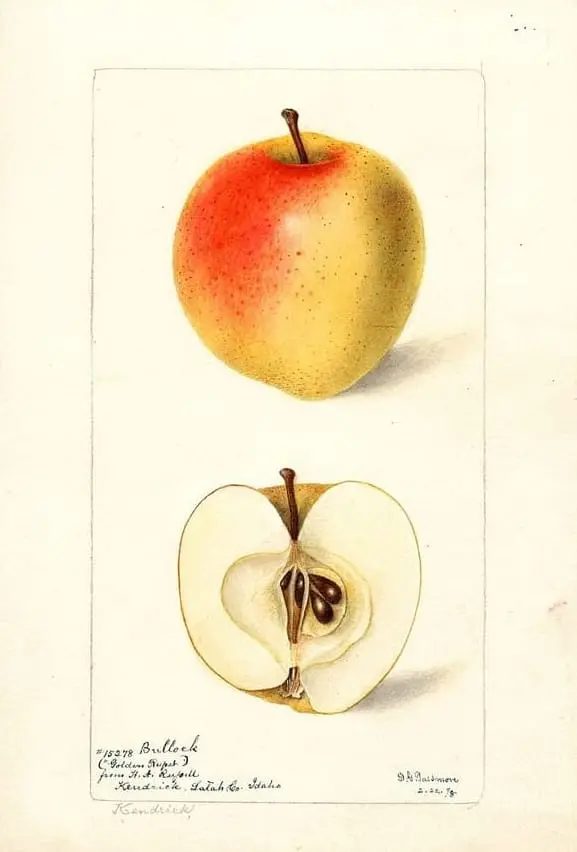
American Golden Russet
A small New Jersey russet whose flesh Downing likened to a buttery pear; Coxe knew it in 1817 as Sheep-nose
-
American Grindling
-
American Summer Pearmain
-
Ames
-
Arkansas