Jonagored
A blood-red sport of Jonagold, found in 1980 at the top of a tree in Jos Morren's orchard at Halen, Belgium
History
Jonagored is a sport of Jonagold, the cross of Golden Delicious and Jonathan bred at the New York State Agricultural Experiment Station1. In 1980 Jos Morren found four blood-red apples at the top of a tree in his Jonagold orchard at Halen, in Belgium2,3. His US patent describes the fruit on that limb as already red at the beginning of September, while the rest of the block was still green, and turning blood red over three weeks1.
In 1981 he grafted twenty trees from the changed branch, and then a second generation from one of them; both kept the deep-red colour when they fruited, in 1983 and 19843. He applied for plant breeders’ rights under the name Jonagored in 19833, and for a US plant patent in October 1984; it was granted in April 19871. According to the firm, the English pomologist L. H. Clark found the variety distinct, uniform and stable in November 19853, the year the National Fruit Collection gives for its introduction4. The Morren firm promotes it under the registered trade mark Morren’s Jonagored3, which the European Union’s marketing standard for apples also lists for it8.
By the firm’s figures, European production rose from 159,135 tonnes in 1994 to 266,437 tonnes in 1998, led by Belgium, the Netherlands and Germany3. A Flemish agricultural news service put its production at 270 million kilos in 2006, when Morren was presenting a daughter strain, Jonagored Supra2. By the European industry’s figures it made up 2 per cent of Europe’s apples in 2025/26 and 1 per cent of the forecast for 2026/276. In Germany’s 2022 orchard survey it covered 435 hectares in Lower Saxony and 291 in Baden-Württemberg7.
The fruit
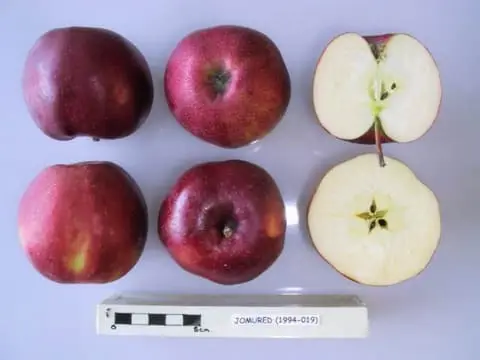
The patent describes Jonagored as like its parent in tree, leaves, flowers and fruit, except for its large, dark-red fruit, most with white lenticels, its dark-brown trunk and branches, darker than Jonagold’s, and the keeping quality of its fruit1. Where the original Jonagold is green to green-yellow with a large, striped orange-red flush, Jonagored is evenly flushed dark red5. The firm adds that the colour covers practically the whole skin, with little or no influence from the weather, and that the flesh is firmer and more acid than Jonagold’s3.
The fruit is large and round to round-conical, with a long, slender stalk1. The skin is tough, smooth and glossy, brownish red when young and blood red at maturity1. The flesh is white tinged with yellow, firm, fine, crisp and juicy, and sweet-sharp1; the National Fruit Collection describes it as creamy white, with a sweet, rich flavour4. At Halen the first fruit is picked at the end of September and the last before 15 October1; at Brogdale, Kent, it is picked in mid-October4. It keeps up to seven months in ordinary storage, and as well as Golden Delicious in cold storage1.
Growing
The tree is medium-sized, vigorous, upright and fast-growing, hardy, very productive and a regular bearer1. At Halen it flowers about the end of April, with Jonagold1. Its patent records no unusual susceptibility to pests or diseases1.
Uses
Jonagored is mainly a dessert apple, but it is also used in the kitchen and for juice1.
Family tree
Parents, grandparents and great-grandparents, as the entries in the atlas record them.
- Jonagored Belgium, 1980
- Sport of Jonagold United States, 1943
- Seed parent Golden Delicious United States, 1905
- Parent Grimes Golden United States, by 1804
- Pollen parent Jonathan United States, by 1826
- Parent Esopus Spitzenburg United States, before 1790
- Seed parent Golden Delicious United States, 1905
- Sport of Jonagold United States, 1943
Sources
- Apple tree: Jonagored (US Plant Patent 5,937), Jos Morren-De Coster; Google Patents, 1987-04-14. Supports: filed 16 October 1984; "a sport limb mutation of a Jonagold apple tree variety, Jonagold being a crossing of Golden Delicious with Jonathan, bred by New York State Agricultural Experiment station"; found in the inventor's orchard at Halen, Belgium, at the top of a Jonagold tree bearing brown-red apples, already red at the beginning of September while the rest of the Jonagold was still green, turning blood red over three weeks; propagated by grafting and stable into the second generation; "generally similar to its parent" in trunk, branches, leaves, flowers and fruit but with "significantly large dark-red fruit with most of the apples having white lenticels", a dark-brown trunk and branches, and the keeping quality of its fruit; tree medium-sized, vigorous, upright, a rapid grower, hardy, very productive, a regular bearer; flowering about the end of April, as with Jonagold; picked from the end of September, the last picking before 15 October; fruit large, between round and round-conical; skin tough, smooth, glossy, brown when immature, blood red at maturity on a yellow ground; flesh juicy, white with a yellowish tint, firm, fine, crisp, sweet/sour; stem slender and very long; uses "Dessert, culinary, juice; primarily for dessert"; up to 7 months in ordinary storage and very good in artificial storage, as well as Golden Delicious; no unusual susceptibility to insects or diseases.
- Red apples conquer the apple market (in Dutch), VILT (Flemish information centre for agriculture and horticulture), after Het Nieuwsblad, 2006-12-06. Supports: Jos Morren of Halen finding by chance, in 1980, four blood-red apples at the top of a tree in his Jonagold planting, and grafting the scion wood onto twenty young trees; his variety then accounting for a production of 270 million kilos; Jonagored not the only Jonagold mutant; the Halen nurseryman presenting a daughter of the Jonagored mother strain, Jonagored Supra.
- The Jonagored apple, 1994–98 (in Dutch), Jos Morren firm, Halen, company leaflet. Supports: the 1980 find of four blood-red apples at the top of a tree in Jos Morren's Jonagold planting; twenty trees grafted from the changed branch in 1981, and second-generation trees from one of them the next summer; deep-red fruit from the first generation in 1983 and identical fruit from the second the year after; an application for plant breeders' rights under the variety name "Jonagored" in 1983; the English pomologist L. H. Clark judging the cultivar stable, uniform and distinct in November 1985; the firm's registered trade mark, Morren's Jonagored, under which the leaflet presents the variety throughout; red colour over practically 100% of the skin, little affected by weather, and, by the firm's account, firmer and more acid flesh than its mother variety; European production of 159,135 t in 1994 and 266,437 t in 1998, the largest producers in 1998 Belgium (58,130 t), the Netherlands (57,405 t) and Germany (54,442 t).
- Jonagored (accession 1987-056), National Fruit Collection, Brogdale, Kent (Defra). Supports: "A more highly coloured sport of Jonagold. Originated at Halen, Belgium, by Jos Morren. It was introduced in 1985. Fruits have creamy white, fine-textured, juicy flesh with a sweet and good rich flavour."; 10% flowering on 25 April and picking in mid-October at Brogdale.
- Jonagold and Jonagold mutants (in Dutch), Pomospost, autumn 2012, pp. 8–10; Wageningen University and Research eDepot, 2012. Supports: the original Jonagold gone from commercial growing; the mutants better coloured than the original, sometimes earlier to ripen, more deeply coloured and larger; only mutants in Dutch shops, chiefly Jonagored, Red Jonaprince, Jonagored Supra and Novajo; table of the commonest mutants in the Netherlands and Belgium: the original Jonagold green to green-yellow with a large orange-red, striped flush, sometimes wholly yellow or green; Jonagored "Egaal donkerrood geblost" (evenly flushed dark red).
- Industry Outlook 2026, Christopher Gerlach, U.S. Apple Association, 2026. Supports: Table 13, European apple production by select varieties (European industry figures): Jonagored 2% of European production in 2025/26 and on the five-year average, 1% of the 2026/27 forecast.
- Growth and harvest: tree fruit 2022 (Fachserie 3, Reihe 3.2.1), table 3 (in German), Statistisches Bundesamt (Destatis), 2023-01-09. Supports: table 3, the 2022 apple harvest by variety in the main growing states, with planted areas from the 2022 orchard survey: Jonagored on 435 ha in Lower Saxony and 291 ha in Baden-Württemberg.
- Commission Delegated Regulation (EU) 2023/2429, Annex I, Part B, Part 1 (marketing standard for apples), Appendix: non-exhaustive list of apple varieties, European Commission; Official Journal of the European Union, L series, 3 November 2023, 2023-08-17. Supports: the note that some listed varieties "may be marketed under names for which trademark protection has been sought or obtained in one or more countries", with "References to known trademarks" given in the fourth column "for information only"; Jonagored, listed among the mutants of Jonagold, with the trade mark Morren's Jonagored.