Apple varieties, United States
Grimes Golden
A West Virginia apple sold to New Orleans traders by 1804; DNA confirms it as a parent of Golden Delicious
History
The original tree grew on the farm of Thomas Grimes near Wellsburg in Brooke County, West Virginia3,4. In a letter printed by The Horticulturist in February 1869, Thomas P. Grimes wrote that it stood on the farm his father had bought sixty-seven years before, that it was believed to be at least eighty years old, and that his father had sold its fruit “to the New-Orleans traders as long ago as 1804”1. The journal added that it had been found in “an old natural orchard”1.
Scions from the original tree soon stocked a large orchard nearby4. The tree itself bore for more than a hundred years and was carrying a crop when it blew down in 1905; its wood made gavels for the West Virginia Agricultural Society, and a stone monument marks the site4.
By 1905 the variety had spread through the Ben Davis regions of the South, West and Southwest, where it was often planted for home use and highly valued as a dessert apple2. In 1909–13 it was the tenth most important apple in the United States, and in 1928 American commercial orchards held an estimated 2,465,000 trees of it, 3.0 per cent of the total, again the tenth variety5.
SNP data published in 2020 confirm that Grimes Golden is a parent of Golden Delicious, as earlier marker studies had found6. In that study’s reconstructed pedigree it is one of the two oldest founders, with 38 inferred descendants6. Golden Delicious has largely replaced it in popularity4.
The fruit
The fruit is medium-sized or larger and roundish oblong, often flattened at the ends2,4. Its tough, somewhat rough skin is a clear deep or rich golden yellow with scattered pale, grey or russet dots2,3. The yellow flesh is very firm yet tender, crisp and moderately juicy, with a rich, aromatic, sprightly subacid flavour that Downing found spicy; both he and Beach rated it very good to best2,3.
It is ready to pick 140 to 145 days after full bloom5. Beach found it not a good keeper and apt to scald in storage, in season in New York from November to January or February2; in 1941 it was reckoned to keep 60 to 90 days in cold storage, 120 at most, with a severe tendency to scald5. At Brogdale, Kent, it begins to flower around 6 May and is picked in mid-October7.
Growing
Downing described a vigorous, hardy, upright-spreading and very productive tree, prized in its home district because it came through the hardest winters unharmed and never broke its limbs3. A 1941 USDA bulletin rated it very resistant to scab but very susceptible to bitter rot, and susceptible to fire blight; it is a good pollinator, partly self-fruitful, and blooms in midseason5. In New York it grew smaller, less coloured and poorer than farther south, with heavy losses from drops and culls2. Grimes Golden is diploid6.
Uses
Beach thought it excellent for dessert or cooking2; it was long popular for eating, cooking and cider, and made outstanding applesauce4. Thomas P. Grimes found it fit for cooking in September and for eating from December till April1.
Where the sources disagree
- Origin. The National Fruit Collection says it was raised by Thomas Grimes7; the 1869 account has an old tree found in a natural orchard1, and local legend says it grew from a seed planted by John Chapman, Johnny Appleseed4.
- Date. The National Fruit Collection says it was first known in 1804, and Beach that its fruit was being sold by then2,7; e-WV says only that the tree was found in the early 1800s4.
- Bearing. Downing praised its regular annual crops, and Thomas P. Grimes said the original tree had failed only once in his memory1,3; Beach found it biennial or only sometimes annual in New York2, and Magness placed it between annual and biennial bearers5.
Family tree
Offspring in the atlas
- Golden Delicious United States, 1905
- Sinta × Golden Delicious; Canada, 1955
- Sissons's Worksop Newtown × York Imperial; United Kingdom, about 1910
- Yellospur United States, 1959
105 varieties in the atlas descend from Grimes Golden.
Sources
- Grimes's Golden Pippin Apple, in Horticultural Notes and Hints, The Horticulturist and Journal of Rural Art and Rural Taste, vol. 24, no. 272, pp. 51–52, quoting a letter from Thomas P. Grimes; Internet Archive, 1869-02. Supports: the name Grimes's Golden Pippin; found "in an old natural orchard, the property of Thomas P. Grimes"; his letter: the original tree on the farm "bought by father sixty-seven years ago" and "not less than eighty years old"; "my father sold fruit from it to the New-Orleans traders as long ago as 1804"; never known to fail of a good crop except in 1834, a partial failure after a severe late frost in spring; "fit for cooking in September; and for eating, from December till April".
- The Apples of New York, vol. I, pp. 153–155: Grimes, S. A. Beach, New York Agricultural Experiment Station, Internet Archive, 1905. Supports: the synonyms Grimes' Golden, Grimes Golden and Grimes Golden Pippin (pp. 153–154); fruit "beautiful rich golden-yellow" and "excellent either for dessert or culinary use"; not a good keeper and apt to scald in storage; a biennial or sometimes annual bearer and a good cropper; in New York smaller, less coloured and of poorer quality than in more southern latitudes, with heavy losses from drops and culls; "Originated in West Virginia", fruit from the original tree sold to the New Orleans traders as long ago as 1804; generally disseminated through the Ben Davis regions of the South, West and Southwest, where it was highly esteemed as a dessert apple; fruit medium to large, roundish oblong (p. 154); skin tough, somewhat rough, clear deep yellow with scattered pale yellow or russet dots; flesh yellow, very firm, tender, crisp, moderately coarse, moderately juicy, subacid, rich, aromatic, sprightly, "very good to best"; season November to January or February (p. 155).
- The Fruits and Fruit Trees of America, p. 205: Grimes' Golden Pippin, A. J. Downing, revised by Charles Downing, John Wiley & Sons, Internet Archive, 1900. Supports: originated "on the farm of Thomas Grimes, Brooke Co., Va."; prized there for the hardiness of the tree, which withstood the most severe winters uninjured and never broke its limbs, and for its regular annual productiveness; tree vigorous, hardy, upright spreading, very productive; fruit medium, roundish oblate, rich golden yellow with small grey and light dots; flesh yellow, compact, crisp, tender, juicy, rich, sprightly, spicy subacid, with a peculiar aroma; "Very good to best"; December to March.
- Grimes Golden, Amy Donaldson Arnold, e-WV: The West Virginia Encyclopedia, West Virginia Humanities Council, 2024-02-08. Supports: found "in the early 1800s growing on the farm of Thomas Grimes near Wellsburg in Brooke County"; the local legend that it grew from a seed planted by John Chapman, Johnny Appleseed; a large orchard planted nearby with scions from the original tree; popular for eating, cooking and cider, and outstanding for applesauce; fruit of medium size or larger, with tough yellow skin and firm, juicy flesh; largely replaced in popularity by Golden Delicious, of which it is thought to be a parent; the original tree bore for more than 100 years and was carrying a crop when it blew down in 1905; gavels for the West Virginia Agricultural Society made from its trunk; a stone monument at the site.
- Apple Varieties and Important Producing Sections of the United States (Farmers' Bulletin 1883), pp. 21–29, J. R. Magness, U.S. Department of Agriculture, Internet Archive, 1941. Supports: Table 1 (p. 21): an estimated 2,465,000 Grimes Golden trees in US commercial orchards in 1928, 3.0 per cent of the total and tenth among varieties, with a moderate decrease since; tenth of the ten leading US varieties in 1909–13 (p. 22); Table 2 (p. 23): tree spreading, of medium vigour and medium to large size, first bearing at a medium age (6 to 8 years), intermediate between annual and biennial bearing; Table 3 (p. 25): very resistant to scab, very susceptible to bitter rot, susceptible to fire blight, resistant to cedar rust, susceptible to spray injury; Table 4 (p. 26): a good pollinizer, partially self-fruitful, blooming in midseason; Table 5 (pp. 28–29): 140 to 145 days from full bloom to picking maturity; fruit medium to below medium, yellow, roundish oblong; flesh medium tender, crisp and juicy, of medium acidity; dessert quality good to very good and cooking quality good; 60 to 90 days in cold storage normally and 120 at most; a severe tendency to storage scald.
- Using whole-genome SNP data to reconstruct a large multi-generation pedigree in apple germplasm, Hélène Muranty and others, BMC Plant Biology 20:2, with Additional files 1 and 6, 2020. Supports: the parent–offspring relationship of Grimes Golden and Golden Delicious, consistent with earlier marker-based studies, with Grimes Golden (dated 1804) the parent of Golden Delicious (1890) (Table S5); in the reconstructed pedigree Grimes Golden one of the two founders, "the oldest ancestors", with 38 inferred offspring "within the second to seventh generation"; Grimes Golden diploid (Table S1).
- Grimes Golden (accession 1921-089), National Fruit Collection, Brogdale, Kent (Defra). Supports: "Raised by Thomas Grimes, Brook County, West Virginia, USA. It was first known in 1804."; the synonyms Doree de Grimes, Grime's Golden, Grime's Golden Pippin, Grimes, Grimes Goldapfel, Grimes Golden Pippin, Grimes Yellow Pippin, Grimes', Grimes' Golden, Grimes' Golden Pippin and Zolotoe Graima; 10% flowering on 6 May and picking in mid-October at the collection.
More from United States
-
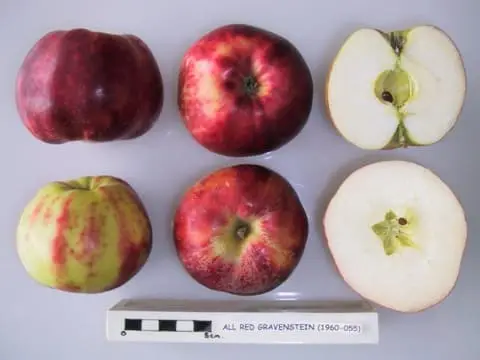
All-Red Gravenstein
-
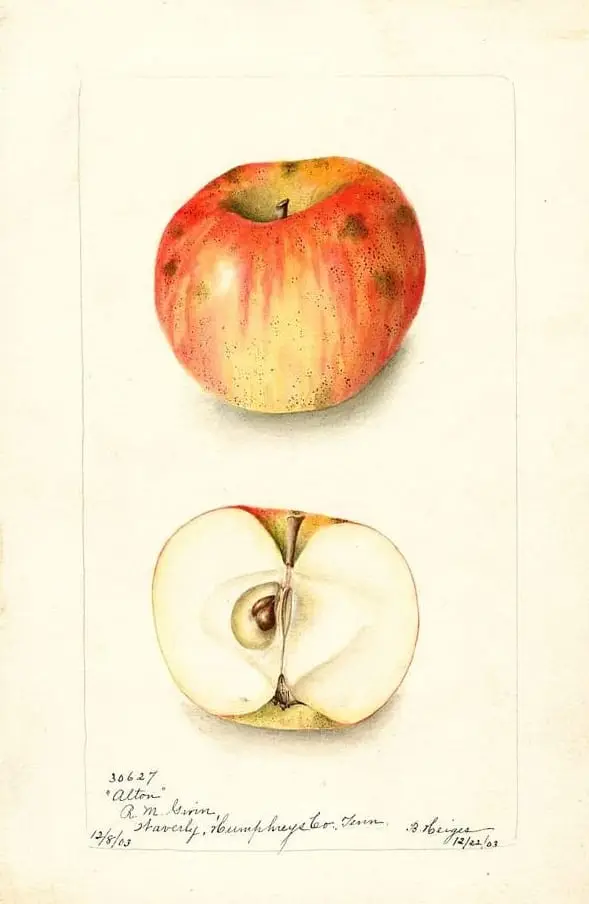
Alton
-
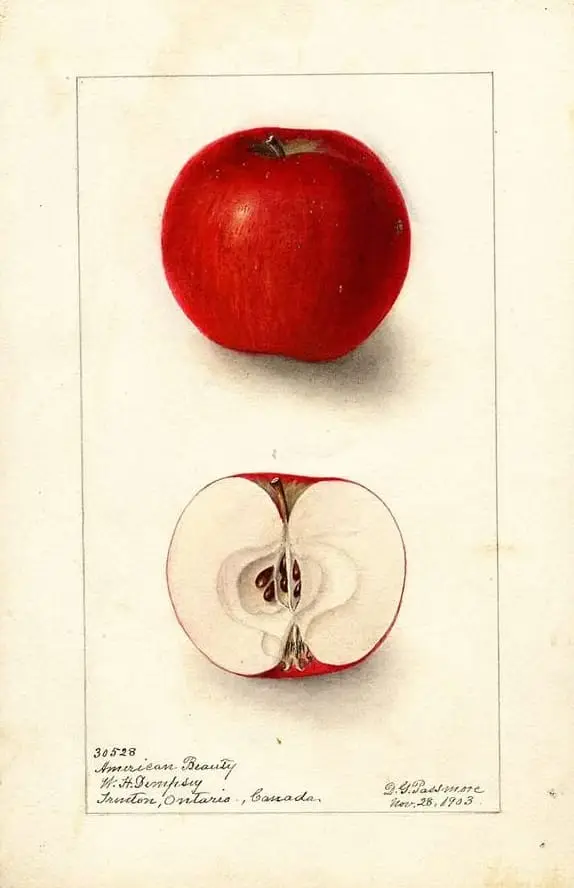
American Beauty
-
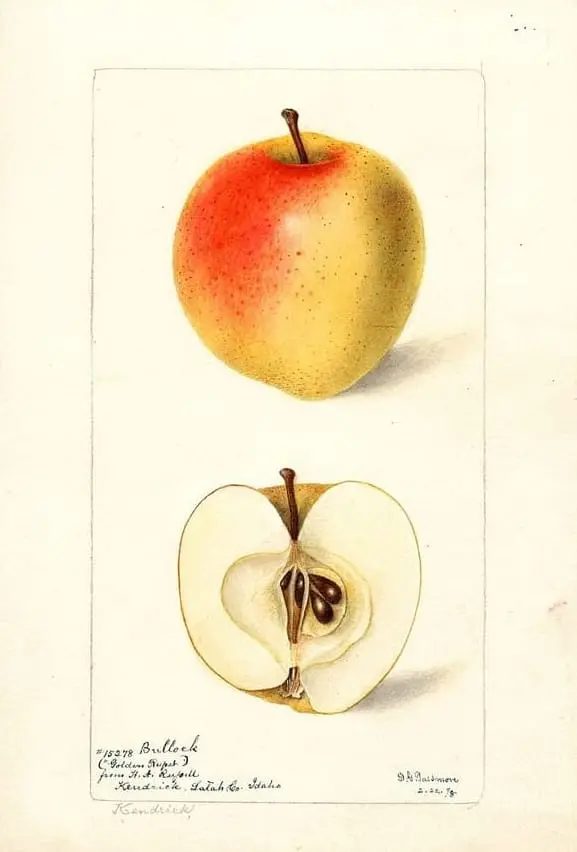
American Golden Russet
A small New Jersey russet whose flesh Downing likened to a buttery pear; Coxe knew it in 1817 as Sheep-nose
-
American Grindling
-
American Summer Pearmain
-
Ames
-
Arkansas