Apple varieties, United States
Empire
Grown from McIntosh seed gathered near Claverack in 1945, after spring frosts had destroyed Geneva's planned crosses
History
By 1945 the New York State Agricultural Experiment Station at Geneva had been breeding apples for more than half a century1. That spring a warm spell brought the orchards of western New York into flower by 14 April, about a month early, and the frosts that followed destroyed nearly the whole crop, the station’s crosses with it1. A. J. Heinicke, the station’s director, suggested gathering seed instead from isolated orchards holding only the two varieties the breeders wanted to combine, whose fruit would most likely come from cross-pollination between them1.
One such orchard, Asrow Miller’s south of Claverack in the Hudson Valley, held only mature McIntosh and Delicious trees1. At harvest 4,035 seeds were taken from its McIntosh apples and sent to Geneva1,2, and 1,199 seedlings were planted out in 19471. The tree that became Empire first fruited in 19542, and that year, for its McIntosh-like fruit, it was given the selection number NY45500-5; who chose it was not recorded1. Roger D. Way, in charge of apple breeding from 1962, had recognised its promise by 19651. Of at least 104 names suggested, the shippers strongly preferred Empire, and the station released the apple under that name in September 19661,3.
Empire was not patented, so it brought the breeding programme no income; when the Teeple family of Wolcott, New York, found a highly coloured limb sport, they released it jointly with Cornell as Royal Empire so that the royalties could be shared5. By 1997 Empire was also grown extensively in Michigan and was valued for export, “prized by English consumers”5; New York had grown about 43,000 tonnes (95 million pounds) of it in 19955. In the US industry’s forecast for 2025/26 it made up 1 per cent of the US crop, against 2 per cent on the previous five-year average, with New York the largest grower and Michigan next6. Canadian growers’ forecast for the same season placed most of their Empire crop in Quebec and Ontario6.
The fruit
The station described a fruit shaped like McIntosh, with a thick, solid red skin, slightly striped and heavily bloomed with wax, and cream-coloured, crisp, juicy flesh, mildly subacid and aromatic3. It bruised less than McIntosh and kept considerably better3. The National Fruit Collection records it as medium-large and flattish4.
It ripens with Delicious3, about two weeks after McIntosh, and hangs longer on the tree2; at Brogdale in Kent it is picked in mid-October4. A USDA storage handbook gives two to three months in cold air and five to ten in controlled atmosphere, and advises against late picking7.
Growing
At its release the tree was said to bear from its fifth or sixth year, crop every year and outyield Delicious, with its fruit borne singly and evenly along the branches, easy to pick3. It seldom sets too much fruit and needs no sprays against drop before harvest3. The USDA describes a vigorous, upright tree of spur-type habit, hardy to about −34 °C (−30 °F)2.
Uses
Empire was released as strictly a fresh-market dessert apple, “not suitable for processing”3, though the USDA calls it good for cider too2. In 2020–2024 an average of 67 per cent of the US crop was sold fresh and 33 per cent processed6.
Where the sources disagree
- Its father. The seed came from McIntosh trees in an orchard of McIntosh and Delicious only1,2, so Delicious is the presumed pollen parent; the station said only that Empire was “believed” to come from that cross3. None of the sources read tests the parentage with DNA.
- Self-fertility. The 1966 description calls it self-unfruitful3; the USDA inventory, “self-fruited”2.
- Keeping. The USDA inventory gives 160 days at −1 °C (30 °F)2; the storage handbook, two to three months in cold air7.
Family tree
Parents, grandparents and great-grandparents, as the entries in the atlas record them.
Sources
- The History of the 'Empire' Apple, M. Derkacz, D. C. Elfving and C. G. Forshey, Fruit Varieties Journal 47(2): 70–72, American Pomological Society, 1993. Supports: apple breeding at Geneva "for over half a century" by 1945; the warm spell of late March and early April 1945, bloom in western New York by 14 April, about a month early, and the frosts that eliminated virtually the whole crop and the station's crosses; A. J. Heinicke, head of the Department of Pomology and director of the station, proposing seed from isolated orchards holding only the two cultivars wanted; Asrow Miller's orchard south of Claverack, of mature McIntosh and Delicious trees only; 4,035 seeds extracted from its McIntosh apples and 1,199 seedlings planted at the station in spring 1947; selection NY45500-5 in 1954, the selector unrecorded; Roger D. Way in charge of apple breeding from 1962 and recognising its potential by 1965; at least 104 names suggested, the shippers' strong preference for Empire, and official release in September 1966.
- Plant Inventory No. 204, Part I (Plant Materials Introduced January 1 to June 30, 1995), p. 328: PI 588842, Empire, R. A. Norris (ed.), USDA Agricultural Research Service, 1996-08. Supports: "Open-pollinated seeds collected from McIntosh fruits borne in Claverack, New York"; seed produced 1945 and "first fruited 1954"; a vigorous, upright tree of spur-type habit; "Self-fruited"; ripening two weeks after McIntosh and hanging longer on the tree; "Hardy to -30 degrees F"; "Storage: 160 days at 30 degrees F"; "High quality dessert apple also good for cider".
- Five New Fruits from New York, George M. Kessler, Fruit Varieties and Horticultural Digest 21(2): 33–34, American Pomological Society (adapted from articles by R. D. Way, J. Einset and others in Farm Research, 1966), 1967. Supports: introduced by the New York Agricultural Experiment Station in 1966; "believed to have resulted from a cross of McIntosh x Delicious"; "strictly a fresh market clone which ripens with Delicious"; bearing at 5 or 6 years, annual cropping, more productive than Delicious, fruit borne singly and evenly along the branches and easily picked; self-unfruitful; no usual oversetting and no stop-drop sprays needed; fruit shaped like McIntosh, solid red with slight striping, thick skin with a heavy waxy bloom; flesh cream-coloured, crisp, juicy, mildly subacid, aromatic; resists bruising better and stores considerably better than McIntosh; "not suitable for processing".
- Empire (accession 1962-041), National Fruit Collection, Brogdale, Kent (Defra). Supports: raised in 1945 at the New York State Agricultural Experiment Station, Geneva; named and introduced in 1966; parentage "McIntosh x Delicious"; a dessert apple, medium-large and flat globose, red and striped, with cream, crisp flesh and a "subacid and aromatic" flavour; picking in mid-October at Brogdale.
- The Cornell University Apple Breeding Program: Past, Present, and Future, Susan K. Brown and David E. Terry, Fruit Varieties Journal 51(4): 199–204, American Pomological Society, 1997. Supports: Empire "also grown extensively in Michigan" and "a valuable export cultivar prized by English consumers"; New York's 1995 production of 95 million pounds; the highly coloured limb sport found by the Teeple family at Wolcott, New York, co-released with Cornell as Royal Empire to share royalties, Empire not having been patented and so earning the breeding programme no funds.
- Industry Outlook 2025, Christopher Gerlach, U.S. Apple Association, 2025. Supports: Table 6: Empire 1% of US production in the 2025/26 forecast and 2% on the five-year average; Table 7: New York (2,956,205 bushels) and Michigan (1,010,094) the largest producers in the 2025/26 forecast; Table 9: 67% fresh and 33% processing, 2020–2024 average; Table 15 (Canadian growers' figures): Empire forecast at 1,013,082 bushels in Canada in 2025/26, of which 582,237 in Quebec and 417,000 in Ontario.
- Apple, in The Commercial Storage of Fruits, Vegetables, and Florist and Nursery Stocks (Agriculture Handbook 66), Chris B. Watkins, Eugene Kupferman and David A. Rosenberger, USDA Agricultural Research Service, 2016. Supports: Table 2 (p. 180): Empire "2-3" months at 0 °C in air and "5-10" in controlled atmosphere; "Avoid late harvest".
More from United States
-
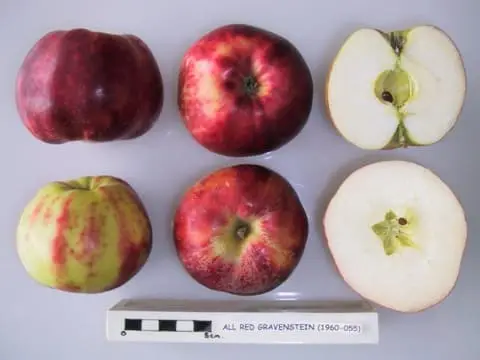
All-Red Gravenstein
-
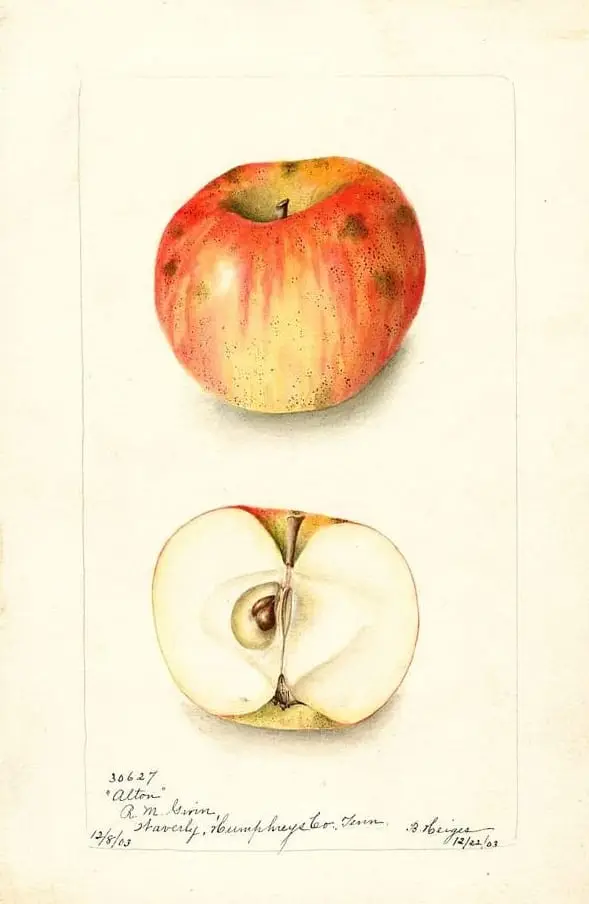
Alton
-
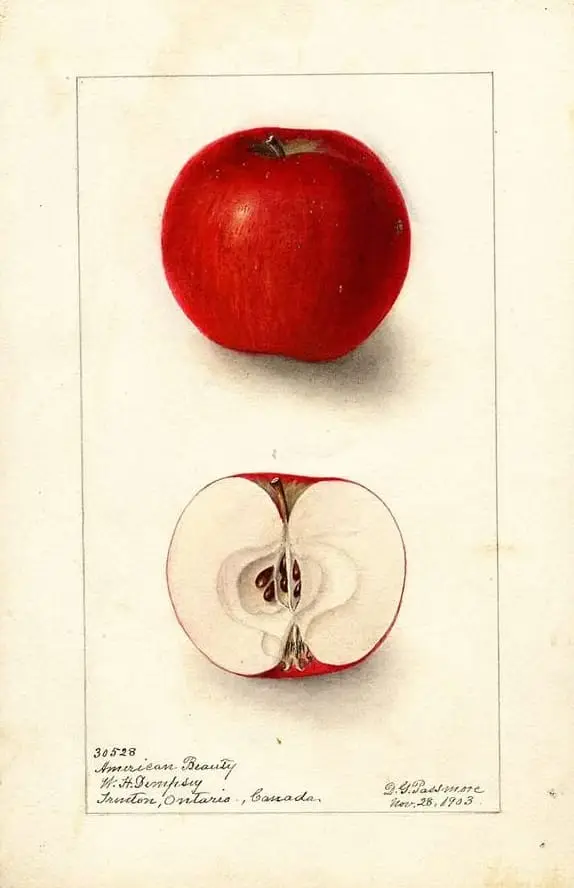
American Beauty
-
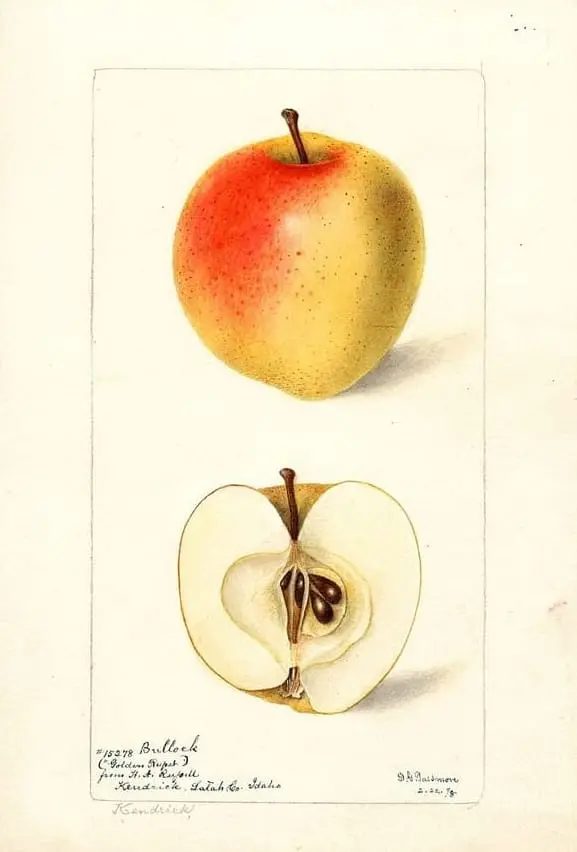
American Golden Russet
A small New Jersey russet whose flesh Downing likened to a buttery pear; Coxe knew it in 1817 as Sheep-nose
-
American Grindling
-
American Summer Pearmain
-
Ames
-
Arkansas