Apple varieties, United States
Winesap
Of unknown origin, it was "the most favored cider fruit in West Jersey" in 1817 and a parent of Delicious
History
Beach called Winesap “one of the oldest and most popular apples in America”, known in every apple-growing region from Virginia westward to the Pacific coast1. Nothing definite is known of its origin1. Coxe, who described it in 1817, called it “the most favored cider fruit in West Jersey”, and many writers took West Jersey for its home, which Beach thought hardly warranted by the evidence1,3.
In 1892, 73 nursery firms offered it for sale, against 64 for Baldwin1. It was fourth among American apples in 1909–13 and a close second to Delicious in 1928, with 6,617,000 trees in commercial orchards, 8.2 per cent of the total5. In 1936 it made up 33 per cent of Washington’s apple trees, and in 1941 it was the third variety by number of trees in the central Atlantic apple region and the most important in central and southern Virginia5. As a commercial orchard apple it had succeeded chiefly in the Piedmont of Virginia and certain other districts1.
It has many seedlings that resemble it more or less, the best known being Arkansas, Arkansas Black, Paragon and Stayman Winesap1. SNP data published in 2020 show Winesap and Delicious to be parent and offspring, with Winesap, the older, taken to be the parent; they also identify Winesap and Jonathan as the parents of King David4.
The fruit
The fruit is conical and fairly uniform, of medium size or smaller, and in New York it seldom reached even a good medium size1,5. The tough, smooth, glossy skin is bright deep red, faintly striped with dark purplish red over a yellow ground, with a faint bloom1. The flesh is tinged yellow, sometimes with red veins, very firm, rather coarse, very juicy and sprightly subacid1. Downing found it a good table apple and “one of the very finest cider fruits”2.
Magness counted 160 to 170 days from full bloom to picking, and gave 150 to 210 days in cold storage, at most 2405. Grown at Beach’s experiment station in New York, it was in season from January to June, with April the usual commercial limit; it shipped well and stood heat before storage but often scalded late in the season1. At Brogdale, Kent, it begins to flower around 4 May and is picked in late October3.
Growing
The tree is rather vigorous and crops with remarkable regularity1, and its fruit hangs late on the tree without harm2. It prefers light, rich, deep soils and fails on heavy clay or in low, damp places; in poor sites the trees are short-lived1. Magness found it very susceptible to scab but very resistant to bitter rot, fire blight and cedar rust5. Although a diploid, it normally produces no viable pollen, so it is worthless as a pollinator; it is also self-unfruitful5.
Uses
Winesap has served as a table apple and for cider1,2, and Magness rated it good for both dessert and cooking5.
Where the sources disagree
- Bearing age. Beach and Downing say it bears early1,2; Magness put first bearing at six to eight years5.
- Hardiness. Downing called the tree very hardy2; Beach found it less hardy in New York than the region’s leading varieties1.
- Season. Downing gives November to May2; Beach, January to June in New York1.
Family tree
Offspring in the atlas
- Arkansas United States, about 1833
- Arkansas Black United States, about 1870
- Delicious United States, 1872
- King David × Jonathan; United States, 1893
- McLiver's Winesap New Zealand, by 1950
- Shenandoah × Opalescent; United States, 1942
- Stayman United States, 1866
81 varieties in the atlas descend from Winesap.
Sources
- The Apples of New York, vol. I, pp. 374–376: Winesap, S. A. Beach, New York Agricultural Experiment Station, Internet Archive, 1905. Supports: Coxe (1817) first among the references (p. 374); the synonyms Holland's Red Winter, Royal Red of Kentucky, Texan Red, Wine Sap and Wine Sop; "Winesap is one of the oldest and most popular apples in America", known from Virginia westward to the Pacific coast; 73 nursery firms offering it in 1892 against 64 for Baldwin; its many seedlings, the best known Arkansas, Arkansas Black, Paragon and Stayman Winesap; a rather vigorous tree, bearing early and "a remarkably regular cropper"; best on light, rich, deep soils, failing on heavy clay or low, damp ground; short-lived in unfavourable sites and less hardy in New York than the leading local varieties; commercially successful only in the Piedmont region of Virginia and certain districts elsewhere; seldom of good medium size in New York; pretty uniform in size and shape (p. 375); at the station in season from January to June, April the ordinary commercial limit; a good shipper that stands heat but often scalds late in the season; "Nothing definite is known of the origin of Winesap"; Coxe's "the most favored cider fruit in West Jersey" and the doubt that West Jersey was its home; skin tough, smooth, glossy, bright deep red faintly striped with dark purplish red over yellow, with faint bloom; flesh tinged yellow, veins sometimes red, very firm, rather coarse, very juicy, sprightly subacid (p. 376).
- The Fruits and Fruit Trees of America, p. 411: Winesap, A. J. Downing, revised by Charles Downing, John Wiley & Sons, Internet Archive, 1900. Supports: the synonyms Wine Sop and Potpie Apple; "not only a good Apple for the table" but "one of the very finest cider fruits"; the tree bearing early, the apples hanging late on the tree without injury, thriving on sandy, light soils; "very hardy"; season November to May.
- Winesap (accession 1951-103), National Fruit Collection, Brogdale, Kent (Defra). Supports: "Originated in the U.S.A. First described in 1817"; the synonym Winesop; mother of Arkansas; 10% flowering on 4 May and picking in late October at the collection.
- Using whole-genome SNP data to reconstruct a large multi-generation pedigree in apple germplasm, Hélène Muranty and others, BMC Plant Biology 20:2, with Additional files 1, 3 and 6, 2020. Supports: Winesap and Delicious a parent–offspring duo with 6 Mendelian errors, oriented by documented dates (Winesap 1804, Delicious 1880), so that Winesap is the probable parent (Additional file 6, Table S5); King David inferred as Jonathan × Winesap (Table S3); Winesap diploid (Table S1).
- Apple Varieties and Important Producing Sections of the United States (Farmers' Bulletin 1883), pp. 9–29, J. R. Magness, U.S. Department of Agriculture, Internet Archive, 1941. Supports: third variety by number of trees in the central Atlantic section and the most important in central and southern Virginia (p. 9); 33 per cent of Washington's apple trees in 1936 (p. 18); "a close second" to Delicious in 1928 (p. 20), with 6,617,000 trees, 8.2 per cent of the total (Table 1, p. 21); fourth of the ten leading US varieties in 1909–13 (p. 22); first bearing at a medium age, 6 to 8 years (Table 2, p. 23); very susceptible to scab, very resistant to bitter rot, fire blight and cedar rust (Table 3, p. 25); a diploid that "normally does not produce viable pollen", "Worthless" as a pollinator, self-unfruitful (p. 26 and Table 4); 160 to 170 days from full bloom to picking; medium to below medium, conical, dark uniform red; dessert and cooking quality good; 150 to 210 days in cold storage, at most 240 (Table 5, pp. 28–29).
More from United States
-
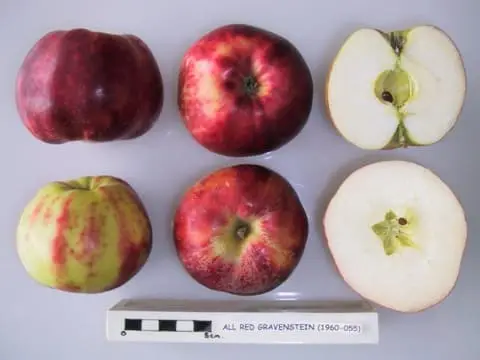
All-Red Gravenstein
-
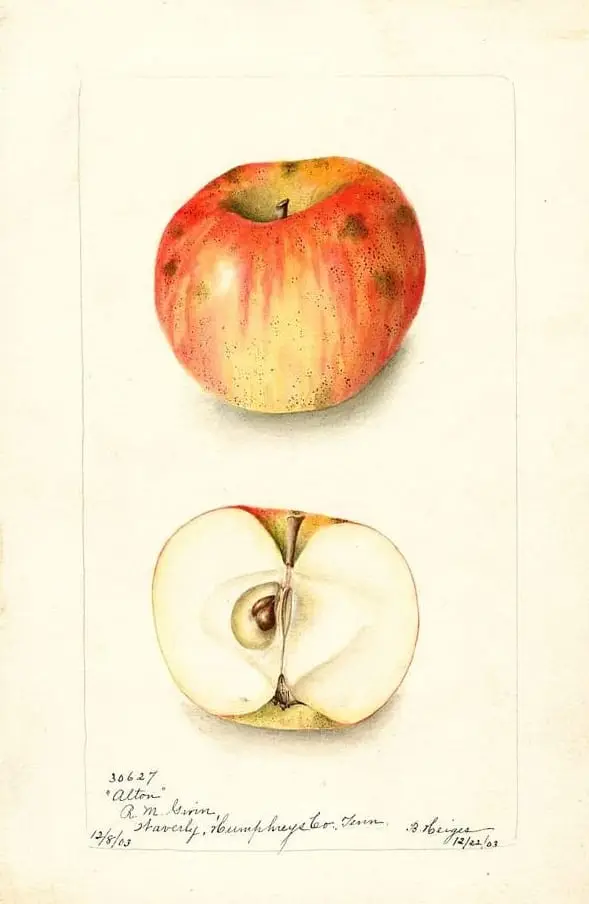
Alton
-
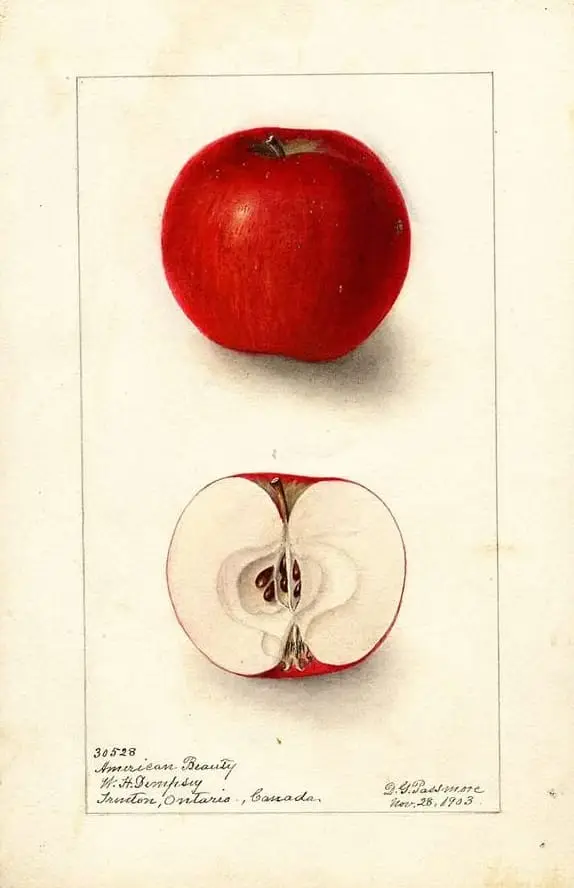
American Beauty
-
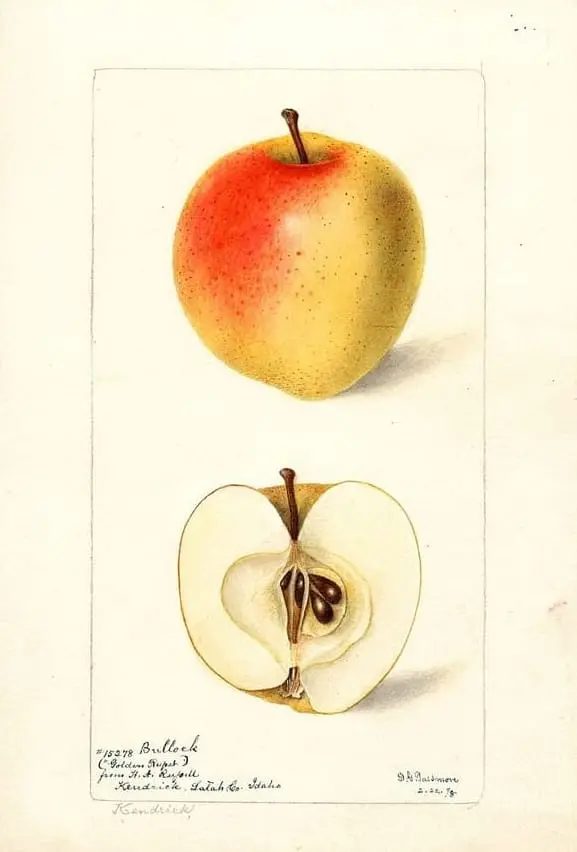
American Golden Russet
A small New Jersey russet whose flesh Downing likened to a buttery pear; Coxe knew it in 1817 as Sheep-nose
-
American Grindling
-
American Summer Pearmain
-
Ames
-
Arkansas