Apple varieties, United States
Stayman
A Winesap seedling raised at Leavenworth, Kansas, in 1866; the fifth apple of American orchards in 1928
History
Stayman was raised by Dr J. Stayman at Leavenworth, Kansas, from seed of Winesap in 1866, and first fruited in 18751,3. SNP data analysed by Larsen and colleagues confirm Winesap as a parent; the other is unknown4. Downing described it in 1881 and Stayman in 1883, but in Taylor’s account, quoted by Beach, it drew little attention until after 18901. Then R. J. Black of Bremen, Ohio, and J. W. Kerr of Denton, Maryland, both fruited it on top-grafted trees and saw its merits; Kerr first catalogued it in 1894–95, and it was afterwards planted extensively in New Jersey, Pennsylvania, Delaware, Maryland and Virginia1. The USDA gives 1895 as the year of its introduction3.
Van Deman rated it the best of the Winesap group for general planting, and Taylor judged it its parent’s equal in all but colour, and suited to a wider range of soils and climates1. By 1928 it was fifth among the apples of American commercial orchards, with 5,076,000 trees, 6.3 per cent of the total2. In 1941 Magness named it and York Imperial as the two leading varieties of the central Atlantic states, Stayman being first in New Jersey, Pennsylvania and Maryland2. Its colour strains Staymared and Blaxtayman carried a little more colour but cracked just as readily2. In August 2026 the US industry forecast 111,053 bushels of 42 lb for 2026/27, the smallest crop of any variety it named and well below the five-year average of 266,833; 34,388 bushels were expected from Virginia5.
The fruit
The fruit is medium to large and uniform, roundish-conical to globular1,2. The smooth, rather thick, tough skin turns from green to yellowish and is mostly covered with dull red, faintly striped with carmine, with conspicuous grey and russet dots1. The flesh is tinged yellow or greenish, firm, moderately fine-grained, tender, moderately crisp and juicy to very juicy, aromatic and sprightly, with a pleasant subacid flavour1. Magness rated it very good both for dessert and for cooking2. The fruit’s greatest weakness is cracking2; the USDA notes “sometimes small cracks”3.
It is a very late apple, harvested from November, three weeks after Delicious, in the USDA record3; Magness counted 160 to 165 days from full bloom to picking2. It keeps 120 to 150 days in cold storage, at most 150 to 180, but scalds badly2; Beach gives its season as December to May1.
Growing
Magness described a large, vigorous, spreading tree that bears early, at four to six years, and annually2. It is triploid2,3,4: a poor pollinator and only slightly self-fruitful2. It is very susceptible to scab, but resistant to bitter rot and fire blight and very resistant to cedar rust2. At Beach’s experiment station in New York the tree bore young, but the fruit did not reach its proper size and colour, and he thought it unsuited to so northerly a region1.
Where the sources disagree
Family tree
Parents, grandparents and great-grandparents, as the entries in the atlas record them.
- Stayman United States, 1866
- Seed parent Winesap United States, by 1817
Offspring in the atlas
- Blaxtayman United States, 1926
- Dark Red Staymared United States, by 1927
- Scarlet Staymared United States, 1930
Sources
- The Apples of New York, vol. I, pp. 318–319: Stayman Winesap, S. A. Beach, New York Agricultural Experiment Station, Internet Archive, 1905. Supports: references including Downing, 1881, and Stayman, Mo. Hort. Soc. Rpt., 1883; the synonyms Stayman and Stayman's Winesap; Van Deman calling it "the best variety of the Winesap class for general cultivation"; Taylor finding it unequal to its parent only in its less brilliant colour, and adapted to a wider range of soil and climate; at the Geneva station a moderately vigorous tree that comes into bearing young and is "a reliable annual cropper, alternating heavy with light crops", but whose fruit does not develop properly there in size and colour, so that it is "not well suited for regions as far north as this"; "originated from seed of Winesap in 1866 at Leavenworth, Kan., by Dr. J. Stayman" and first fruiting in 1875; the earliest descriptions by Downing and Stayman; Taylor's account that it drew little attention until after 1890, when R. J. Black of Bremen, Ohio, and J. W. Kerr of Denton, Maryland, fruited it on top grafts, that Kerr first catalogued it in 1894–1895, and that it was planted extensively in New Jersey, Pennsylvania, Delaware, Maryland and Virginia (p. 318); the tree spreading and somewhat open; fruit medium to large, uniform, roundish conic to globular; skin smooth, rather thick, tough, green becoming yellowish, often nearly covered with dull mixed red and indistinctly striped with dull carmine, with light grey and russet dots, often large; flesh tinged yellow or slightly greenish, firm, moderately fine-grained, tender, moderately crisp, juicy to very juicy, aromatic, sprightly, pleasant subacid; season December to May, commercial limit April (p. 319).
- Apple Varieties and Important Producing Sections of the United States (Farmers' Bulletin 1883), pp. 9–31, J. R. Magness, U.S. Department of Agriculture, Internet Archive, 1941. Supports: York Imperial and Stayman Winesap the two leading varieties of the central Atlantic section, Stayman Winesap leading all others in New Jersey, Pennsylvania and Maryland (p. 9); Table 1, 1928: Stayman Winesap fifth, with 5,076,000 trees, 6.3 per cent of the total, trend since 1928 "Steady", plantings about equal to removals (p. 21); Table 2: spreading, vigorous, large tree, first bearing early (4 to 6 years), annual (p. 23); very susceptible to scab but quite resistant to spray injury (p. 24); Table 3: very susceptible to scab, resistant to bitter rot and fire blight, very resistant to cedar rust (p. 25); Table 4: triploid, poor pollinator, slightly self-fruitful, midseason bloom (p. 26); Table 5: 160 to 165 days from full bloom to picking; medium to large; medium red; roundish conic; firm, crisp, juicy; medium acidity; very good for dessert and for cooking; 120 to 150 days normal cold storage, 150 to 180 at most; severe storage scald (pp. 28–29); the colour strains Staymared and Blaxtayman, carrying somewhat more colour at maturity but no less prone to cracking, "the greatest weakness of this variety" (p. 31).
- Plant Inventory No. 204, Part I (Plant Materials Introduced January 1 to June 30, 1995), p. 349: PI 588975, Stayman, R. A. Norris (ed.), USDA Agricultural Research Service, 1996-08. Supports: developed by J. Stayman; "Pedigree - Winesap x ?; raised 1866; first fruited 1875; introduced 1895"; fruit medium to large, about 75 mm; skin 90% red, striped, "sometimes small cracks"; round-conic; flesh firm, greenish light yellow; eating quality very good; harvest very late, beginning November, three weeks after Delicious; tree vigorous, spreading, productive, "biennial cropping"; triploid; produced in commercial quantities in Virginia, West Virginia and Pennsylvania (R. D. Way, 1993).
- Cultivar fingerprinting and SNP-based pedigree reconstruction in Danish heritage apple cultivars utilizing genotypic data from multiple germplasm collections in the world, Bjarne Larsen and others, Genetic Resources and Crop Evolution 72: 2397–2411, with supplementary Table S5, 2025. Supports: Table S5: Stayman Winesap (MUNQ 117) with Winesap as its SNP-confirmed parent and no second parent identified; ploidy 3 (triploid).
- Industry Outlook 2026, Christopher Gerlach, U.S. Apple Association, 2026-08. Supports: Table 6: Stayman forecast at 111,053 bushels for 2026/27, against 176,050 in 2025/26 and a five-year average of 266,833, the smallest of the named varieties (p. 18); Table 7: 34,388 bushels from Virginia, 16,307 from Pennsylvania, 7,636 from New York and 52,722 from other states (p. 19); production in 42-pound bushels.
More from United States
-
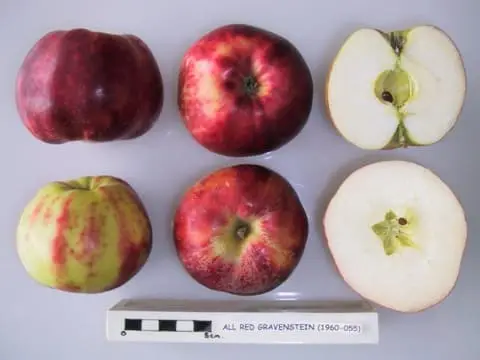
All-Red Gravenstein
-
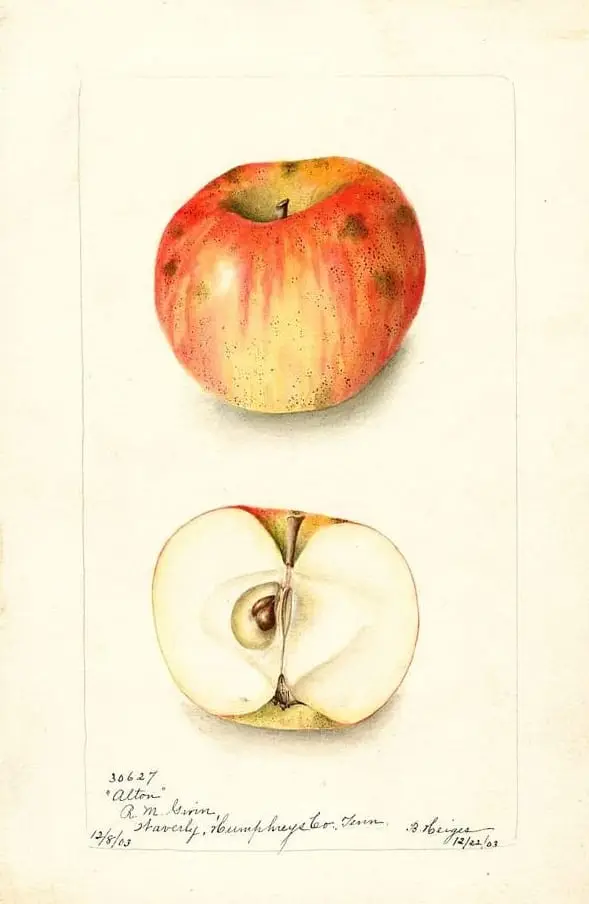
Alton
-
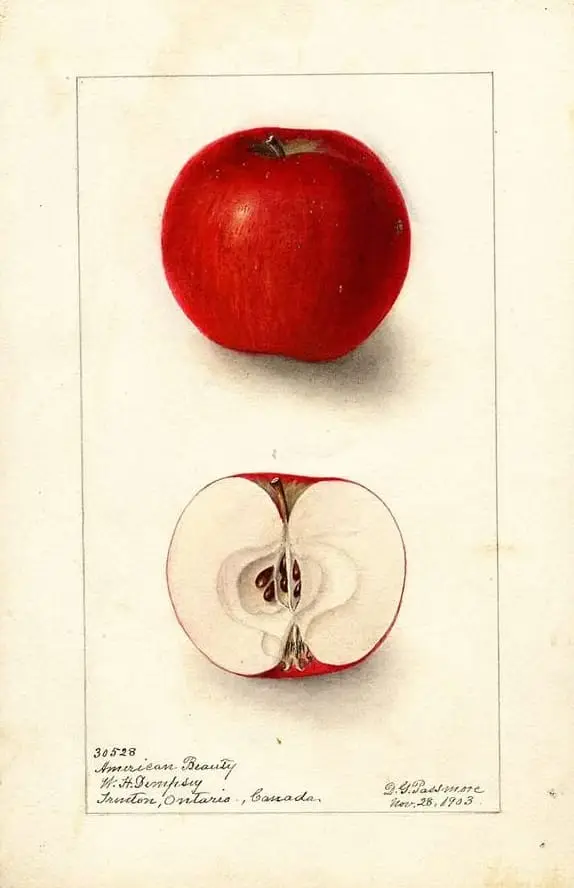
American Beauty
-
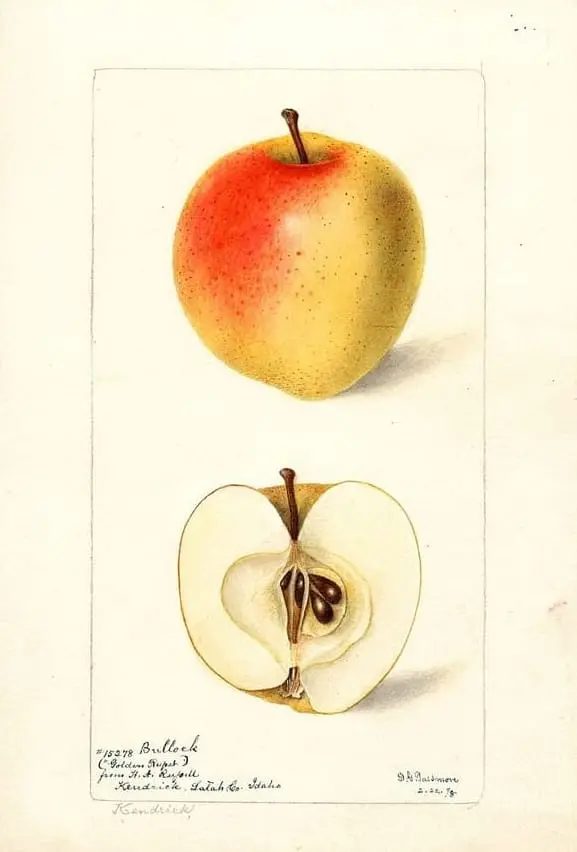
American Golden Russet
A small New Jersey russet whose flesh Downing likened to a buttery pear; Coxe knew it in 1817 as Sheep-nose
-
American Grindling
-
American Summer Pearmain
-
Ames
-
Arkansas