Apple varieties, United States
Delicious
Found by Jesse Hiatt at Peru, Iowa, and first called Hawkeye; by 1928 the most planted apple in American orchards
History
Carlos Fear and Paul Domoto of Iowa State University tell how, in 1872, Jesse Hiatt of Peru, Iowa, found a sprout growing from the roots of a Bellflower seedling that had twice been cut down for standing out of line in his orchard1. Its fruit differed from the Bellflower’s in aroma and in shape, with prominent calyx lobes, and Hiatt named it Hawkeye, after Iowa’s nickname1.
In 1893 Clarence Stark held a New Fruit Show at Louisiana, Missouri, seeking an apple to replace the poor-flavoured Ben Davis1,3. Tasting Hiatt’s elongated, striped red apple, he is said to have declared, “Delicious! That will be its name,” but the entry card had been lost3. Hiatt sent the apple again in 1894, it won, and the Stark brothers bought the rights to it1,3. By 1922 its annual crop was valued at an estimated $12 million1.
By 1928 Delicious was the most widely planted apple in American commercial orchards, with 6,826,000 trees, 8.4 per cent of the total6, and in 1986 Fear and Domoto called it, with its strains, the most widely planted apple in the world1. In 2024/25 Red Delicious, as the US industry lists it, made up 15 per cent of US production, second to Gala7. The original tree, killed to the ground by the Armistice Day freeze of 1940, sprouted again, and one sprout still stood in 19861.
More than 100 strains trace to Delicious1. Richared, a better-coloured bud sport, was found in 1919 at Monitor, Washington1; in 1921 a branch of dark red, unstriped fruit on Lewis Mood’s tree at Monroeville, New Jersey, gave a strain that Stark Bro’s named and introduced; it became the parent of more than 25 others1,3. In 1956 the firm paid $25,000 for a compact tree from Hood River, Oregon, which began its line of spur-type strains3.
SNP data published in 2020 show Delicious and Winesap to be parent and offspring, with Winesap, the older, taken to be the parent; they also confirm Delicious as a parent of Fuji and identify it, with Sturmer’s Pippin, as a parent of Braeburn5.
The fruit
Bunyard described a medium-sized, round-conical, angular apple, golden yellow with a dark crimson flush and stripes, its flesh firm, yellow, juicy and highly flavoured4. Magness found it crisp and juicy but mealy when overripe, very good for dessert, poor for cooking, and the lowest in acid of the leading American varieties6; USDA puts its acidity at 0.2 to 0.4 per cent malate8. It keeps for three months in cold air storage and twelve in controlled atmosphere8.
Growing
The tree is vigorous, large and upright-spreading and begins to bear at five to eight years; it is very susceptible to scab but very resistant to fire blight and cedar rust, and is a diploid, a good pollinator and self-unfruitful6. Growers valued its hardiness, vigour and annual bearing, though in some regions it suffers from bitter pit, internal bark necrosis and poor fruit set1.
Uses
A dessert apple6, it is mostly sold fresh: 82 per cent of the US crop of Red Delicious on average in 2020–20247.
Where the sources disagree
- Date. Fear and Domoto give 18721 and Bunyard about 18804; Taylor, writing in 1908 and quoted by Eaton, has the tree come to notice about 1881 as a sprout some six years old2.
- Origin. Fear and Domoto describe a sprout from the roots of a Bellflower seedling1, and other writers a seedling of Yellow Bellflower2. Taylor described a sprout from the stock of a Yellow Bellflower tree whose top had been destroyed, and the UK National Apple Register “a sprout from a rootstock”; Eaton thought a Yellow Bellflower seedling unlikely, and the stories of the twice-cut sprout and of Hiatt’s saying “If thee must live, thee may” apocryphal2. Yellow Bellflower was among the apples genotyped in 2020, and no parent–offspring link between it and Delicious was reported5.
Family tree
Parents, grandparents and great-grandparents, as the entries in the atlas record them.
- Delicious United States, 1872
- Parent Winesap United States, by 1817
Offspring in the atlas
- Braeburn × Sturmer Pippin; New Zealand, by 1952
- Chieftain × Jonathan; United States, 1917
- Criterion × Golden Delicious; United States, 1968
- Empire × McIntosh; United States, 1945
- Fuji × Ralls Janet; Japan, 1939
- Fukunishiki × Ralls Janet; Japan, 1933
- Idaho Delicious United States, by 1965
- Jonadel × Jonathan; United States, 1923
- Jonalicious × Jonathan; United States, 1933
- Kidd's Orange Red × Cox's Orange Pippin; New Zealand, 1924
- Kinrei × Golden Delicious; Japan, 1932
- Legana × Democrat; Australia, about 1940
- Medina × Deacon Jones; United States, 1911
- Melrose (1) × Jonathan; United Kingdom, by 1831
- Melrose (2) × Jonathan; United States, by 1937
- Murasaki × Jonathan; Japan, 1935
- Oregon Spur United States, by about 1966
- Orleans × Deacon Jones; United States, 1912
- Ozark Gold × Golden Delicious; United States, by 1970
- Regent × Daniel's Red Duchess; United States, by 1963
- Richared Delicious United States, about 1915
- Sekai Ichi × Golden Delicious; Japan, 1930
- Spartan × McIntosh; Canada, 1926
- Starking United States, 1921
- Starkrimson Delicious United States, about 1953
- Starkspur Supreme United States
- Sungold × Golden Delicious; United States, 1960
- Sweet Delicious × Deacon Jones; United States, 1911
- Toyo × Ben Davis; Japan, by 1935
- Wellspur Delicious United States, 1952
71 varieties in the atlas descend from Delicious.
Sources
- The 'Delicious' Apple, Carlos D. Fear and Paul A. Domoto (Iowa State University), Fruit Varieties Journal 40(1):2–4, American Pomological Society, 1986. Supports: Jesse Hiatt of Peru, Iowa, finding "in 1872" a sprout from the roots of a Bellflower seedling twice cut down for growing out of the row; the saying "If thee must live, thee may"; fruit unlike the Bellflower, with a different aroma and prominent calyx lobes; the name Hawkeye after Iowa's nickname; C. M. Stark's fruit show of 1893 at the Stark Brothers Nursery in Louisiana, Missouri; the 1894 show and permission to propagate; the 1922 crop "estimated at 12 million dollars"; hardiness, vigour and annual bearing; regional problems of bitter pit, internal bark necrosis and poor fruit set; strains "over 100"; Richared found in 1919 at Monitor, Washington, with better colour; a strain found in 1921 at Monroeville, New Jersey, colouring much earlier and parent of more than 25 named strains; with its strains the most widely planted cultivar in the world (1986); the original tree killed to the ground by the Armistice Day freeze of 1940 and sprouting again, one sprout still standing in 1986.
- Observations on the Origin of 'Delicious' Apple, George W. Eaton (University of British Columbia), Fruit Varieties Journal 44(2):98–99, American Pomological Society, 1990. Supports: the National Apple Register of the United Kingdom (Smith, 1971): originated "as a sprout from a rootstock" on Hiatt's farm; other accounts of a seedling of Yellow Bellflower (Blodgett and Aichele 1960; Maas 1970); Taylor's account (USDA Yearbook 1907): noticed in Hiatt's orchard "about 1881" as a sprout "supposed to be about 6 years old, from the stock of a 'Yellow Bellflower' tree, the top of which had been destroyed"; Eaton's view that it is unlikely to be a seedling of Yellow Bellflower and that the repeated cutting back, the tree out of the row and the saying "If thee must live, thee may" are apocryphal.
- Stark Brothers' Nurseries & Orchards: Two Centuries of New Fruit Cultivars and Innovations, Michele R. Warmund, Journal of the American Pomological Society 75(2):115–129, 2021. Supports: the First International New Fruit Show of 1893, held by Clarence Stark to find cultivars to replace the poor-flavoured Ben Davis, with entries from 27 states; the "oddly-elongated, red apple with stripes and five prominent calyx lobes"; "Delicious! That will be its name."; the missing entry card; Hawkeye sent again to the 1894 show, where it won; Clarence and Edgar Stark's journey to Peru, Iowa, to buy the rights (p. 118); Lewis Mood's branch of dark red, non-striped fruit on his Delicious tree in New Jersey, named and introduced by Stark Bro's, which began "the bud sport era"; the compact Delicious tree from Roy Bisbee's orchard at Hood River, Oregon, bought for $25,000 in 1956, the start of Stark Bro's spur-type cultivars (pp. 125–126).
- A Handbook of Hardy Fruits, vol. I, p. 46: Delicious, E. A. Bunyard, John Murray, Internet Archive, 1920. Supports: a dessert apple, November to January; medium, round, conical, angular; golden-yellow with dark crimson flush and stripes; flesh firm, yellow, juicy and highly flavoured; originated in the garden of Jesse Hiatt of Peru, Iowa, "about 1880".
- Using whole-genome SNP data to reconstruct a large multi-generation pedigree in apple germplasm, Hélène Muranty and others, BMC Plant Biology 20:2, with Additional files 1, 3 and 6, 2020. Supports: Delicious and Winesap a parent–offspring duo with 6 Mendelian errors (the threshold being 600), oriented by documented dates (Winesap 1804, Delicious 1880) so that Winesap is the probable parent (Additional file 6, Table S5); Yellow Bellflower among the genotyped cultivars (Table S1) with no duo or trio linking it to Delicious; Delicious confirmed as a parent of Fuji, and inferred with Sturmer's Pippin as a parent of Braeburn (text; Table S3); Delicious diploid (Table S1).
- Apple Varieties and Important Producing Sections of the United States (Farmers' Bulletin 1883), pp. 20–30, J. R. Magness, U.S. Department of Agriculture, Internet Archive, 1941. Supports: "By 1928 Delicious had become the most widely planted tree in American apple orchards" (p. 20), with 6,826,000 trees, 8.4 per cent of the total (Table 1, p. 21); upright spreading, vigorous, large tree, first bearing at 5 to 8 years (Table 2, p. 23); very susceptible to scab, very resistant to fire blight and cedar rust (Table 3, p. 25); diploid, good pollinator, self-unfruitful (Table 4, p. 26); crisp, juicy, mealy when overripe; dessert quality very good, cooking quality poor (Table 5, pp. 28–29); "Of the leading varieties, Delicious is lowest in acidity" (p. 30).
- Industry Outlook 2025, Christopher Gerlach, U.S. Apple Association, 2025. Supports: Table 6: Red Delicious 41,411,815 bushels, 15 per cent of US production in 2024/25, second to Gala (17 per cent); Table 9: Red Delicious 82 per cent fresh and 18 per cent processing, 2020–2024 average.
- Apple, in The Commercial Storage of Fruits, Vegetables, and Florist and Nursery Stocks (Agriculture Handbook 66), Chris B. Watkins, Eugene Kupferman and David A. Rosenberger, USDA Agricultural Research Service, 2016. Supports: the acidity of Red Delicious "low (0.2 to 0.4%)" as malate (p. 176); Table 2 (p. 180): Delicious "3" months at 0 °C in air and "12" in controlled atmosphere.
More from United States
-
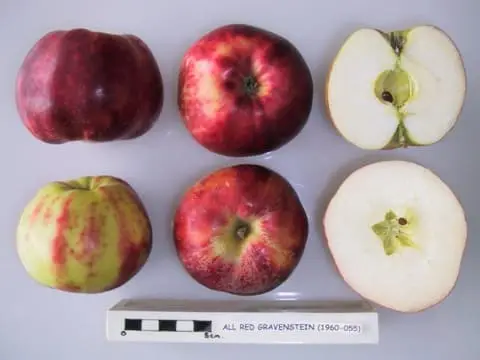
All-Red Gravenstein
-
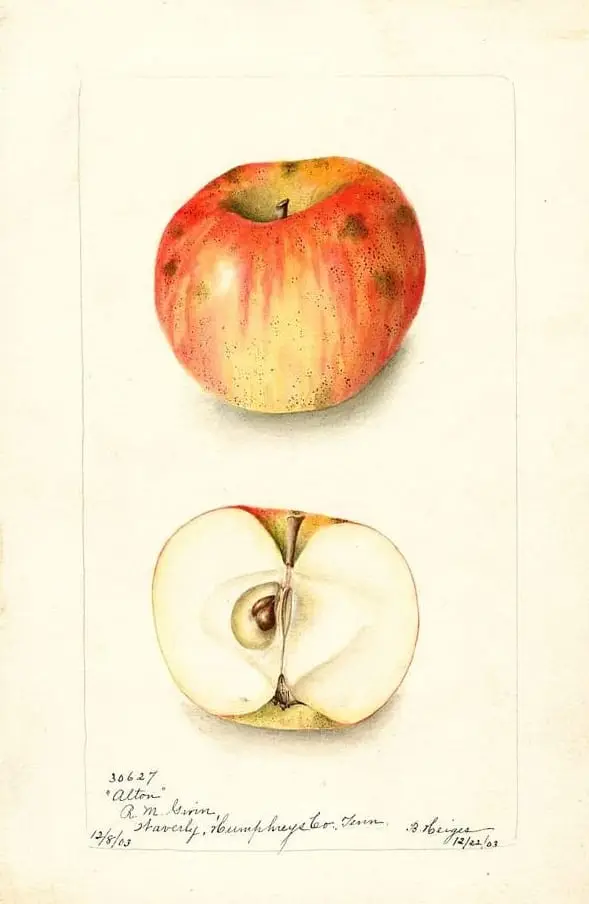
Alton
-
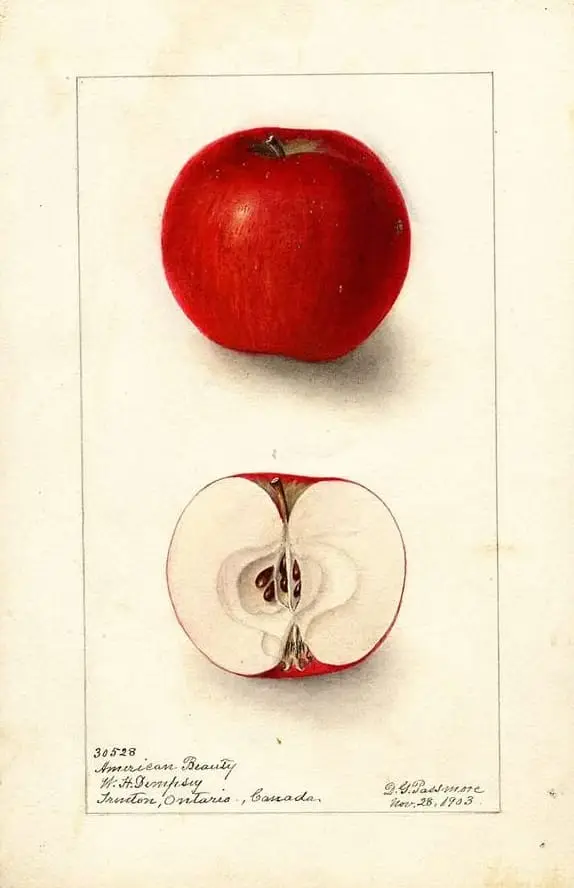
American Beauty
-
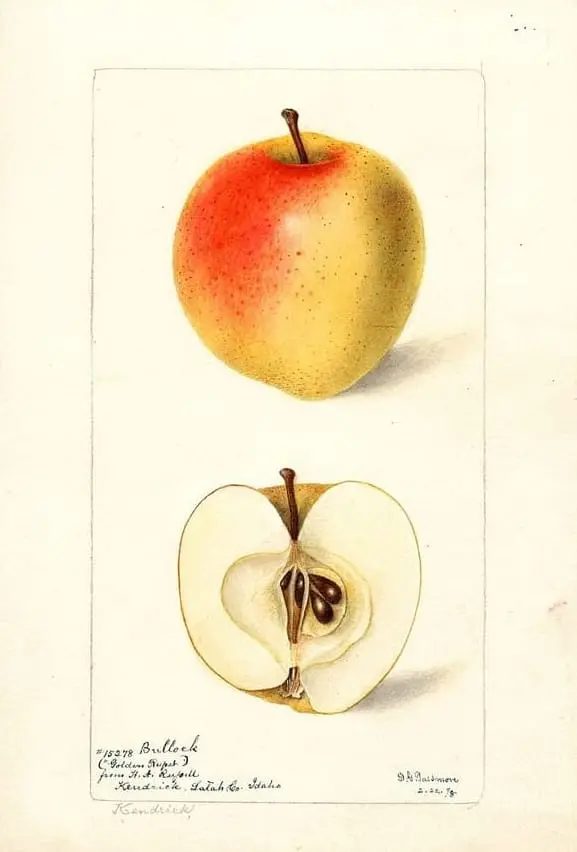
American Golden Russet
A small New Jersey russet whose flesh Downing likened to a buttery pear; Coxe knew it in 1817 as Sheep-nose
-
American Grindling
-
American Summer Pearmain
-
Ames
-
Arkansas