Apple varieties, United States
Yellow Bellflower
In 1817 the most popular apple in the Philadelphia market, it came from near Crosswicks, New Jersey
History
William Coxe described the Bell-flower in 1817 as “a remarkably large, beautiful and excellent apple” for both dessert and cooking, and wrote that its original tree, “very large and old”, was said to be still standing on a farm near Crosswicks in Burlington County, New Jersey1. For its beauty and quality, he said, it was “the most popular apple in the Philadelphia market”1. Downing also found it most plentiful in the Philadelphia markets, and well suited to the sandy soils of New Jersey3.
In 1852 Hovey found it widely grown in New Jersey but still rare in New England2. In New York it had been grafted into farm orchards for a century or more by 1905, and was known in most of the state, though nowhere grown on a large scale; it had spread early through the Middle West, and had lately become an important commercial apple in parts of the Pacific states2. In 1928 American commercial orchards held an estimated 296,000 trees of it, 0.4 per cent of the total, a number that had moderately decreased by 19415. In 1941 it and Yellow Newtown were the two leading varieties in the coastal district around Watsonville, south of San Francisco5.
SNP data published in 2025 identify Yellow Bellflower and Smith’s Cider as the parents of Fåremule, an apple of the Danish heritage collection6.
The fruit
The fruit is large or very large, though variable in size, and oblong, often ribbed, narrowing to the eye and ridged around it1,2. The smooth skin is pale lemon yellow, sometimes with a pinkish-red blush on the sunny side, and grows clearer yellow in store2,3. The core is large; Coxe noted that the big seeds lie in a cavity so roomy that they can be heard when the apple is shaken1,2. The flesh is whitish tinged with yellow, firm, crisp, moderately fine-grained, tender, juicy and aromatic, rather acid early in the season but milder later2,3.
Coxe found that it ripened late in October, when its weight brought it down in windy weather1. At Geneva, New York, it lasted from December to April, January or February being the commercial limit2. At Brogdale, Kent, it begins to flower around 4 May and is picked in early October7.
Growing
The tree grows very large and spreading, and Coxe advised training it high so that the laden limbs would not touch the ground1. Warder found it remarkably hardy and successful almost everywhere, best flavoured on exposed ridges of thin soil; on rich bottomland it was slow to bear, and its large, exposed blossoms were often killed by spring frosts4. Beach found it healthy and long-lived on warm, well-drained soils, but quite susceptible to scab2. It is diploid6.
Uses
Warder thought it “one of the finest culinary apples in the catalogue”4. Beach found it highly esteemed both for cooking and for dessert, though too brisk for some tastes before January2.
Where the sources disagree
- Cropping. Downing called it “a regular and excellent bearer”3; Beach found it not generally a satisfactory cropper in New York, and Warder that its crops on rich low ground were not always satisfactory2,4.
- Keeping. Coxe said that carefully picked fruit kept “in high perfection” until late spring1; Beach reported that some growers did not think it a good keeper, while others found that it kept pretty well2.
Sources
- A View of the Cultivation of Fruit Trees, pp. 120–121: Bell-flower, William Coxe, M. Carey and Son, Philadelphia, Internet Archive, 1817. Supports: "A remarkably large, beautiful and excellent apple, both for the dessert and for cooking"; pale but bright yellow, the cheek next the sun sometimes blushed but more often without red; oblong, somewhat pointed at the blossom end; flesh rich, juicy, tender and sprightly; large seeds in a seed cavity of unusual size that "if shaken can be distinctly heard"; ripening late in October, when its weight makes it fall in windy weather; carefully picked, keeping "in high perfection" through the winter till late spring; "the most popular apple in the Philadelphia market"; the tree very large and spreading, to be trained high or its limbs will touch the ground in full bearing; best on light rich soils; "The original tree is said to be now standing on a farm near Crosswicks, Burlington county, N. Jersey, very large and old".
- The Apples of New York, vol. I, pp. 381–383: Yellow Bellflower, S. A. Beach, New York Agricultural Experiment Station, Internet Archive, 1905. Supports: the synonyms, among them Bellflower, Belle Fleur, Gelber Bellefleur, Lady Washington, Lincoln Pippin, Metzger Calvill, Warren Pippin and Weisser Metzgerapfel (p. 381); large or very large but variable in size; colour improving in storage; highly esteemed for cooking and for its excellent dessert qualities, though too briskly subacid for some early in the season and at its best for dessert from January; quite susceptible to scab; some not regarding it as a good keeper while others found it kept pretty well; at Geneva in season from December to April, with January or February the commercial limit; in cold storage keeping about as long as Tompkins King but not as well as Rhode Island Greening; a good grower, pretty hardy, healthy and long-lived in favourable places, thriving on warm, well-drained soils; not generally a satisfactory cropper in New York; Coxe's report of the original tree near Crosswicks; Hovey's remark in 1852 that it was extensively grown in New Jersey but little in New England; grafted into farm orchards and grown in nurseries throughout New York a century or more before 1905, and known in most parts of the state but nowhere extensively grown; early introduced through the Middle West and lately an important commercial variety in certain districts of the Pacific states (p. 382); fruit roundish oblong to oblong conic, often ribbed with prominent ridges at the apex; skin smooth, pale lemon yellow, whitish in the shade, sometimes with a pinkish-red blush; core large and remarkably abaxile; flesh whitish tinged with pale yellow, firm, crisp, moderately fine-grained, rather tender, juicy, aromatic, "very good for culinary use" (p. 383).
- The Fruits and Fruit Trees of America, pp. 418–419: Yellow Bellflower, A. J. Downing, revised by Charles Downing, John Wiley & Sons, Internet Archive, 1900. Supports: the synonyms Bellefleur Yellow, Belle Fleur, Bishop's Pippin of Nova Scotia, Lady Washington, Reinette Musquée and Warren Pippin; "everywhere highly esteemed in the United States"; most abundant in the markets of Philadelphia, thriving in the sandy soils of New Jersey; first described by Coxe, the original tree growing in Burlington, New Jersey; "A regular and excellent bearer"; fruit very large, oblong, pale lemon yellow, often with a blush next the sun; flesh tender, juicy, crisp, sprightly subacid, considerably acid before fully ripe.
- American Pomology: Apples, pp. 692–693: Yellow Bellflower, J. A. Warder, Orange Judd, Internet Archive, 1867. Supports: "This noble and valuable constituent of our orchards" from Burlington County, New Jersey, first described by Coxe; successful in almost all parts of the country, North and South, and "remarkably hardy"; best flavoured and coloured on exposed ridges of rather thin soil, while on rich low bottoms or prairies slow to bear, with very large fruit and crops not always satisfactory; the blossoms often destroyed by spring frosts, being very large, on long stems and not protected by the leaves; use table, kitchen and market; "One of the finest culinary apples in the catalogue".
- Apple Varieties and Important Producing Sections of the United States (Farmers' Bulletin 1883), pp. 19–21, J. R. Magness, U.S. Department of Agriculture, Internet Archive, 1941. Supports: the coastal district around Watsonville, south of San Francisco, with "Yellow Newtown and Yellow Bellflower the two leading varieties" (p. 19); Table 1 (p. 21): an estimated 296,000 Yellow Bellflower trees in US commercial orchards in 1928, 0.4 per cent of the total, with a moderate decrease since.
- Cultivar fingerprinting and SNP-based pedigree reconstruction in Danish heritage apple cultivars utilizing genotypic data from multiple germplasm collections in the world, Bjarne Larsen and others, Genetic Resources and Crop Evolution 72: 2397, supplementary Table S5, 2025. Supports: Yellow Bellflower and Smith's Cider the SNP-identified parents of Fåremule, an accession of the Danish heritage collection at the Pometum, University of Copenhagen; Yellow Bellflower diploid.
- Yellow Bellflower (accession 1953-140), National Fruit Collection, Brogdale, Kent (Defra). Supports: "Originated near Crosswicks, Burlington County, New Jersey, U.S.A. It was old in 1817."; all the synonyms given above, taken from its longer list; 10% flowering on 4 May and picking in early October at the collection.
More from United States
-
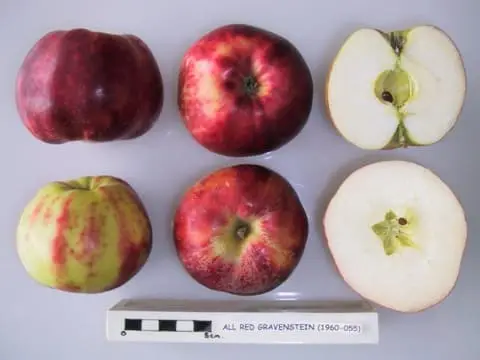
All-Red Gravenstein
-
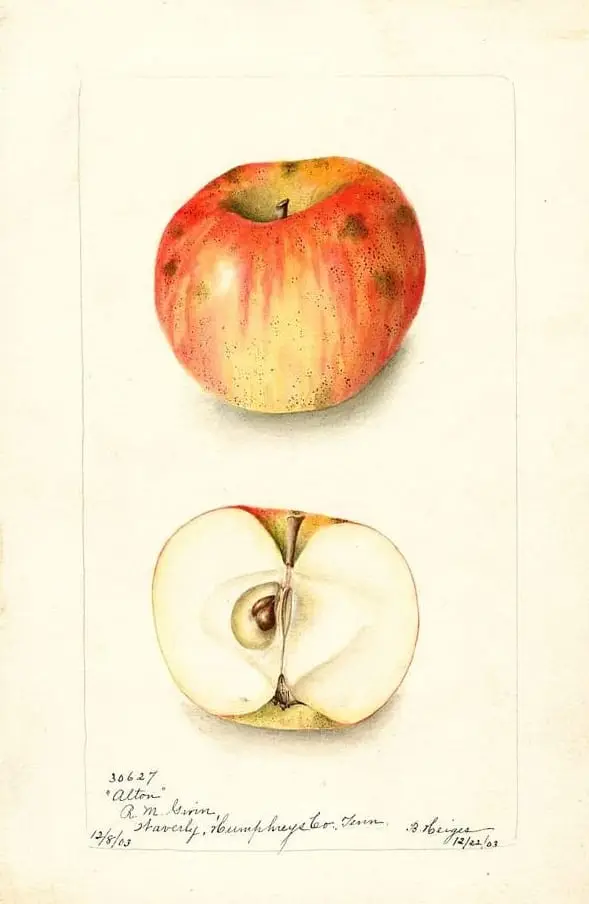
Alton
-
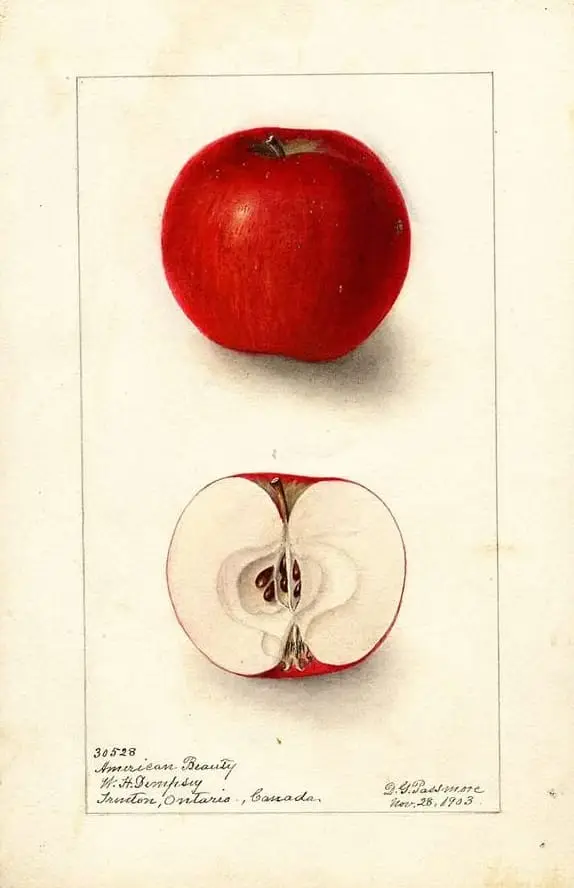
American Beauty
-
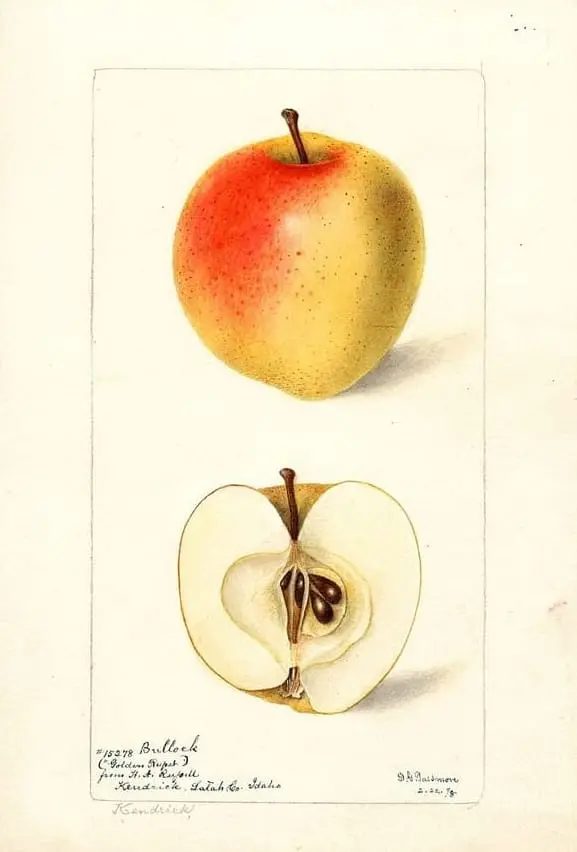
American Golden Russet
A small New Jersey russet whose flesh Downing likened to a buttery pear; Coxe knew it in 1817 as Sheep-nose
-
American Grindling
-
American Summer Pearmain
-
Ames
-
Arkansas