Spartan
Bred at Summerland from a 1926 cross; "probably the most important apple variety introduced ever in British Columbia"
History
Spartan came from a breeding project begun in 1926 at the Dominion Experimental Station at Summerland, British Columbia, which set out to raise apples with the good tree and fruit of McIntosh but with better handling, a later harvest and longer storage life1. R. C. Palmer made the cross in 1926, recorded as McIntosh pollinated by Newtown1,2,3. The original tree was planted in November 1928 and first fruited in 19321, and A. J. Mann selected it in 19342. It was named in 1936, “because of the robust nature of the tree and the good handling characteristics of the fruit”, and released that year for limited commercial trial1,2.
The station’s history calls Spartan “probably the most important apple variety introduced ever in British Columbia”, and says the hope was that it would combine the hardiness and quality of McIntosh, the vigour and productivity of Delicious and the long storage life of Newtown2. By 1948 it was being planted in Okanagan Valley orchards, chiefly because it ripened two to three weeks after McIntosh and so lengthened the picking and packing season1.
SNP data published in 2025 confirm McIntosh as one parent but identify the other as Delicious, not Newtown4.
In the 2025/26 forecasts Spartan was the smallest of the nine named varieties in the Canadian table, nearly all of it expected from British Columbia, and the US industry expected about four times as much, mostly from New York5.
The fruit
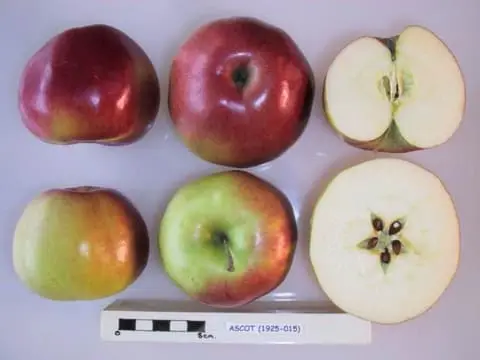
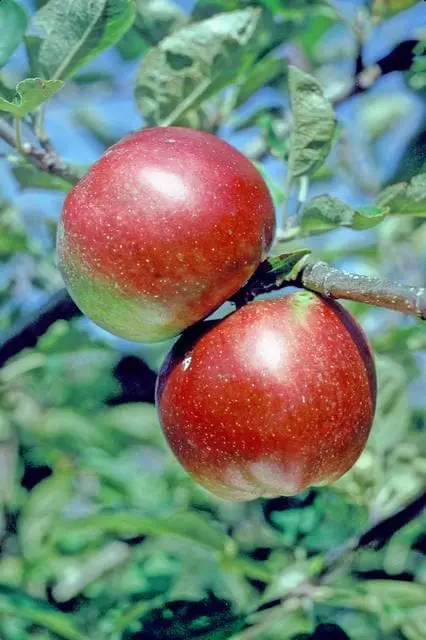
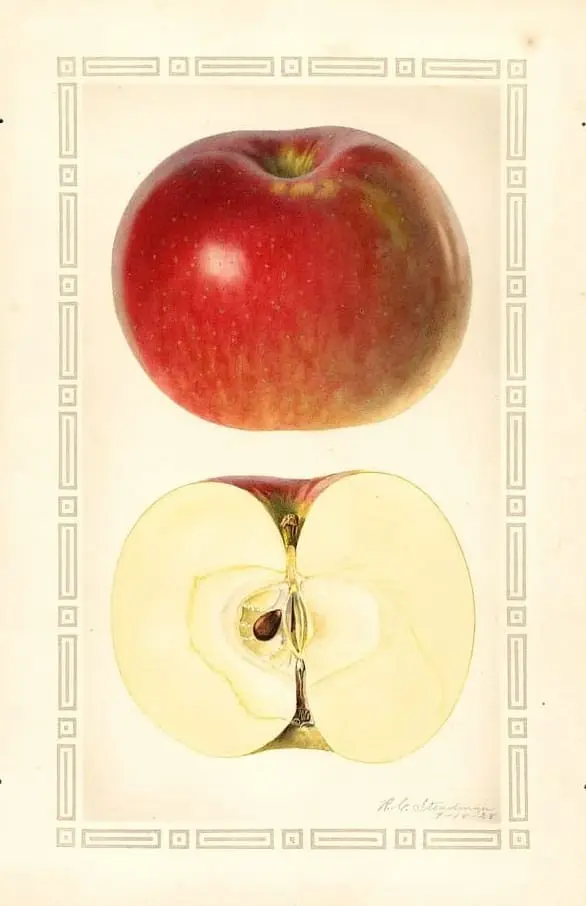
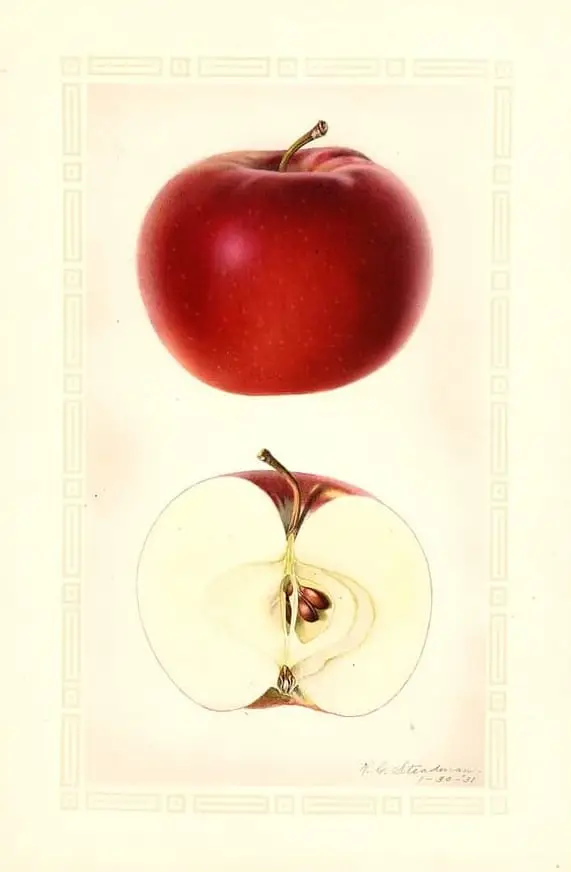
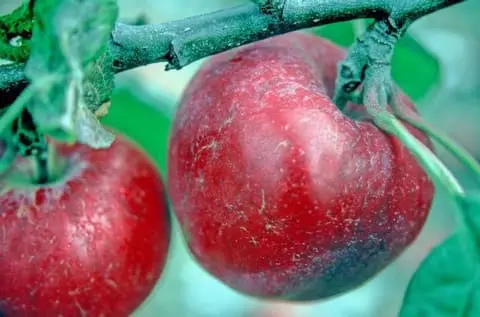
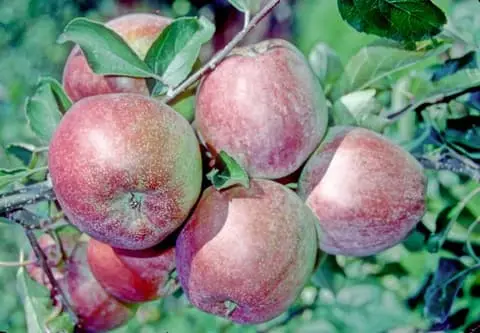
Mann and Keane described a fruit like McIntosh in size, shape and quality but darker red, its skin taking on a solid dark red blush even before the fruit is ready to pick1. The National Fruit Collection records a yellow ground almost entirely flushed deep purplish red, with indistinct stripes3. The white flesh is firm, crisp and juicy1,3, with a refreshing, vinous flavour3, and the core is smaller than McIntosh’s1. Its short stalk tends to puncture the skin, as McIntosh’s does, but the skin is comparatively thick, so the fruit handles well1.
In common storage Spartan lasted a little longer than McIntosh; stored promptly at −0.6 °C (31 °F), it kept well until early February, and it shrivelled and suffered core flush less than McIntosh1. Breakdown in storage later became a problem, and the Summerland station’s research led Okanagan packinghouses to treat Spartans meant for long storage with calcium chloride after harvest2. At the National Fruit Collection in Kent it is picked in early October3.
Growing
In 1948 Spartan seemed about as hardy as McIntosh, though it had not yet met a really severe winter1. The tree is of the McIntosh type, with a strong framework and a large bearing area, and the original tree bore a fairly heavy crop every year from 19321. Spartan and McIntosh pollinate each other well1. Spartan is diploid4.
Uses
Spartan is a dessert apple3. On average in 2020–2024, 90 per cent of the US crop was sold fresh5.
Where the sources disagree
Family tree
Parents, grandparents and great-grandparents, as the entries in the atlas record them.
Offspring in the atlas
- Nova Easygro × Scab Resistant seedling; Canada, 1956
Sources
- The Spartan and Jubilee Apples, A. J. Mann and F. W. L. Keane, Dominion Experimental Station, Summerland; Fruit Varieties and Horticultural Digest 3(1): 13–14, American Pomological Society, 1948. Supports: a breeding project begun at the Summerland Experimental Station in 1926 to originate apples with "the good tree and fruit characteristics of McIntosh but with better handling qualities, later harvesting season and longer storage life"; Spartan "a seedling of McIntosh crossed by Newtown"; crosses made in 1926 and original trees planted in November 1928; about as hardy as McIntosh but not yet tested by a really severe winter; first fruit in 1932 and a fairly consistently heavy crop every year since; named in 1936 "because of the robust nature of the tree and the good handling characteristics of the fruit"; a tree of McIntosh type with a strong framework and an extensive bearing area; fruit like McIntosh in size, shape and quality but darker red, the skin taking a solid dark red blush before the fruit is ready to harvest; flesh white, firm, crisp and juicy; core smaller than McIntosh's; a short stem that tends to puncture the skin, but a comparatively thick skin and good handling; slightly longer life than McIntosh in common storage, keeping well until early February at 31 °F if stored promptly, with less shrivelling and core flush than McIntosh; a good pollinizer for McIntosh and pollinized by it; planted in Okanagan orchards because it matures two to three weeks after McIntosh, extending the harvesting and packing season.
- Summerland Research Station, 1914–1985, pp. 30 and 51, W. W. Fleming, Research Branch, Agriculture Canada, Historical Series No. 34; Government of Canada Publications, 1986. Supports: p. 30: "Probably the most important apple variety introduced ever in British Columbia is Spartan"; introduced in 1936 for limited commercial trial; a hybrid of McIntosh × Newtown made in 1926 by Palmer and selected in 1934 by Mann; hoped to combine the hardiness and high quality of McIntosh, the vigour and productivity of Delicious and the long storage life of Newtown; p. 51: Spartan breakdown in storage had become a problem, and post-harvest treatment with calcium chloride for Spartans destined for long-term storage became common practice in Okanagan packinghouses as a result of the station's work.
- Spartan (accession 1974-252), National Fruit Collection, Brogdale, Kent (Defra). Supports: raised in 1926 by R. C. Palmer at the Dominion Experiment Station, Summerland, British Columbia, and introduced in 1936; parentage "McIntosh x Yellow Newtown Pippin"; dessert apple; firm, crisp, fine-textured, juicy flesh with "a refreshing vinous flavour"; yellow ground almost completely flushed deep purplish red with indistinct stripes; flesh very white; picking in early October at Brogdale.
- Cultivar fingerprinting and SNP-based pedigree reconstruction in Danish heritage apple cultivars utilizing genotypic data from multiple germplasm collections in the world, Bjarne Larsen and others, Genetic Resources and Crop Evolution 72: 2397, with supplementary Table S5, 2025. Supports: Table S5: Spartan (MUNQ 309) diploid, with McIntosh (parent 1) and Delicious (parent 2) identified from SNP data.
- Industry Outlook 2025, Christopher Gerlach, U.S. Apple Association, 2025. Supports: Table 15 (Fruit & Vegetable Growers of Canada, 2025/26 forecast): Spartan 154,597 bushels in Canada, the smallest of the nine named varieties, with 145,000 in British Columbia; Table 6: Spartan 620,753 bushels in the US 2025/26 forecast; Table 7: 500,229 of them from New York; Table 9: 90% fresh and 10% processing, 2020–2024 average.