Ambrosia
A seedling that came up by chance in a Cawston orchard about 1987; fourth in Canada's 2025/26 apple forecast
History
Ambrosia began as a self-sown seedling on the farm of Wilfrid and Sally Mennell, fruit growers at Cawston in the interior of British Columbia1,3. In 1987 they replanted a block of mixed apple and plum trees with Jonagold; a stray seed sprouted among the young trees about then, and it escaped the mower only because it stood in line with the new row3. The patent says the block had been planted to Golden Delicious and Starking Delicious, which may be its parents; its parentage is unknown1.
The tree first fruited in 1990, and the pickers ate every apple, that year and the next3. The Mennells named it after the food of the gods in Greek mythology3. Family trials were planted in 1994 and growers tested it at sites in British Columbia1, with the Okanagan Plant Improvement Corporation (PICO) of Summerland, newly founded to license fruit varieties, as its sponsor3. Canadian plant breeders’ rights, applied for in March 1994, were granted in August 1997 for a term ending in August 20152, and a US plant patent followed in February 19991.
When packers in British Columbia hesitated over the first shipments in the late 1990s, growers formed the New Varieties Development Council and paid a voluntary levy of a dollar a carton to promote it3. By 2012 any Canadian grower could plant it for a royalty per tree, and PICO had licensed it to groups in the United States, New Zealand, Chile and the European Union3.
In the Canadian growers’ forecast for 2025/26 it was the fourth named variety, after Gala, McIntosh and Honeycrisp; half was expected from British Columbia, where only Gala was larger, and most of the rest from Ontario4. In the US industry’s forecast it made up 1 per cent of the crop, three-quarters of it from Washington4.
The fruit
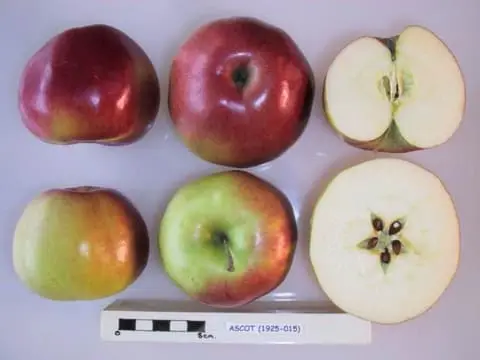
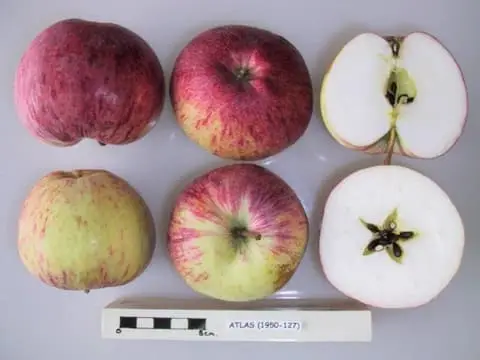
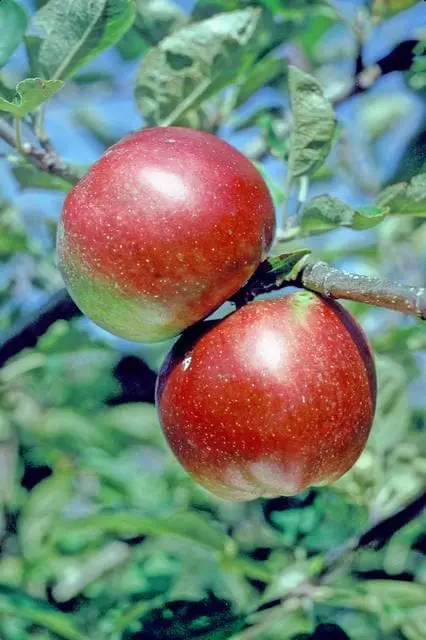
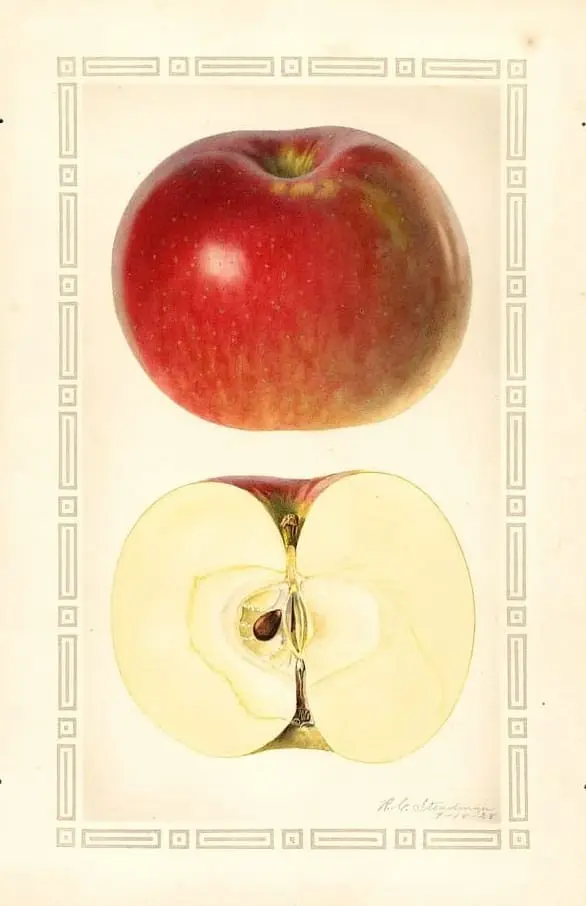
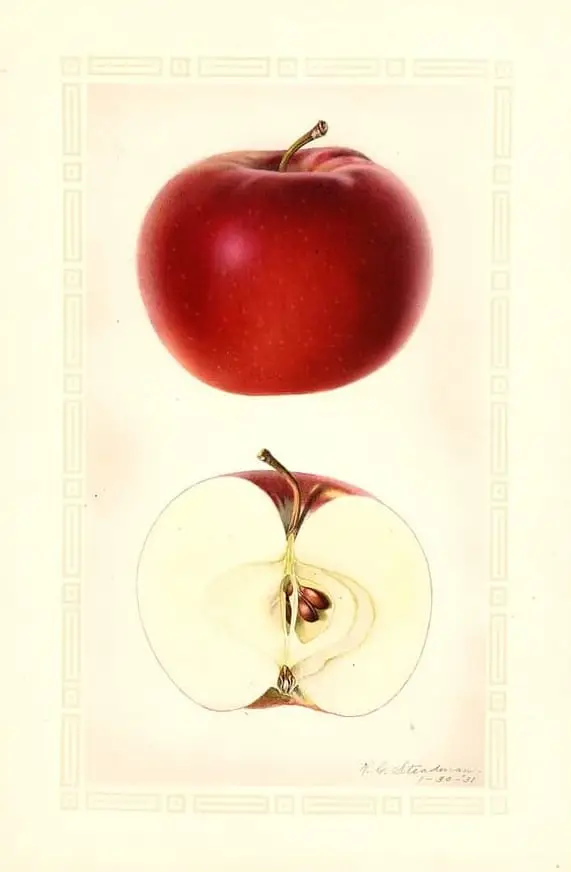
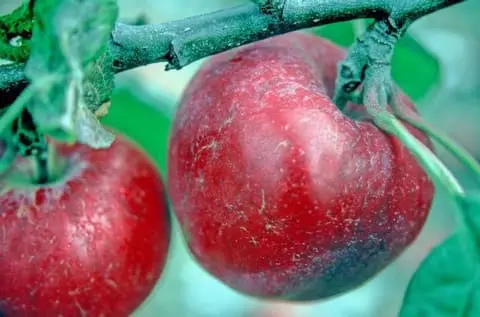
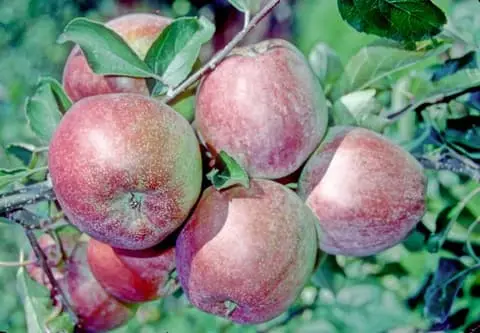
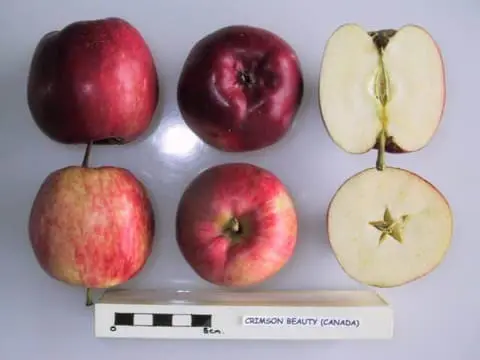
The fruit is medium to large, averaging 210 to 220 grams, and conical and angular in shape1. Its smooth, very glossy skin carries a bright red blush with broad, faint stripes over 70 to 90 per cent of a cream to yellow ground, without russet1. The cream flesh is firm, crisp and juicy, very sweet and subacid, with a distinct fruity aroma, and shows little browning an hour after cutting1.
At Cawston it ripens in the third week of September, about the same time as Jonagold1. In storage trials by Okanagan Federated Shippers it kept four months in air and six in controlled atmosphere1.
Growing
The tree is vigorous and upright-spreading, and bears on spurs rather than at the tips of its shoots1. It starts to crop in its second or third year and bears moderate to heavy crops every year1. In the breeders’ trials it resisted mildew better than the commercial varieties it was compared with, and showed no unusual susceptibility to fire blight or scab1.
Uses
Ambrosia is a dessert apple1. On average in 2020–2024, 83 per cent of the US crop was sold fresh4.
Where the sources disagree
- When it was first propagated. The patent says Wilfrid Mennell budded the seedling in 19901; the Country Guide account has it first fruiting in 1990 and budded, by Wilfrid and his brother Robert, only after its second crop3.
- When rights were sought. The Country Guide dates the registration for plant breeders’ rights to 19933; the Canadian record gives an application date of 21 March 19942.
Sources
- Apple tree named 'Ambrosia' (US Plant Patent PP10,789), Wilfrid John Mennell and Sally Beth Mennell, assigned to Okanagan Plant Improvement Co. Ltd; Google Patents, 1999-02-16. Supports: filed on 19 June 1997 and granted on 16 February 1999; a chance seedling "of unknown parentage" discovered and evaluated by Wilfrid Mennell in the cultivated orchard of Sally Mennell at Cawston, British Columbia, found in "a cultivated plum orchard previously planted to 'Golden Delicious' and 'Starking Delicious'", which it "may be the result of"; budded by Wilfrid Mennell in 1990; family trials planted in 1994 and grower test sites in British Columbia and at the Okanagan Plant Improvement Co. test orchard at Oliver; maturing about 16 to 21 September at Cawston, about with Jonagold; dessert class; fruit medium to large, 210–220 g, conical and angular; smooth, very glossy skin with a 70–90% bright red blush and broad faint stripes on a cream to yellow ground, no russet; cream, firm, crisp, juicy flesh, very sweet and subacid, with a distinct fruity aroma; weak browning one hour after cutting; storage trials by Okanagan Federated Shippers, 4 months in air and 6 in controlled atmosphere; tree vigorous, upright-spreading, spur-bearing, not a tip bearer, cropping from the second or third year with moderate to heavy crops annually; more resistant to mildew than the commercial reference varieties, no unusual susceptibility to fire blight or scab.
- Plant breeders' rights crop report: Apple, 'Ambrosia', Canadian Food Inspection Agency; copy archived by Library and Archives Canada, 2011. Supports: denomination 'Ambrosia'; applicants, holders and breeders Wilfrid and Sally Mennell of Cawston, British Columbia; agent the Okanagan Plant Improvement Corporation (PICO), Summerland; application no. 94-332 dated 21 March 1994; rights granted on 20 August 1997 (certificate 0388), with a termination date of 20 August 2015.
- The apple from heaven, Madeleine Baerg, Country Guide; Internet Archive copy, 2012-10-17. Supports: the Mennells, longtime apple producers in the British Columbia interior; in 1987 they replaced a block of mixed apple and plum trees with Jonagold, and about then a seed sprouted unnoticed among the new trees, spared because it stood in line with the new row; first fruit in 1990, eaten by the pickers that year and the next; budding by Wilfrid and his brother Robert in Robert's nursery; named after the food of the gods in Greek mythology; PICO, newly founded at Summerland to license new fruit varieties, as its sponsor, facilitating registration for plant breeders' rights in 1993; sales to the local organic market by the early 1990s; reluctance of British Columbia packers and marketers in the late 1990s, the growers' New Varieties Development Council and their voluntary levy of a dollar per 40-lb carton; general release in Canada with a tree-based royalty and sublicences to groups in the US, New Zealand, Chile and the EU (2012).
- Industry Outlook 2025, Christopher Gerlach, U.S. Apple Association, 2025. Supports: Table 15 (Fruit & Vegetable Growers of Canada, 2025/26 forecast): Ambrosia 3,001,542 bushels in Canada, fourth among named varieties after Gala, McIntosh and Honeycrisp, with 1,500,000 in British Columbia (where Gala has 1,680,000 and no other variety more than 200,000) and 1,255,000 in Ontario; Table 6: Ambrosia 2,676,385 bushels, 1% of US production in the 2025/26 forecast; Table 7: 2,007,831 of them from Washington; Table 9: 83% fresh and 17% processing, 2020–2024 average.