Braeburn
A Nelson chance seedling grown commercially from 1952; DNA names Delicious and Sturmer Pippin as its parents
History
Braeburn began as a chance seedling2,4. The National Fruit Collection records that it was found on the property of O. Moran at Waiwhero, Upper Moutere, and first grown commercially in 1952 at the Braeburn orchard in Upper Moutere1; Te Ara speaks of “a chance seedling growing in a hedgerow in the Braeburn area of Nelson in the 1950s”2. A small group of Nelson growers took it up, and it was widely planted from the late 1980s into the early 1990s2. By the early 2000s Braeburn and the red sport of Gala made up about 77 per cent of New Zealand’s apple production, and a cross between the two, made in 1984–85, had given Scifresh2. In 2025 Braeburn made up 2.9 per cent of New Zealand’s apple exports, and between 2022 and 2025 the combined planted area of Braeburn, Cripps Pink and Scifresh shrank by a third7,2.
Its parentage has been revised by DNA4,5. The National Fruit Collection records it as a seedling of Lady Hamilton1. In 1996 Gardiner and colleagues compared Braeburn with 15 other cultivars using isozyme, RAPD and RFLP markers; they showed that Lady Hamilton was not the same apple, excluded every other cultivar tested as a parent, and judged it highly likely that Lady Hamilton was one3. A 2020 study of genome-wide SNP data instead inferred Delicious and Sturmer Pippin as Braeburn’s parents4, and a 2025 pedigree study gives the same pair5. Lady Hamilton was not genotyped on the SNP array, but SSR markers suggested that it came from the same cross, which would make it Braeburn’s full sibling4.
The fruit
The fruit is medium-sized and broadly rounded-conical, about 55 mm high and 68 mm wide1. The skin is greenish yellow under an orange flush, striped or solid, with little russet1. The cream-coloured flesh is crisp, firm and rather coarse, with a perfumed flavour1.
Growing
At Brogdale, Kent, Braeburn flowers late, starting around 14 May, and is picked in late October, but the fruit usually fails to mature fully in Britain1. In store it is subject to Braeburn browning disorder, a disorder brought on by carbon dioxide6. A 1999 study found that the disorder varied widely between districts and orchard blocks and was commoner in late-picked fruit and in fruit from lightly cropping trees; its authors advised keeping fruit from susceptible orchards out of controlled-atmosphere storage and managing crop load to curb biennial bearing6. Braeburn is diploid4,5.
Uses
Braeburn is a dessert apple1.
Where the sources disagree
- Parents. The National Fruit Collection records Lady Hamilton and an unknown second parent1, and the 1996 marker study pointed to Lady Hamilton3. Two SNP studies name Delicious and Sturmer Pippin instead and make Lady Hamilton a probable full sibling4,5. The 2020 study rested on some 253,000 SNPs4, the 1996 study on 41 RFLP probe–enzyme combinations and 39 RAPD primers3.
Family tree
Parents, grandparents and great-grandparents, as the entries in the atlas record them.
- Braeburn New Zealand, by 1952
- Parent Delicious United States, 1872
- Parent Winesap United States, by 1817
- Parent Sturmer Pippin United Kingdom, by 1831
- Pollen parent Nonpareil France, by the mid 1500s
- Parent Delicious United States, 1872
Offspring in the atlas
Sources
- Braeburn (accession 1974-357), National Fruit Collection, Brogdale, Kent (Defra). Supports: "Discovered on the property of O.Moran, Waiwhero, Upper Moutere, New Zealand" and "first grown commercially by William Bros. at Braeburn orchard, Upper Moutere in 1952"; crisp, firm flesh "with a perfumed flavour", though fruits "usually fail to mature fully in the U.K."; synonym Breaburn; parentage "Lady Hamilton x Unknown"; a dessert apple of medium size, broad globose conical, 55.43 mm high and 67.64 mm wide; green-yellow ground with an orange over colour, striped or solid flush; low russet; cream, coarse flesh; 10% flowering on 14 May and picking in late October at Brogdale.
- Apples and pears, John Palmer, Te Ara – the Encyclopedia of New Zealand (Ministry for Culture and Heritage); archived copy, Internet Archive, 2008-11-24. Supports: Braeburn "a chance seedling growing in a hedgerow in the Braeburn area of Nelson in the 1950s", championed by a small group of Nelson growers and widely planted in the late 1980s and early 1990s; Braeburn and the red sport of Gala "about 77%" of New Zealand's apple production in the early 2000s; Scifresh selected from a cross of the two made in 1984–85 by Allan White of HortResearch; Scifresh fruit sold under a trade mark (which identifies the third variety in source 7).
- Isozyme, randomly amplified polymorphic DNA (RAPD), and restriction fragment-length polymorphism (RFLP) markers used to deduce a putative parent for the 'Braeburn' apple, S. E. Gardiner, H. C. M. Bassett, C. Madie and D. A. M. Noiton, Journal of the American Society for Horticultural Science 121(6): 996–1001 (abstract, via Crossref), 1996-11. Supports: Braeburn and 15 cultivars compared by RFLP (41 probe-enzyme combinations) and RAPD (39 primers), chosen with the help of a rare isozyme allele and historical information; the proposal that Lady Hamilton and Braeburn are genetically identical excluded; all cultivars except Lady Hamilton excluded as parents; "a high likelihood that 'Lady Hamilton' is one of the parents of 'Braeburn'".
- Using whole-genome SNP data to reconstruct a large multi-generation pedigree in apple germplasm, Hélène Muranty and others, BMC Plant Biology 20: 2, with Additional files 1 and 3, 2020. Supports: genotyping on the Axiom Apple480K array, with a set of 253K SNPs used in the analysis; Braeburn, "initially discovered as a chance seedling", long hypothesised to be an offspring of Lady Hamilton; Delicious and Sturmer's Pippin inferred as its parents (Table S3: a trio with 23 Mendelian errors, below the threshold of 600; the literature parent Lady Hamilton not confirmed; dates consistent); Lady Hamilton not genotyped with the 480K array, but SSR data indicating it "most probably derives from the same cross", which "would make it a full-sib of 'Braeburn'"; Braeburn diploid, dated 1952 (Table S1).
- Cultivar fingerprinting and SNP-based pedigree reconstruction in Danish heritage apple cultivars utilizing genotypic data from multiple germplasm collections in the world, Bjarne Larsen and others, Genetic Resources and Crop Evolution 72: 2397, with supplementary Table S5, 2025. Supports: Table S5: Braeburn's SNP-confirmed parents Sturmer Pippin and Delicious; Braeburn diploid.
- Harvest date and crop load effects on a carbon dioxide-related storage injury of 'Braeburn' apple, H. John Elgar, Nagin Lallu and Christopher B. Watkins, HortScience 34(2): 305–309 (abstract, via Crossref), 1999-04. Supports: "Braeburn browning disorder", a CO2-induced disorder of Braeburn whose incidence and severity "vary markedly with production district and orchard block"; higher incidence in late-harvested fruit and in fruit from lightly cropping trees; fruit from orchards with a history of the disorder to be segregated and not held in controlled-atmosphere storage; crop load to be managed "to reduce the occurrence of biennial bearing".
- Fresh Facts 2025, pp. 16–17: Sector profile – apples, United Fresh New Zealand, 2025. Supports: "New Zealand Apple Exports by Variety 2025", from Stats NZ harmonised export data accessed on 19 August 2025: Braeburn 2.9%; "Between 2022 and 2025, the total planted area of Braeburn, Cripps Pink" and a third variety, listed under its trade mark, "declined by one-third" (citing the Ministry for Primary Industries' Situation and Outlook for Primary Industries, June 2025).
More from New Zealand
-
Captain Kidd
-
Cox's Early Export
-
Dillington Beauty
-
Freyberg
-
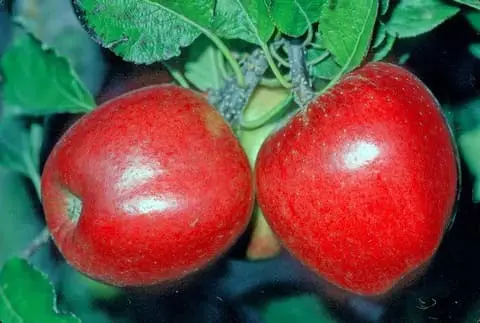
Gala
Raised by J. H. Kidd at Greytown, New Zealand, about 1934 from Kidd's Orange Red and Golden Delicious
-
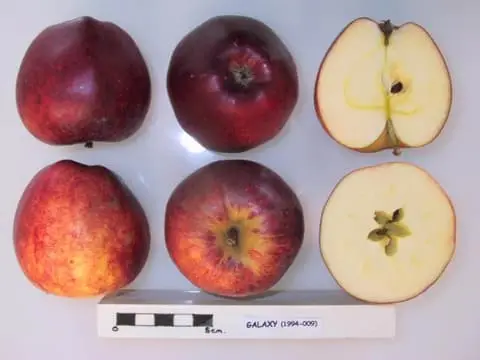
Galaxy
-
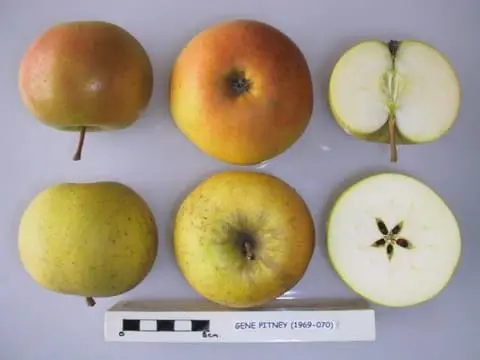
Gene Pitney
-
Hidala