Nicoter
Crossed at Sint-Truiden, Belgium, in May 1993 from Gala and Braeburn; its variety rights reached the EU Court of Justice
History
Nicoter was bred by Johan Nicolaï at Sint-Truiden, in Belgium, from a controlled cross between Gala, the seed parent, and Braeburn, made in May 19931,2. The seeds germinated in March 1994 at the University of Leuven, and the seedlings were grafted that winter1. After a year in the Nicolaï nursery the young trees were planted in a screening plot at Fernelmont in 1996, and when this one first fruited, in September 1997, it was chosen for further trials1. Trees planted at Sint-Truiden in 1997–98 were observed from 2000 to 2003, and it was then finally selected for its fruit quality, keeping and appearance1. Better3fruit applied for a United States patent in 2002, granted in 2006, and holds Canadian rights that run to 20411,2.
By 2011 Better3fruit held both the variety rights and the trade mark Kanzi, under which the fruit is sold, and kept “a strict distribution system” to protect them4. In 2003 it gave the Nicolaï nursery the exclusive right to grow and sell Nicoter trees, on condition that each sale came with a grower’s or marketing licence; in 2004 the nursery nevertheless sold trees to a grower who had signed none4. The exclusive rights passed to another licensee in 2005, which sued for infringement when fruit from those trees was found on sale in 20074. The Court of Justice of the European Union ruled in 2011 that such a licensee may sue if the terms that were broken relate directly to the essential features of the variety right, and that it does not matter whether the alleged infringer knew of them4.
In 2019 Sansavini and Gregori counted Nicoter among Italy’s club varieties, whose managers plan each year’s plantings and bind nurseries and growers by contract; they called it the most successful new Belgian variety in Europe5. In South Tyrol it covered 690 hectares in 2024 and 745 in 2025, about 4 per cent of the province’s apple and pear orchards6.
The fruit
The patent describes fruit resembling Gala’s but less conical, and “more pink and less red”: about 201 g, 66 mm high and 73 mm wide, short globose-conical, with a red flush on a yellow ground, small white lenticels and yellow flesh2. The National Fruit Collection’s record adds that it has no ribs, very little russet and firm flesh3. In Canadian trials it showed a large pink-red flush on a green ground and cream flesh1. It is a dessert apple for the fresh market; it does not bruise easily and keeps for up to ten months in ultra-low-oxygen storage at 1 °C, with 2 per cent oxygen and 2 per cent carbon dioxide2.
Growing
The tree is of medium vigour and spreading, and bears on spurs1,2. It begins to flower at about the same time as Cox’s Orange Pippin, and the patent lists Everest, Professor Sprenger, Golden Hornet, Idared and Granny Smith as pollinators2. It is susceptible to scab, came through the winters of north-western Europe and the Alps without trouble, and tolerates heat and drought well, though its fruit takes on a yellow blush in hot, dry climates2.
Where the sources disagree
Family tree
Parents, grandparents and great-grandparents, as the entries in the atlas record them.
- Nicoter Belgium, 1993
- Seed parent Gala New Zealand, about 1934
- Parent Kidd's Orange Red New Zealand, 1924
- Parent Cox's Orange Pippin United Kingdom, about 1825
- Parent Delicious United States, 1872
- Parent Golden Delicious United States, 1905
- Parent Grimes Golden United States, by 1804
- Parent Kidd's Orange Red New Zealand, 1924
- Pollen parent Braeburn New Zealand, by 1952
- Parent Delicious United States, 1872
- Parent Winesap United States, by 1817
- Parent Sturmer Pippin United Kingdom, by 1831
- Pollen parent Nonpareil France, by the mid 1500s
- Parent Delicious United States, 1872
- Seed parent Gala New Zealand, about 1934
Sources
- Nicoter (plant breeders' rights application 07-6070), Canadian Food Inspection Agency, Plant Breeders' Rights Office. Supports: holder Better3fruit N.V., Heverlee; breeder Johan Nicolaï, N.V. Johan Nicolaï, Sint-Truiden; the controlled cross of Gala, female, and Braeburn, male, in May 1993 at Sint-Truiden; seeds germinated in March 1994 at the University of Leuven and seedlings grafted in the winter of 1994–95; grown in the Nicolaï nursery in 1995 and planted in a first screening plot at Fernelmont in March 1996; first fruit and selection for further trials in September 1997; trees planted on a second plot at Sint-Truiden in the winter of 1997–98; observation from 2000 to 2003 and final selection for fruit quality, storability and appearance; Canadian rights granted in 2016, ending in 2041; trials at Summerland, British Columbia, in 2014–15: a tree of medium vigour, spreading and bearing on spurs only; fruit medium to large and conic, green ground with a large solid flush of medium pink-red, cream flesh of medium to firm texture, mid-season harvest.
- US Plant Patent 17,201: Apple tree named 'Nicoter', Johan Nicolai, for Better3Fruit NV; United States Patent and Trademark Office, via Google Patents, 2006-11-14. Supports: bred by Johan Nicolai at Sint-Truiden as a controlled cross of Gala and Braeburn; filed by Better3Fruit in 2002 and granted on 14 November 2006; fruit like Gala but less conical, "more pink and less red"; 201 g, 66 mm high and 73 mm wide, short globose-conical; yellow ground, red overcolour, small white lenticels, yellow flesh; ripening late, compared with Golden Delicious; flowering beginning at about the same time as Cox's Orange Pippin; medium vigour; susceptible to scab; no winter problems in north-western Europe and the Alps; good drought and heat tolerance, with "a yellow blush" in hot, dry climates; fresh market and dessert use; not sensitive to bruising; very good storage under ULO conditions (1 °C, 2% oxygen, 2% carbon dioxide) for up to 10 months; Everest, Professor Sprenger, Golden Hornet, Idared and Granny Smith as pollinators.
- Nicoter (accession 2004-077), National Fruit Collection, Brogdale, Kent (Defra). Supports: a dessert apple; fruit medium-large, globose-conical, without ribs; yellow ground, red overcolour as a solid flush, very little russet; firm.
- ECJ Rules on Exhaustion of Plant Variety Rights, Peter L'Ecluse, Van Bael & Bellis, on Lexgo.be, 2011-12-19. Supports: the judgment of 20 October 2011 in Case C-140/10; the apples of Nicoter trees marketed under the trade mark Kanzi; the variety and trade-mark rights held by Better3fruit, which "maintains a strict distribution system" to protect the mark and the quality of the variety; the 2003 licence giving the Nicolaï nursery the exclusive right to grow and market Nicoter trees, on condition that their sale was accompanied by a grower's or marketing licence agreement; the sale of trees in 2004 to a grower with no such agreement; the passing of the exclusive exploitation rights to a new licensee in 2005; the discovery in 2007 of fruit from those trees on sale, and the licensee's action for infringement; the ruling that a person with the exclusive right of exploitation may sue for infringement where the licence terms broken relate directly to the essential features of the variety right, and that it does not matter whether the alleged infringer knew of those terms.
- Which distribution strategy will support new exclusive apple varieties: club, trademark, or free production?, Silviero Sansavini and Roberto Gregori, Chronica Horticulturae 59(4): 6–12, International Society for Horticultural Science, 2019. Supports: the club formula, in which variety managers plan plantings each year and make contracts for the supply of trees with nurseries and for growing and delivering the fruit with growers; Nicoter, with Kanzi as its trade mark, in Table 1 of new exclusive (club) varieties planted in Italy, from Belgium, harvested in autumn and grown in South Tyrol; the caption to Figure F, which names the fruit by its trade mark, calling Kanzi "the most successful new Belgian variety in Europe (Better3Fruit)".
- Agrar- und Forstbericht 2025, p. 41: Bestand der wichtigsten Apfel- und Birnensorten in Südtirol, Autonome Provinz Bozen – Südtirol, Abteilung Landwirtschaft, 2026. Supports: Nicoter, listed as "Nicoter- Kanzi", on 690 ha (4%) of South Tyrol's apple and pear orchards in 2024 and 745 ha (4%) of 17,491 ha in 2025.
More from Belgium
-
Baumann's Reinette
-
Calville Duquesne
-
Decosta
-
Doree de Tournai
-
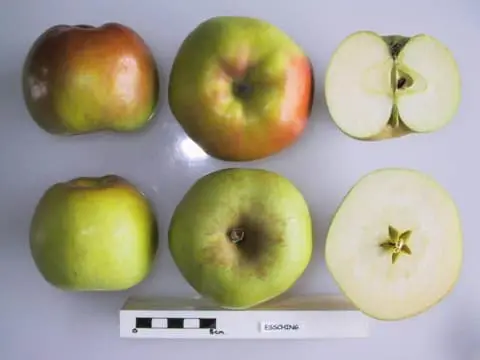
Essching
-
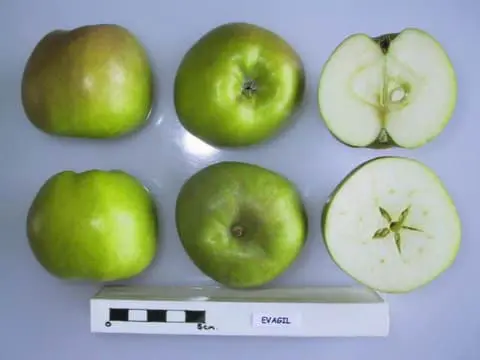
Evagil
-
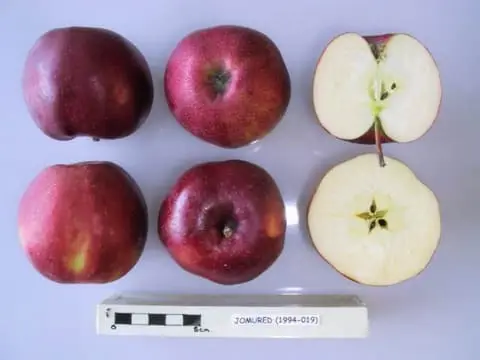
Jomured
-
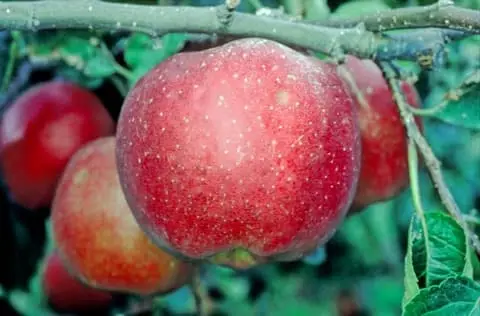
Jonagored
A blood-red sport of Jonagold, found in 1980 at the top of a tree in Jos Morren's orchard at Halen, Belgium