Apple varieties, United Kingdom
Sturmer Pippin
Raised at Sturmer by 1831; Tasmania's most important apple in 1936, and by DNA a parent of Braeburn
History
Sturmer Pippin was raised by a nurseryman named Dillistone at Sturmer, near Haverhill1,2,3. Hogg wrote that it came from a deliberate cross, Ribston Pippin pollinated with Nonpareil2. The National Fruit Collection says it was first recorded in 18311, and Bunyard says it was introduced about 18433. Hogg called it “one of the most valuable dessert apples of its season”, at its best from February to June, when the other favourites were over2, and Bunyard “an indispensable fruit for late use”3.
It became one of the main apples of Tasmania and New Zealand6,7. Of the 45 apples widely grown in Tasmania in 1936, it was the most important, its average crop exceeding those of the next two, Jonathan and Cleopatra, combined6. When Tasmania’s industry was restructured in the 1970s, growers abandoned Sturmer and Jonathan for Red Delicious and Democrat, which were more popular and kept better6. In New Zealand it was one of the main apple varieties in the 1960s, its harvest beginning in April7, and in 2008 small quantities could often still be found there at growers’ markets and fruit stalls8.
DNA has revised Hogg’s account of its parents4,5. A 2020 SNP study confirmed Nonpareil as a parent4, and a 2025 study names the other as “Unknown Founder 1”, an unnamed parent whose genotype was reconstructed from the DNA of its other offspring5. The same studies identify Sturmer Pippin, with Delicious, as a parent of Braeburn4,5, and the earlier one also as a parent of Hog’s Snout and Lady Isabel4. The National Fruit Collection records further offspring, among them King’s Acre Pippin and High View Pippin1.
The fruit
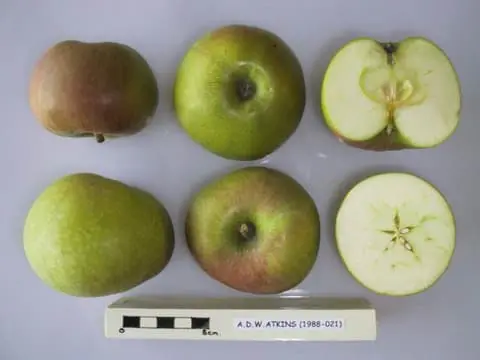
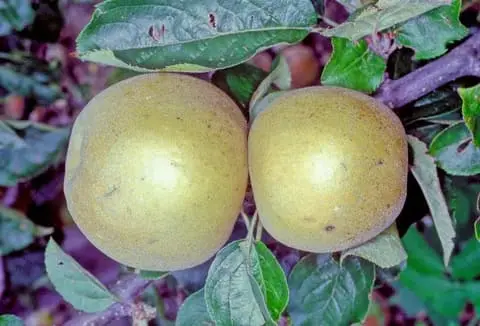
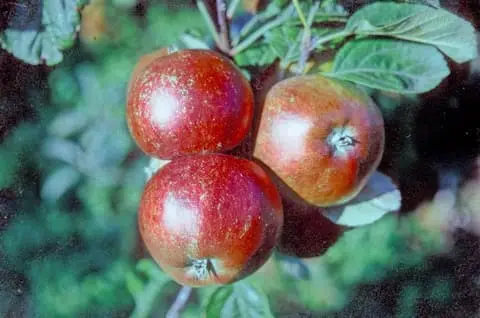
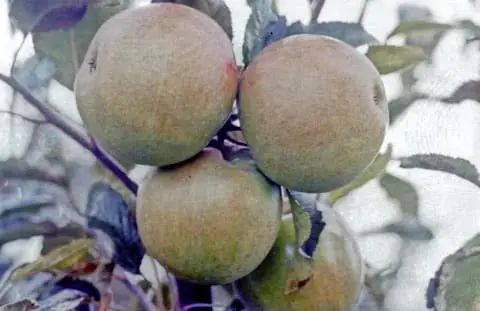
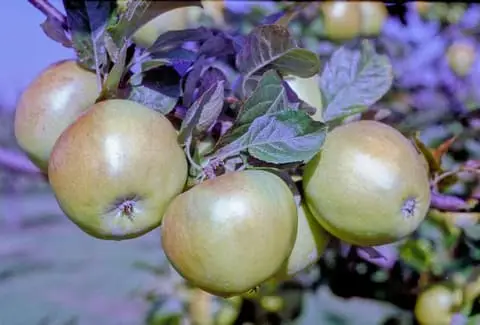
Hogg described a fruit below medium size, roundish, somewhat flattened and narrowing towards the apex, “a good deal resembling the old Nonpareil”2; the National Fruit Collection gives about 52 mm high and 60 mm wide1. The skin is green, turning yellowish green, with a dull red or brown flush on the sunny side1,2,3. The flesh, yellow to greenish, is firm, crisp and very juicy1,2,3, with what Hogg called “a brisk and rich sugary flavour”2; the National Fruit Collection finds it fine-textured, a little subacid and richly aromatic1.
Growing
Hogg found the tree hardy, of middle size and an excellent bearer2. Bunyard described its growth as slender and the tree as fertile, advised leaving the fruit on the tree as late as possible, and found that it did well on light or heavy soils3. At Brogdale, Kent, it starts to flower around 5 May and is picked in late October1. It is diploid4,5.
Uses
Sturmer Pippin is a dessert apple, kept for eating late in the season2,3.
Where the sources disagree
- Parents. Hogg’s Ribston Pippin × Nonpareil, still the National Fruit Collection’s record1,2, is only half borne out by DNA4,5.
- Date. The National Fruit Collection’s first record is from 18311, Bunyard gives about 1843 for its introduction3, and the 2020 DNA study’s table dates it to 18274.
- Russet. Hogg found the skin almost entirely covered with brown russet2; Bunyard saw only slight russet, and the National Fruit Collection rates it very low1,3.
- County. Hogg, Bunyard and the National Fruit Collection place Sturmer in Suffolk1,2,3; the 1916 inventory of Essex’s historic monuments lists it as an Essex parish on the Suffolk border9.
Family tree
Parents, grandparents and great-grandparents, as the entries in the atlas record them.
- Sturmer Pippin United Kingdom, by 1831
- Pollen parent Nonpareil France, by the mid 1500s
Offspring in the atlas
- Braeburn × Delicious; New Zealand, by 1952
- High View Pippin × Cox's Orange Pippin; United Kingdom, 1911
- Hog's Snout × Manks Codlin; United Kingdom, by 1947
- Lady Isabel × Aport; United Kingdom, 1939
- Merton Joy × Cox's Orange Pippin; United Kingdom, 1946
- Merton Pippin × Cox's Orange Pippin; United Kingdom, by 1948
- Merton Russet × Cox's Orange Pippin; United Kingdom, 1921
- Oxford Hoard × Golden Russet; United Kingdom, by 1943
14 varieties in the atlas descend from Sturmer Pippin.
Sources
- Sturmer Pippin (accession 2000-091), National Fruit Collection, Brogdale, Kent (Defra). Supports: "Raised by nurseryman Dillistone at Sturmer, Suffolk, England. First recorded in 1831"; "very firm, fine-textured, juicy flesh with a little subacid and rich aromatic flavour"; the synonyms listed; parentage "Ribston Pippin x Nonpareil"; mother of Oxford Hoard, Merton Russet, King's Acre Pippin and High View Pippin, father of Ball's Pippin and Merton Pippin; a dessert apple 51.50 mm high and 60.00 mm wide, green-yellow ground with a brown over colour, russet "very low", greenish flesh (Smith, 1971); 10% flowering on 5 May and picking in late October at Brogdale.
- The Fruit Manual, 5th ed., pp. 221–222: Sturmer Pippin, Robert Hogg, Journal of Horticulture Office, Internet Archive, 1884. Supports: raised by Mr Dillistone, a nurseryman at Sturmer, near Haverhill, in Suffolk, "obtained by impregnating the Ribston Pippin with the pollen of Nonpareil"; fruit below medium size, roundish, somewhat flattened and narrowing to the apex, "a good deal resembling the old Nonpareil"; skin lively green turning yellowish green, almost entirely covered with brown russet, a tinge of dull red on the sunny side; flesh yellow, firm, crisp, very juicy, "with a brisk and rich sugary flavour"; "one of the most valuable dessert apples of its season", at its best when other favourite varieties are past, not fit for use until Ribston Pippin is nearly gone, in perfection from February to June; the tree hardy, of middle size and an excellent bearer (checked against the page images).
- A Handbook of Hardy Fruits, vol. I, p. 124: Sturmer Pippin, E. A. Bunyard, John Murray, Internet Archive, 1920. Supports: dessert, "till May"; greenish-yellow with a dull brown flush and slight russet; flesh crisp, juicy, greenish and brisk; growth slender, fertile; raised by Mr Dillistone, a nurseryman, at Sturmer, near Haverhill, Suffolk, and "introduced about 1843"; "An indispensable fruit for late use"; to be left on the tree as late as possible; does well on light or heavy soils (checked against the page image).
- Using whole-genome SNP data to reconstruct a large multi-generation pedigree in apple germplasm, Hélène Muranty and others, BMC Plant Biology 20: 2, with Additional files 1, 3 and 6, 2020. Supports: Sturmer's Pippin and Nonpareil a parent–offspring pair (Additional file 6, Table S5: 2 Mendelian errors), oriented by the documented parentage Ribston Pippin × Nonpareil; Delicious and Sturmer's Pippin inferred as the parents of Braeburn (text and Table S3); Sturmer's Pippin also inferred as a parent of Hog's Snout (with Manks Codlin) and Lady Isabel (with Alexander) (Table S3); Sturmer's Pippin diploid and dated 1827, Ribston Pippin genotyped as a triploid (Table S1).
- Cultivar fingerprinting and SNP-based pedigree reconstruction in Danish heritage apple cultivars utilizing genotypic data from multiple germplasm collections in the world, Bjarne Larsen and others, Genetic Resources and Crop Evolution 72: 2397, with supplementary Tables S1 and S5, 2025. Supports: Table S5: Sturmer Pippin's SNP-confirmed parents Nonpareil and "Unknown Founder 1", an unknown common parent imputed from the genotypes of a group of half-sibling cultivars (text); Sturmer Pippin diploid; Braeburn's parents Sturmer Pippin and Delicious; Ribston Pippin among the accessions genotyped (Table S1).
- The history and heritage of the Tasmanian apple industry: a profile, pp. 58 and 66, Anne McConnell and Nathalie Servant, Queen Victoria Museum and Art Gallery, Launceston, 1999-12. Supports: in 1936, of 45 varieties extensively grown in Tasmania, "The Sturmer Pippin was the most important variety, its average crop exceeding that of the two next most important varieties, the Jonathan and Cleopatra taken together" (p. 66, citing S. F. Limbrick's 1936 report on the industry); in the restructuring of the 1970s, old varieties "such as Sturmers and Jonathans were abandoned and replaced by Red Delicious and Democrats which were more popular and kept better" (p. 58).
- Fruit farming: pome fruits, C. E. Woodhead, in An Encyclopaedia of New Zealand, ed. A. H. McLintock; Te Ara (Ministry for Culture and Heritage); archived copy, Internet Archive, 1966. Supports: Sturmer Pippin among the main apple varieties of New Zealand, with harvesting beginning in April, alongside production figures for 1960–64.
- Apples and pears, John Palmer, Te Ara – the Encyclopedia of New Zealand (Ministry for Culture and Heritage); archived copy, Internet Archive, 2008-11-24. Supports: small quantities of older cultivars, among them Sturmer Pippin, "can often be found at growers' markets and local fruit stalls".
- Sturmer, in An Inventory of the Historical Monuments in Essex, vol. 1, North West, Royal Commission on Historical Monuments (England), His Majesty's Stationery Office; British History Online, 1916. Supports: Sturmer listed among the parishes of Essex: "a small parish and village on the border of Suffolk", about 10½ miles east-north-east of Saffron Walden.