Apple varieties, United States
New York 2
A late, firm and tart Cornell apple from a 1992 cross of Braeburn and Autumn Crisp; sold under the trade mark RubyFrost
History
New York 2 comes from a cross between Braeburn and Autumn Crisp, itself from Golden Delicious and Monroe, made in 1992 at Cornell University’s New York State Agricultural Experiment Station in Geneva, New York1. Susan Brown and Kevin Maloney chose it from 1,017 seedlings, as NY 92609-4631. US Plant Patent 22,207, granted on 25 October 2011, names them as inventors and Cornell as assignee1.
Like New York 1, it was released under the “managed” arrangement Cornell made in May 2010 with a new New York growers’ group, which took an exclusive licence for North America; the first trees went into growers’ orchards in 20112. After a year of consumer testing as NY2, its name, RubyFrost, was announced at the station on 1 August 20132, and its fruit is sold under the trade mark RubyFrost4,5. In 2023 Brown said it had not matched New York 1’s success, but that some abroad saw it as “a dark horse”6.
The fruit
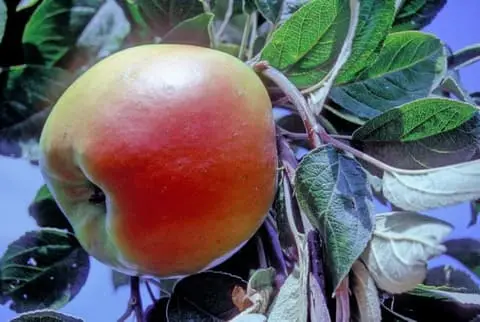
The fruit is large to very large, about 210 g, round and uniform, and a deeper, more even red than either parent’s1. Its smooth, medium-thick skin has little bloom and is about 80 per cent covered by a mostly solid red blush with small dots1. The white flesh is juicy, crisp, firm and slightly coarse, with a rich, complex aroma; the patent calls the flavour tart, with 13.7° Brix and 0.61 per cent malic acid1, and in a 2011 trial its fruit had much lower soluble solids and higher acidity than New York 1’s3. Cornell notes its vitamin C2,6. Like its parent Autumn Crisp and like Cortland, it resists browning when cut4,6.
At Geneva it is picked from about 13 to 28 October, after Autumn Crisp and before Braeburn, and it does not drop before harvest1. It keeps for 100 to 150 days, according to the patent1. In the 2011 trial, untreated fruit softened steadily in cold air and some developed superficial scald by four months; 1-methylcyclopropene (1-MCP) stopped the softening and almost prevented scald but brought core browning, so the authors suggested a warmer store, about 2–3 °C (36–38 °F)3.
Growing
The patent describes a medium-sized, spreading tree that bears early on spurs and crops regularly1. It is very winter-hardy, with no injury seen in USDA zones 4b to 6a, but its leaves are moderately susceptible to powdery mildew1. Its S-alleles share one with New York 1’s, but the two pollinate each other well enough4.
Uses
The patent lists it for dessert and fresh slices1; its licensee also presents it as a cooking apple5, and its US marketers call it “the ultimate baking apple”6.
Where the sources disagree
- Vigour. Medium in the patent1; vigorous according to Brown and Maloney, who advise choosing the rootstock to suit, and to its licensee4,5.
- Flavour. Tart in the patent1; sweet with moderate acidity according to its licensee5.
- Harvest. About 13 to 28 October at Geneva in the patent1; in the 2011 trial, a wide window centred on about 10 October3.
Family tree
Parents, grandparents and great-grandparents, as the entries in the atlas record them.
- New York 2 United States, 1992
- Parent Braeburn New Zealand, by 1952
- Parent Delicious United States, 1872
- Parent Winesap United States, by 1817
- Parent Sturmer Pippin United Kingdom, by 1831
- Pollen parent Nonpareil France, by the mid 1500s
- Parent Delicious United States, 1872
- Parent Autumn Crisp
- Parent Braeburn New Zealand, by 1952
Sources
- Apple tree named 'New York 2' (US Plant Patent 22,207), Susan K. Brown and Kevin Maloney, inventors; Cornell University, assignee; Google Patents, 2011-10-25. Supports: variety denomination 'New York 2', tested as NY 92609-463; derived from crossing Braeburn with Autumn Crisp in 1992, Autumn Crisp being from Golden Delicious × Monroe; selected from 1,017 seedlings, with pollination, cultivation and selection at Geneva, N.Y.; granted 25 October 2011, inventors Susan K. Brown and Kevin Maloney, assigned to Cornell University; fruit maturing after Autumn Crisp and before Braeburn, with a brighter, deeper and more uniform red than either parent; no pre-harvest drop; harvest from about 13 October to about 28 October at Geneva; trees medium, spreading, early bearing on spurs, vigour medium; fruit large to very large, 210 g, uniform, globose; Brix 13.7°, 0.61% malic acid; skin medium-thick, smooth, scant bloom; about 80% red over-colour, "mostly solid blush with small dots"; flesh juicy, crisp, firm, white, with a "rich complex aroma"; texture crisp, slightly coarse, firm; flavour "Tart and pleasant mild"; use market, dessert, fresh slice; "very long storage life (100-150 days)", no disorders after 100 days; early and regular cropping; moderately susceptible to powdery mildew of the foliage; very winter hardy, with no injury in USDA zones 4b, 5a, 5b and 6a.
- SnapDragon and RubyFrost are new apple varieties, Amanda Garris, Cornell Chronicle, Cornell University, 2013-08-01. Supports: a year of consumer testing as NY1 and NY2; the names revealed on 1 August 2013 at a field day at the New York State Agricultural Experiment Station; RubyFrost to "provide a boost of vitamin C well into winter"; in May 2010 Cornell's "managed release" partnership with a new industry group, with an exclusive licence in North America for the two varieties; first trees planted in growers' orchards in 2011.
- Harvest Indices and Storage of NY-1 and NY-2: Observations from the 2011 Harvest Season, Susan K. Brown, Kevin E. Maloney, Jackie F. Nock and Chris B. Watkins, New York Fruit Quarterly 20(2): 11–15, New York State Horticultural Society (read in the Internet Archive's copy), 2012. Supports: weekly harvests in 2011 from a single orchard at Geneva, for one year only; NY-1 fruit with "much higher SSC and lower TA values than NY-2"; NY-2 with "a wide range of acceptable harvest dates", centred on about 10 October; in air storage at 33 °F untreated fruit softening progressively, and superficial scald after four months, especially in earlier-picked fruit; 1-methylcyclopropene (1-MCP) preventing softening and almost eliminating scald, but core browning only in treated fruit, so that "a warmer temperature such as 36 to 38oF may be warranted".
- Apple Breeding, Genetics and Genomics, Susan K. Brown and Kevin E. Maloney, New York Fruit Quarterly 23(3): 5–8, New York State Horticultural Society (read in the Internet Archive's copy), 2015. Supports: NY 1 and NY 2 patented in 2011 and trademarked as SnapDragon and RubyFrost respectively; "NY 2 is a vigorous grower", so that rootstock choice should be adjusted; Cortland, AutumnCrisp and RubyFrost, "an offspring of 'AutumnCrisp'", among the Cornell varieties with excellent resistance to flesh browning; S-alleles S9S20 for NY 2 and S2S20 for NY 1, sharing one allele but "sufficiently cross-compatible".
- RubyFrost, Proprietary Variety Management (PVM). Supports: "Internationally (with the exception of China), PVM manages the commercialization of New York 2 sold under the trademark RubyFrost"; sweet, with moderate acidity; a snacking apple and an ingredient for cooking; a good source of vitamin C; a cross of Braeburn and Autumn Crisp; not prone to pre-harvest drop; a vigorous grower; ripening later in the season.
- SnapDragon apple wins outstanding cultivar award, Mike Hibbard, Cornell University College of Agriculture and Life Sciences, 2023-10-11. Supports: RubyFrost called "the ultimate baking apple" by the growers' cooperative that markets it; Brown: "RubyFrost has great resistance to browning and good levels of vitamin C", it "hasn't risen to the same level of SnapDragon", but some abroad see it as "a dark horse".
More from United States
-
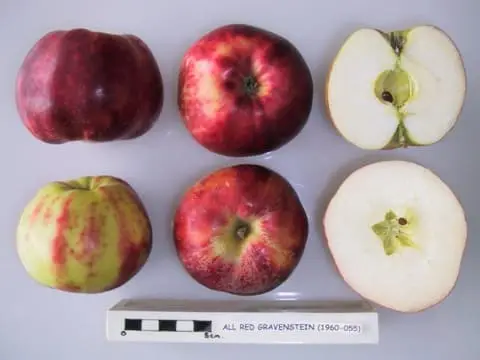
All-Red Gravenstein
-
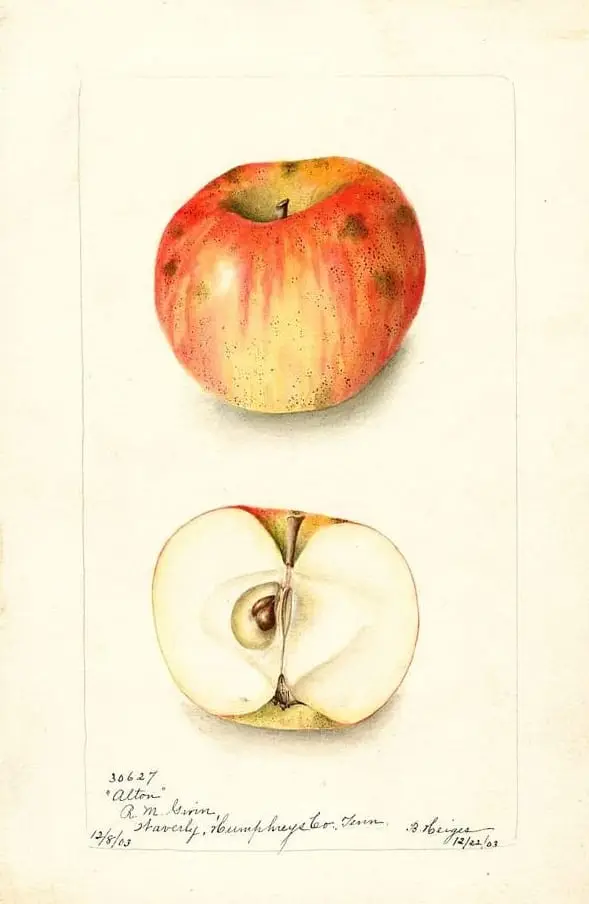
Alton
-
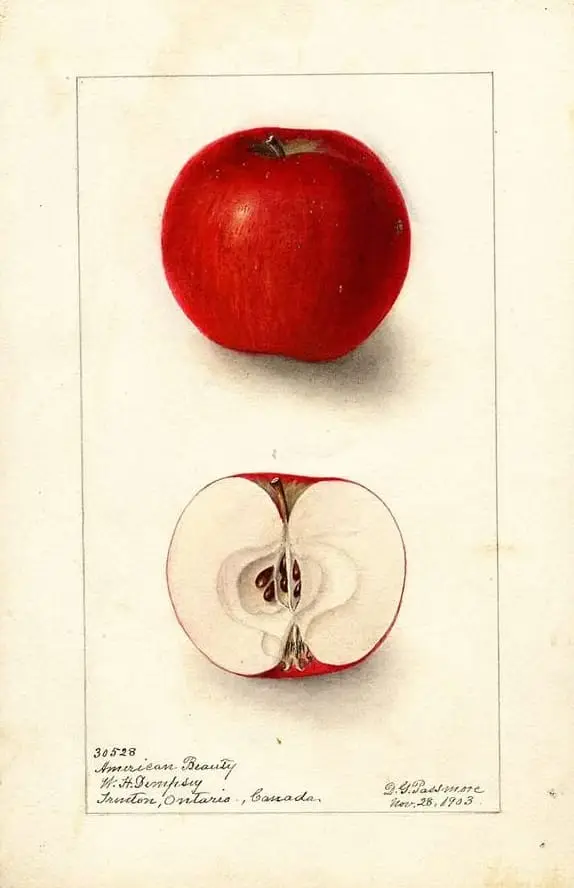
American Beauty
-
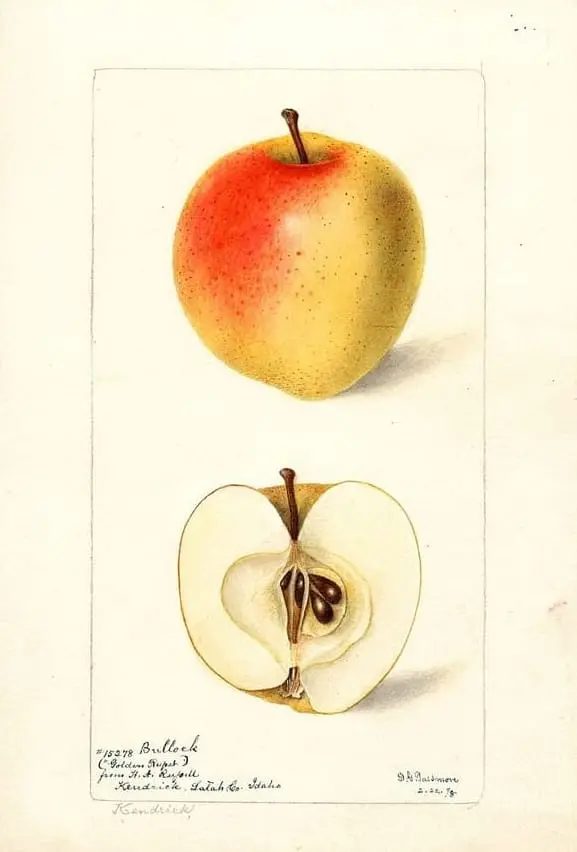
American Golden Russet
A small New Jersey russet whose flesh Downing likened to a buttery pear; Coxe knew it in 1817 as Sheep-nose
-
American Grindling
-
American Summer Pearmain
-
Ames
-
Arkansas