Apple varieties, United States
New York 1
Bred at Geneva, New York, from a 1998 cross with Honeycrisp; its fruit is sold under the trade mark SnapDragon
History
New York 1 was bred by Cornell University at the New York State Agricultural Experiment Station in Geneva, New York, from a cross made in 1998 between Honeycrisp and NY 752, a Geneva selection from Starkspur Golden Delicious and NY 88 (Monroe × Melrose)1. Susan Brown and Kevin Maloney chose it from 381 seedlings, as NY 98804-001, for its attractive fruit, early cropping and quality1, and Brown fast-tracked it for release2. US Plant Patent 22,228, granted on 8 November 2011, names them as inventors and Cornell as assignee1.
Public universities had long released new apples freely, but in May 2010 Cornell agreed a “managed release” of this apple and New York 2 with a new New York growers’ group, which took an exclusive licence for North America; growers pay royalties on trees, acreage and fruit, which fund marketing and Cornell’s breeding2. The first trees were planted in growers’ orchards in 20112. After a year of consumer testing as NY1, the name SnapDragon was announced at the station on 1 August 20132, and the variety’s fruit is sold under the trade mark SnapDragon5,6. A second licensee manages it internationally, except in China3,6; in 2023 it was being commercialised in Australia, Argentina, Chile, greater Europe, New Zealand, South Africa, South Korea and India3.
In 2023 it won the American Society for Horticultural Science’s Outstanding Cultivar Award, the first apple scion cultivar to do so since Empire (1987) and Jonagold (1988)3.
The fruit
The fruit is medium-sized, about 168 g, conical and uniform1. The smooth skin has some bloom and is about 90 per cent covered by a dark, mostly solid red blush, darker and more even than Honeycrisp’s1. The white flesh is firm, crisp and juicy, with a rich, sweet aroma; the patent calls the flavour sweet and mild with a light acidity, with 15.3° Brix and 0.41 per cent malic acid1, and Cornell calls it spicy-sweet with a hint of vanilla3.
At Geneva it is picked from about 20 September to 2 October, after Honeycrisp1. In a one-year trial there in 2011, fruit picked on 19 September tasted best but was unevenly coloured, so several pickings may be needed4. The patent records no disorders after 100 days and good quality for 100 to 150 days1; in the trial, fruit stayed as firm as at harvest for two months in cold air and then softened, and fruit picked after 19 September developed core browning by four months4.
Growing
The tree is small to medium, upright and of low vigour, and bears early on spurs1; Brown and Maloney call it a weak scion and advise choosing its rootstock to suit5. It crops regularly and, unlike Honeycrisp, is not prone to bitter pit, biennial bearing or soft scald1,6. Its licensee reports good field resistance to powdery mildew and fire blight6. Trees suffered no winter injury in USDA zones 4b to 6a1. Its S-alleles share one with New York 2’s, but the two pollinate each other well enough5.
Uses
New York 1 is a dessert apple, also suited to fresh slices1.
Family tree
Parents, grandparents and great-grandparents, as the entries in the atlas record them.
- New York 1 United States, 1998
- Parent Honeycrisp United States, about 1960
- Parent Keepsake United States, 1936
- Parent MN 447
- Parent Northern Spy United States, about 1800
- Parent MN1627
- Parent Keepsake United States, 1936
- Parent NY 752
- Parent Honeycrisp United States, about 1960
Sources
- Apple tree named 'New York 1' (US Plant Patent 22,228), Susan K. Brown and Kevin Maloney, inventors; Cornell University, assignee; Google Patents, 2011-11-08. Supports: variety denomination 'New York 1', tested as NY 98804-001; a controlled pollination made in 1998 between Honeycrisp and the breeding selection NY 752, itself from Starkspur Golden Delicious × NY 88 (Monroe × Melrose); selected from 381 seedlings for attractive fruit, precocity and fruit quality, at Geneva, N.Y.; granted 8 November 2011, inventors Susan K. Brown and Kevin Maloney, assigned to Cornell University; not prone to bitter pit, biennial bearing or soft scald, unlike Honeycrisp; fruit darker and more uniformly red than Honeycrisp's, maturing after Honeycrisp; harvest from about 20 September to about 2 October at Geneva; trees small to medium, upright, early bearing on spurs, vigour low; fruit medium, 168 g, uniform, medium to long conical; Brix 15.3°, 0.41% malic acid; skin medium-thick, smooth, with bloom; about 90% red over-colour, "mostly solid blush"; flesh juicy, firm, white, with a "rich sweet aroma"; texture crisp and firm; flavour "sweet and mild with a light acid balance"; use market, dessert, fresh slice; "no disorders after 100 days"; quality kept "during long storage (100-150 days)"; early and regular cropping; no winter injury in USDA zones 4b, 5a, 5b and 6a over several seasons.
- SnapDragon and RubyFrost are new apple varieties, Amanda Garris, Cornell Chronicle, Cornell University, 2013-08-01. Supports: a year of consumer testing as NY1 and NY2; the names revealed on 1 August 2013 at a field day at the New York State Agricultural Experiment Station; Brown "fast-tracked it for commercialization"; public universities historically released new apples to the industry freely; in May 2010 Cornell's "managed release" partnership with a new industry group, with an exclusive licence in North America for the two varieties, growers paying royalties on trees, acreage and fruit, the income used for marketing and for Cornell's apple breeding; first trees planted in growers' orchards in 2011.
- SnapDragon apple wins outstanding cultivar award, Mike Hibbard, Cornell University College of Agriculture and Life Sciences, 2023-10-11. Supports: the outstanding cultivar award of the American Society for Horticultural Science in 2023; the last two apple scion cultivars to receive it were Empire (1987) and Jonagold (1988); its "spicy-sweet flavor with a hint of vanilla"; a growers' cooperative its domestic master licensee and a separate company Cornell's international master licensee, commercialising it in Australia, Argentina, Chile, greater Europe, New Zealand, South Africa, South Korea and India.
- Harvest Indices and Storage of NY-1 and NY-2: Observations from the 2011 Harvest Season, Susan K. Brown, Kevin E. Maloney, Jackie F. Nock and Chris B. Watkins, New York Fruit Quarterly 20(2): 11–15, New York State Horticultural Society (read in the Internet Archive's copy), 2012. Supports: weekly harvests in 2011 from a single orchard at Geneva, for one year only; the optimum harvest date for NY-1 at Geneva around 19 September, with the best flavour ratings in growers' tastings, but colour then not uniform, so that "spot picking" may be needed; in air storage at 33 °F, firmness after two months similar to that at harvest, then softening; core browning absent at two months but increasing after four months in fruit picked after 19 September.
- Apple Breeding, Genetics and Genomics, Susan K. Brown and Kevin E. Maloney, New York Fruit Quarterly 23(3): 5–8, New York State Horticultural Society (read in the Internet Archive's copy), 2015. Supports: NY 1 and NY 2 patented in 2011 and trademarked as SnapDragon and RubyFrost respectively; "NY 1 is a weak scion", so that rootstock choice should be adjusted; S-alleles S2S20 for NY 1 and S9S20 for NY 2, sharing one allele but "sufficiently cross-compatible".
- SnapDragon, Proprietary Variety Management (PVM). Supports: "Internationally (with the exception of China), PVM manages the commercialization of New York 1 sold under the trademark SnapDragon"; less prone to soft scald and bitter pit than Honeycrisp; good field resistance to powdery mildew and fire blight.
More from United States
-
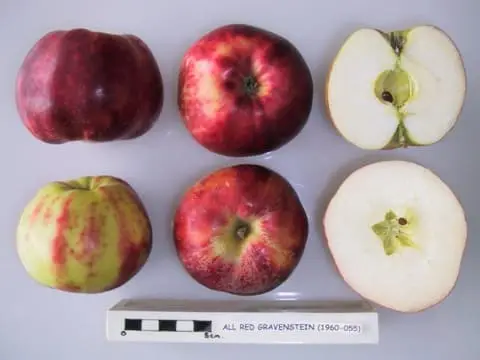
All-Red Gravenstein
-
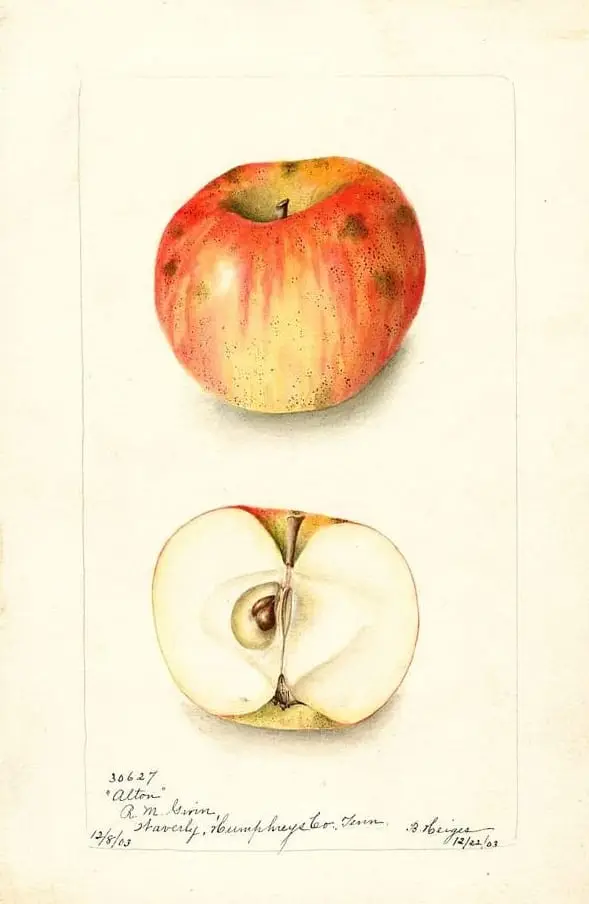
Alton
-
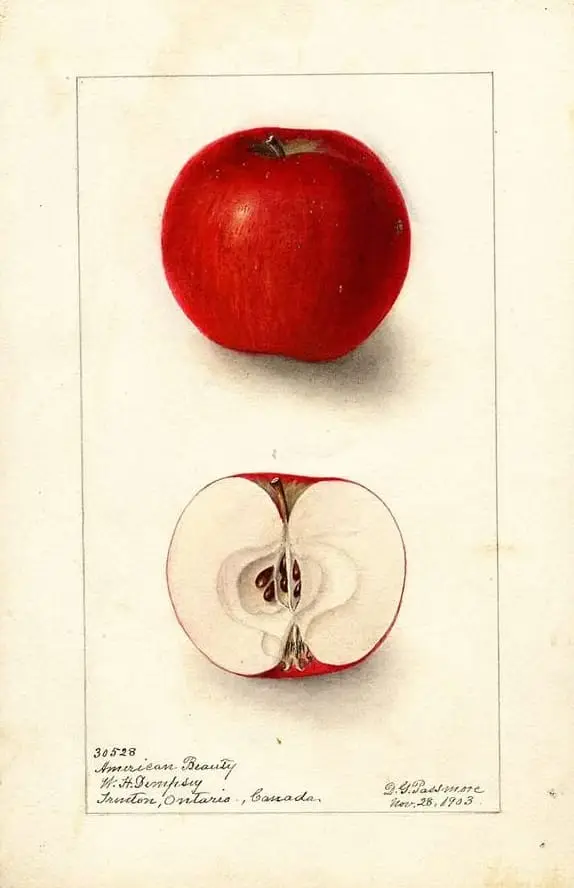
American Beauty
-
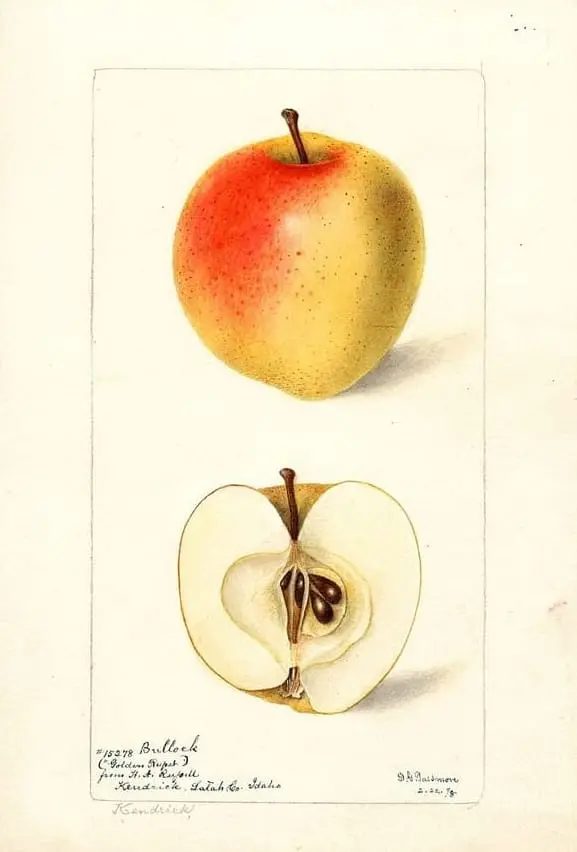
American Golden Russet
A small New Jersey russet whose flesh Downing likened to a buttery pear; Coxe knew it in 1817 as Sheep-nose
-
American Grindling
-
American Summer Pearmain
-
Ames
-
Arkansas