Apple varieties, United States
Ben Davis
A tough-skinned keeper of unknown Southern origin; in 1909–13 second only to Baldwin among American apples
History
“The origin of this apple will probably never be definitely known,” Beach wrote in 19051. It has been credited to Kentucky, Tennessee and Virginia, and was supposed to date from about the beginning of the nineteenth century1. J. S. Downer of Kentucky told Downing of old trees there from which suckers were taken to propagate it2. Before the Civil War it had spread through those states and, along the routes of migration, into southern Indiana, Illinois, Missouri and Arkansas1.
To Warder in 1867 it was a “handsome Southern apple” whose planting had spread fast, “not on account of its superlative excellence” but for its merits as an orchard tree and market fruit; in Bureau County, Illinois, Verry Aldrich had long grown it as New York Pippin3.
By 1905 Beach called it “unquestionably the leading commercial sort and the most popular apple grown south of the Baldwin region”, and broadly the most important apple between latitudes 32° and 42° from the Atlantic to the Pacific1. In 1909–13 it ranked second among American apples, after Baldwin, and in 1928 American commercial orchards held 4,529,000 Ben Davis trees, 5.6 per cent of the total and the sixth-largest number4. It then suffered, probably more than any other variety, from the droughts that recurred in the Middle West from 1930, and by 1940 it had dropped out of the leading group, displaced by apples of better dessert quality4. A USDA germplasm record notes that it “paid off many farm mortgages”, but that by 1990 other cultivars were better5.
Beach himself raised Cortland from Ben Davis × McIntosh in 1898 at the New York State Agricultural Experiment Station6, and SNP data confirm Ben Davis, with Jonathan, as a parent of Faurot and of Wright7. Its own parents remain unknown: a 2025 SNP study identified none8.
The fruit
The fruit is usually above medium to large and roundish1. The tough, waxy, usually glossy skin is clear yellow or greenish, washed with bright red and striped and splashed with dark carmine1. The flesh is whitish tinged with yellow, firm, moderately coarse, not very crisp, juicy, somewhat aromatic and mildly subacid1. Its quality was a common complaint: Beach rated it “good” yet at best second-rate even in the South, Warder “only good”, and Downing not first-rate1,2,3; the USDA record calls the flesh spongy and the eating quality fair5.
Its strength was in keeping and carrying2. The thick skin did not show bruises easily, and the fruit still looked well in the package after ordinary handling and shipping1. Grown in New York, where it ripened and kept later than in the South, it often kept until May in ordinary storage and until June, or often July, in cold storage1,3. The USDA record gives a harvest date of 20 October, a week after Delicious, and a storage life of eight months at −0.5 °C5.
Growing
Nurserymen liked it because it grew freely and quickly made saleable trees1. In the orchard it is very hardy, healthy and vigorous, and bears young, usually every year and heavily, though it seems not to live as long as Baldwin1,2. It blossoms late, after the spring frosts, and in some regions it often crops when other varieties fail1,2. Ben Davis is diploid7.
Uses
Warder listed it for market and kitchen use3; in New York some found it acceptable for home use once the Baldwin season had ended1.
Where the sources disagree
- Origin. Beach records claims for Kentucky, Tennessee and Virginia1. Warder thought it Southern, though in Illinois it was shown as New York Pippin, a name suggesting an eastern origin3.
- Date. Beach reports it supposed to date from about the beginning of the nineteenth century1, the USDA gives the early 1800s5, and Muranty and colleagues’ table gives a documented date of 17997.
Family tree
Offspring in the atlas
- Cortland × McIntosh; United States, 1898
- Toyo × Delicious; Japan, by 1935
- West View Seedling × York Imperial; United Kingdom, 1932
6 varieties in the atlas descend from Ben Davis.
Sources
- The Apples of New York, vol. I, pp. 68–71: Ben Davis, S. A. Beach, New York Agricultural Experiment Station, Internet Archive, 1905. Supports: the synonyms listed, among them New York Pippin, Kentucky Pippin, Kentucky Streak, Baltimore Pippin, Baltimore Red, Baltimore Red Streak, Carolina Red Streak, Funkhouser, Red Pippin, Victoria Pippin, Victoria Red and Pepin de New-York (p. 69); "unquestionably the leading commercial sort and the most popular apple grown south of the Baldwin region"; the most important variety between parallels 32 and 42 from the Atlantic to the Pacific, pre-eminent in the Virginias, Kentucky, Tennessee, Illinois, Missouri and Arkansas; in New York not good enough for home use for most, though some used it after the Baldwin season, and in the South "at its best ... but of second rate quality"; ripening and keeping later in New York than farther south, until May in ordinary storage and until June or often July in cold storage; thick-skinned, not showing bruises easily, presenting well in the package after ordinary handling and shipping (pp. 69–70); liked by nurserymen for its free growth; tree very hardy, healthy and vigorous, less long-lived than Baldwin, bearing early, usually annually and abundantly; late blossoming, so that it often crops when other varieties fail; "The origin of this apple will probably never be definitely known"; credited to Tennessee, Kentucky and Virginia; "supposed to have originated about the beginning of the last century"; spread before the Civil War through those states and along the routes of migration into southern Indiana, Illinois, Missouri and Arkansas (p. 70); fruit usually above medium to large, roundish; skin tough, waxy, smooth, often glossy, clear yellow or greenish, mottled and washed with bright red, striped and splashed with bright dark carmine; flesh whitish tinged with yellow, firm, moderately coarse, not very crisp, somewhat aromatic, juicy, mildly subacid, good (p. 71).
- The Fruits and Fruit Trees of America (1869 revision, 1900 printing), p. 93: Ben Davis, A. J. Downing, revised by Charles Downing, John Wiley & Sons, Internet Archive, 1900. Supports: "The origin of this apple is unknown"; J. S. Downer of Kentucky reporting old trees there from which suckers were taken to propagate it; tree very hardy, a free grower, bearing early and abundantly; "In quality it is not first-rate"; very popular in all the Southwest and West for its early productiveness, blooming late after the late frosts, good size, fair even fruit, and "keeping and carrying well".
- American Pomology: Apples, pp. 585–586: Ben Davis, J. A. Warder, Orange Judd, Internet Archive, 1867. Supports: "This handsome Southern apple"; its culture greatly extended "not on account of its superlative excellence" but for its qualities as an orchard tree or market fruit; long cultivated by Verry Aldrich in Bureau County, Illinois, and exhibited as New York Pippin, a name suggesting an eastern origin, while elsewhere its relations pointed to the South (p. 585); fruit from a cooler climate keeping later than that grown in the South; tree remarkably healthy and vigorous; flavour "sub-acid, not rich", quality "only good"; use market and kitchen (p. 586).
- Apple Varieties and Important Producing Sections of the United States (Farmers' Bulletin 1883), pp. 21–22, J. R. Magness, U.S. Department of Agriculture, Internet Archive, 1941. Supports: Ben Davis second of "the 10 leading varieties in the United States" in 1909–13, after Baldwin (p. 22); 4,529,000 trees in commercial orchards in 1928, 5.6 per cent of the total and "in sixth place" (Table 1 and text, p. 21); "The Ben Davis variety suffered probably more than any other as a result of the prolonged drought periods that have occurred in the middle western districts intermittently since 1930" (p. 21); among the varieties that "dropped out of positions of leadership" between 1915 and 1940, replaced by "high-dessert-quality varieties" (p. 22).
- Plant Inventory No. 204, Part I, p. 345: Ben Davis (PI 588953), R. A. Norris (ed.), U.S. Department of Agriculture, Agricultural Research Service, 1996. Supports: pedigree "Early 1800's"; flesh whitish, firm, "spongy texture", somewhat aromatic, juicy, mildly subacid; "fair eating quality"; harvest date 20 October, a week after Delicious; "very long storage life, 8 mo. at -0.5D C"; very heavy cropping and annually productive; "paid off many farm mortgages but in 1990 other cultivars are superior".
- Cortland (accession 1976-139), National Fruit Collection, Brogdale, Kent (Defra). Supports: "Raised in 1898 by S.A. Beach at New York State Agricultural Experiment Station, Geneva, USA"; parentage "Ben Davis x McIntosh".
- Using whole-genome SNP data to reconstruct a large multi-generation pedigree in apple germplasm, H. Muranty and others, BMC Plant Biology 20: 2, with Additional files 1 and 3, 2020. Supports: Table S3: Ben Davis inferred from SNP data as a parent, with Jonathan, of Faurot and of Wright, both as documented in the literature; Table S1: Ben Davis diploid (2n), with a documented date of 1799.
- Cultivar fingerprinting and SNP-based pedigree reconstruction in Danish heritage apple cultivars utilizing genotypic data from multiple germplasm collections in the world, B. Larsen and others, Genetic Resources and Crop Evolution 72: 2397, supplementary file 2 (Table S5), 2025. Supports: Table S5: no parent identified for Ben Davis.
More from United States
-
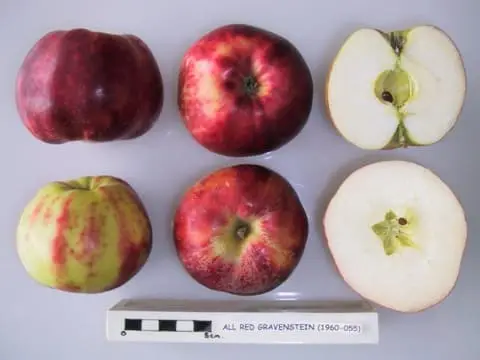
All-Red Gravenstein
-
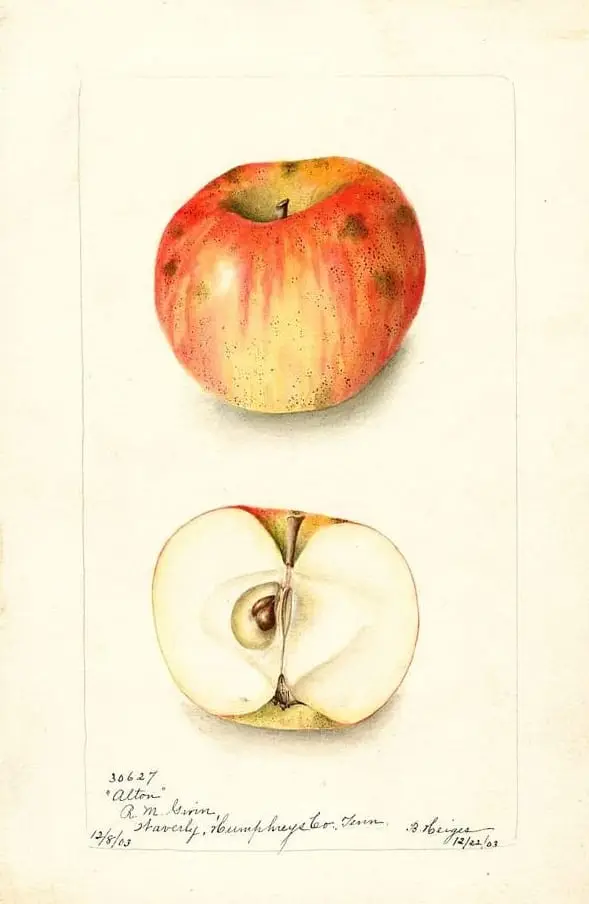
Alton
-
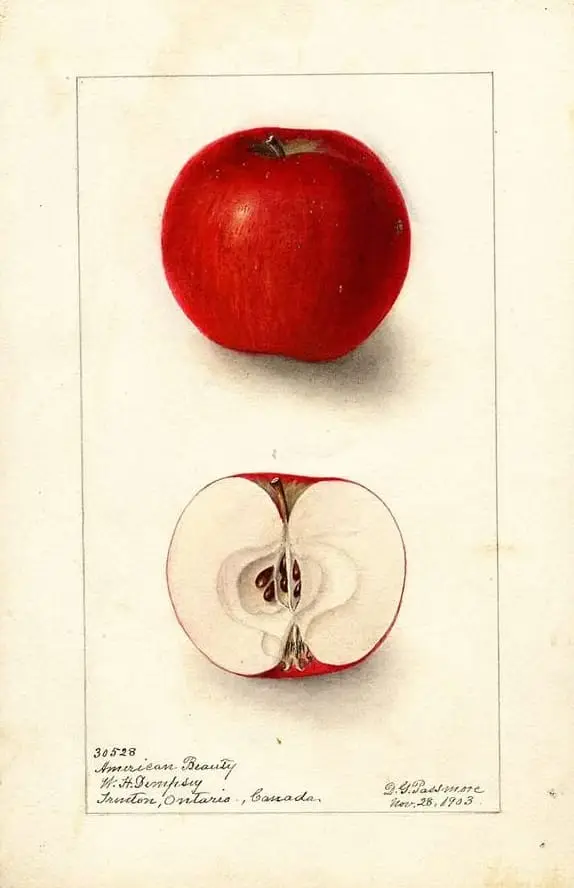
American Beauty
-
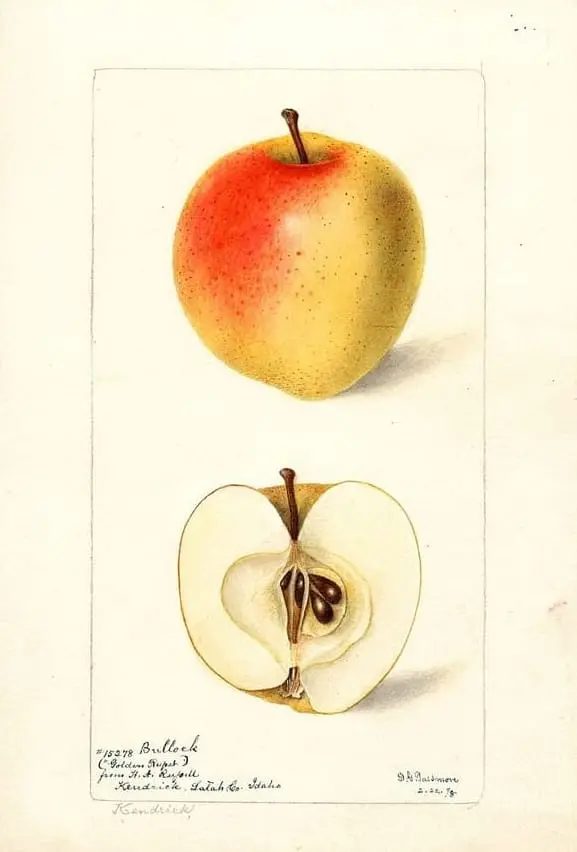
American Golden Russet
A small New Jersey russet whose flesh Downing likened to a buttery pear; Coxe knew it in 1817 as Sheep-nose
-
American Grindling
-
American Summer Pearmain
-
Ames
-
Arkansas